
Yes, individuals and small businesses can sell on Jumia. Registration is open to anyone who can pass the platform’s identity checks, and the path from signup to your first sale runs through three moves: register your Vendor Center account, complete KYC and the mandatory seller training, then list your first product. Fees apply on every order, and you’ll need to decide early whether Jumia handles shipping or you do it yourself.
TL;DR:
- Most new sellers should prioritize completing verification and training, as skipping steps delays account activation and first sales.
- Properly handling product listings—including accurate categories, attributes, and quality images—is crucial to avoid delisting and improve sales.
- Choosing between Jumia Express and self-shipping impacts costs, shipping speed, and Seller Score, so scaling volume often justifies platform fulfillment.
- Regularly monitoring and managing Seller Score, order confirmations, and dispute claims helps maintain visibility and steady payouts on the platform.
- Importers and cross-border sellers benefit from partnering with compliance and warehousing services that simplify customs, duties, and multi-market fulfillment.
Table of Contents
- Jumia Seller Guide: How to Register Your Vendor Account
- How Do You List a Product on Jumia?
- Should You Use Jumia Express or Ship Products Yourself?
- How Do Order Cancellations and Payouts Work?
- What Is Seller Score and Why Does It Matter?
- What Promotions and Growth Tactics Actually Work?
- Common Jumia Seller Problems and How to Fix Them
- When to Consider Cross-Border Enablement: MoreShores’ Role Explained
- How to Manage Inventory to Avoid Stockouts and Overstock
- How to Scale Your Jumia Business Beyond Your First Market
- Jumia’s Rules on Prohibited Items and Compliance
- A 30-Day Checklist for New Jumia Sellers
- MoreShores: An Optional Partner for Cross-Border Compliance, Warehousing, and Fulfillment
- Sources
- FAQ
Jumia Seller Guide: How to Register Your Vendor Account
Opening a Jumia seller account takes less time than most people expect, but the verification stage rewards preparation. Here’s the sequence you’ll follow:
- Sign up on Jumia’s Vendor Center with your email, phone number, and basic business details.
- Verify your identity by submitting KYC documents through the portal.
- Complete the mandatory New Seller Training, which walks you through listing rules, fees, and order handling before your account goes live.
- Activate your Vendor Center dashboard once verification clears, then set up your store profile and bank details for payouts.
For KYC, Jumia’s Vendor Center FAQs list a national ID for individual sellers or business registration documents for companies, plus valid bank account details for payouts. New Seller Training is not optional. Skipping ahead to list products before finishing it typically stalls your account activation.
Pro Tip: Scan your ID and business documents in good lighting and upload them as PDFs rather than photos. Blurry or cropped scans are the single most common reason verification drags past a week.
How Do You List a Product on Jumia?
A listing lives or dies on a handful of fields, and getting them right the first time saves you from delisting notices later.
Your seller SKU is the unique code you assign to each product variant. A clean structure, something like BRAND-CATEGORY-COLOR-SIZE, keeps your inventory sortable once you’re managing more than a dozen items. Beyond the SKU, every listing needs:
- A clear product title with brand, model, and key specs in that order
- At least four to six images on a plain background, meeting Jumia’s minimum resolution
- An accurate category and subcategory, since a mismatched category is a fast route to delisting
- Complete attribute fields (size, weight, material, color) rather than leaving them blank
- A description that answers the buyer’s obvious questions before they have to ask
If you’re listing more than a few dozen SKUs, use Jumia’s bulk upload template instead of adding items one by one. Download the category-specific template from Vendor Center, fill every required column, and check the upload confirmation report for rejected rows before assuming the batch succeeded. A few rejected rows almost always trace back to a missing attribute or an invalid category code. Product page structure also affects conversion once the listing goes live, and optimizing product pages for search and sales is worth a look before you finalize copy.
Should You Use Jumia Express or Ship Products Yourself?
Fulfillment choice shapes both your costs and your Seller Score, so it’s worth deciding deliberately rather than defaulting to whatever option is easiest to set up.
- Jumia Express (platform-fulfilled): you send stock to a Jumia warehouse, and the platform handles picking, packing, and delivery. This usually improves your shipping speed metric because Jumia controls the last mile.
- Seller-managed shipping: you pack and ship every order yourself, which keeps costs lower at low volume but puts the shipping speed KPI entirely on your own logistics.
- Cost trade-off: platform fulfillment carries storage and handling contributions, while self-fulfillment avoids those fees but exposes you to courier delays you can’t control.
- When to switch: once order volume climbs to the point where late dispatches start dragging your Seller Score, moving to platform fulfillment or a third-party warehouse partner usually pays for itself.
How Do Order Cancellations and Payouts Work?
Order handling on Jumia runs on a tight clock, and how you manage it directly affects both your Seller Score and your cash flow.
- Confirm and process orders quickly. Most Vendor Center guidance points to roughly 48 hours to confirm stock and prepare dispatch before a delay counts against you.
- Handle cancellations carefully. Every cancellation you initiate counts against your cancellation rate, one of the core Seller Score inputs.
- Check your account statement monthly. Jumia’s reconciliation guidance for sellers recommends comparing reported sales, total deductions such as commissions and marketing fees, and net payment against what actually lands in your bank account.
- Raise a claim with evidence. If a payout doesn’t match your statement, submit the claim through Vendor Center with order IDs, screenshots of the statement line, and your bank deposit record attached.
What Is Seller Score and Why Does It Matter?
Your Seller Score is built from four inputs: shipping speed, cancellation rate, product quality or returns, and customer rating. A low score doesn’t just look bad on a dashboard. It actively suppresses how often your listings show up in search and category pages.
- Check your score regularly inside Vendor Center’s performance tab, where each KPI is broken out individually.
- Sync your inventory levels daily to avoid the cancellations that come from selling stock you don’t actually have.
- Pack products securely and dispatch faster than the minimum SLA whenever you can. It buys you a buffer on shipping speed.
- If a penalty looks wrong, document the order timeline and file a dispute through Vendor Center rather than letting it sit.
Pro Tip: Treat your Seller Score like a credit score. Small, consistent good behavior across every order matters more than occasional heroics on a handful of them.
What Promotions and Growth Tactics Actually Work?
New sellers often reach for paid placements before fixing the basics, and that’s usually backwards.
- Sponsored listings and on-site promotional slots exist, but they amplify a listing that already converts. They rarely rescue a weak one.
- Fix pricing, images, and shipping time first. Cheap, fast, well-photographed products win the buy box more often than ad spend does.
- Run small promotional tests and measure the actual lift in orders before committing a larger budget.
- Track ROI on any promotional spend the same way you’d track any other line item. If it doesn’t move sales, cut it.
Common Jumia Seller Problems and How to Fix Them
Most seller headaches trace back to a handful of repeat issues.
- Listing errors: category mismatches and wrong weight or dimension entries are the most common cause of delisting. Recheck the attribute fields before resubmitting.
- Payout discrepancies: run the reconciliation checklist (reported sales, deductions, net payout) before assuming an error. Most “missing” money is a fee you overlooked.
- Unresolved disputes: if Vendor Center support doesn’t resolve a claim within its stated window, escalate to your account manager with your documentation attached.
When to Consider Cross-Border Enablement: MoreShores’ Role Explained
Sellers importing stock, lacking a local entity, or facing customs and VAT complexity usually hit a wall that a standard Vendor Center account can’t solve alone. That’s the gap cross-border enablement fills.
- Acting as Importer of Record for customs clearance
- Handling duties, VAT, and regulatory compliance on your behalf
- Warehousing and multi-courier fulfillment
- Marketplace integration across platforms including Jumia
Given that Jumia is projecting GMV growth of 27% to 32% for 2026, sellers scaling into that demand often find a compliance partner shortens time-to-shelf. Moreshores’ onboarding flow outlines the next step for sellers who need one.
How to Manage Inventory to Avoid Stockouts and Overstock
Inventory mismanagement is quieter than a bad review, but it costs more over time. A stockout kills momentum on a listing that was ranking well, and an overstock ties up cash in products sitting in a warehouse instead of moving.
Start with a reorder point for each SKU: the stock level at which you place a new order, based on how long restocking actually takes plus your average daily sales. A product that sells five units a day and takes two weeks to restock needs a reorder point well above zero, not a scramble the day you run out.
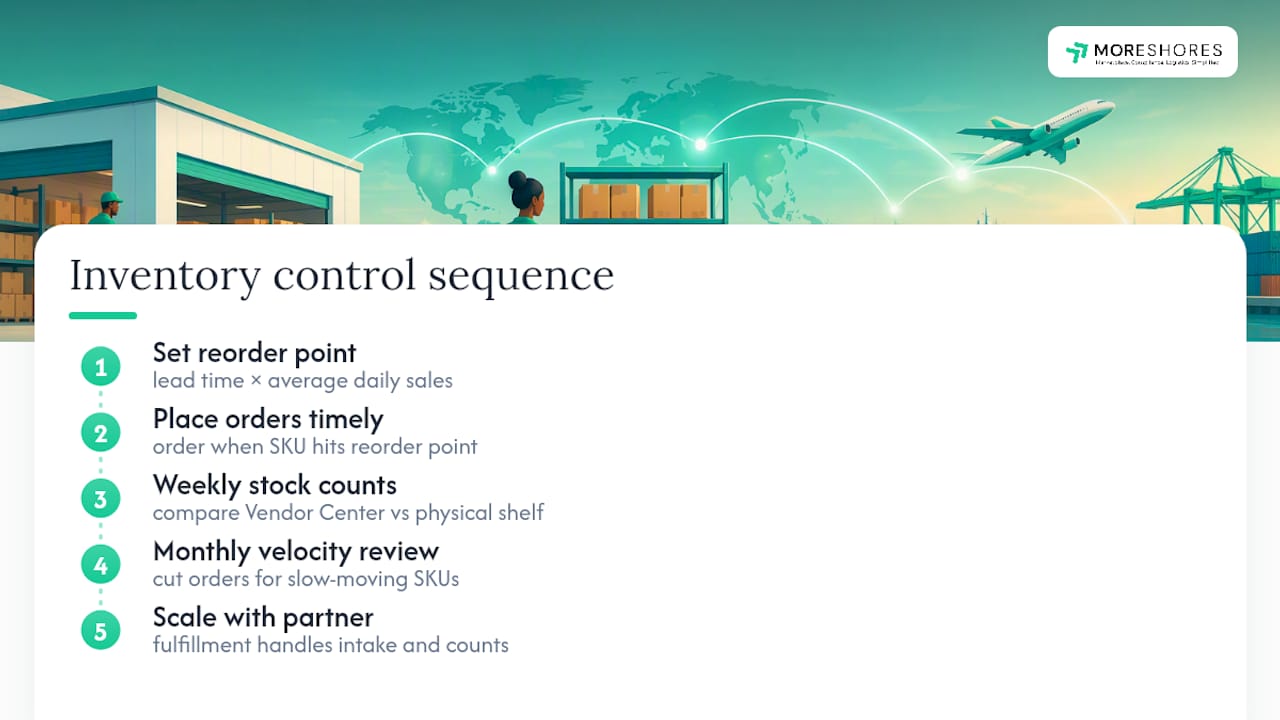
Weekly stock counts catch discrepancies between your Vendor Center dashboard and your physical shelf before they turn into cancelled orders. Jumia’s Vendor Hub documentation covers the product content management tools that help keep listed quantities synced with what you actually have on hand.
Overstock is the quieter problem. Slow-moving inventory ties up capital and, in a platform warehouse arrangement, keeps racking up storage charges. Review sales velocity by SKU monthly and cut orders on anything trending down before it becomes dead stock. If you’re managing multiple pallets or shelves across a warehouse, a fulfillment and warehousing partner can handle stock intake and counts on a schedule you’d struggle to run manually as volume grows.
How to Scale Your Jumia Business Beyond Your First Market
Growth on Jumia usually follows a pattern: nail one category and one country first, then expand outward in two directions, more products or more markets.
Multi-channel selling is the more common next step. Once your listings, images, and fulfillment process work on Jumia, the same product data and photography largely transfer to other marketplaces, whether that’s Kilimall, Amazon SA, or Takealot, plus your own Shopify or WooCommerce storefront. The marginal cost of adding a channel is much lower than building the first one from scratch.
International expansion adds a layer most sellers underestimate: customs, duties, VAT, and the question of whether you need a local entity in the destination market at all. This is where scaling gets expensive fast if you handle it piecemeal, contracting a broker here, a courier there, a compliance consultant somewhere else. A marketplace integration service that lists your catalog across channels from one dashboard removes a meaningful chunk of that operational drag.
Before scaling, confirm your fulfillment setup can absorb higher order volume without your shipping speed metric slipping. A Seller Score that held up at 50 orders a month can crack under 500 if your packing process doesn’t scale with it.
Jumia’s Rules on Prohibited Items and Compliance
Every category on Jumia carries listing rules, but a smaller set of items are barred outright or restricted to sellers with specific documentation.
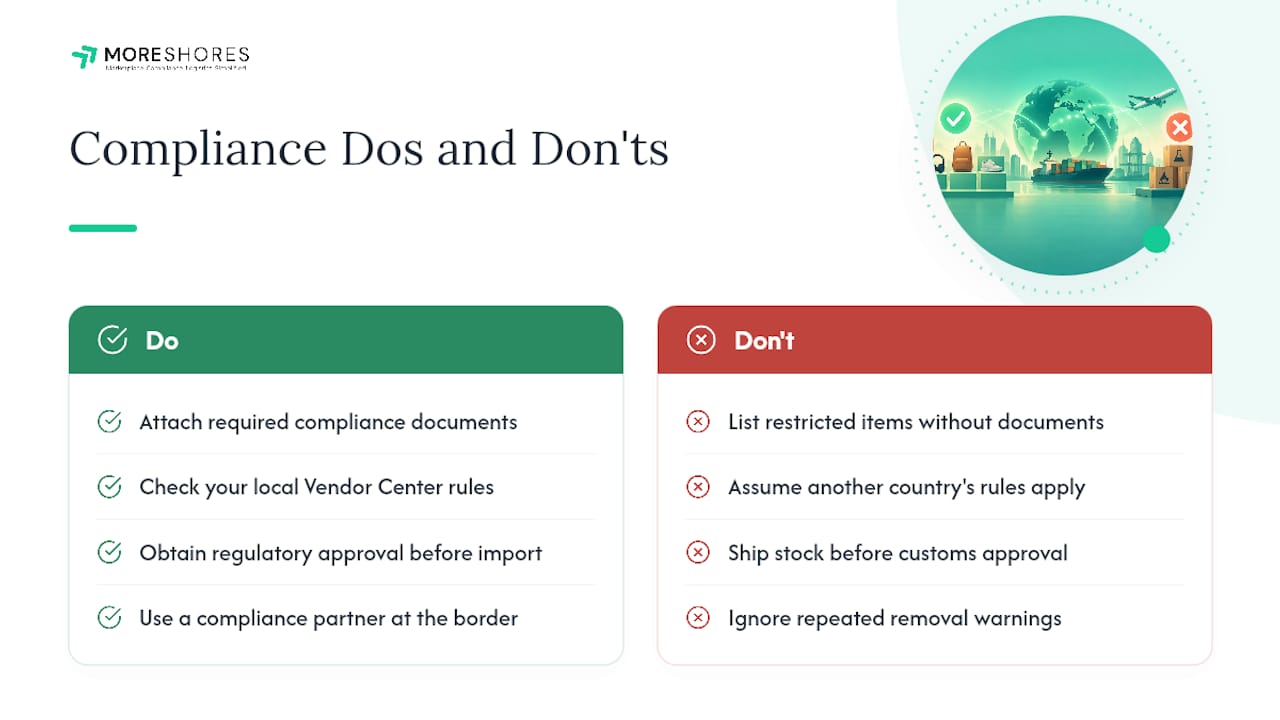
Counterfeit and unauthorized branded goods are removed on sight, and repeat violations typically lead to account suspension. Items requiring regulatory approval, certain electronics, cosmetics, and health-adjacent products among them, need the relevant compliance documentation attached before Jumia will approve the listing. Weapons, certain chemicals, and items restricted under national import law are excluded entirely, and the specifics vary by country, so check your local Vendor Center policy page rather than assuming a rule from one market applies in another.
Compliance failures don’t just cost you a listing. They can flag your entire account for review, which stalls every other product you’re selling in the meantime. If you’re importing stock from outside the market you’re selling in, customs clearance and regulatory approval need to happen before the product ever reaches a Jumia warehouse, not after a listing gets flagged. That sequencing is exactly where a compliance partner earns its fee: catching a restricted-item issue at the border is far cheaper than catching it after a suspension notice.
When in doubt on a specific product, Jumia’s Vendor Center is the authoritative source for current category rules, since restrictions get updated more often than most third-party guides reflect.
A 30-Day Checklist for New Jumia Sellers
Register in week one, finish KYC and training by week two, and get three SKUs live by week three. Everything after that is refinement.
Fulfillment reliability and listing accuracy do more for your account than any promotional spend early on. Watch two numbers weekly: shipping speed and cancellation rate. Both feed directly into Seller Score, and both are fixable before they become a visibility problem.
— Matt
MoreShores: An Optional Partner for Cross-Border Compliance, Warehousing, and Fulfillment
Running your own imports, customs paperwork, and multi-courier logistics works fine at small volume. It becomes a full-time job the moment you add a second market or a supplier overseas. That’s the gap Moreshores closes: acting as Importer of Record, clearing customs, handling duties and VAT, warehousing your stock, and fulfilling orders through a multi-courier network, all from one dashboard instead of a pile of separate contracts.
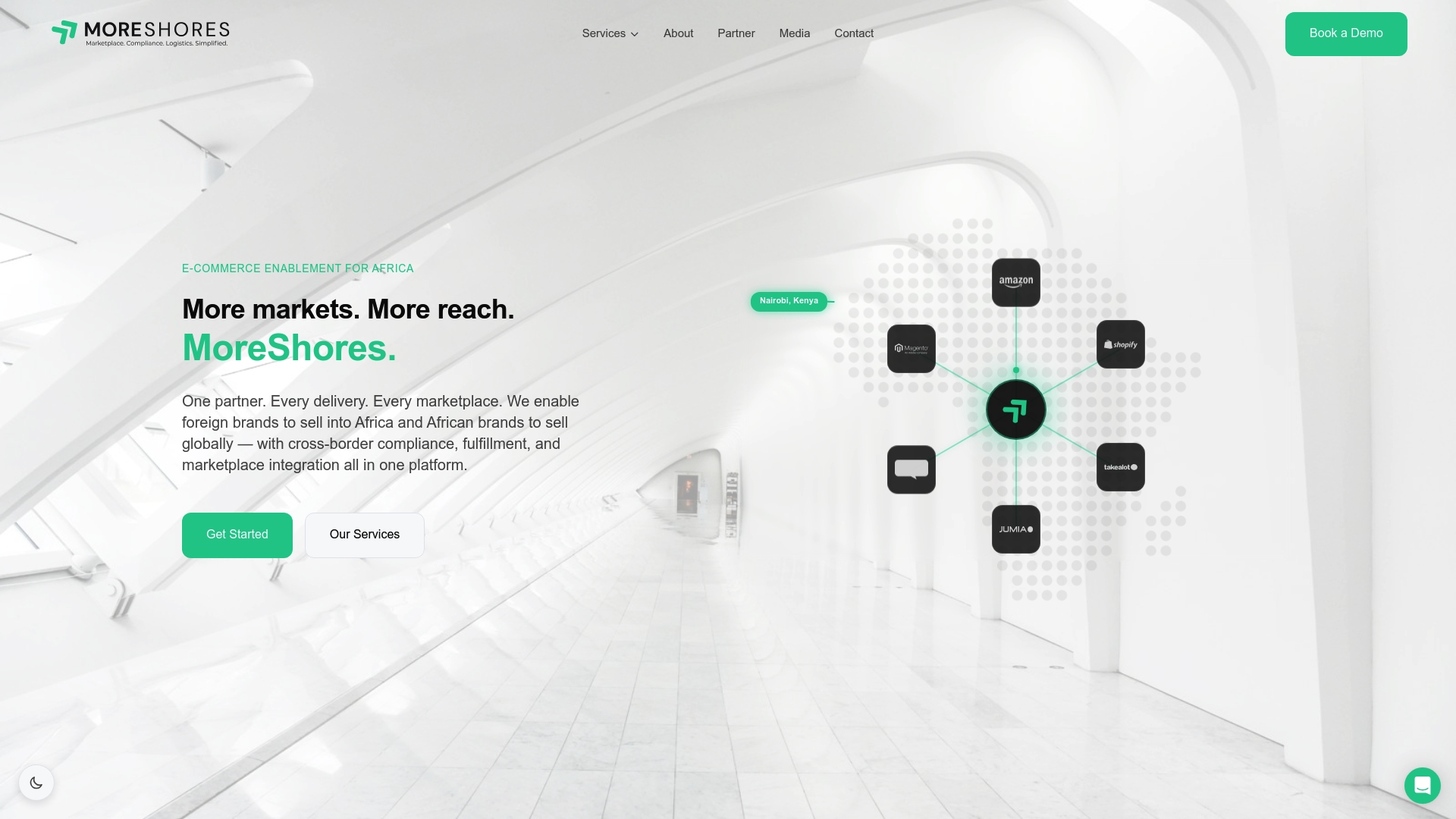
If you’re a small Jumia seller shipping domestically, you likely don’t need any of this yet. But if you’re importing inventory, expanding into a market where you have no local entity, or trying to list the same catalog across Jumia, Kilimall, and your own Shopify store without juggling five vendors, this is exactly the situation Moreshores was built for. Cross-border sellers avoid needing separate broker, courier, and compliance agreements by running everything through one integrated platform. Setup starts with a market-entry fee of $950, and fulfillment costs from there are itemized by pallet, box, and order. Check current pricing or review the cross-border compliance services to see if your situation fits.
Sources
FAQ
Can Anyone Become a Jumia Seller?
Yes. Individuals with a valid national ID and small businesses with registration documents can both open a Vendor Center account, provided they pass KYC verification and complete the mandatory New Seller Training. There’s no minimum size requirement to start.
What Sells the Most on Jumia?
Phones and electronics, fashion, and home and personal care items consistently rank among the highest-volume categories across Jumia’s markets. Success within any category still comes down to accurate listings, competitive pricing, and a Seller Score that keeps your products visible.
What Does “Seller SKU” Mean on Jumia?
A seller SKU is the unique identifier you assign to each product variant in your own inventory system, separate from Jumia’s internal product code. A structured format, like brand, category, and size combined, makes tracking stock across dozens of listings far easier than random codes.
How Can I Sell on Jumia in Nigeria?
The process mirrors the standard Jumia seller guide: register through Vendor Center, submit KYC documents (national ID or CAC registration for businesses), complete New Seller Training, then list your first product. Nigerian sellers use the same Vendor Hub reconciliation tools to track payouts once sales start.