4 Core Jumia Seller Fees and the Pricing Formula Nigerian Sellers Need

Jumia charges four core fees on every sale: a category-based commission, a shipping cost contribution, an order processing fee, and, for sellers using Jumia Express, a storage fee once free days run out. VendorHub’s own worked examples show VAT applied on top of the commission amount rather than folded silently into your product price, so you need to confirm the exact VAT percentage currently listed on VendorHub before you set your prices.
TL;DR:
- VAT is applied separately to the commission amount on each transaction, using current rates that sellers must verify before setting prices.
- Minimum commission floors can override percentage calculations on low-value items, potentially reducing your expected margin.
- Storage fees for Jumia Express are free for initial days, often 15, after which daily charges increase if stock remains unsold.
- Processing fees vary by product size and handling warehouse, and misclassifying product size can lead to unexpected costs.
- Fees are deducted after successful delivery and reflect on a weekly statement; disputes require documented proof of delivery or returns.
Table of Contents
- Understanding Jumia Seller Fees and What Each Charge Covers
- Calculating VAT on Your Jumia Commission
- Working Out Your Final Payout After Fees
- When Jumia Charges Fees and How Returns Affect Them
- How to Manage and Reduce Your Jumia Selling Costs
- Where MoreShores Fits Into Your Fee and Fulfillment Picture
- A Seller’s Take on Fees and Fulfillment Choices
- A Fulfillment Partner for Fee-Related Headaches
- Where to Verify Current Jumia Fee Rates
- Sources
- FAQ
Understanding Jumia Seller Fees and What Each Charge Covers
Jumia seller commissions vary by product category, and VendorHub sets a different percentage for phones than it does for fashion or home goods. The commission is not charged the moment you list an item or even when a customer buys it. It’s deducted only after successful delivery, then reflected on your weekly account statement. Some categories carry a minimum commission floor, which matters most for low-priced items stored in your own warehouse rather than a Jumia facility, since the percentage-based commission calculation can fall below that floor on cheap products.
Beyond commission, four other charges show up regularly on a Jumia seller’s statement:
- Shipping cost contribution: a category-based amount that differs depending on whether you’re drop shipping from your own location or using Jumia Express for pickup and delivery.
- Order processing and preparation fees: fixed charges tied to product size and which warehouse handles the item, with larger or bulkier goods costing more to process.
- Storage fees (Jumia Express only): VendorHub’s storage tables show a free initial window, often the first 15 days, after which daily charges escalate the longer stock sits unsold.
- VAT on commission: VendorHub’s examples add VAT as a separate increment on top of the commission figure rather than baking it into a single blended rate.
Order processing fees deserve a closer look because they’re the charge most sellers underestimate. A warehouse fulfilling a large appliance pays a different prep fee than one handling a phone case, and getting the size classification wrong on your listing can quietly inflate this line item across hundreds of orders.
Calculating VAT on Your Jumia Commission
VendorHub’s Nigerian pages walk through VAT arithmetic using a straightforward pattern: calculate the commission first, then add VAT as a separate step. Here’s how that works in practice:
- Determine the commission by multiplying your sale price by the category commission rate.
- Apply VAT to that commission amount, not to the full sale price.
- Add the VAT figure to the commission to get the total deducted for that line item.
Statistic Callout: VendorHub’s own examples use a 7.5% VAT rate on the commission portion of a transaction, illustrated with a commission of 300 naira plus 7.5% VAT landing at 322.50 naira total. Confirm this percentage on VendorHub before pricing, since rates get updated.
This matters because VAT is charged on the commission, not on your gross sale price. Sellers who assume VAT applies to the full transaction often overestimate their total deductions, which throws off pricing decisions built on the wrong base number.
Working Out Your Final Payout After Fees
VendorHub publishes a pricing formula sellers can use to reverse-engineer a listing price from a target take-home amount: (desired payout + shipping contribution) / (1 - commission rate). This tells you what to charge the customer so that after Jumia deducts its cut, you still walk away with the margin you planned for.
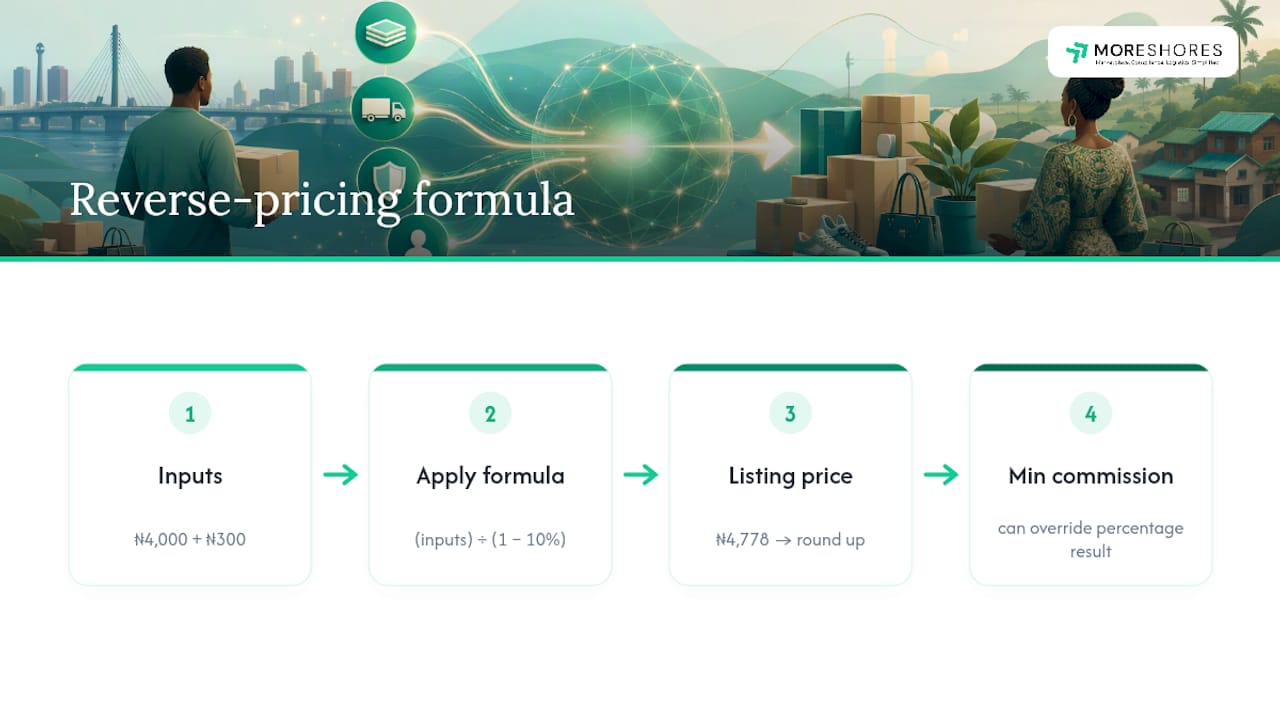
Say you want to net ₦4,000 on an item with a ₦300 shipping contribution and a 10% commission rate. The math looks like this:
Round up rather than down when the formula lands on an odd number. Watch for minimum commission floors on low-value items, which can override the percentage calculation entirely and quietly shrink your margin below plan.
When Jumia Charges Fees and How Returns Affect Them
Commission only hits your account after a delivery is confirmed successful, and it shows up on your weekly VendorHub statement alongside shipping and processing charges for the same period. That timing matters for reconciliation:
- Expect settlement and fee reporting on a weekly cycle, not per-order in real time.
- Failed deliveries and confirmed returns typically reverse the commission tied to that order rather than leaving it as a permanent deduction.
- Keep delivery confirmations and return documentation on hand, since disputing a fee without a paper trail rarely goes anywhere.
How to Manage and Reduce Your Jumia Selling Costs
Price every listing to absorb commission and VAT upfront, not as an afterthought once orders start rolling in. Building the fee into your sale price protects your margin instead of eating into it after the fact.
Choosing between Jumia Express and self-fulfillment comes down to turnover speed and item size. Fast-moving small goods usually do fine on Jumia Express since the free storage window covers a typical sales cycle, while slow-moving or bulky inventory can rack up storage charges that erase your margin. Get your size and weight coding right at listing time. Misclassifying a product as smaller than it is triggers processing fee discrepancies that are tedious to dispute later.

Pro Tip: Reconcile your weekly VendorHub statement against your actual order log every single week, not monthly. Catching a miscoded fee within seven days is a quick fix; catching it three months later after 200 more orders have shipped is a much bigger cleanup job.
Where MoreShores Fits Into Your Fee and Fulfillment Picture
Commission, VAT, and storage fees are only part of a Jumia seller’s cost structure. If you’re importing stock into Nigeria to sell on the platform, customs duties, VAT on imports, and regulatory compliance add another layer entirely. MoreShores works as an Importer of Record for sellers bringing goods across borders, handling duties and import VAT so those costs are accounted for before the product ever reaches a Jumia warehouse. Pairing that with warehousing and multi-courier fulfillment means fewer surprise storage or processing charges, and consolidated statements make it easier to see your true landed cost against what Jumia deducts on the selling side.
A Seller’s Take on Fees and Fulfillment Choices
Choose Jumia Express when your inventory turns fast enough to clear the free storage window; go seller-fulfilled when it doesn’t. Every pricing decision should already account for commission and VAT before the customer sees your listing, and your weekly statement should get checked with the same discipline as your bank account.
— Matt
A Fulfillment Partner for Fee-Related Headaches
Jumia’s fee structure is manageable once you know the formulas. What’s harder to manage is everything upstream of it: getting inventory into Nigeria, clearing customs, and handling import VAT without a customs broker eating your margin before Jumia even takes its cut. MoreShores works as an alternative to juggling freight forwarders and compliance paperwork separately for sellers who source internationally, combining Importer of Record services, duties and VAT handling, and warehousing under one operation.
That consolidation means your landed cost is known upfront, so the pricing formulas in this guide actually produce accurate margins instead of guesses. Some fulfillment partners also integrate listings across Jumia and other marketplaces, keeping fee reconciliation in one place instead of scattered across platform dashboards. If you’re bringing stock into Nigeria to sell on Jumia, get in touch about cross-border enablement and see how the numbers change once customs and duties stop being a variable.
Where to Verify Current Jumia Fee Rates
Fee percentages change, so check the Commissions page on Jumia VendorHub and the Fees page directly before finalizing your pricing. These are Jumia’s own worked examples and the most current source available.
Sources
FAQ
What Sells the Most on Jumia?
Electronics, phones and accessories, and fashion items consistently rank among Jumia’s top-selling categories across its markets. Category matters directly for fees too, since commission rates and shipping contributions vary by category on VendorHub.
Is Jumia a Nigerian Company?
Jumia was founded in Nigeria but is headquartered internationally and operates as a pan-African e-commerce group rather than a purely domestic Nigerian retailer. It runs country-specific VendorHub portals, including a dedicated Nigerian fee structure sellers should reference directly.
What Countries Does Jumia Operate In?
Jumia operates across multiple African markets, including Nigeria, Egypt, Ghana, and Kenya, each with its own VendorHub portal and fee tables. Commission rates, shipping contributions, and storage fees differ by country, so a Nigerian seller should always confirm figures on the Nigerian VendorHub pages rather than assuming another market’s rates apply.
What Payment Methods Are on Jumia Kenya?
Jumia Kenya supports mobile money options alongside card payments and cash on delivery, reflecting how Kenyan shoppers typically pay online. Payment method availability doesn’t directly affect seller commission rates, but it does affect how quickly a sale clears and shows up on your settlement cycle.
How Often Are Jumia Seller Fees Charged?
Commission, shipping contribution, and processing fees are deducted after a delivery is confirmed successful, then appear on your weekly VendorHub statement. Storage fees for Jumia Express accrue daily once your free storage window expires, so they show up as a running charge rather than a one-time deduction.