Cut RTO and Speed Cash Flow: Make Cash on Delivery Work in Africa

Offer cash on delivery selectively, not universally: use it where digital payment trust is low or unproven, and skip it for high-value or custom orders where refusal risk is steepest. The trade-off is real. COD lifts conversion but slows cash flow and raises return-to-origin costs. Merchants that survive it pair COD with order confirmation calls, mobile-money-at-door options, and tight zone-by-zone rules rather than treating it as an all-or-nothing switch.
TL;DR:
- Using cash on delivery selectively helps reduce returns and cash flow issues, especially in regions with low digital payment trust.
- The three main COD collection methods—cash, card-on-delivery, and mobile wallet—vary in risk, speed, and reconciliation complexity.
- Address verification, order confirmation calls, and zone-based rules significantly lower failed deliveries and fraud risks.
- Shortening delivery windows via regional hubs and reliable courier networks decreases refused or missed shipments.
- Partnering with cross-border fulfillment providers like Moreshores can mitigate customs delays and streamline reconciliation in African markets.
Table of Contents
- Why COD Still Drives Conversion Across African Markets
- The Three Ways COD Actually Gets Collected
- The Real Cost of COD: RTO, Refusals, and Cash-Flow Drag
- A Practical Risk-Reduction Playbook for Merchants
- Making COD Scalable With a Cross-Border Fulfillment Partner
- Legal and Regulatory Considerations for COD Across Africa
- Will Digital Payments Eventually Replace COD in Africa?
- How COD Shapes Customer Experience and Satisfaction
- Fraud Prevention Beyond Basic Order Confirmation
- What Successful COD Programs Look Like in Practice
- Three Lessons From Enabling Brands Into African Markets
- Let Moreshores Handle the Operational Side of COD
- Sources
Why COD Still Drives Conversion Across African Markets
Cash on delivery persists because it solves a trust problem digital checkout can’t. First-time buyers on unfamiliar sites, and shoppers in areas where card fraud or delivery scams are common, want to see and touch a product before money changes hands. That instinct shows up clearly in the numbers.
In Kenya, nearly 72% of online shoppers prefer COD, a figure that climbs to roughly 80% outside major urban hubs like Nairobi and Mombasa. Nigeria tells a similar story: about 70% of consumers prefer COD, compared with 28% using cards and just 12% on mobile money. In South Africa, cash reliance stays strong outside the major metros, where shoppers still want to inspect goods before paying.
A few patterns hold across all three markets:
- COD adoption is highest for low-value, tangible goods like apparel, electronics accessories, and household items.
- Custom or made-to-order products see much lower COD demand, since inspection-before-payment loses its appeal.
- Non-urban buyers lean on COD more heavily than city shoppers, who have better access to cards and mobile wallets.
- First-time customers on a new storefront convert at higher rates when COD is available, even if they never use it again.
The Three Ways COD Actually Gets Collected
COD isn’t one payment method. It’s three distinct operational flows, and each carries different reconciliation math.
- Doorstep cash collection. The courier collects physical currency, then remits it to the merchant or marketplace on a delayed cycle. This is the riskiest variant: drivers carry cash, counting errors happen, and reconciliation against order records is manual unless the courier’s app logs the collection digitally.
- mPOS or card-on-delivery. The delivery agent carries a mobile card reader, letting the customer pay by tap or chip instead of handing over notes. This cuts cash-handling risk for the courier and gives merchants a digital transaction record the moment the sale closes.
- Mobile-money-at-delivery. The customer pays through a wallet like M-Pesa the moment the courier arrives, often via a QR code or short-code prompt. This shortens the gap between delivery and funds landing in a merchant account, though payout timing still depends on the wallet provider’s settlement schedule.
- Marketplace-managed COD. Platforms like Jumia handle COD collection on the seller’s behalf, pooling courier networks, local agents, and payout cycles so individual sellers never touch the cash directly.
Whichever flow a merchant uses, tying collections to predictable remittance cycles matters more than which variant looks most modern. A courier that pays out weekly on a fixed schedule is worth more to cash flow than one offering flashy mPOS hardware with unpredictable settlement.
The Real Cost of COD: RTO, Refusals, and Cash-Flow Drag
Failed deliveries are the single biggest hidden cost of COD. A customer who isn’t home, refuses at the door, or placed a bogus order in the first place triggers a return-to-origin event, and every RTO carries a double shipping cost: one leg out, one leg back, plus the labor of reprocessing inventory.
Industry analysis flags RTO and reverse logistics as major margin drains for merchants running COD at scale across African markets. The cost stack looks like this:
- Double transport costs on every failed delivery (outbound plus return).
- Warehouse labor to inspect, restock, or write off returned goods.
- Cash-flow timing gaps between delivery and remittance, since couriers and marketplaces batch payouts rather than settling instantly.
- Informal or incomplete addresses that force couriers into repeat visits or phone-based navigation, extending delivery windows and increasing refusal odds.
Address quality deserves its own attention. Where formal street addressing is inconsistent, COD functions partly as a trust mechanism that only works when the courier can actually find the customer. Verification calls before dispatch materially cut failed collections.
A Practical Risk-Reduction Playbook for Merchants
You don’t need to eliminate COD to fix its economics. You need rules that filter out the orders most likely to fail before a courier ever leaves the warehouse.
Start with pre-dispatch confirmation. A quick WhatsApp message or phone call to verify the order and address catches a large share of fraudulent or mistaken orders before they cost you a delivery attempt. Layer selective COD rules on top: cap COD eligibility by order value, require prior purchase history for high-value COD orders, and disable COD automatically in postal zones with a track record of high RTO. Algorithmic disable rules in the order management system do this without manual review on every order.
Prepayment incentives close the gap further. A small discount or faster shipping window for customers who pay upfront can meaningfully raise prepaid conversion while keeping COD available for buyers who genuinely need it.
On the technology side, integrating mobile-money and mPOS options reduces how much physical cash your delivery fleet carries and gives you a digital trail for every collection.
- Confirm every COD order by phone or WhatsApp before it ships.
- Set COD eligibility thresholds by order value and customer history.
- Offer a small prepay discount or expedited shipping incentive.
- Use mPOS or mobile-money-at-door wherever courier coverage allows it.
- Establish regional hubs to shorten delivery windows and cut RTO.
Pro Tip: Regional fulfillment hubs in cities like Lagos, Cairo, Casablanca, or Nairobi can shrink delivery times from a week down to one to three days, and shorter windows consistently mean fewer refused or missed deliveries.
Making COD Scalable With a Cross-Border Fulfillment Partner
Most COD failures trace back to two things: customs delays that stretch delivery windows, and fragmented courier and reconciliation systems that make cash collection hard to track. A cross-border enablement partner closes both gaps at once.
Moreshores operates as Importer of Record for merchants entering African markets, clearing customs and handling duties and VAT so goods reach warehouses faster instead of sitting in a bonded facility while a courier’s delivery window ticks down. From there, warehousing and a multi-courier fulfillment network shorten last-mile delivery time, the single biggest lever against RTO.
- Importer of Record status removes customs bottlenecks that delay COD delivery windows.
- Multi-courier fulfillment gives merchants routing flexibility when one carrier underperforms in a specific zone.
- Marketplace and storefront integration centralizes orders and payment reconciliation across channels like Jumia, Takealot, and Shopify storefronts.
Legal and Regulatory Considerations for COD Across Africa
COD itself isn’t a regulated payment instrument in most African markets, but the transactions around it are. Consumer protection rules in countries like Kenya, Nigeria, and South Africa generally require accurate product descriptions and a defined return window, and refusing a COD delivery for a legitimate reason (wrong item, damage) typically falls under standard consumer rights rather than any COD-specific statute.
Where regulation does bite is on the courier and payment side. Cash-handling limits, anti-money-laundering reporting thresholds, and mobile-money transaction caps vary by country and by provider, and they can affect how much cash a delivery agent is legally allowed to carry or how a marketplace remits collected funds to sellers. VAT and customs treatment also differ sharply depending on whether goods are cleared domestically or imported, and merchants selling cross-border need to confirm which entity is legally responsible for duties and compliance at the border.
This is where structure matters more than instinct. A merchant shipping into Nigeria, Kenya, or South Africa without a local compliance partner is exposed to rules that change by product category, courier license, and import value. Using an Importer of Record to formally assume customs responsibility removes ambiguity about who owes what, and it keeps COD operations from becoming a compliance liability layered on top of a logistics one. Merchants running COD at volume should treat regulatory review as an ongoing task tied to each market they enter, not a one-time checklist.
Will Digital Payments Eventually Replace COD in Africa?
Mobile money is growing fast across the continent, and that growth is chipping away at COD’s dominance in specific segments, but it isn’t replacing it outright. The more accurate read is substitution at the margins: customers who once demanded cash on delivery are shifting toward mobile-money-at-door once they trust a merchant, while first-time buyers and non-urban shoppers keep defaulting to COD regardless of how mature the local digital payment ecosystem becomes.
The practical effect for merchants is a slow narrowing of COD’s share rather than its disappearance. As mobile wallets like M-Pesa expand into new corridors and more delivery agents carry mPOS devices, the friction that once forced cash-only transactions keeps shrinking. That doesn’t eliminate the underlying trust gap driving COD demand, though. A buyer’s first purchase from an unfamiliar storefront still carries risk in their mind, and no amount of payment infrastructure fixes that on its own.
Merchants planning multi-year market entry should build for a hybrid state, not a cash-free endpoint. That means treating COD as a permanent feature of the payment stack in certain segments (rural buyers, first-time customers, low-trust categories) while pushing prepayment and mobile-money-at-door aggressively everywhere digital adoption is rising. The mix will keep shifting year over year, but the total elimination of COD isn’t a realistic planning assumption for most of the continent in the near term.
How COD Shapes Customer Experience and Satisfaction
Satisfaction with COD hinges less on the payment moment itself and more on everything around it. Customers rate their experience on delivery speed, communication before the courier arrives, and whether the item matches what they ordered, closely enough to justify handing over cash on the spot.
The single biggest satisfaction driver is predictability. A customer who gets a confirmation call, a delivery window, and a courier who actually shows up in that window rates the experience well, even if the payment itself is a slightly clunky cash exchange. Conversely, a vague delivery estimate, an unannounced courier arrival, or a driver who can’t make correct change turns an otherwise fine transaction into a frustrating one.
Inspection rights also shape satisfaction directly. Buyers who can open a package and confirm contents before paying feel more in control of the transaction than those locked into a prepaid, no-recourse purchase. That sense of control is a large part of why COD retains loyalty even among customers who have used cards or mobile money elsewhere.

Merchants can improve COD satisfaction without touching the payment mechanism at all: tighter delivery windows, proactive SMS or WhatsApp updates, and couriers trained to carry change all move the needle more than any payment technology upgrade.
Fraud Prevention Beyond Basic Order Confirmation
Order confirmation calls catch obvious problems, but merchants running COD at scale need layered fraud controls that don’t depend on manual review of every transaction.
Address and phone number verification against a shared blacklist is a first technical layer: courier networks and marketplaces increasingly share data on customers who’ve repeatedly refused deliveries or placed fraudulent orders, letting merchants flag risky orders automatically before dispatch. Order pattern analysis adds a second layer, flagging unusual behavior like multiple high-value COD orders from a new account, or orders placed from an IP address inconsistent with the delivery location.
Digital proof of delivery closes the loop on the collection side. Requiring a courier to log a photo, signature, or geolocation stamp at the point of cash collection creates an audit trail that discourages both customer disputes and agent-level cash mishandling. Marketplace platforms that manage COD centrally, as Jumia does across its courier and agent network, build much of this verification into the order pipeline by default, which is one reason large platforms sustain COD at volumes individual merchants would struggle to manage alone.
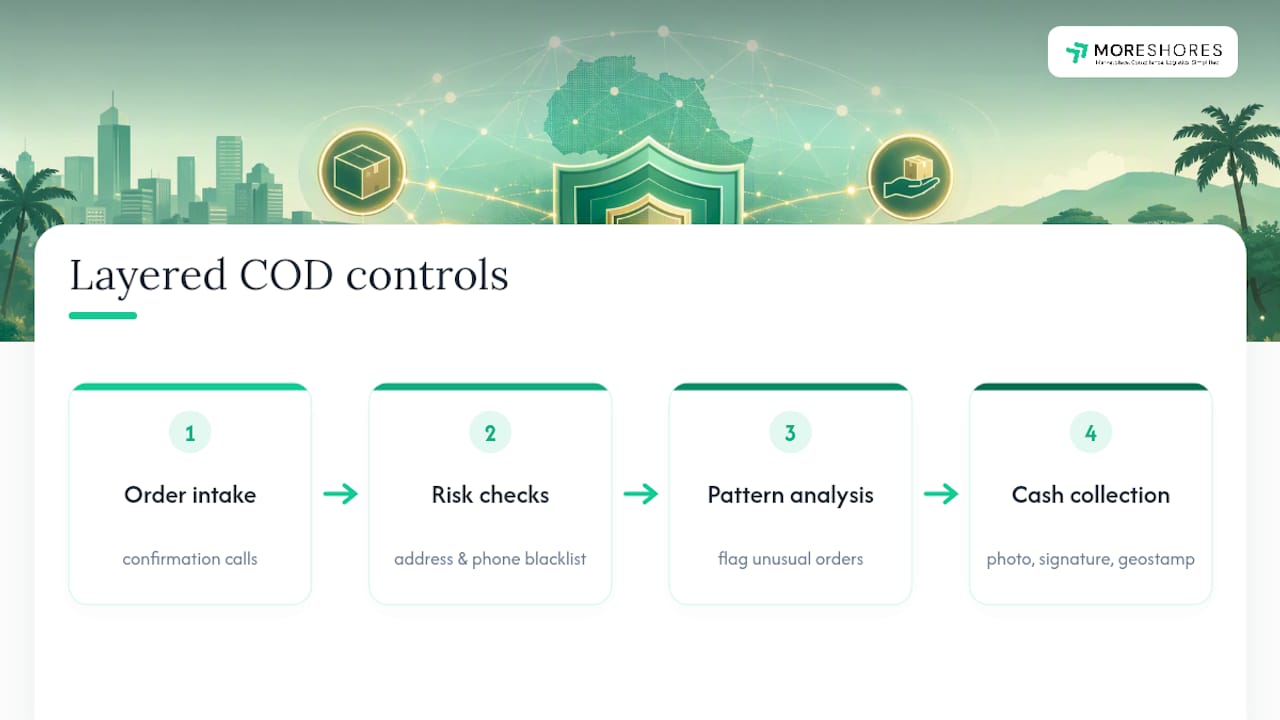
The technology layer matters, but it works best stacked on the operational basics: confirmation calls, selective COD eligibility, and zone-based rules still catch more fraud per dollar spent than any single software tool.
What Successful COD Programs Look Like in Practice
The clearest lesson from large-scale COD operators is that scale itself is a fraud and RTO control, not just a growth outcome. Jumia’s model across Nigeria and other West African markets pools courier capacity, local delivery agents, and payout processing into one managed system, which means individual sellers benefit from fraud-detection patterns built from millions of transactions rather than their own limited order history.
Kenya’s e-commerce sector shows a different version of success: courier networks that pair COD with strong communication practices, like confirmation calls and clear delivery windows, sustain COD preference above 70% without it becoming an unmanageable cost center. The common thread across these successful implementations isn’t the payment method itself. It’s the infrastructure wrapped around it: reliable courier coverage, address verification, and payout cycles predictable enough that merchants can plan cash flow around them instead of treating every remittance as a surprise.
Smaller merchants without that infrastructure tend to see the worst of COD: high RTO, delayed payouts, and fraud losses that erode thin margins. The difference between a merchant that makes COD work and one that doesn’t usually comes down to whether they’ve built (or partnered into) the same operational scaffolding the larger platforms use by default.
Three Lessons From Enabling Brands Into African Markets
Selective COD works when it’s tied to real metrics, not instinct. Watch RTO rate by zone and by order value, then cut COD eligibility where the numbers say to, not where it feels safe.
Delivery speed is the lever that moves everything else. Shorter windows from regional hubs cut refusals more reliably than any fraud script.
Measure, iterate, and bring in a partner where the operational lift exceeds what your team can run in house.
— Matt
Let Moreshores Handle the Operational Side of COD
Moreshores gives merchants a way to keep offering cash on delivery without absorbing the customs delays and reconciliation chaos that usually come with it. Acting as Importer of Record removes the customs bottleneck that stretches delivery windows and drives refusals, while warehousing and multi-courier fulfillment shorten the last mile that determines whether a COD order gets collected or returned.
Marketplace and storefront integration can pull order and payment data from channels like Jumia, Takealot, and Shopify into one view, so reconciling COD collections against orders stops being a manual, error-prone task. For a merchant weighing whether to expand COD into a new zone or country, that centralized visibility is often the difference between a controlled rollout and a costly guess. If your team is planning to enter or scale COD operations in African markets, explore Moreshores’ cross-border enablement services and talk to the team about what your specific product category and delivery zones actually need.