Avoid U.S. Customs Holds: Amazon FBA Exports from Africa

Yes, African exporters can use Amazon FBA to reach major international marketplaces, and it is a workable route for many small and medium sellers today. In practice this means shipping inventory to Amazon’s international fulfillment centers while Amazon handles storage, packing, and delivery. The first practical move is to register a verified seller account and line up a multi-currency receiving solution or an Importer of Record partner before your first shipment leaves the ground.
TL;DR:
- African exporters must pre-arrange a multi-currency payout account and supply all necessary business, tax, and identification documentation to complete Amazon seller verification efficiently.
- Shipping options depend on product value and volume, with air freight for high-value items and sea freight for large, heavy shipments, both requiring careful planning to avoid delays.
- Moving inventory into the US or European fulfillment centers generally favors physical local storage over export-only settings, reducing risks and improving reliability.
- Exporters must understand US customs procedures, including the role of the Importer of Record, and prepare accurate paperwork like invoices, packing lists, and HTS codes to prevent shipment holds.
- Using a comprehensive partner like MoreShores can simplify cross-border compliance, warehousing, customs, and marketplace management, reducing operational complexity and friction.
Table of Contents
- How Amazon FBA and Global Selling Work for African-Based Exporters
- Step-by-Step Setup: Documents, Verification, and Getting Paid
- Shipping and Logistics Options to FBA
- Customs and Importer of Record: What US Entry Requires
- Costs, Fees, and Payouts: Modeling Your Margins
- Compliance, Restricted Goods, and Enforcement Risks
- Operations and Scaling: Inventory, Returns, and Listing Health
- What Consistently Helps African Exporters Succeed
- How MoreShores Can Help You Export With Less Friction
- Official and Practical Resources to Consult Next
- Sources
- FAQ
How Amazon FBA and Global Selling Work for African-Based Exporters
Amazon does not run local marketplaces in most African countries, so exporters typically reach international buyers through Amazon Global Selling. This program lets a seller registered in one country list products on marketplaces such as Amazon’s US, UK, or Germany stores. Once your account is set up, African sellers commonly use Amazon Global Selling and FBA to list on these stores and ship inventory to the destination country’s fulfillment centers rather than trying to fulfill orders themselves from home.
Under FBA, Amazon takes over the parts of the business that are hardest to manage across borders: storage, picking and packing, shipping to the buyer, returns processing, and even customer service in the local language and time zone. That division of labor is exactly why FBA appeals to exporters who cannot realistically run a call center in a market they have never visited.
There is a distinction worth understanding early. FBA Export allows inventory already stored in one country’s fulfillment centers to ship to customers in other countries, while local-market FBA means storing inventory directly inside the destination country’s warehouses. For an African exporter targeting American buyers, the more reliable route is usually getting inventory physically into a US fulfillment center rather than relying on export settings from a different region.
Getting inventory there is its own challenge, and Amazon offers two built in tools. Amazon SEND (Seller Export & Delivery) is a shipping workflow that lets sellers move inventory to FBA and Amazon Warehousing and Distribution centers in supported countries, integrated directly into the Send to Amazon process in Seller Central. Amazon Global Logistics is a related freight option some sellers use for ocean and air shipments. Both exist as alternatives to arranging freight entirely through a private forwarder.
A basic seller flow looks like this:
- Register your seller account and complete identity and business verification.
- List products on your target marketplace with compliant titles, images, and category data.
- Prepare inventory with correct labeling, packaging, and prep according to Amazon’s requirements.
- Ship inventory to the assigned fulfillment center using SEND, Global Logistics, or a freight forwarder.
- Amazon receives, stores, and fulfills orders as they come in, including customer returns.
Each step has its own failure points, which is why the setup and logistics sections below matter as much as the sales strategy itself.
Step-by-Step Setup: Documents, Verification, and Getting Paid
Amazon’s seller verification process is thorough by design, and African exporters should expect to gather several documents before an account goes live. Missing paperwork is one of the most common reasons registration stalls for weeks instead of days.
- Gather your business registration certificate, a valid government-issued ID for the account owner, and proof of business address such as a utility bill or bank statement.
- Prepare a valid credit card for account verification and a bank or payment account capable of receiving international payouts.
- Confirm your tax identification details, since Amazon will ask for tax information relevant to the marketplace you are selling on.
- Open or activate a multi-currency receiving account before your first sale, rather than scrambling once payouts start arriving.
- Submit your application and respond quickly to any Amazon verification requests, since delays on your end extend the whole timeline.
The receiving account step deserves particular attention. Many African sellers use a multi-currency solution such as World Account to collect payouts in US dollars, British pounds, or euros without needing a local bank account in each market. This matters because it lets you pay suppliers and cover Amazon fees without converting currency at every step, which reduces the foreign exchange friction that erodes margins over time.
On the tax side, sellers should expect obligations tied to the marketplace they sell into rather than their home country alone. Some marketplaces require tax registration once sales cross a certain threshold, and VAT rules for platforms selling into the European Union differ from US sales tax rules, which are typically collected and remitted by Amazon on the seller’s behalf in most states. Treat this as a jurisdiction-by-jurisdiction question rather than assuming one rule applies everywhere.
Realistic timelines: account verification often takes one to three weeks depending on document quality, opening a multi-currency account can take a few days once documents are ready, and your first inventory shipment should not leave until both are confirmed.
Shipping and Logistics Options to FBA
Getting product from an African port or airport into an Amazon fulfillment center is where many export plans either work or fall apart. The transport mode you choose depends on how much time pressure you are under and how thin your margins are.
- Air freight is fastest, typically days rather than weeks, but costs significantly more per kilogram, making it suited to lightweight, high-value goods.
- Sea freight is the cheaper option for bulk shipments and heavier goods, though transit times run into weeks and require more advance planning.
- Express couriers work well for small test shipments or samples, but rarely make sense once volumes scale.
For moving inventory into FBA specifically, sellers can choose between Amazon’s own tools and a private freight forwarder. Amazon SEND supports shipments into fulfillment centers across supported countries, and choosing it inside the Send to Amazon workflow can cut down on the coordination normally needed when booking freight separately and then matching it to an Amazon shipment plan. A freight forwarder still makes sense when you need door-to-door service, consolidation with other cargo, or routes that SEND does not yet cover.
Carton and pallet prep is where many first-time shipments get rejected or delayed. Amazon has specific rules on box weight limits, barcode placement, and pallet dimensions, and small errors like an unscannable label or an overweight carton can trigger a hold at the receiving dock.

Pro Tip: Photograph every carton and label before it leaves your warehouse. If Amazon flags a shipment, you will have proof of what was actually sent.
Budget for freight cost, insurance, any forwarder handling fees, and a buffer for delays. Sea freight quotes can shift with fuel surcharges, and air freight rates spike around peak shopping seasons, so book earlier than you think you need to.
Customs and Importer of Record: What US Entry Requires
Every shipment crossing into the United States needs an Importer of Record, the legal entity responsible for ensuring duties are paid and goods comply with import law. As an exporter, you can act as your own IOR if you have a US tax presence, or you can work with an IOR service or licensed customs broker who takes on that responsibility on your behalf.
- Assemble your commercial invoice, packing list, and bill of lading or air waybill for every shipment, since these are the base documents any entry requires.
- If you are using a broker, sign a power of attorney authorizing them to file on your behalf.
- Understand Section 321 rules for low-value shipments valued at $800 or less, which can qualify for duty-free entry, and note that CBP guidance addresses how a domestic warehouse or fulfillment center is treated for eligibility purposes.
- Review CBP’s importing guidance directly rather than relying on secondhand summaries, since it lays out entry types, documentation, and valuation rules in detail.
- Hand your broker or IOR service a clean checklist including product descriptions, HTS codes if known, country of origin, and declared value for every SKU to reduce the chance of a hold.
CBP’s guide describes an “informed compliance” principle: the legal burden for correct classification and valuation sits with the importer, not the carrier or the platform. That means if you are the IOR, inaccurate paperwork is your risk to carry, and working with an established IOR service can reduce that exposure considerably for exporters without a US legal entity.
Fulfillment centers themselves are treated by CBP as receiving locations, not as customs authorities, so clearance has to happen before goods ever reach the Amazon dock. Build that step into your timeline rather than assuming Amazon handles it.
Costs, Fees, and Payouts: Modeling Your Margins
Amazon FBA pricing has several layers, and exporters who only account for the product cost and freight often find their real margin much thinner once fees are applied.
- Per-order fulfillment fees cover picking, packing, and shipping the item to the buyer.
- Monthly storage fees are charged per cubic foot and rise sharply for inventory classified as long-term storage.
- Removal or disposal fees apply if you need to pull unsold stock out of a fulfillment center.
- Inbound freight, customs duties, and clearance fees are separate from Amazon’s own charges and have to be added on top.
Amazon SEND supports shipments into fulfillment centers across multiple countries including the US, UK, Germany, Japan, the UAE, and Saudi Arabia, which means the fee structure and duty rules will differ depending on which market you target first, so model each destination separately rather than using one blended number.
A practical approach is to start with Amazon’s own FBA revenue calculator for the base fulfillment and storage fees, then manually add your freight cost per unit and estimated duty rate to arrive at a landed cost. Only after landed cost is set should you compare it against your intended selling price to see what margin is actually left.
On the payout side, using a single multi-currency account to receive Amazon payments in the currency of sale, rather than converting immediately, gives you flexibility to pay suppliers or Amazon-related costs in the same currency and avoid paying a conversion spread twice.
Compliance, Restricted Goods, and Enforcement Risks
Account suspensions and shipment refusals are usually caused by a small set of recurring problems, and most of them are avoidable with the right documentation habits.
- The seller-of-record rule means the entity listed as selling the product must match who actually controls the listing, so using someone else’s account or unclear third-party branding arrangements risks suspension.
- The Uyghur Forced Labor Prevention Act creates a rebuttable presumption that certain goods are made with forced labor, and rebutting it requires traceability records, supplier declarations, and audit-ready documentation showing the origin of materials and labor.
- US product standards and labeling requirements vary by category, and goods that pass inspection in one market can still fail US labeling rules around materials, warnings, or country-of-origin marking.
- Weak or missing chain-of-custody documentation is one of the fastest ways to trigger a customs hold, even when the underlying product is fully compliant.
Practical mitigation starts with supplier due diligence before you ever place a purchase order, not after a shipment gets flagged. Keep signed supplier declarations, retain shipping and material records for every batch, and work with an IOR or clearance partner familiar with the specific product category you export.
Pro Tip: Treat every new supplier relationship as a documentation exercise first. A clean paper trail is often the difference between a shipment clearing in days versus sitting in a bonded warehouse for weeks.
Operations and Scaling: Inventory, Returns, and Listing Health
Long lead times from Africa to international fulfillment centers mean inventory planning has to be more conservative than it would be for a domestic seller.
- Calculate a reorder point that accounts for your full lead time plus a safety stock buffer, since running out of stock during peak demand costs you sales rank as well as revenue.
- Decide whether returns should route to a local returns hub in the destination market or ship back to Africa, weighing the cost of return freight against the value of the returned goods.
- Optimize your listing content with accurate keywords, clear product images, and category-specific compliance details, since international buyers rely entirely on the listing to judge trust before ever handling the product.
- Introduce a third-party fulfillment partner or split-inventory strategy once volume across multiple markets makes a single-warehouse setup inefficient.
Building buyer trust across a distance is less about marketing language and more about consistency: accurate delivery estimates, responsive handling of buyer messages, and a returns process that does not leave customers waiting weeks for a resolution.
What Consistently Helps African Exporters Succeed
Some companies work with brands on the compliance, warehousing, and fulfillment side of cross-border trade, acting as Importer of Record and managing customs, duties, and marketplace integration for exporters moving goods internationally. Across that work, a few patterns repeat.
Sellers who prepare documentation before their first shipment, consolidate currency receipts into one account, and invest in compliant prep and labeling from day one tend to scale without major disruptions. The ones who struggle usually share the same three habits: incomplete paperwork discovered only at customs, underestimating freight and duty costs until margins disappear, and weak supplier traceability that turns into a compliance problem months later. None of these are hard to fix, but they are much cheaper to fix before the first container ships than after.
— Matt
How MoreShores Can Help You Export With Less Friction
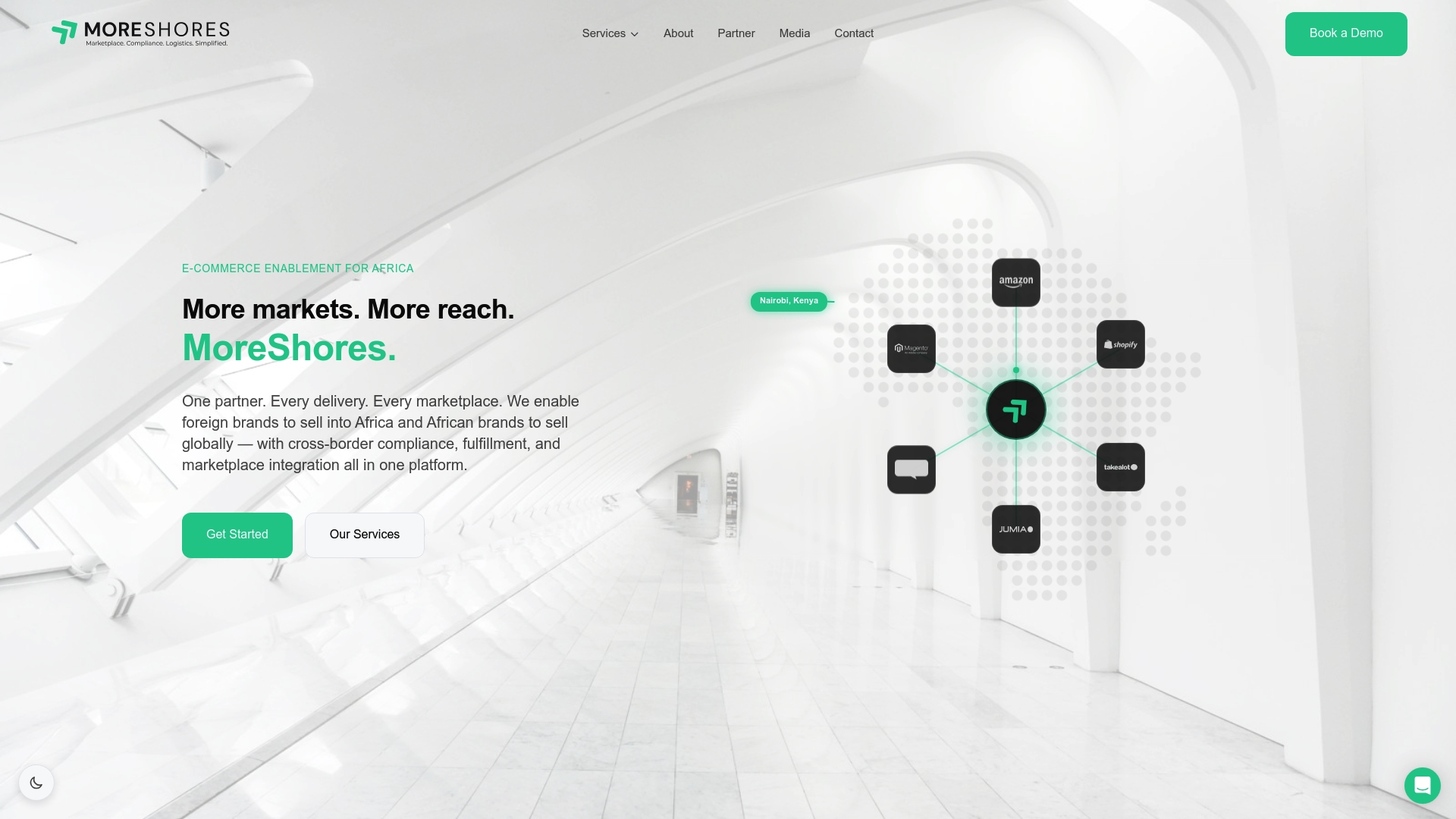
Running FBA exports from Africa usually means juggling a customs broker, a freight forwarder, a warehousing provider, and Amazon’s own systems separately, often without a local entity to tie it together. MoreShores replaces that patchwork with one partner: we act as Importer of Record, handle customs clearance and VAT, manage warehousing and multi-courier fulfillment, and integrate your listings across marketplaces including Amazon SA, Takealot, Jumia, and Kilimall.
What that looks like in practice:
- Importer of Record and cross-border compliance handling so you do not need a local legal entity to clear goods.
- Warehousing and fulfillment through a multi-courier network, separate from or alongside your Amazon FBA operation.
- Marketplace and channel distribution support for sellers expanding beyond a single platform.
- A market-entry setup fee of $950 and a 10% cross-border service fee, listed on our pricing page, with no separate contracts needed for brokers or couriers.
If you are weighing whether to handle IOR and compliance yourself or bring in a partner, our cross-border and compliance page walks through exactly what is included, and our how it works guide covers onboarding from first contact to your first shipment.
Official and Practical Resources to Consult Next
For rules that change without much notice, go to the source. Review Amazon SEND’s program details for shipping into FBA, CBP’s importing guide for entry requirements. Also consult a freight solutions overview to choose between shipping modes before your first shipment.
Sources
- Selling on Amazon from Africa? Here’s how Fulfilment by Amazon works and what it costs | WorldFirst AF
- Seller Export & Delivery (SEND) | Sell on Amazon
FAQ
Does Amazon have any warehouses in Africa?
Amazon does not currently operate FBA fulfillment centers within most African countries. African sellers typically list through Amazon Global Selling and ship inventory to fulfillment centers in the destination market, such as the US or UK, rather than storing goods locally.
Can I make $1,000 a month selling on Amazon?
Monthly earnings on Amazon FBA depend heavily on product category, pricing, fees, and freight costs, so there is no fixed outcome that applies to every seller. Building a realistic landed cost model, using Amazon’s revenue calculator alongside your actual freight and duty figures, is the only reliable way to estimate what a specific product can earn.
Can Amazon deliver to Africa?
Amazon’s FBA Export program is built around exporting goods to customers in supported international destinations, and eligibility depends on the product and the seller’s FBA Export settings. Delivery coverage into African countries varies by category and by the specific Amazon marketplace involved, so sellers should check current export eligibility for each product before assuming delivery is available.
Can I sell on Amazon FBA in South Africa?
Yes, South African-based sellers can register for Amazon Global Selling and use FBA by shipping inventory to fulfillment centers in markets such as the US, UK, or Germany. This generally requires a verified seller account, compliant documentation, and a multi-currency receiving solution to collect payouts without relying on a local Amazon marketplace.
What documents do I need to sell internationally on Amazon FBA from Africa?
Amazon typically requires business registration documents, a valid government ID, proof of address, and a bank or payment method capable of receiving international funds. Exporters shipping to the United States also need a commercial invoice, packing list, and bill of lading or air waybill for customs entry.