Why seamless storefront integration powers global e-commerce

TL;DR:
- Seamless storefront integration connects your front end and back-end systems in real time to improve cross-border e-commerce. This reduces operational errors, boosts conversion rates, and enables automatic localization of pricing, payments, and fulfillment for international markets. Implementing continuous, shared data flows helps businesses grow efficiently across borders, especially in complex regions like Africa.
Checkout uncertainty quietly kills revenue. When international buyers encounter unexpected shipping costs, unrecognized payment options, or pricing in the wrong currency, they leave without buying, and most never return. Localization at checkout directly reduces this kind of drop-off by giving buyers the certainty they need to complete a purchase. For e-commerce businesses selling across borders into Africa or expanding African brands globally, seamless storefront integration is the foundation that makes this certainty possible. This guide explains what integration really means, why it drives cross-border revenue, and how to apply it practically in your business.
Table of Contents
- What is seamless storefront integration?
- How seamless integration drives cross-border growth
- Conversion impact: Why checkout integration is a game-changer
- Advanced integration: Getting it right when complexity rises
- Our experience: What most guides miss about seamless integration
- How MoreShores drives seamless integration for cross-border success
- Frequently asked questions
Key Takeaways
| Point | Details |
|---|---|
| Unified data is essential | Real-time integration prevents errors and delivers consistent customer experiences across borders. |
| Localization boosts conversions | Offering local payment, currency, and checkout options increases trust and sales. |
| Checkout certainty reduces abandonment | Clear, accurate landed costs and shipping turn more carts into completed checkouts. |
| Anticipate technical complexity | Plan for challenges like currency handling, webhook retries, and avoid overengineering when simpler will do. |
| Integration is a capability, not a project | Long-term e-commerce success requires treating integration as an ongoing business advantage, not a one-off fix. |
What is seamless storefront integration?
With conversion optimization top of mind, let’s break down what “seamless integration” really means for your business infrastructure.
Seamless storefront integration is the real-time connection between your customer-facing storefront and the back-end systems that power your operations. These systems include your Customer Relationship Management (CRM) platform, Enterprise Resource Planning (ERP) software, Product Information Management (PIM) system, and Order Management System (OMS). When these platforms share data continuously and automatically, your storefront reflects accurate information at every touchpoint.
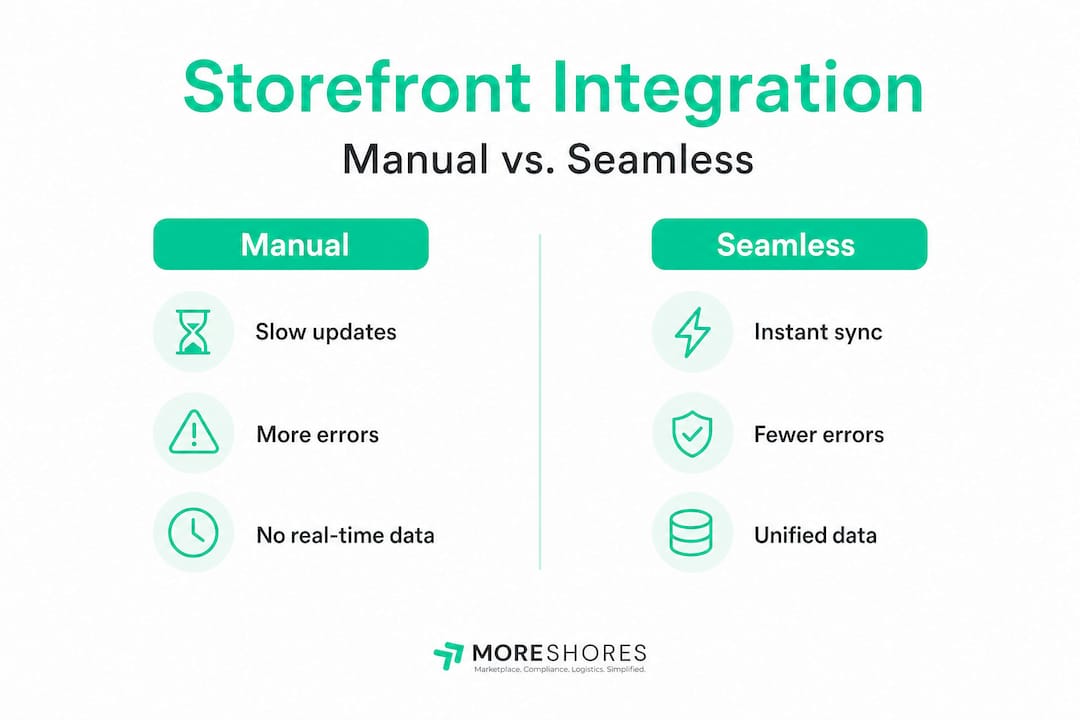
Storefront integration eliminates operational latency, which is the dangerous delay between what happens in your back end and what customers see on your website. When there is latency, customers can purchase out-of-stock products, see incorrect prices, or experience order delays that stem entirely from internal data gaps rather than actual supply problems. These failures are preventable, and they erode trust fast.
Before integration, most businesses manage these gaps manually. A warehouse team updates a spreadsheet. Someone syncs it to the storefront. Delays happen. Errors accumulate. By the time a customer sees the wrong inventory count or incorrect pricing, the damage is already done. The operational cost of correcting these errors adds up significantly over time.
Here is what your business gains when fulfillment and logistics integration works in real time:
- Accurate inventory counts across all channels and geographies, updated instantly when stock moves
- Consistent pricing that reflects correct currency, promotions, and landed cost calculations per region
- Real-time order updates that flow from storefront to fulfillment without manual hand-offs
- Synchronized product data so listings remain correct across every marketplace and storefront you operate
- Reduced return rates because customers receive exactly what was described at the time of purchase
The table below illustrates the contrast between a fragmented setup and a fully integrated one:
| Operational area | Without integration | With seamless integration |
|---|---|---|
| Inventory management | Manual updates, frequent stockouts | Automated, real-time stock sync |
| Order processing | Human-triggered, error-prone | Automated flow from order to fulfillment |
| Pricing accuracy | Delayed, inconsistent across channels | Centralized, live, per-market pricing |
| Customer data | Siloed per platform | Unified view across all touchpoints |
| Reporting | Manual consolidation, slow | Real-time dashboards, cross-channel |
This is why marketplace integration is not a luxury for scaling businesses. It is the operational backbone that allows you to grow without adding proportional headcount or manual oversight.
How seamless integration drives cross-border growth
Now that we’ve clarified what seamless integration is, let’s look at how it’s pivotal for cross-border selling, especially in Africa and emerging global markets.

Africa’s e-commerce sector is growing at a pace that rewards early movers. But entering a new market is not simply a matter of listing products on a local marketplace. You need your storefront to behave differently per country. Language, currency, local payment methods, tax structures, and delivery expectations all vary across markets like Nigeria, Kenya, South Africa, and Ghana. Cross-border expansion becomes operationally sustainable only when your integration layer handles these differences automatically.
The localized storefront behavior that buyers expect includes correct currency display, translated content, region-specific pricing, and checkout options that match local norms. Without integration, you build and maintain this manually per market. With it, a single change propagates correctly across every region through API-driven rules.
Manual workarounds vs. API-driven integration
| Factor | Manual local workarounds | Seamless API-driven integration |
|---|---|---|
| Currency handling | Updated periodically, prone to lag | Live exchange rates, auto-applied per region |
| Language/content | Separate pages, manually maintained | Dynamic content served per locale |
| Payment options | Configured once, rarely updated | Per-country payment methods, dynamically loaded |
| Tax and duties | Estimated, often inaccurate | Calculated in real time at checkout |
| Scalability | Breaks under volume | Scales automatically with demand |
To enable localized content, pricing, and checkout in a new market, work through these steps:
- Define your market parameters including target currency, language, tax regime, and preferred local payment methods for each geography you want to enter.
- Select an integration layer or middleware that connects your storefront to your OMS, ERP, and payment gateway using APIs. This layer will route data correctly per market.
- Configure geo-based pricing rules so your storefront automatically displays local currency with accurate conversions and any region-specific markup that accounts for duties or logistics costs.
- Integrate local payment processors for each target market. In East Africa, this means mobile money. In South Africa, it means card rails alongside instant EFT options.
- Test end-to-end checkout flows in each market before going live, verifying that taxes, duties, shipping costs, and payment options all display correctly.
- Monitor and iterate using region-level conversion data to identify where buyers drop off and optimize accordingly.
Pro Tip: Segment your inventory and order management by region from the start. This gives your operations team clear visibility and control, reduces fulfillment errors, and makes it far easier to comply with local tax reporting requirements as you scale into new African e-commerce solutions.
Conversion impact: Why checkout integration is a game-changer
Integration offers more than just operational efficiency. It is your conversion lever at checkout. Here’s why.
Cart abandonment is a universal problem, but it hits international sellers harder. When buyers from a specific country reach checkout and find that their preferred payment method is unavailable, or that shipping costs appear suddenly and feel unreasonably high, the transaction ends there. These are not preference issues. They are trust issues. And trust issues are solved through accurate, integrated checkout experiences.
“Uncertainty at checkout, including unexpected costs, vague shipping terms, and wrong pricing, directly increases cart abandonment. Integration supports certainty by making landed costs and localized policies accurate and timely.”
For African markets specifically, this point is critical. Local payment methods like mobile money are not alternative options. For millions of buyers across Kenya, Ghana, Tanzania, and beyond, mobile money is the primary and often only digital payment tool available. If your checkout does not surface M-Pesa, MTN Mobile Money, or Airtel Money as live options per country, you are excluding the majority of your addressable buyers.
Integrated checkout solutions, especially those built on embedded and API checkout solutions, dynamically present the payment options that match a buyer’s location. This is not a manual configuration. The integration detects the buyer’s geography and loads the correct options automatically.
Here are the practical conversion drivers that integration enables at checkout:
- Real-time landed cost display so buyers see the true total, including duties and shipping, before they commit
- Localized return and refund policies shown in the buyer’s language and formatted to local regulatory norms
- Trusted local payment methods loaded dynamically per country, including mobile money, bank transfer, and card options
- Accurate delivery timelines pulled from your logistics integration, not estimated manually
- Currency presented in local denomination so buyers do not need to mentally convert or feel uncertain about exchange rates
Every one of these elements reduces friction. And reduced friction at checkout means more completed orders.
Advanced integration: Getting it right when complexity rises
Integration gets harder as you grow. Here are the advanced considerations and potential pitfalls you should plan for.
Scaling integration across multiple markets introduces a category of technical problems that most guides do not address until after they’ve caused damage. The most common are duplicate orders, currency mismatches, and webhook retry failures. Understanding these in advance lets you design around them rather than debug them under pressure.
Edge cases in multi-market checkout are where integrations break silently. A webhook that fires twice during a network interruption can create duplicate orders that are both fulfilled. A currency presentment mismatch between your storefront and your payment gateway can cause settlement failures or incorrect revenue reporting. These problems are difficult to detect and expensive to reverse.
Watch for these edge cases as your integration scales:
- Webhook idempotency failures where the same event triggers duplicate processing because the receiving system does not check whether it has already handled that event ID
- Currency split errors when your storefront shows one currency but the payment gateway settles in another, creating reconciliation gaps
- Inventory race conditions where two simultaneous orders deplete stock that only existed as a single unit, leading to overselling
- Timeout handling gaps where a slow API response causes the checkout to display an error while the payment actually completed
- Multi-region tax calculation conflicts when your tax rules overlap between a shipping origin and destination jurisdiction
Pro Tip: Design every integration touchpoint for idempotency from day one. This means every API call and webhook handler should be able to receive the same request multiple times and produce exactly the same result without creating duplicate records. Keep currency splits intact from presentment through settlement, and never convert currencies mid-flow between systems.
“A unified data foundation for orders, inventory, customer data, and product information prevents the kind of fragmentation that creates both customer-facing errors and internal operational breakdowns at scale.”
On the question of headless commerce, be deliberate. Fully decoupled or headless integration adds engineering complexity that smaller teams cannot absorb without real cost. If your current architecture meets your market needs, a more conventional integration approach will serve you better. Headless makes sense when you have specific experimentation requirements, multiple distinct front-end experiences, and a development team with the capacity to maintain the decoupled architecture. It does not make sense simply because it sounds modern. Seek marketplace integration challenges guidance before committing to an architecture that may outpace your operational resources, and engage an integration partner who understands African market specifics.
Our experience: What most guides miss about seamless integration
Stepping back from the technical details, here’s what we’ve learned deploying integrations across diverse African and global e-commerce contexts.
Most integration failures we encounter are not caused by choosing the wrong platform. They are caused by treating integration as a technology project rather than a data strategy. Businesses spend months selecting tools, configuring connectors, and negotiating API access, then go live with systems that pull from different data sources on different schedules. The result is a “connected” system that still produces inconsistent customer experiences and operational errors.
The real foundation of seamless integration is shared, real-time data across orders, inventory, customers, and products. If your CRM holds a different customer record than your OMS, your support team is working blind. If your PIM updates at midnight while your storefront serves live traffic, buyers see outdated descriptions or unavailable products during the delay. These are data synchronization problems, not tool mismatches.
We also consistently see operational teams excluded from integration decisions. Technology teams choose platforms based on developer experience or vendor relationships, and the operations staff who live inside the systems daily are consulted only after go-live. This produces integrations that are technically functional but operationally impractical. The people responsible for fulfillment best practices and day-to-day order flow need to shape the integration design from the beginning.
The final and perhaps most important insight: integration is not a project with a completion date. It is a business capability that evolves as your market footprint grows. Every new marketplace, every new payment method you add, and every new country you enter requires that your integration layer adapts. Organizations that maintain integration as an ongoing investment outperform those that treat it as a one-time implementation. Build the team, the processes, and the vendor relationships to support it continuously.
How MoreShores drives seamless integration for cross-border success
For businesses ready to achieve seamless store integration without the headaches, the right partner can make all the difference.
MoreShores is purpose-built for exactly the complexity this article describes. From connecting your Shopify or WooCommerce storefront to African marketplaces, to managing duties, VAT, and customs as your Importer of Record, we handle the end-to-end integration layer so you can focus on growth.
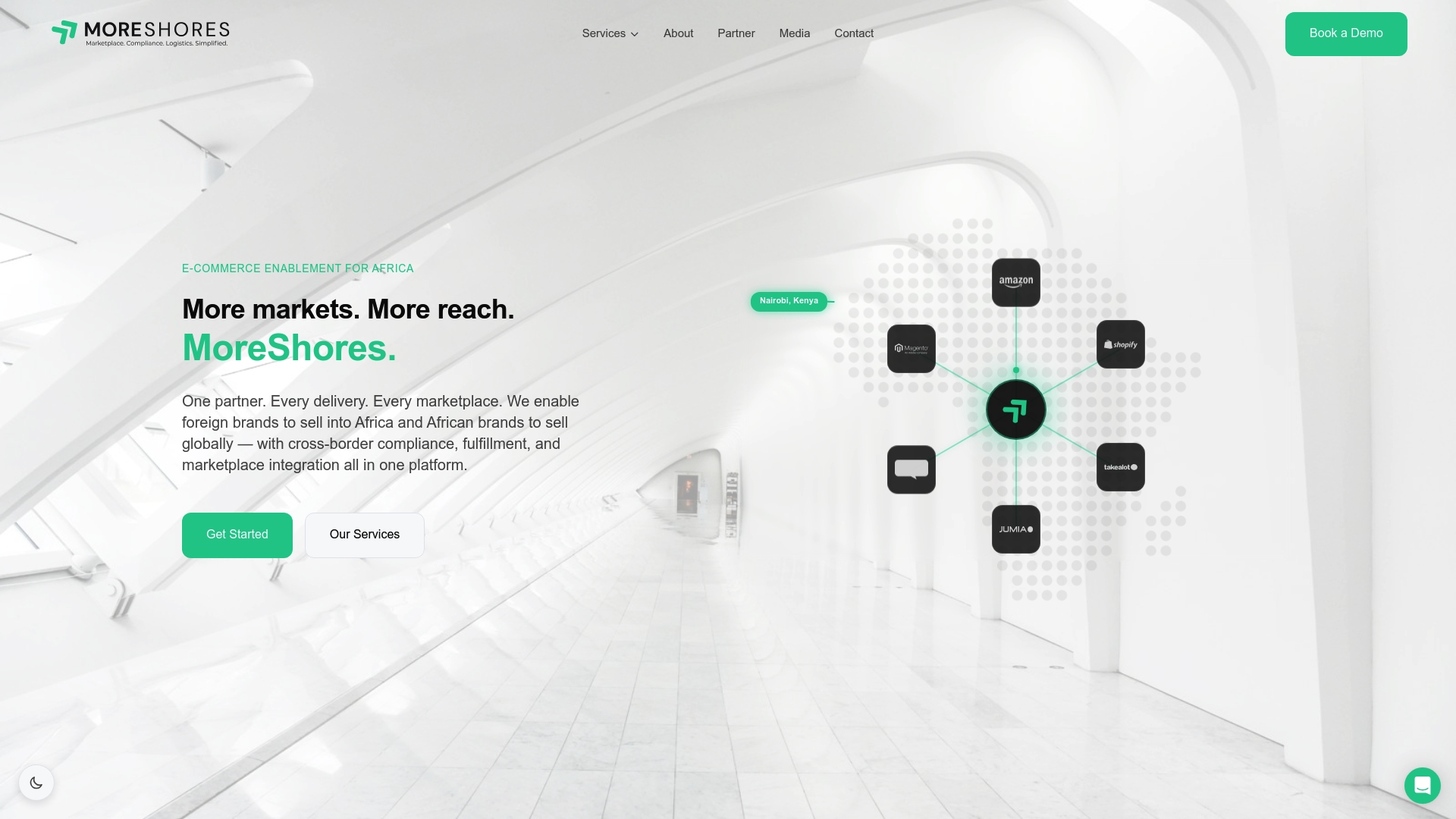
Our marketplace integration solutions connect your product listings to Takealot, Amazon SA, Jumia, Kilimall, and more, all managed from a single back end. Our cross-border enablement services include localized checkout support, multi-courier fulfillment, and real-time inventory management across African geographies. Whether you are a global brand entering Africa or an African business expanding internationally, MoreShores provides the integrated infrastructure to do it efficiently, compliantly, and at scale. Reach out to our team to discuss what seamless integration looks like for your specific markets and product range.
Frequently asked questions
What is the biggest benefit of seamless storefront integration for e-commerce?
It enables real-time synchronization of orders, customers, and inventory across multiple markets, reducing errors and creating consistent customer experiences. As storefront integration eliminates operational latency between your storefront and back-end systems, your customers always see accurate, up-to-date information.
How does integration reduce cart abandonment?
By presenting accurate pricing, clear shipping, and localized payment options at checkout, integration reduces uncertainty and drop-off. Landed costs and localized policies displayed in real time give buyers the confidence to complete their purchase.
Why is local payment integration vital for selling in Africa?
Buyers often abandon their carts if their preferred local payment methods are not offered. Local payment methods like mobile money are a primary trust and conversion lever across East and West Africa, and excluding them effectively excludes a large portion of your market.
Does every business need fully headless integration?
Not always. Fully decoupled or headless integration increases engineering and operational complexity, and for many businesses a conventional integration approach delivers equal results at a fraction of the cost and effort.