Why Consider Foreign Trade Compliance for Your Business

TL;DR:
- Foreign trade compliance involves adhering to laws governing product classification, sanctions, licensing, and financial regulations across borders. Ignoring these requirements can result in costly fines, shipment seizures, loss of privileges, and damage to reputation, making compliance a vital business priority. Implementing a proactive, technology-enabled system accelerates customs clearance, reduces costs, and safeguards long-term market access.
Shipping a product across a border feels straightforward until customs holds your shipment, a regulator issues a six-figure fine, or a bank freezes your account because a transaction touched a sanctioned entity. Understanding why consider foreign trade compliance is not an academic exercise. It is a practical business decision that affects your cash flow, your market access, and your long-term reputation. This guide breaks down what trade compliance actually covers, what it costs you to ignore it, and how making it a priority gives your business a genuine competitive edge in international markets.
Table of Contents
- Key Takeaways
- Why foreign trade compliance protects your business
- The real cost of ignoring trade regulations
- Strategic benefits of a strong compliance program
- Navigating 2026 compliance challenges
- My perspective on why this cannot wait
- How Moreshores helps you trade with confidence
- FAQ
Key Takeaways
| Point | Details |
|---|---|
| Compliance is not just paperwork | Foreign trade regulations cover sanctions, product classification, documentation, and financial flows, all of which carry legal weight. |
| Non-compliance is expensive | Consequences range from shipment seizures and heavy fines to criminal prosecution and permanent loss of export privileges. |
| Compliance reduces costs | Correct HS code classification and use of Foreign Trade Zones can lower duty payments and speed up customs clearance. |
| 2026 adds new layers of risk | Carbon border rules, forced labor regulations, and tariff volatility are creating overlapping compliance demands for global traders. |
| Technology is the difference maker | Integrated, technology-enabled compliance systems outperform manual checks and reduce the risk of systemic errors. |
Why foreign trade compliance protects your business
Trade compliance is the practice of following the laws, regulations, and procedures that govern how goods, services, and money move across international borders. It is not one rule. It is a system of interconnected requirements, and missing one piece can invalidate the rest.
Here is what that system actually includes:
- Customs classification: Every product traded internationally needs an HS (Harmonized System) code. That code determines the duty rate, any applicable restrictions, and what documentation is required. Misclassifying a product, even unintentionally, can trigger audits, back-duty assessments, and penalties.
- Valuation and country of origin: Customs authorities scrutinize declared values and origins closely. Incorrect valuation affects duty calculations. Incorrect origin declarations can void preferential trade agreement benefits or, worse, constitute fraud.
- Sanctions and denied party screening: Before any transaction, you need to verify that your customer, supplier, or logistics partner does not appear on a restricted party list. Screening after shipment or payment offers no legal protection whatsoever.
- Export licenses and controlled goods: Certain products, including dual-use technology and semiconductors, require government-issued export licenses. Violations may result in civil fines, criminal prosecution, and denial of future export privileges.
- Financial compliance: Foreign exchange controls, transfer pricing documentation, and anti-money laundering requirements all sit under the trade compliance umbrella.
These elements do not operate in isolation. A shipment that clears customs with the right HS code but is sent to a sanctioned buyer is still a violation. Compliance is a continuous system requiring integrated data and active collaboration across your procurement, logistics, finance, and legal teams.
Pro Tip: Before your first international shipment, build a simple checklist that covers classification, origin, sanctions screening, and required licenses. Review it for every new product line and every new trading partner.
The real cost of ignoring trade regulations
Many businesses treat compliance as a background concern until something goes wrong. That is a costly miscalculation.
- Fines and financial penalties: Regulatory authorities impose significant monetary penalties for customs violations, export control breaches, and sanctions violations. In some jurisdictions, fines are calculated per violation, meaning a shipment with multiple errors generates multiple penalties.
- Seizure of goods: Customs authorities have the power to detain or permanently seize shipments that violate import or export rules. A seized container of goods is not just lost inventory. It is also the duties and shipping costs you already paid.
- Loss of trading privileges: Consequences include suspension of import and export licenses, removal from approved trader programs, and debarment from government contracts.
- Criminal prosecution: Individuals and companies can face criminal charges for deliberate or grossly negligent violations. Companies that believed DDP Incoterms insulated them from import liability have discovered otherwise. Downstream purchasers can face criminal exposure when they knew or should have known goods were imported through duty evasion.
- Banking relationship damage: Financial institutions actively monitor clients for trade-related compliance risks. A sanctions flag or anti-money laundering concern can result in frozen accounts or terminated correspondent banking relationships, which can effectively end your ability to transact internationally.
“Ignorance is not a defense recognized by customs authorities or export regulators. If the shipment was made, the obligation existed — whether your team knew about it or not.”
The impact of trade compliance failures also extends to your commercial relationships. Partners, distributors, and marketplace operators increasingly run due diligence checks. A compliance incident on your record can cost you a distribution agreement or marketplace listing before you even get the chance to explain it.
Strategic benefits of a strong compliance program

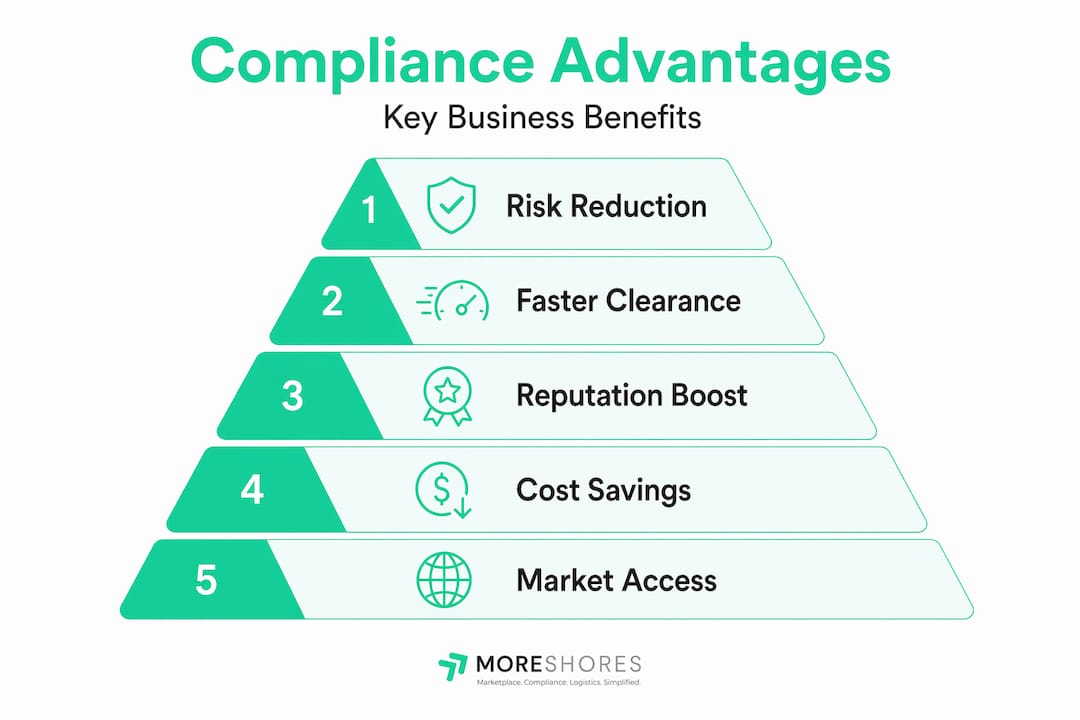
Getting compliance right is not just about avoiding problems. It creates tangible operational and financial advantages that build over time.
Faster clearance and lower costs
Accurate classification and complete documentation reduce the likelihood of customs holds. Shipments that consistently clear without queries earn trusted trader status in many jurisdictions, which comes with expedited processing and fewer physical inspections. Using Foreign Trade Zones allows businesses to defer duty payments, reduce insurance premiums, and improve cash flow without changing their logistics footprint.
Credibility with partners and regulators
Regulators, financial institutions, and enterprise buyers now treat compliance capability as a signal of business maturity. When you can demonstrate audit-ready records, proactive screening processes, and documented internal controls, you open doors that remain closed to competitors who treat compliance reactively.
| Compliance approach | Business outcome |
|---|---|
| Reactive, manual processes | Higher audit frequency, delayed shipments, increased error rates |
| Proactive, technology-integrated | Faster clearance, lower duty costs, preferred partner status |
| No formal program | Fines, seizures, loss of trading privileges, reputational damage |
Access to trade incentives
Many countries offer preferential duty rates, VAT refunds, and export financing to businesses that meet specific compliance criteria. Qualifying for these programs requires documented compliance histories. A business that cannot demonstrate clean records loses access to savings that its compliant competitors are already capturing.
Pro Tip: Review your trade agreements annually. Preferential tariff rates under agreements like AfCFTA, AGOA, or EU-SADC can significantly reduce your landed costs, but only if your origin documentation is current and correct.
Navigating 2026 compliance challenges
The biggest compliance challenge in 2026 is managing overlapping risks from tariffs, carbon rules, and forced labor regulations simultaneously. These are not independent issues. They interact in ways that create compounding risk for businesses operating across multiple markets.
Here is what you need to track:
- Carbon Border Adjustment Mechanisms (CBAM): The EU’s carbon border rules require importers to report the embedded emissions of certain goods. Non-alignment between your emissions data and customs declarations raises scrutiny and can trigger penalties.
- Forced labor regulations: The US Uyghur Forced Labor Prevention Act and similar legislation in other jurisdictions create a presumption that goods from certain regions are tainted. Clearing this presumption requires detailed supply chain documentation going several tiers deep.
- Tariff volatility: Organizations that rely on periodic manual reviews struggle to keep pace with tariff changes and expanding trade actions. Continuous monitoring is not optional for businesses with significant import or export volumes.
- Enhanced pre-arrival data requirements: Customs authorities in multiple jurisdictions are requiring more detailed cargo information earlier in the supply chain. Late or incomplete submissions trigger delays and penalties.
Audits now focus on the quality and logic of your compliance evidence, not just whether forms were filed. Regulators want to see that your compliance program operates as a real system. To stay audit-ready, structure your approach around these practical steps:
| Compliance action | Why it matters |
|---|---|
| Centralize trade data in one system | Eliminates siloed records that cause inconsistencies during audits |
| Document supplier certifications annually | Supports forced labor and origin claims across multiple regimes |
| Automate restricted party screening | Catches new designations before transactions are executed |
| Conduct internal compliance reviews quarterly | Identifies gaps before regulators do |
| Train cross-functional teams regularly | Reduces human error across procurement, logistics, and finance |
Global operators must also assess their US regulatory exposure even when they primarily operate outside the United States, because correspondent banking networks and USD-denominated transactions can create unexpected liability under US sanctions law.
My perspective on why this cannot wait
I have seen businesses of all sizes treat compliance as something to deal with later. They are focused on growth, on securing the next supplier, on landing the next marketplace listing. Compliance sits in a pile labeled “admin” until the fine arrives or the shipment disappears into a customs hold.
What I have learned is that the businesses that embed compliance into their daily operations do not just avoid problems. They move faster. They clear goods quicker, qualify for better payment terms, and get approved by enterprise buyers who require vendor compliance documentation as a condition of doing business.
The common failure pattern I keep seeing is not ignorance. It is that failure stems from scattered data and siloed teams relying on brokers to catch problems at the border. By then, you are already exposed. Your broker is managing paperwork, not your regulatory risk.
In 2026, the stakes are higher because the rules are more numerous and change faster. Tariff volatility, environmental requirements, and forced labor scrutiny mean that a compliance program that worked two years ago may already be creating gaps. My honest advice: treat compliance as an operational function with its own budget, its own owner, and its own review schedule. It will cost you less than the first serious incident.
— Matt
How Moreshores helps you trade with confidence
Understanding why consider foreign trade compliance is the first step. Building the infrastructure to stay compliant across every market you operate in is where Moreshores comes in. As a cross-border trade enablement platform built specifically for Africa-facing and globally expanding businesses, Moreshores acts as your Importer of Record, handling customs clearance, duties, VAT, and regulatory documentation on your behalf. Whether you are entering South Africa, expanding into East Africa, or sourcing from international suppliers, Moreshores integrates compliance directly into your fulfillment and logistics operations. You get audit-ready records, marketplace integration across Takealot, Jumia, Amazon SA, and Kilimall, and a partner that treats compliance as a built-in feature, not an afterthought. Partner with Moreshores to scale internationally without the compliance guesswork.
FAQ
What does foreign trade compliance actually cover?
Foreign trade compliance covers customs classification, import and export licensing, sanctions screening, product valuation, country of origin documentation, and financial regulations like foreign exchange controls. It applies to every cross-border transaction your business makes.
What are the penalties for failing to comply with trade regulations?
Consequences include heavy fines, seizure of goods, loss of export and import privileges, criminal prosecution, and termination of banking relationships. Regulators do not accept ignorance as a defense.
How do Foreign Trade Zones help with compliance costs?
Foreign Trade Zones allow businesses to defer duty payments, reduce insurance premiums, and lower processing fees, which improves cash flow without requiring changes to the physical supply chain.
Why is 2026 a particularly complex year for trade compliance?
Carbon border adjustment rules, forced labor enforcement, tariff volatility, and enhanced pre-arrival data requirements are all active simultaneously, creating overlapping obligations that manual compliance processes cannot reliably manage.
How often should a business review its trade compliance program?
Compliance programs should be reviewed at least quarterly for operational accuracy and annually for regulatory updates. Businesses operating in high-volume or high-risk product categories should monitor regulatory changes continuously.