What Is Retail Export Strategy for Global Retailers

TL;DR:
- Most retailers misunderstand retail export as simple international shipping, risking significant costs and missed market opportunities. A comprehensive retail export strategy involves market selection, compliance, logistics, fulfillment, and returns management to ensure profitable expansion. Building operational integration, especially between compliance and logistics, is essential for sustainable international growth.
Most retailers think exporting means putting a shipping label on a domestic order and sending it abroad. That framing costs them money, customers, and market access. A retail export strategy is the planned approach a retailer takes to sell products in foreign markets, covering market selection, regulatory compliance, logistics infrastructure, fulfillment operations, and customer experience from the first click to the last mile. If you are a business professional or marketer exploring cross-border growth, understanding what is retail export strategy at the operational level is what separates profitable international expansion from expensive guesswork.
Table of Contents
- Key Takeaways
- Core components of retail export strategy
- Logistics and fulfillment for scaling retail exports
- Compliance, customs, and regulatory requirements
- Market selection and entry tactics
- Managing returns in international retail operations
- My take on what actually drives retail export success
- How Moreshores helps you build retail export operations that work
- FAQ
Key Takeaways
| Point | Details |
|---|---|
| Retail export is multi-dimensional | A retail export strategy covers far more than shipping: it includes compliance, market selection, fulfillment, and returns. |
| Logistics scale determines cost structure | Retailers shipping over 300 orders daily can cut per-unit shipping costs by 30-40% using distributed fulfillment hubs. |
| Compliance is ongoing, not one-time | HS code classification, DDP duties, and VAT registration must be reviewed and updated quarterly to avoid penalties. |
| Market selection needs data, not instinct | Analyze at least 12 months of traffic, conversion, and average order value data before committing to a new market. |
| Returns can erase margins | Reverse logistics mismanagement can consume 20-30% of profitability, making a returns infrastructure plan non-negotiable. |
Core components of retail export strategy
Before you can build an effective export strategy for retailers, you need a clear retail export definition. Retail export refers to the process of selling consumer goods directly to end customers or retail buyers in foreign countries, as opposed to bulk commodity or industrial exports. It is distinct from general exporting in that the customer experience, brand presentation, and last-mile delivery are all part of the value proposition.
There are three main export approaches retailers typically use:
- Direct export: You sell and ship directly to international customers through your own website or marketplace accounts, managing all logistics, compliance, and customer service internally.
- Indirect export: You work through a domestic intermediary, such as an export trading company, that handles international sales on your behalf. Lower operational burden, but also lower margin control.
- Merchant of Record (MoR) model: A third-party specialist assumes legal, tax, and compliance responsibilities on your behalf. MoR models let brands expand internationally without establishing local legal entities, which is a significant advantage for mid-market retailers.
These approaches are not mutually exclusive. Many retailers start with indirect or MoR models to test a market, then shift to direct export once volume and demand are confirmed.
The strategic pillars that hold any retail internationalization strategy together are market selection, regulatory compliance, logistics and fulfillment, and returns management. Each pillar influences the others. A compliance gap can freeze your logistics operation. A poor fulfillment setup can undermine a sound market selection decision. You cannot build effective retail export plans by treating these pillars in isolation.
Logistics and fulfillment for scaling retail exports
Logistics is where retail export strategies succeed or fail at scale. The model that works for 20 international shipments a day falls apart at 500. Understanding the thresholds helps you plan ahead rather than react under pressure.
Here is a practical framework based on shipment volume:
-
Under 50 international shipments per day. At this stage, a multi-carrier platform is your best option. These platforms compare rates across carriers in real time, handle documentation, and give you label generation without the need for negotiated volume contracts. Your operational complexity stays low while you validate market demand.
-
Between 50 and 300 shipments per day. You need carrier redundancy. Relying on a single carrier at this volume exposes you to service disruptions that directly impact customer satisfaction. Rate shopping across two or three carriers, combined with a basic third-party logistics (3PL) partner, keeps you agile without overbuilding infrastructure.
-
Over 300 shipments per day. This is where distributed fulfillment centers become financially justified. Retailers at this volume can reduce per-unit shipping costs by 30-40% by positioning inventory in regional hubs closer to their customers. The cost of operating regional warehouses is offset by savings in last-mile delivery and reduced transit times.
Carrier redundancy matters beyond cost. If your primary carrier experiences a service disruption during a peak period, having a pre-negotiated backup relationship means your operations continue. This is not a contingency plan. It is a baseline operational requirement for serious export retailers.
Operational excellence in S&OP processes is equally critical. High-performing export operations synchronize SKU-level demand forecasts with supply capacity, preventing the stockout and overstock situations that become dramatically more expensive when inventory is split across international locations.
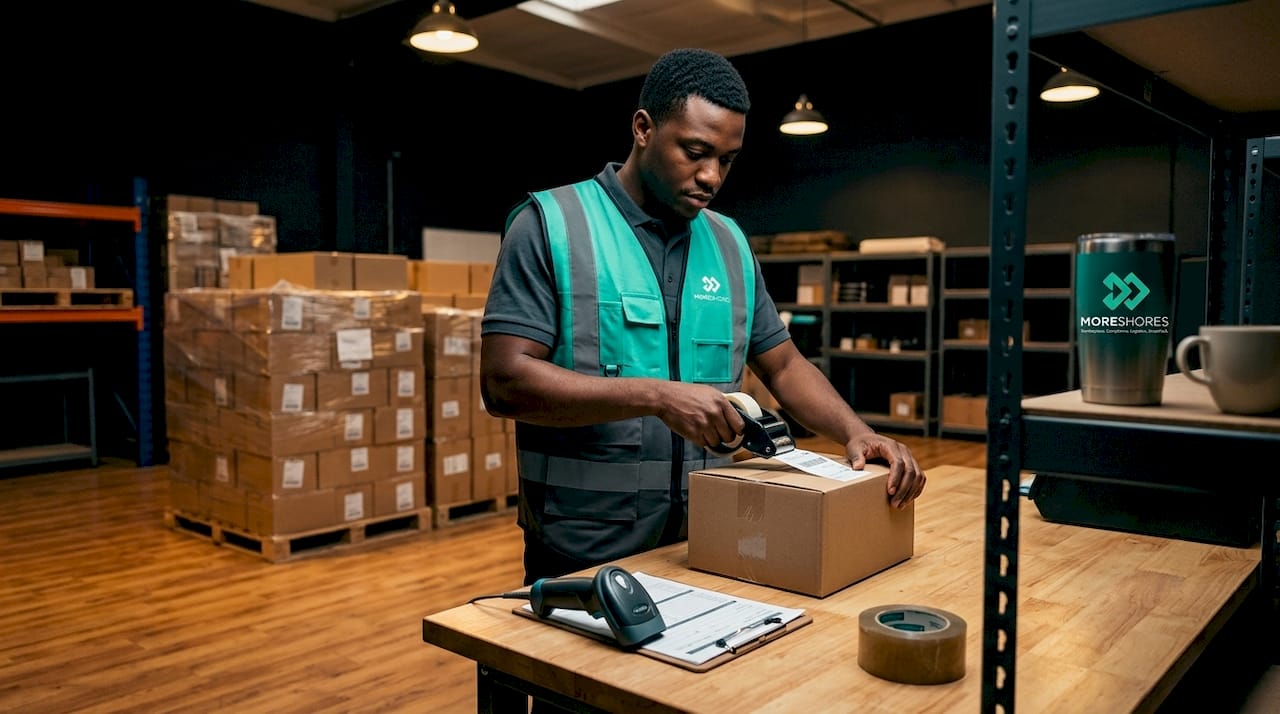
Pro Tip: When evaluating logistics partners for your retail export operations, ask specifically whether they support multi-carrier rate shopping, regional hub placement, and returns consolidation. A partner that handles only outbound shipping will create a gap you will have to fill later, usually at a higher cost.
Compliance, customs, and regulatory requirements
Customs and regulatory compliance is where many retail export strategies quietly hemorrhage money. A single misclassified shipment can trigger delays, fines, or seizure. And unlike a logistics failure, a compliance failure often has no immediate warning sign until the damage is done.
The foundational documentation every retail export shipment requires includes:
- Commercial invoice: Must include accurate product descriptions, quantities, unit values, country of origin, and the correct Harmonized System (HS) code. Inaccuracies here trigger customs queries.
- Packing list: Itemizes the physical contents of the shipment. Discrepancies between the packing list and commercial invoice are a red flag for customs authorities.
- Certificate of origin: Required for preferential duty treatment under free trade agreements. Getting this wrong can mean paying full duties where reduced rates apply.
Duty payment models matter to your customers, not just your operations. Delivered Duty Paid (DDP) fulfillment with accurate landed cost visibility at checkout improves conversion rates and reduces post-purchase disputes. Customers who see an unexpected customs bill on delivery return products at higher rates and rarely buy again.
Region-specific requirements add another layer. Selling into the European Union requires Import One-Stop Shop (IOSS) registration for goods under €150. Selling into the UK requires an Economic Operators Registration and Identification (EORI) number. Selling into Australia triggers Goods and Services Tax (GST) obligations above certain thresholds. Each market has its own framework, and ignorance is not a legal defense.
HS code classification deserves special attention. Quarterly HS code audits embedded into your operational calendar prevent classification drift, where codes assigned at product launch become inaccurate as products are updated or regulations change. The cost of an audit is a fraction of the cost of a customs dispute.
Pro Tip: Treat compliance as an operational function, not a legal one. Assign a specific team member or external partner ownership of your compliance calendar, including HS code reviews, VAT registration renewals, and documentation audits. Compliance gaps are almost always a process failure, not a knowledge failure.
Market selection and entry tactics
Knowing how to develop retail export strategies starts with knowing which markets to enter and in what order. The instinct to go big fast is understandable. It is also a reliable way to spread resources too thin.
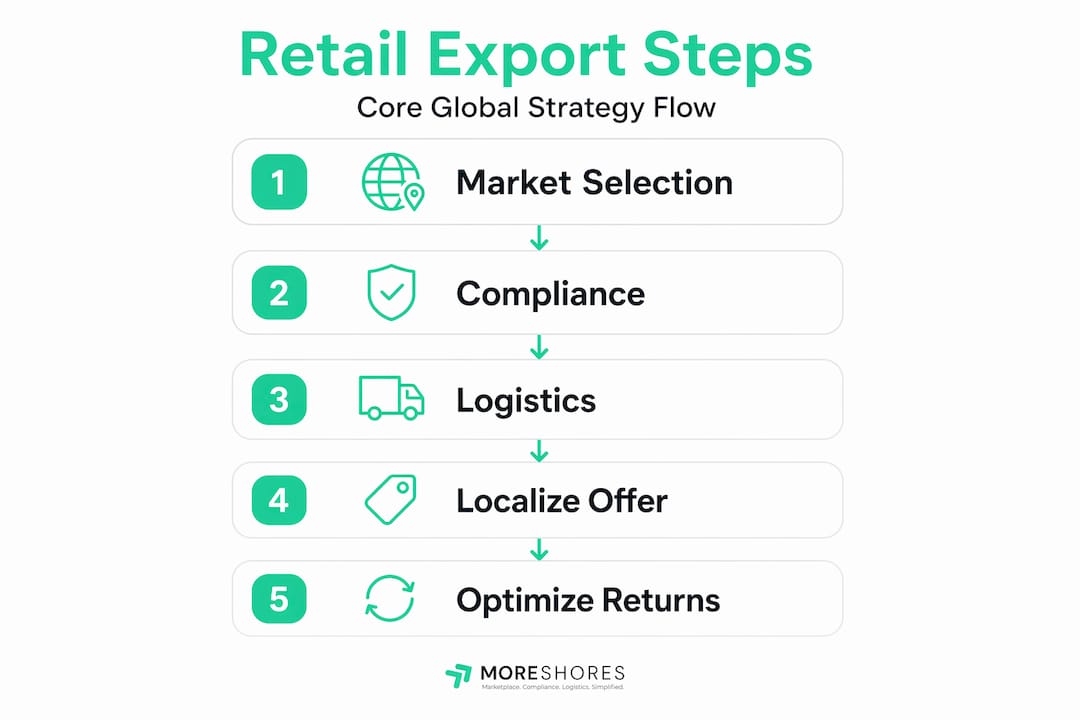
The most defensible market selection methodology uses three concurrent data signals measured over at least 12 months of analytics: traffic volume from the target market, conversion rate of international visitors, and average order value. Markets where all three signals are strong simultaneously are your tier-one targets.
| Market type | Examples | Advantages | Challenges |
|---|---|---|---|
| Easy-win markets | UK, Canada, Australia | English-language, familiar legal frameworks, established logistics networks | Competitive, saturated in many categories |
| High-growth complex markets | Southeast Asia, EU, Nigeria | Large populations, growing middle class, rising e-commerce adoption | Regulatory complexity, fragmented logistics, currency risk |
| Emerging African markets | South Africa, Kenya, Egypt | Underserved by global brands, strong mobile commerce growth | Infrastructure variability, import compliance requirements |
For mid-sized retailers without the infrastructure or capital to establish local entities, distributors and EMCs represent the most accessible and cost-effective entry point. An export management company acts as your brand representative in the foreign market, handling local regulatory requirements, customer relationships, and sometimes fulfillment. You retain brand control while offloading operational complexity.
Data analytics reduces entry risk significantly. Reviewing your existing website analytics for international traffic before investing in market entry often reveals demand signals you did not know existed. New Zealand, for example, saw goods exports rise 12% year-on-year in April 2026, reflecting genuine regional trade momentum that retailers with data-driven strategies can identify and act on before competitors do.
Managing returns in international retail operations
Returns are the part of the retail export strategy that most marketers underestimate until the margin impact becomes impossible to ignore. Reverse logistics mismanagement can consume 20-30% of profitability. At international scale, the complexity multiplies because you are managing cross-border shipments in reverse, often through markets where your logistics infrastructure is thinner.
The practical options for managing international returns include:
- Local returns consolidation centers: Instead of routing returns back to your home country warehouse individually, you aggregate them in a regional hub and ship in bulk. Regional consolidation with aggregators dramatically reduces per-unit reverse logistics costs compared to single-point return routing.
- Returnless refund policies: For low-cost items where the cost of return shipping exceeds the product value, refunding the customer and instructing them to discard or donate the item can be more cost-effective than processing a physical return.
- Returns aggregation partners: Specialist providers collect returns within a market, inspect and sort items, and ship consolidated loads back to your warehouse or to a regional resale partner.
Clear return policies also reduce the volume of returns you process. Customers who understand lead times, duty implications, and the return process before purchase are less likely to initiate a return on a misunderstanding.
Integrating returns data with your order management system gives you early visibility into product quality issues, sizing problems, or regional preference mismatches. That data feeds back into your market selection and catalog decisions, making your overall export strategy smarter over time.
My take on what actually drives retail export success
I have watched retailers build what looked like solid export strategies on paper, only to find the whole thing unraveling within six months of launch. The common thread is almost never a bad product or a weak market. It is operational unreadiness that leadership did not take seriously until the cost was real.
The most underestimated factor in scaling international retail is the integration between compliance and logistics. Most teams treat them as separate workstreams. Compliance sits with legal or finance. Logistics sits with operations. Nobody owns the point where a customs documentation error causes a fulfillment delay that triggers a wave of customer service escalations. That gap is where margin disappears.
What I have found actually works is building compliance into the logistics workflow from the start, not retrofitting it later. When your 3PL or fulfillment partner has compliance data baked into their shipping rules, documentation errors decrease dramatically. It is a structural fix, not a training fix.
I am also skeptical of the instinct to enter every market simultaneously. The retailers who scale most successfully internationally are the ones who go deep in two or three markets before going wide. Cross-border infrastructure and compliance capabilities are growth levers, but only when you have the operational depth to use them. Going wide before going deep just spreads your weaknesses across more markets.
Invest in technology early. An international order management system with multi-currency, multi-carrier, and multi-warehouse support costs more upfront than a patchwork of tools. It costs far less than unraveling a patchwork system at 300 shipments a day.
— Matt
How Moreshores helps you build retail export operations that work
If you are ready to move from strategy to execution, Moreshores offers the infrastructure to do it without building everything from scratch.
Moreshores operates as a B2B cross-border enablement platform connecting African and global markets, with distributed fulfillment and multi-courier logistics built in. The platform acts as Importer of Record, handling customs clearance, duties, VAT, and regulatory compliance so you can focus on growth rather than paperwork. Moreshores also integrates with major marketplaces including Takealot, Amazon SA, Jumia, and Kilimall, as well as Shopify and WooCommerce storefronts.
Whether you are a global brand entering African markets or an African retailer expanding internationally, the cross-border enablement services at Moreshores give you the logistics, compliance, and marketplace integration you need in one platform. Explore how Moreshores can support your export strategy by partnering with Moreshores today.
FAQ
What is retail export strategy in simple terms?
A retail export strategy is a structured plan for selling products to customers in foreign markets, covering market selection, logistics, compliance, fulfillment, and returns management. It goes well beyond shipping products abroad and requires coordinated operational infrastructure.
How do I choose which international markets to enter first?
Analyze at least 12 months of website data for traffic volume, conversion rate, and average order value from each target market simultaneously. Markets where all three signals are strong are your best first entries, and established markets like the UK, Canada, and Australia typically offer more predictable logistics and regulatory frameworks.
What is Delivered Duty Paid and why does it matter?
Delivered Duty Paid (DDP) means the seller covers all import duties and taxes before the customer receives the shipment. DDP with landed cost visibility at checkout reduces cart abandonment and post-purchase disputes, directly improving conversion rates in international markets.
When should a retailer use an export management company?
Export management companies (EMCs) are best suited for mid-sized retailers that lack the infrastructure or capital to establish a local entity in a foreign market. EMCs act as local brand representatives, managing regulatory requirements and customer relationships at a lower entry cost than direct market establishment.
How do I reduce international return costs?
Use regional returns consolidation centers to aggregate returns locally before shipping in bulk, rather than processing each return individually back to your home country warehouse. For low-value items, returnless refund policies can be more cost-effective than managing physical returns across borders.