What is omnichannel retail? How integration drives growth

TL;DR:
- Most brands confuse multichannel presence with true omnichannel integration, risking revenue loss. Connecting customer data, inventory, and fulfillment across channels creates seamless experiences, especially in African markets. Without reliable infrastructure, even sophisticated strategies will fail at scale, making operational partnerships essential.
Most e-commerce and retail managers will tell you they are running an omnichannel strategy. They are on Shopify, listed on Takealot, active on a social commerce channel, and maybe running a few pop-up stores. But presence on multiple channels is not the same as omnichannel retail. It is one of the most common and costly misconceptions in cross-border e-commerce today. When your inventory, customer data, and fulfillment systems do not talk to each other, customers feel the disconnect immediately, and that friction translates directly into lost revenue. For international brands expanding into African markets, getting this distinction right is not optional.
Table of Contents
- Defining omnichannel retail: Beyond just many channels
- Omnichannel vs. multichannel: Key differences for e-commerce managers
- The foundations of effective omnichannel: Data, inventory, and fulfillment
- Common pitfalls: Why omnichannel retail often fails at scale
- Measuring true omnichannel impact: What metrics matter
- Our perspective: The infrastructure gap is the real challenge
- How MoreShores helps you build real omnichannel infrastructure in Africa
- Frequently asked questions
Key Takeaways
| Point | Details |
|---|---|
| Omnichannel is integration | It connects all touchpoints and data for seamless customer interactions. |
| True omnichannel requires unified systems | Real-time data, shared inventory, and fulfillment integration are essential for success. |
| Customer metrics matter most | Measure success by lifetime value, retention, and cross-channel engagement. |
| Execution is hard at scale | Breakdowns in technology, data, or process can undermine omnichannel promises, especially cross-border. |
Defining omnichannel retail: Beyond just many channels
To understand what sets real omnichannel apart, let’s define exactly how it works and why integration is central.
Omnichannel retail is a strategy that integrates multiple customer touchpoints so customers experience continuity while moving between channels without losing context. That means a customer who browses your products on your Shopify storefront, asks a question via WhatsApp, and then completes a purchase on Jumia should have a consistent, connected experience throughout, not three separate interactions that your business treats as unrelated events.
This is fundamentally different from simply being present across multiple sales channels. Real omnichannel is about ecosystem design, where every channel shares data, reflects the same inventory truth, and recognizes the same customer.
Here is what that integration looks like in practice:
- Unified customer identity: A shopper is recognized whether they contact support, browse your mobile app, or walk into your partner retail location.
- Shared inventory: Stock levels update in real time across every channel, eliminating overselling and customer disappointment.
- Consistent pricing and promotions: A discount active on your website also applies at the point of sale, not just on one channel.
- Connected fulfillment: Orders placed on any channel flow into a single fulfillment pipeline with accurate tracking.
“True omnichannel is not about being everywhere. It is about being connected everywhere. The channel is irrelevant; the experience is everything.”
For brands entering African markets, where consumer behavior spans mobile-first platforms like Jumia and Kilimall, regional marketplaces like Takealot and Amazon SA, and informal trade networks, the operational complexity of building a genuinely integrated system is real. But so is the competitive advantage when you get it right.
Omnichannel vs. multichannel: Key differences for e-commerce managers
Building from this definition, it is critical to see where omnichannel fundamentally diverges from a standard multichannel approach.
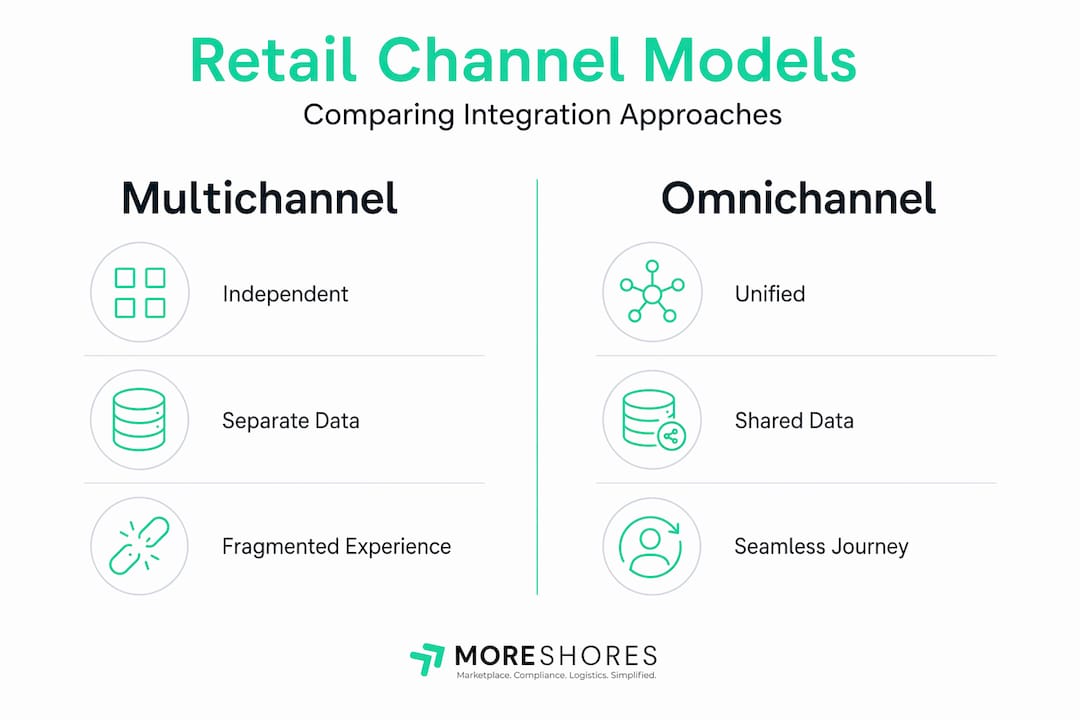
Multichannel retail uses multiple channels that can operate independently, while omnichannel connects those channels via shared data and technology to deliver a single coordinated customer experience. That one sentence explains why two brands can both claim to sell on five platforms, yet produce completely different customer experiences.
Here is a direct comparison to make the distinction concrete:
| Feature | Multichannel | Omnichannel |
|---|---|---|
| Channel relationship | Independent, parallel | Integrated, connected |
| Customer data | Siloed per channel | Unified across channels |
| Inventory visibility | Per-channel stock pools | Single shared inventory |
| Promotions and pricing | May vary by channel | Consistent everywhere |
| Fulfillment | Separate per channel | Centralized pipeline |
| Customer experience | Disjointed | Seamless and continuous |
| Technology stack | Fragmented tools | Integrated platform |
The strategic implications of this table are significant for any cross-border brand. A multichannel setup might get your products listed on Takealot, Amazon SA, and Kilimall, but if your stock data is updated manually on each platform, you will oversell. If your pricing differs between your WooCommerce store and a marketplace listing, customers will notice and lose trust. If a customer contacts support about an order placed on one channel but your team cannot see it in another system, that experience damages your brand.
Here are the key operational risks of staying in a multichannel mindset:
- Inventory conflicts: Two customers purchase the same last unit simultaneously on different platforms.
- Pricing inconsistencies: Marketplaces undercut your direct store, eroding margin and brand positioning.
- Disconnected loyalty: Customers earn points on one channel but cannot redeem them elsewhere.
- Fragmented support: Customer service agents cannot view the full purchase history because data lives in separate systems.
For brands using MoreShores to enter African markets, these risks are not theoretical. They are day-one operational realities if you launch without integrated infrastructure in place.
The foundations of effective omnichannel: Data, inventory, and fulfillment
Now let’s look at the practical backbone that turns omnichannel from theory into reality.
The practical mechanics of omnichannel typically require shared, or unified, data and inventory so that availability, pricing and promotions, customer identity, and fulfillment decisions stay consistent across channels. This is not just a technology problem. It is a data governance and operations problem that requires deliberate planning before you scale.

Three foundations matter most:
1. Unified customer data
Every interaction a customer has with your brand, whether it is a product view, a support ticket, or a completed purchase, should feed into a single customer record. This is what enables personalization at scale and accurate attribution. Without it, you cannot understand the real path to purchase, especially in African markets where consumers often research on mobile, compare on desktop, and purchase through a marketplace.
2. Real-time inventory visibility
This is arguably the most operationally critical element. When inventory is updated in real time across all channels, you eliminate overselling, reduce canceled orders, and improve the accuracy of estimated delivery dates. In cross-border scenarios, where restocking can take weeks due to customs clearance timelines, accurate inventory data is not a nice-to-have. It is essential.
3. Seamless fulfillment integration
Modern fulfillment management is where omnichannel either succeeds or falls apart. Orders placed across different platforms must route into a single fulfillment workflow, with clear visibility at every stage. For cross-border brands shipping into Africa, this includes managing last-mile delivery partners, handling customs documentation, and processing returns across borders.
| Omnichannel foundation | What breaks without it | Operational fix |
|---|---|---|
| Unified customer data | Disconnected support, poor personalization | Centralized CRM or CDP |
| Real-time inventory | Overselling, canceled orders | Shared inventory layer |
| Seamless fulfillment | Missed SLAs, returns chaos | Integrated fulfillment partner |
Pro Tip: Before launching on a new African marketplace, audit your current tech stack to confirm that inventory updates propagate in under 60 seconds. Manual sync processes are a liability at scale.
One often-overlooked element is the returns workflow. Cross-border returns in Africa can involve re-import declarations, local storage, and multi-step courier coordination. If your omnichannel system does not account for reverse logistics from day one, you will face operational chaos as order volumes grow.
Common pitfalls: Why omnichannel retail often fails at scale
With the foundational elements clear, it is vital to know what can and often does go wrong as complexity increases.
At scale, omnichannel commonly fails when organization and technology fall out of alignment, leading to data sync issues with inventory, orders, and returns, pricing conflicts, inconsistent loyalty rewards, and broken fulfillment promises. These are not edge cases. They are patterns that repeat across international brands that enter new markets without the right infrastructure.
Here are the most common failure points, in order of frequency:
- Data misalignment between systems: Your ERP shows 200 units in stock. Your marketplace feed shows 50. A customer orders 30, but your warehouse has already committed those units to another platform. This happens when systems are not connected in real time.
- Technology silos across geographies: A brand managing a Shopify store in Europe and a Takealot listing in South Africa through separate teams will quickly accumulate inconsistencies in product data, pricing, and promotions.
- Loyalty program fragmentation: Customers who earn points on your website expect to use them on your marketplace listing. Without a unified loyalty engine, these promises break down and damage retention.
- Reverse logistics failure: Cross-border returns from African markets require careful coordination. Without a partner who manages this end to end, returned goods get stuck in customs or simply disappear from your inventory count.
- Localization gaps: Pricing in USD on a Kenyan marketplace listing, or shipping timelines that do not account for local public holidays, creates friction that appears small but compounds into significant drop-off rates.
“The brands that fail at omnichannel in Africa are not failing because of demand. They are failing because their back-end systems cannot keep up with the front-end promises.”
E-commerce logistics partnerships that operate natively across African markets reduce several of these failure points by design. The same logic applies to marketplace integration solutions that connect product data, pricing, and inventory across platforms through a single control layer, rather than requiring manual management on each.
Pro Tip: Map every failure scenario in your customer journey before you launch. Ask your operations team: “What happens to an order placed on Jumia if our WooCommerce inventory is not updated in the next 10 minutes?” If the answer involves manual intervention, that process is a future failure point.
The organizational dimension of these failures is equally important. Omnichannel requires that your marketing, logistics, customer service, and technology teams share data and coordinate decisions. Brands that silo these functions will find that their omnichannel strategy is only as strong as the weakest internal handoff.
Measuring true omnichannel impact: What metrics matter
To finally know if your omnichannel strategy is working, measurement has to move beyond each individual channel.
Omnichannel success measurement should emphasize customer-level outcomes, such as lifetime value, cross-channel purchase behavior, and retention, rather than only channel-level activity metrics. This is a meaningful shift for most e-commerce managers who are accustomed to reporting on channel-specific GMV, conversion rates, or cost-per-click figures.
The problem with channel metrics is that they understate omnichannel value. A customer who discovers your product on Instagram, researches on your website, and purchases through Takealot will appear in your analytics as a Takealot conversion. The contribution of the other two touchpoints disappears. That misattribution leads to underinvestment in upper-funnel activity and overemphasis on the final purchase channel.
Here are the customer-centric metrics that actually tell you whether your omnichannel strategy is performing:
- Customer lifetime value (CLV): Are customers who engage across multiple channels worth more over time than single-channel buyers? In most mature omnichannel programs, they are significantly more valuable.
- Cross-channel purchase frequency: How often do customers complete purchases that started on one channel and converted on another? Rising frequency here signals that your integration is working.
- Customer retention rate: Are customers coming back? Retention is the most reliable signal of a seamless experience, because customers who feel friction do not return.
- Journey completion rate: What percentage of customers who start a purchase journey on one channel complete it, regardless of where they finish? Abandoned journeys point to specific breakpoints in your integration.
- Return rate by channel: High returns on specific channels often signal product data inconsistencies, such as inaccurate sizing information or misleading images, rather than product quality issues.
Unified attribution is the analytical capability that ties these metrics together. For cross-border brands operating across multiple African marketplaces and their own storefronts, unified attribution lets you see the full customer journey and make investment decisions based on actual influence rather than last-touch assumptions. Connecting this to your omnichannel e-commerce strategy from the outset means you are measuring the right things before you are too far into scaling to change your data model.
A useful benchmark: brands that achieve genuine omnichannel integration typically see 30% higher customer retention rates compared to single-channel or disconnected multichannel operations. That retention difference compounds into substantial revenue advantage over a 12 to 24-month horizon.
Our perspective: The infrastructure gap is the real challenge
Most articles on omnichannel retail focus on strategy and customer experience design. Those things matter. But for international brands entering African markets, the actual barrier is infrastructure, not intent.
We work with brands that arrive with sophisticated omnichannel ambitions and quickly discover that their existing tech stack was built for markets with mature logistics networks, fast customs clearance, and standardized address systems. African markets do not always fit that mold. Delivery zones overlap. Customs timelines vary by corridor. Marketplace requirements differ between Takealot in South Africa, Jumia in Nigeria, and Kilimall in Kenya.
The uncomfortable truth is that omnichannel in Africa requires you to solve logistics and compliance problems before you can unlock the customer experience benefits. You cannot offer seamless cross-channel fulfillment if your goods are sitting in a port warehouse waiting for import documentation to clear. You cannot maintain real-time inventory accuracy if your courier network does not provide tracking data at the item level.
This is why we believe the most important omnichannel decision an international brand makes when entering Africa is choosing an infrastructure partner who operates natively in those markets. Not a technology platform that promises connectivity, but a partner who manages the physical and regulatory complexity on your behalf while your systems stay synchronized.
The brands that win in African e-commerce are not necessarily the ones with the most sophisticated customer experience design. They are the ones whose back-end operations are reliable enough to keep the front-end promises that omnichannel requires.
How MoreShores helps you build real omnichannel infrastructure in Africa
If omnichannel retail’s core requirement is integration, then the right enablement partner makes all the difference when you are crossing borders into African markets.
MoreShores is built specifically for this challenge. We act as your Importer of Record, handling customs clearance, duties, VAT, and regulatory compliance so your goods move without delays that break your inventory promises. Our warehousing and fulfillment network provides real-time stock visibility across every channel you sell on, whether that is Takealot, Amazon SA, Jumia, Kilimall, your Shopify storefront, or your WooCommerce store. Product listings, pricing, and inventory sync across marketplaces through a single integrated layer, reducing the manual overhead that creates data misalignment. If you are ready to build the infrastructure your omnichannel strategy actually requires, explore what we offer and connect with our team.
Frequently asked questions
How does omnichannel retail help cross-border expansion in Africa?
Omnichannel retail creates a single operational layer for inventory, pricing, and fulfillment, which reduces the friction international customers experience when moving between channels. When data stays consistent across all touchpoints, brands can scale into new African markets without the order errors and customer service failures that multichannel setups produce.
What makes omnichannel retail different from multichannel retail?
Omnichannel connects all sales and service channels through unified data so customers move between them without losing context, while multichannel operates each channel independently. The difference is coordination versus coverage, and that distinction determines whether customers experience your brand as one entity or several disconnected storefronts.
What is a core challenge for omnichannel retail in Africa?
The core challenge is real-time data synchronization across systems that were not designed to work together. When that synchronization fails, inventory and order issues cascade quickly, damaging customer trust and increasing operational costs across every channel simultaneously.
Which metrics best show omnichannel success?
Customer lifetime value, cross-channel purchase frequency, and customer retention are the metrics that most accurately reflect omnichannel performance. Customer-level outcomes reveal whether integration is actually creating seamless experiences, while channel-level metrics like GMV can mask the fragmentation that omnichannel is designed to eliminate.