Top benefits of importing into Africa for global brands

TL;DR:
- Africa’s rapidly growing youth demographic, digital adoption, and regional trade agreements create a compelling import market for international brands. Cost advantages from direct sourcing, mobile money, and improved trade facilitation further enhance market potential, while local expertise ensures long-term success. Early strategic planning and regional supply chain development are essential for capitalizing on Africa’s expanding consumer demand.
Africa’s consumer market is changing faster than most global brands realize. With over 1 billion people demanding imported goods across fashion, electronics, and home goods, the window for early-mover advantage is wide open. Digital adoption is accelerating across the continent, fintech is reshaping how people pay, and regional trade agreements are lowering the cost of doing business. If you are an international brand or e-commerce merchant evaluating where to focus your import strategy next, Africa offers a compelling, evidence-based case worth examining carefully.
Table of Contents
- Accessing Africa’s fast-growing consumer market
- Cutting costs and maximizing sourcing advantages
- Unlocking frictionless payments and fintech innovation
- Leveraging trade facilitation and regional integration
- Building regional supply chains and entrepreneurship
- Our take: Practical realities and strategic considerations
- Unlock seamless importing with MoreShores
- Frequently asked questions
Key Takeaways
| Point | Details |
|---|---|
| Massive market reach | Africa’s youthful and digitally connected market offers enormous demand for imported goods. |
| Cost and variety advantage | Importing enables overseas sourcing, cost savings, and access to unique products not available locally. |
| Streamlined payments | Mobile money and fintech solutions unlock payments for more consumers, reducing barriers for importers. |
| Lower tariffs, faster logistics | Regional agreements like AfCFTA reduce trade costs and clearance times, helping brands move goods more efficiently. |
| Support for local supply chains | Importing stimulates entrepreneurship and regional value chain integration, fueling economic growth. |
Accessing Africa’s fast-growing consumer market
Africa is not a single market. It is 54 distinct economies, each with its own regulatory framework, logistics infrastructure, and consumer behavior. But they share a few powerful common traits that make the continent attractive for importers right now.
The most important is demographics. Africa’s youthful consumer market of over 1 billion people is predominantly under 25, which means demand for imported goods is not slowing down anytime soon. Younger consumers are more digitally connected, more brand-aware, and more willing to shop online than older generations. That combination directly drives import demand.
A growing middle class is also fueling appetite for quality goods that local manufacturers cannot always supply at scale. Categories seeing the most import demand include:
- Consumer electronics: Smartphones, laptops, accessories, and smart home devices
- Fashion and apparel: International brands, footwear, and athleisure
- Home goods and furniture: Decorative items, kitchenware, and small appliances
- Health and beauty: Skincare, supplements, and personal care products
For Africa e-commerce expansion, these categories represent the clearest entry points. The demand is real. The question is whether your supply chain can meet it efficiently.
Statistic callout: Sub-Saharan Africa’s e-commerce market is projected to grow at a compound annual growth rate of over 17% through 2027, driven by smartphone penetration, mobile internet access, and a rising urban consumer base.
Pro Tip: When evaluating which African market to enter first, prioritize countries with developed courier networks and active online marketplaces, such as South Africa, Kenya, Nigeria, and Egypt. These markets have the infrastructure to receive imported goods reliably and the consumer base willing to purchase them online.
The digital adoption story is especially relevant. Mobile internet access has leapfrogged fixed broadband infrastructure across most African countries. Consumers in Nairobi, Lagos, Accra, and Johannesburg are shopping via mobile apps daily. That mobile-first behavior creates a direct pipeline for international brands that integrate with the right local marketplace platforms.
Cutting costs and maximizing sourcing advantages
One of the strongest business cases for importing is the direct cost advantage. When you source goods overseas and import them directly, you remove layers of middlemen, reduce markup at each distribution stage, and gain access to manufacturing quality that may simply not exist locally.

According to cross-border e-commerce research, importing directly generates cost savings through better pricing, broader variety, and quality standards not available from local suppliers. This is especially true for electronics sourced from China, precision goods from Europe, and fashion items from global manufacturing hubs.
Key sourcing advantages for importers include:
- Eliminating distribution markups: Buying direct from manufacturers or first-tier suppliers reduces cost of goods sold significantly
- Access to global product innovation: Importing exposes your catalog to SKUs, materials, and designs not yet replicated locally
- Competitive retail pricing: Lower landed costs allow brands to price competitively while protecting margins
- Unique product differentiation: Offering SKUs unavailable in local markets builds brand loyalty and reduces direct price competition
When you are expanding your product range for African consumers, this variety advantage is particularly powerful. Local supply chains often lack depth in categories like consumer electronics accessories, specialized personal care, or premium home goods. Importers who fill these gaps early build category authority fast.
“Cost savings from direct sourcing overseas, eliminating middlemen, better pricing, variety, and quality not available locally (e.g., electronics from China).”
Pro Tip: Focus your initial import catalog on non-sensitive product categories such as electronics accessories, fashion, and home goods. These categories face fewer regulatory hurdles at customs, faster clearance times, and lower risk of product seizure compared to food, pharmaceuticals, or chemicals.
The margin math improves further when you consider long-term volume. As your import volume scales, you gain negotiating leverage with suppliers, lower per-unit shipping costs, and better payment terms. The cost advantage is not static. It compounds as you grow.
Unlocking frictionless payments and fintech innovation
Payment infrastructure is often the overlooked factor in import strategy. You can have the right products at the right price. But if your target consumers cannot easily pay for them, the entire supply chain effort stalls.
Africa’s fintech landscape has changed that equation dramatically. Mobile money transactions surpassed $1 trillion globally in 2022, with the majority of activity concentrated in Sub-Saharan Africa. Services like M-Pesa, MTN Mobile Money, and Airtel Money allow consumers to send, receive, and spend money without a bank account or credit card. That is a structural shift that expands your addressable market far beyond traditional cardholders.
| Payment method | Adoption region | Import relevance |
|---|---|---|
| Mobile money (M-Pesa, MTN MoMo) | Sub-Saharan Africa | High: enables microtransactions and COD alternatives |
| Bank transfer | South Africa, Egypt | Medium: suited for higher-value B2B imports |
| Credit/debit card | Urban centers only | Limited: excludes majority of consumers |
| Buy-now-pay-later (BNPL) | Growing in SA, Nigeria | Emerging: increases average order value |
| Cash on delivery | Rural, semi-urban | Declining as mobile money scales |
For importers, this means your payment gateway decisions directly affect how many people can buy from you. Brands that integrate with mobile money platforms at checkout capture consumers that card-only merchants miss entirely.
The import onboarding steps for entering African markets should include a payment localization strategy from day one. Work with platforms and fulfillment partners that already have mobile money integration built in, rather than retrofitting it later.
Fintech innovation also reduces cash-on-delivery (COD) dependency, which is operationally expensive for importers. COD creates reverse logistics complexity, working capital delays, and higher fulfillment costs per order. As mobile money adoption scales, the shift away from COD directly benefits import economics.
Leveraging trade facilitation and regional integration
Policy infrastructure is catching up with market demand. Two developments in particular are making importing into Africa structurally cheaper and faster than it was even five years ago.
The first is the African Continental Free Trade Area, or AfCFTA. This agreement aims for 90% tariff liberalization across signatory countries over five to ten years, while also harmonizing e-commerce rules and enabling local currency settlements through the Pan-African Payment and Settlement System (PAPSS). For importers, this means lower duty costs, faster cross-border flows, and the ability to settle transactions in local currencies rather than USD or EUR, which reduces foreign exchange friction.
The second is the WTO Trade Facilitation Agreement (TFA). World Bank TFSP data shows that implementation of TFA measures has reduced import and export clearance times by 21% across 58 countries, supporting 283 specific trade facilitation measures. Faster clearance means lower demurrage costs, more predictable delivery windows, and better inventory planning for your supply chain.
| Import process | Pre-reform | Post-reform (AfCFTA and TFA) |
|---|---|---|
| Average clearance time | 5 to 7 days | 1 to 3 days |
| Tariff rates (AfCFTA goods) | 15% to 25% | 0% to 5% (liberalized goods) |
| Currency settlement | USD only | PAPSS enables local currency |
| Documentation requirements | 8 to 12 documents | Reduced to 3 to 5 core documents |
| Dispute resolution | Slow, country-by-country | Harmonized protocols |
To claim these trade preferences, you need to act on a few specific steps:
- Confirm AfCFTA membership of your destination country and verify which tariff schedules apply to your product categories
- Obtain a Certificate of Origin that meets the rules of origin requirements under the relevant agreement
- Prepare a Certificate of Conformity for regulated product categories (electronics, cosmetics, food-adjacent goods)
- Register with customs authorities in the destination country or appoint an Importer of Record to handle clearance on your behalf
- Use PAPSS-compatible banking channels if settling in local currencies to reduce conversion costs
Working with a partner that offers streamlined fulfillment and acts as Importer of Record removes most of this compliance burden from your internal team. You focus on product and marketing. They handle the regulatory detail.
Building regional supply chains and entrepreneurship
Importing into Africa does more than generate revenue for global brands. It catalyzes ecosystem development across the entire region.
When international brands import at scale, they create demand for local logistics providers, warehousing operators, customs brokers, and last-mile delivery networks. That demand investment drives infrastructure upgrades, tech adoption, and job creation. The ripple effect is substantial.
Consider this: intra-African trade sits at just 15% of total trade on the continent, compared to 60% or more in Europe and Asia. That gap represents both a current limitation and a long-term growth opportunity. As import infrastructure matures, intra-African trade will scale alongside it.
Key regional development impacts from organized importing include:
- SME growth: Local distributors, fulfillment agents, and resellers grow alongside import volumes
- Tech adoption: Logistics and customs digitization accelerates when international brands demand it
- Rural access: E-commerce import networks extend product availability beyond urban centers, reducing geographic inequality in consumer access
- Cross-border entrepreneurship: Importers create downstream opportunity for local entrepreneurs who build businesses around distributing, reselling, or servicing imported goods
| Trade integration metric | Africa | Europe | Asia |
|---|---|---|---|
| Intra-regional trade share | 15% | 60% | 55% |
| Digital payment penetration | Growing fast | Mature | Very high |
| Cross-border e-commerce growth rate | 17%+ CAGR | 8% CAGR | 12% CAGR |
| SME participation in e-commerce | Increasing | Established | Dominant |
The brands that enter now, build supply chain relationships, and invest in local fulfillment infrastructure will have a significant structural advantage as the market matures. Early importers are not just capturing current demand. They are shaping how the market develops.
Our take: Practical realities and strategic considerations
We have worked with enough international brands entering African markets to know that the opportunity is real, but strategy matters enormously. Not all import decisions deliver equal value, and a few common mistakes can turn a promising market entry into an expensive learning experience.
The single most important practical step is validating your rules of origin before claiming preferential tariff rates under AfCFTA or regional agreements. Many brands assume they qualify automatically. They do not. Rules of origin requirements specify minimum local content thresholds, specific manufacturing processes, or direct shipping conditions that must be met. Skipping this verification leads to unexpected duty bills at clearance, which destroys your landed cost projections.
Non-tariff barriers also persist and are worth planning for. Regulatory standards for electronics (such as NRCS approval in South Africa), labeling requirements, and product testing protocols can add weeks and costs to your import timeline if not addressed early. Build these into your launch calendar, not as an afterthought.
One category worth being cautious about is food imports. Research shows that increased cereal imports in 27 Sub-Saharan African countries between 2000 and 2020 were linked to higher undernourishment rates, driven by price volatility and reduced incentives for domestic food production. Food import strategies carry macroeconomic and reputational complexity that consumer goods and electronics simply do not. If you are a brand evaluating product category entry, we recommend starting with higher-value consumer goods, electronics, and home goods before considering food-adjacent categories.
The brands that succeed long-term in Africa are those that invest in Africa fulfillment partners with genuine in-country expertise, not just those with the cheapest shipping rates. Local knowledge about customs procedures, market-specific compliance, and last-mile logistics is a competitive advantage that pays dividends every single shipment.
Treat compliance as infrastructure, not as overhead. Build it once, properly, and it becomes a scalable foundation for everything else.
Unlock seamless importing with MoreShores
You now have a clear picture of what makes importing into Africa strategically valuable. The consumer demand is real, the cost advantages are measurable, and the regulatory environment is improving year over year. The remaining challenge is execution.
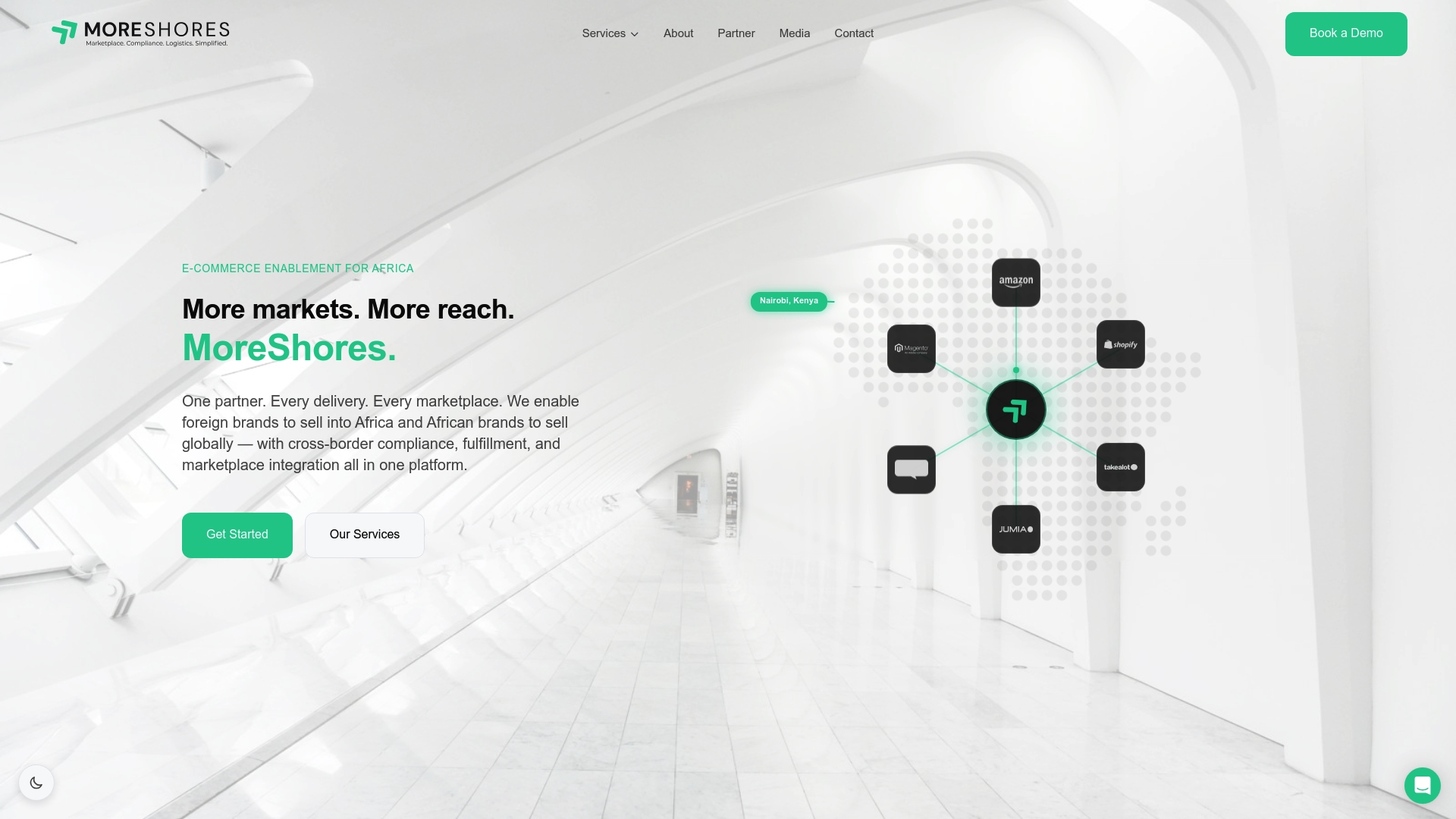
MoreShores is built specifically for international brands and e-commerce merchants ready to move from market research to market presence. Our cross-border enablement services include acting as your Importer of Record, managing customs clearance, duties, VAT, and regulatory compliance across African markets. We handle warehousing, inventory management, and fulfillment through a multi-courier network, and we integrate your products directly onto leading African marketplaces. Through Africa marketplace integration with platforms like Takealot, Jumia, Kilimall, and Amazon SA, plus direct connectivity to Shopify and WooCommerce, we give your brand the full infrastructure it needs. Visit MoreShores to start your import journey today.
Frequently asked questions
What documents are needed for importing goods into Africa?
Importers typically need a Certificate of Origin for preferential tariffs and a Certificate of Conformity for regulated goods. Missing either can result in penalties or shipment seizure at customs.
How does AfCFTA impact import costs into Africa?
AfCFTA reduces tariffs on up to 90% of goods over 5 to 10 years, streamlining cross-border trade and lowering overall import costs across signatory markets.
Is it better to import electronics or food products?
Importing electronics and consumer goods is generally lower risk than food. Increased cereal imports in 27 Sub-Saharan African countries were linked to higher undernourishment and price volatility, risks that consumer goods do not carry.
How can logistics improvements impact import performance?
A 1% improvement in trade facilitation boosts import and export flows by 1.25%, while each additional day or document in the clearance process measurably reduces trade volume.
What role does mobile money play in importing to Africa?
Mobile money transactions surpassed $1 trillion globally in 2022, with Sub-Saharan Africa driving the majority of activity. Mobile money removes the credit card dependency that limits consumer purchasing power, making it a critical payment layer for importers targeting these markets.