The Role of Technology in Trade: 2026 Guide

TL;DR:
- Technology is reshaping global trade by enhancing market access, supply chain resilience, and decision-making through AI, blockchain, and data analytics.
- Effective implementation requires integrated, adaptable systems that connect data across functions, emphasizing human expertise and strategic use.
- Trade leaders investing in connected infrastructure gain real-time insights, competitive advantage, and stronger influence over executive decisions amid geopolitical and regulatory shifts.
Geopolitical shocks, tariff volatility, and energy costs are all pressing down on global commerce. Yet the role of technology in trade tells a strikingly different story. AI-related goods trade grew 21.9% year-on-year in 2025, even as broader merchandise trade slowed to between 1.5% and 2.5% growth in 2026. This split tells you something important: technology is not simply reducing your costs. It is reshaping which businesses gain market access, which supply chains survive disruption, and which decision-makers earn a seat at the executive table.
Table of Contents
- Key takeaways
- Core technologies reshaping trade today
- How technology changes trade decisions at the executive level
- Adoption challenges you need to plan for
- Building a trade technology roadmap that delivers results
- My take on where technology and trade are really heading
- How Moreshores puts this into practice for your business
- FAQ
Key takeaways
| Point | Details |
|---|---|
| AI is driving trade growth | AI-related goods accounted for nearly 50% of global trade growth in 2025, making technology adoption a competitive priority. |
| Technology elevates trade strategy | Trade departments now report 43% more influence over procurement and executive decisions when using integrated tech systems. |
| Interoperability limits AI impact | Disconnected systems prevent AI from accessing relevant data, reducing its ability to support smarter trade decisions. |
| Compliance and agility must coexist | Technology must help you adapt to shifting regulations while maintaining compliance across multiple markets simultaneously. |
| Integrated systems beat isolated tools | Companies that build adaptive, connected technology systems outperform those using discrete, siloed trade tools. |
Core technologies reshaping trade today
The role of technology in trade today extends well beyond automating paperwork. Three technology categories are fundamentally changing how goods, data, and decisions flow across borders.
Artificial intelligence is moving into supply chain risk modeling, tariff classification, and demand forecasting. AI tools can process regulatory changes from dozens of markets simultaneously and flag potential compliance issues before shipments leave the warehouse. That kind of real-time regulatory intelligence was not feasible five years ago.
Blockchain has found a solid use case in provenance verification and compliance documentation. When 51% of trade professionals name supply chain security as their top priority, immutable digital records of product origin, handling, and chain of custody become genuinely valuable. Pharmaceutical companies and food exporters have led adoption here, but the use case applies equally to electronics and consumer goods.
Data analytics platforms are the most widely deployed technology in trade today. Yet despite being the most common tool, only 58% of organizations have deployed trade and supply chain data analytics. That gap represents a real opportunity if you are still running on spreadsheets and manual reporting.
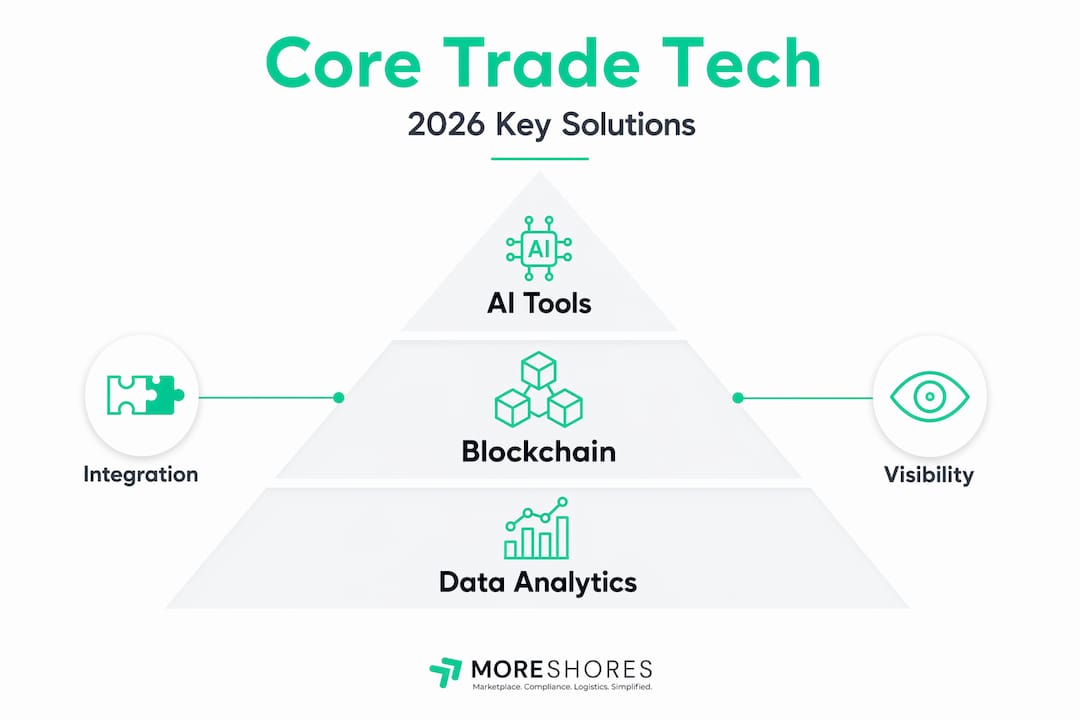
Here is how these technologies compare in practical terms:
| Technology | Primary function | Key trade benefit |
|---|---|---|
| Artificial intelligence | Risk modeling, tariff classification, demand forecasting | Faster, more accurate cross-border decision-making |
| Blockchain | Provenance tracking, compliance records | Trusted documentation across multiple parties |
| Data analytics | Supply chain visibility, performance reporting | Proactive identification of cost and risk exposure |
| Digital compliance platforms | Real-time regulatory intelligence | Reduced delays, lower penalty risk |
| Integrated trade platforms | Multi-system workflow coordination | Unified data across finance, legal, and operations |
The most effective technology deployments connect these tools to each other. A standalone blockchain tool is useful. A blockchain system feeding data into your AI risk models and compliance platform is far more powerful.
Pro Tip: Before investing in any new trade technology, audit whether it can connect to your existing ERP, customs management, and logistics systems. Disconnected point solutions create data gaps that undermine the very decisions you are trying to improve.
How technology changes trade decisions at the executive level
Technology has done something unexpected to trade functions inside large organizations. It has made them strategically relevant in a way compliance-focused trade teams never were before. Trade departments now report 43% more influence over procurement and executive decisions, and 37% say they are involved in executive decision-making more frequently than two years ago.

This shift has a specific cause. When trade data is integrated with financial forecasting, procurement planning, and operations management, trade professionals can answer questions that boardrooms actually care about. Questions like: What does a new tariff regime in Southeast Asia cost us over the next 18 months? Which sourcing routes are most exposed to export controls? How do we reduce our landed cost in West Africa without sacrificing delivery speed?
Those are strategic questions. Technology is what makes answering them possible in real time.
The businesses benefiting most from this shift share a few characteristics:
- They treat trade technology as infrastructure, not as a compliance cost center.
- They have broken down internal silos between legal, finance, operations, and IT so data flows without manual handoffs.
- They use integrated technology systems to run scenario planning before regulatory changes take effect, not after.
- They invest in capability building alongside software, training trade professionals to interpret data and act on it.
This last point matters more than most technology vendors will tell you. Software alone does not change trade outcomes. People who know how to use it do.
Pro Tip: Align your technology investment decisions with the geopolitical realities of your specific trade corridors. A tool that works for intra-EU trade may not address the compliance complexity of trading into or out of Africa or Southeast Asia. Context-specific deployment drives better outcomes.
Adoption challenges you need to plan for
Understanding the impact of technology on trade also means being honest about where adoption breaks down. Several barriers come up consistently across organizations of all sizes.
The biggest one is interoperability. When AI agents cannot access relevant workflows and data, their decision-support capability drops dramatically. Most companies have accumulated a mix of legacy ERP systems, customs management platforms, warehouse management tools, and logistics tracking software that were never designed to talk to each other. Retrofitting connectivity is expensive and time-consuming. But without it, AI-powered trade management stays a marketing concept rather than an operational reality.
There is also a growing tension between compliance and agility. Trade regulations are not static. 76% of trade professionals now view tariff volatility as a permanent condition, not an occasional disruption. Technology must help you move fast and stay compliant simultaneously. That is a harder problem than most digital trade platforms acknowledge.
The geopolitical dimension adds another layer. The USMCA 2026 review has made explicit what trade professionals have quietly known for years: technology investment is now tied to national security priorities. Preferential market access in several corridors is increasingly conditional on compliance with technology governance standards. If your trade technology stack does not align with federal or multilateral policy frameworks in your key markets, that could become a market access issue.
Common adoption challenges and practical responses:
- Siloed systems: Prioritize integration-first architecture when selecting new tools. Evaluate vendors on API capability before features.
- Regulatory complexity: Invest in platforms that provide real-time regulatory intelligence for your specific trade corridors, not generic global databases.
- Internal resistance: Build cross-functional technology governance teams that include legal, finance, and operations from the start.
- Data quality: Conduct a data audit before deploying AI. Poor input data produces poor decisions at scale.
- Governance alignment: Regularly assess whether your technology choices comply with export control regulations and market access requirements in your target markets.
Building a trade technology roadmap that delivers results
The practical application of tech advancements in trade starts with a clear framework. Businesses that treat this as a sequential build process see better results than those who deploy tools reactively.
Here is a practical approach to building a technology roadmap that actually works:
- Audit your current trade data flows. Map every point where data moves between systems manually. These handoff points are where errors, delays, and compliance risks concentrate.
- Prioritize supply chain visibility. Supply chain management is the top priority for 68% of trade professionals. Real-time visibility into shipment status, inventory levels, and supplier performance gives you the baseline data everything else depends on.
- Integrate compliance monitoring. Connect your customs classification and regulatory monitoring tools to your ERP and procurement systems so compliance data is part of every purchasing and shipping decision.
- Deploy AI for scenario planning. Once you have clean, connected data, AI-powered modeling lets you test the financial impact of tariff changes, logistics disruptions, and supplier failures before they happen.
- Add blockchain for high-stakes documentation. Start with the product categories or trade corridors where provenance disputes, counterfeiting, or customs fraud are most costly. Build from there.
- Measure and iterate. Track time-to-clearance, duty overpayment rates, and supply chain disruption frequency. Improvement in these metrics is how you justify continued investment.
One area worth specific attention is the role of e-commerce in trade. Digital marketplaces have become a primary market entry channel for businesses entering new geographies, particularly in Africa and Southeast Asia. Integrating your product listings across multiple marketplaces and connecting that to your fulfillment infrastructure is a technology problem as much as a commercial one. Platforms that enable cross-border e-commerce by handling compliance, duties, and marketplace integration in one place are collapsing what used to be a six-month market entry process into weeks.
Pro Tip: Do not build your technology roadmap around the tools that are most talked about. Build it around the specific trade functions where poor data or slow decisions are costing you money today. Start there, prove the value, then expand.
My take on where technology and trade are really heading
I have watched trade professionals debate technology for years, and the same mistake keeps appearing. Organizations treat technology as a solution to a cost problem when it is actually a solution to a knowledge problem.
The businesses that are winning in 2026 are not winning because they have cheaper logistics. They are winning because they know things faster. They know when a supplier is at risk before the shipment is delayed. They know what a regulatory change in a new market means for their landed cost before they sign a distribution agreement. They know which trade corridor is becoming a liability before the tariff announcement hits the news.
That kind of anticipatory intelligence is what adaptive, integrated trade systems actually deliver. It is also why the gap between organizations that have built connected technology infrastructure and those still managing trade transactionally is widening, not closing.
My honest observation from watching this space: too many trade leaders are still buying point solutions and expecting system-level outcomes. A new AI classification tool bolted onto a legacy customs platform is not a trade technology strategy. A connected, cross-functional system where trade data informs finance, operations, and executive decisions in real time is a different thing entirely.
The businesses that will lead in global commerce over the next three to five years are building that second thing. Technology adoption, viewed as a force multiplier for human expertise rather than a replacement for it, is the frame that actually holds up in practice.
— Matt
How Moreshores puts this into practice for your business
If the technology priorities outlined in this article sound right but the implementation feels out of reach, Moreshores was built specifically to close that gap.

Moreshores operates as a technology-powered trade enablement platform for businesses entering African markets or expanding internationally from Africa. Its cross-border trade solutions handle Importer of Record functions, duties, VAT, and regulatory compliance so you are not building that infrastructure yourself. The platform connects your product listings to Takealot, Amazon SA, Jumia, and Kilimall through marketplace integration that removes the manual coordination typically required to sell across multiple channels. Fulfillment, inventory management, and multi-courier logistics are managed through a single system. If you are ready to stop managing trade reactively and start using technology to grow faster, explore what Moreshores offers and find the service tier that fits your expansion goals.
FAQ
What is the role of technology in trade today?
Technology in global commerce handles supply chain visibility, compliance monitoring, tariff classification, and market entry logistics. It gives businesses the real-time data needed to make faster, more accurate trade decisions.
How does AI affect global trade operations?
AI-related goods accounted for nearly 50% of global trade growth in 2025, and AI tools are actively used for demand forecasting, risk modeling, and regulatory intelligence. They are most effective when connected to existing ERP and logistics systems.
Why is interoperability a challenge in trade technology?
When AI and analytics platforms cannot access data from connected workflows, their decision-support capability is significantly reduced. Most organizations carry a mix of legacy systems that require deliberate integration work before AI delivers real value.
How does technology influence trade compliance?
Digital compliance platforms monitor regulatory changes across multiple markets in real time, flagging issues before shipments are delayed or penalized. Integrated systems connect compliance data directly to procurement and shipping decisions.
What is the role of e-commerce in trade expansion?
E-commerce platforms have become a primary market entry channel, especially in Africa and Southeast Asia. They allow businesses to reach new customers without building physical distribution infrastructure, provided compliance, fulfillment, and marketplace integration are handled correctly.