Product Sourcing Workflow for Cross-Border E-Commerce

TL;DR:
- Getting cross-border product sourcing right is a highly demanding operational challenge that requires thorough verification, clear contractual standards, and ongoing supplier management to minimize risks and ensure quality.
- A structured, step-by-step workflow—including supplier verification, audits, precise quality thresholds, and proper documentation—forms the foundation for scalable international sourcing operations that reduce failure rates.
Getting cross-border product sourcing right is one of the most demanding operational challenges you will face as an e-commerce brand or international buyer. A poorly structured product sourcing workflow costs you more than time. It costs you rejected shipments, compliance failures, damaged supplier relationships, and lost revenue in markets where first impressions determine long-term viability. This article walks you through the foundational steps, execution phases, and optimization strategies that experienced sourcing teams use to reduce risk, control quality, and scale operations across complex international supply chains.
Table of Contents
- Key Takeaways
- Building a solid product sourcing workflow
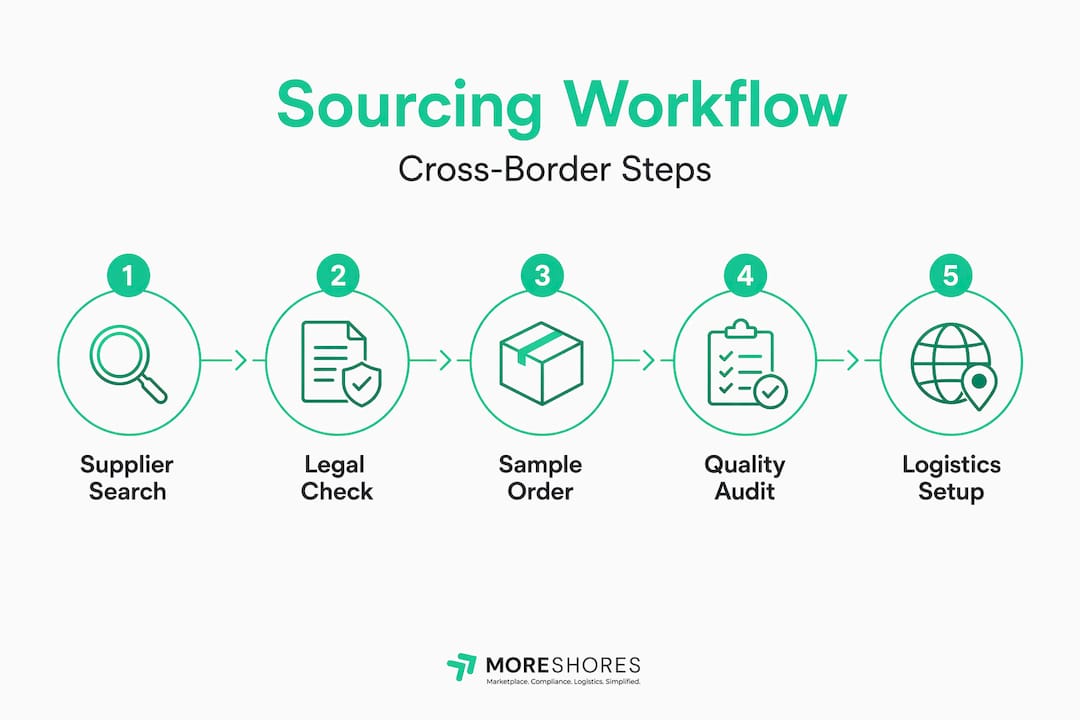
- Executing your sourcing process step by step
- Verifying suppliers and maintaining quality control
- Optimizing and troubleshooting your workflow
- My perspective on getting sourcing right
- How Moreshores simplifies cross-border sourcing
- FAQ
Key Takeaways
| Point | Details |
|---|---|
| Verify before you commit | Legal and license checks on suppliers must happen before any quotation or sample request. |
| Embed inspection rights in contracts | AQL clauses and pre-shipment inspection rights must be written into every purchase agreement. |
| Analyze quotations critically | Unusually low pricing and unfavorable payment terms are early indicators of supply chain risk. |
| Fix workflow basics first | Foundational process fixes deliver faster ROI than deploying complex procurement software. |
| Treat supplier approval as ongoing | Stress-test suppliers for scalability regularly, not just at the point of initial qualification. |
Building a solid product sourcing workflow
Before you send a single RFQ or request a sample, you need a verified foundation. Skipping preparation steps is the single most common reason sourcing processes collapse mid-order. The work you do before active sourcing determines how much control you have once the clock is ticking.
Legal and license verification
Start by confirming the legal status of every prospective supplier. This means checking their business registration, license scope, and registered capital. Differentiating manufacturers from traders via official registry checks is particularly critical when sourcing from China, where traders frequently present themselves as factories. A supplier whose license scope excludes the product category you need is a compliance problem waiting to happen.
For market-specific entry requirements, understand the regulatory framework of your destination market before selecting any supplier. Non-EU manufacturers must appoint an EU Authorized Representative to access European markets legally. The AR holds technical documentation and communicates directly with market surveillance authorities, meaning any gap in your supplier’s compliance transfers directly to your liability.
For FDA-regulated food imports into the US, FSVP recordkeeping requirements demand complete, dated, and specific hazard analyses available within 24 hours of an inspection request. Generic or unsigned records trigger citations.
Supplier verification methods compared
| Method | Timeline | Depth | Best For |
|---|---|---|---|
| Desktop check (registry, license) | 2 to 4 weeks | Surface-level | Initial screening |
| Document review and sample audit | 4 to 8 weeks | Moderate | Shortlisted suppliers |
| Physical factory visit | 6 to 10 weeks | High | Key suppliers |
| Comprehensive third-party audit | 4 to 6 months | Comprehensive | Strategic partners |
Pro Tip: Request a scanned copy of the supplier’s business license and cross-reference the registered business scope with the product categories you are sourcing. This single step eliminates a large percentage of misrepresented vendors before you spend time on samples or negotiation.
Use this verification phase to set clear expectations in writing. Define your financial terms, quality standards, delivery windows, and dispute resolution preferences before moving to sourcing execution. Suppliers who push back hard on written terms at the preparation stage will push back harder when problems arise mid-shipment.
Executing your sourcing process step by step
With a verified supplier shortlist in place, you move into active execution. This is where most of the value in your product procurement workflow is created or lost. Each step below represents a decision point with direct consequences on cost, quality, and timeline.
-
Commission a third-party factory audit. Before placing a trial order, engage an independent inspection firm to conduct a facility audit. This covers production capacity, quality control systems, worker practices, and subcontracting arrangements. Supplier qualification is a multi-stage process that includes pre-engagement screening, capability mapping, and compliance reconfirmation. A single factory visit without documentation review is not sufficient.
-
Set your Acceptance Quality Limits. Define AQL thresholds before production begins, not after. The ISO 2859-1 standard sets AQL at 0% for critical defects, 2.5% for major defects, and 4.0% for minor defects. Under AQL 2.5, a sample of goods with 8 or more major defects triggers a rejection. Agree on these numbers contractually so there is no ambiguity during inspection.
-
Analyze quotations with discipline. Review every line of the quotation, not just the unit price. Red flags include payment terms requiring more than 30% upfront with no Trade Assurance or Letter of Credit option, pricing significantly below market rates without a clear cost justification, and vague specifications that invite substitution later. These patterns indicate either financial instability or a supplier who does not intend to deliver what was quoted.
-
Select the right Incoterms and payment method. FOB is the most common Incoterm for e-commerce sourcing from Asia, but clarity on inspection responsibility matters. Under FOB terms, 57% of ICC disputes involve ambiguous assignment of inspection costs and responsibilities. State explicitly in your contract who commissions the pre-shipment inspection and who bears the cost. Use Trade Assurance or documentary Letters of Credit to protect payments.
-
Place the order with full documentation. Your purchase order must reference the agreed specification sheet, AQL limits, inspection timing, Incoterms, payment schedule, and delivery deadline. Verbal agreements have no standing in international trade disputes. Use your cross-border compliance framework to confirm all export documentation and import permit requirements are addressed before the order is confirmed.
-
Maintain supplier communication through structured channels. WeChat remains essential for real-time updates when working with Chinese factories. However, all binding decisions should be confirmed by email or documented within your procurement platform. Relationship management through informal channels works for speed; formal documentation works for protection.
Sourcing execution stage summary
| Stage | Key Action | Typical Timeline |
|---|---|---|
| Factory audit | Third-party inspection and documentation review | 2 to 4 weeks |
| AQL agreement | Contractual sign-off on defect thresholds | Before production start |
| Quotation analysis | Line-by-line review with red-flag check | 3 to 5 business days |
| Incoterms and payment | Contract drafting with explicit inspection clause | 1 to 2 weeks |
| Order placement | Signed PO with full specification reference | Day 1 of production cycle |
Pro Tip: When negotiating FOB terms, add a specific clause stating “Buyer has the right to commission pre-shipment inspection at seller’s premises at buyer’s cost, with access granted no less than five business days prior to loading.” This eliminates the ambiguity that drives most FOB-related disputes.
Verifying suppliers and maintaining quality control
Placing the order is not the end of your oversight responsibility. Effective supply chain sourcing requires active monitoring from production through loading. What you allow your supplier to do unsupervised is what you will receive at the destination port.
Key practices for ongoing verification:
- Time your pre-shipment inspection correctly. The inspection should take place when 80 to 100% of the production run is complete and packaged but before the goods are loaded. Inspecting too early means finished goods may not match the sample batch. Inspecting after loading means you have lost your leverage.
- Document every deviation. If the inspection report identifies non-conformities, issue a Corrective Action Request in writing with a deadline. Track the response and re-inspection result before authorizing loading.
- Build re-inspection into your contracts. Integrating third-party inspections with FOB terms gives you the strongest quality control position at the exact point where liability transfers. Your contract should specify that a failed inspection halts shipment automatically until re-inspection passes.
- Evaluate supplier performance after every order. Score your suppliers on quality pass rates, on-time delivery, responsiveness to corrective actions, and documentation accuracy. Use this data in your next RFQ cycle.
- Test scalability before you need it. Scaling requires stress-based validation to surface hidden subcontracting risks and production bottlenecks. If you plan to double your order volume, test the supplier’s capacity before the peak season order, not during it.
Pro Tip: Ask your supplier directly: “If our order volume doubles next quarter, what changes in your production process?” The answer reveals whether they have backup capacity, whether they subcontract, and how transparent they are willing to be. A confident, specific answer is a positive signal. Vagueness is not.
Optimizing and troubleshooting your workflow

Once your core process is running, the focus shifts to removing friction and building resilience. Most sourcing operations fail at scale not because the strategy was wrong, but because the workflow was never standardized.
Fix the fundamentals before adding technology
Foundational procurement fixes like clear requisition standards, centralized supplier data, and defined decision rights deliver faster results than deploying complex procurement software. Before you invest in a platform, document your current process. Map each step, identify where decisions stall, and standardize your template library. Specification sheets, PO formats, inspection briefs, and corrective action forms should all be standardized and version-controlled.
Build multi-tier risk buffers
Single-supplier dependency is a structural risk. Qualifying a secondary supplier for your top five SKUs protects you from the most common sourcing disruptions: factory shutdowns, quality failures, and capacity constraints. This does not require splitting every order. It requires having a qualified backup ready to activate.
Sourcing approach comparison
| Approach | Advantage | Risk |
|---|---|---|
| Single-source per SKU | Lower coordination cost | No fallback if supplier fails |
| Dual-source per SKU | Built-in risk mitigation | Higher qualification investment |
| Platform-based sourcing | Speed and price visibility | Quality control gaps without audits |
| Agent-managed sourcing | Local expertise and accountability | Additional cost layer and trust dependency |
Pro Tip: Standardize your supplier onboarding checklist into a shared document accessible to your sourcing, compliance, and logistics teams. When everyone works from the same checklist, the rate of missed documentation drops significantly and dispute resolution becomes much faster.
For effective product sourcing at scale, connect your procurement workflow directly to your e-commerce fulfillment operations so that inventory data informs reorder triggers automatically. Manual reorder decisions introduce delays that compound quickly across multiple SKUs.
My perspective on getting sourcing right
I have worked with enough international e-commerce brands to say this with confidence: most sourcing problems are not supplier problems. They are workflow design problems. The brands that struggle repeatedly with quality failures or compliance rejections almost always have the same root issue. They treated sourcing as a purchasing activity rather than a risk management process.
What I have seen work consistently is compliance integration at the supplier selection stage, not after the order is placed. If a supplier cannot provide the documentation required for your destination market before the contract is signed, they will not provide it when the shipment is at the port either. The time pressure at that point makes compliance shortcuts almost inevitable.
The other lesson I would share is about subcontracting. Most buyers focus their audits on the primary factory and miss the fact that 30 to 40% of actual production may happen at a subcontractor site with no quality oversight. Contractual language prohibiting subcontracting without written approval is the minimum protection. Periodic unannounced visits during large production runs are better.
Finally, I believe the sourcing professionals who build the most durable supply chains are the ones who treat suppliers as long-term partners rather than interchangeable vendors. That does not mean accepting poor performance. It means investing in communication, paying on time, and sharing forecast data so your supplier can plan capacity. That relationship capital is worth more than any negotiated discount when disruption hits.
— Matt
How Moreshores simplifies cross-border sourcing
If you are bringing products into African markets or expanding from Africa to international buyers, the compliance, logistics, and marketplace complexity compounds at every step. Moreshores acts as your cross-border enablement partner, handling Importer of Record responsibilities, customs clearance, duties, VAT, and regulatory compliance so your sourcing workflow connects directly to market-ready fulfillment. From warehousing and multi-courier delivery to marketplace integration across Takealot, Jumia, Amazon SA, and Kilimall, Moreshores gives you the infrastructure to execute your sourcing strategy without building it from scratch. Explore how Moreshores supports your e-commerce growth today.
FAQ
What are the key steps in a product sourcing workflow?
A product sourcing workflow covers supplier identification and legal verification, capability auditing, quotation analysis, contract negotiation, order placement with documented specifications, pre-shipment inspection, and post-order performance evaluation. Each step builds on the previous one to reduce risk and improve quality outcomes.
How long does supplier qualification take?
Supplier qualification ranges from 2 to 4 weeks for desktop checks to 4 to 6 months for comprehensive third-party audits, depending on the depth of verification required.
What is AQL and why does it matter in sourcing?
AQL stands for Acceptance Quality Limit. Under ISO 2859-1 standards, AQL 2.5 means a shipment is rejected if more than 7 major defects appear in the inspection sample. Setting AQL thresholds in your contract before production starts gives you clear, enforceable quality standards.
What is the biggest risk in a cross-border product sourcing process?
Undisclosed subcontracting is one of the most underestimated risks. When your audited supplier outsources production to an unverified facility, your quality and compliance controls no longer apply. Contractual restrictions on subcontracting and unannounced audits are the most effective mitigations.
How do I optimize my product procurement workflow for scale?
Fixing foundational process elements including standardized documentation, centralized supplier data, and clear decision rights delivers faster efficiency gains than software investments. Qualifying backup suppliers for key SKUs and connecting procurement data to fulfillment systems further supports scaling without losing quality control.