Maximize cross-border sales with smart product listing integration

TL;DR:
- Managing hundreds of SKUs across African platforms demands automated, region-specific product listing integration to prevent errors and ensure compliance. Integrating data via real-time APIs, a centralized PIM, and AI tools addresses market fragmentation, currency, language, and regulatory challenges essential for scalable cross-border e-commerce. Effective strategies require local expertise, regional customization, and ongoing operational discipline for success in diverse African markets.
Managing hundreds of SKUs across platforms like Takealot, Jumia, Kilimall, and Amazon SA is not just operationally demanding. It is a high-stakes exercise where one misstep, such as an outdated price, an incorrect size schema, or a missing VAT field, can trigger listing rejections, overselling, and real revenue loss. The African e-commerce market is highly fragmented, with each country and marketplace operating under different rules, currencies, and compliance requirements. If you are an e-commerce manager or decision-maker responsible for cross-border sales in Africa, this guide gives you a structured, practical path to mastering product listing integration at scale.
Table of Contents
- Understanding product listing integration in cross-border African e-commerce
- Key benefits: Why product listing integration matters for scaling
- Choosing the right tools: Centralized PIM, AI, and real-time APIs
- Nuances and pitfalls: Regulatory, tax, and regional schema challenges
- Putting it all together: Steps to streamline your cross-border integration
- Our take: Why most global brands underestimate integration complexity in Africa
- Streamline your product listing integration with MoreShores
- Frequently asked questions
Key Takeaways
| Point | Details |
|---|---|
| Automation drives growth | Seamless integration with APIs and centralized tools is the fastest way to scale cross-border sales in Africa. |
| Compliance is non-negotiable | Ignoring local tax, regulatory, and schema rules quickly leads to errors or lost revenue. |
| Choose adaptable tech | Select product listing solutions that allow real-time updates, regional customization, and AI-powered optimization. |
| Local challenges require expertise | African markets demand specialized strategies and mature workflows for successful e-commerce integration. |
Understanding product listing integration in cross-border African e-commerce
Product listing integration is the process of automatically connecting your product data, including inventory levels, pricing, descriptions, images, and attributes, to multiple online marketplaces or storefronts from a single source. Instead of manually updating each platform separately, integration pushes synchronized data to every channel simultaneously.
In a domestic e-commerce context, this is already valuable. In cross-border African e-commerce, it becomes absolutely critical. Africa is not a single market. It is 54 countries with distinct tax codes, import regulations, preferred payment methods, dominant languages, and marketplace-specific data requirements. A product title that works on a global Amazon listing may be rejected on Jumia Nigeria or require a completely different attribute structure on Kilimall Kenya.
The operational friction is significant. African e-commerce solutions teams that rely on manual processes routinely face these problems: catalog inconsistencies across platforms, delayed updates after price changes, and stockouts caused by inventory data that simply did not sync in time. As cross-border scaling research confirms, integration is pivotal for scaling cross-border sales in fragmented African markets, reducing operational friction, but it requires handling regulatory and tax variances along with platform-specific rules, with API automation prioritized over manual processes for competitiveness.
Major integration challenges unique to Africa
- Regulatory variance: Each country has different import duty structures, VAT registration thresholds, and product certification requirements (for example, NRCS approval in South Africa).
- Platform-specific data schemas: Takealot, Jumia, and Kilimall each have unique product attribute templates, category taxonomies, and image specifications.
- Currency and pricing complexity: Selling in South African Rand, Nigerian Naira, and Kenyan Shilling simultaneously requires real-time currency logic and margin protection.
- Language localization: French-speaking West Africa, Arabic-speaking North Africa, and English-speaking Southern Africa each require adapted product content.
- Limited digital infrastructure: In some markets, API connectivity and internet stability affect the reliability of automated integrations.
Understanding these layers is the first step. The brand onboarding guide at MoreShores outlines exactly how these variables affect the integration setup process for new market entrants.
| Challenge | Manual approach | Automated integration |
|---|---|---|
| Price updates | Hours per platform | Seconds across all channels |
| Inventory sync | Risk of overselling | Real-time stock accuracy |
| Regulatory compliance | Human error prone | Rule-based automatic filtering |
| Platform formatting | Manual reformatting | Schema mapping per marketplace |
| Language localization | Separate spreadsheets | Feed variants per region |
Key benefits: Why product listing integration matters for scaling
Once you understand the landscape, the business case for proper integration becomes very clear. The direct benefits are measurable, and they compound as you expand into more markets.
Reduced manual workload is the most immediate gain. When your product data flows automatically from a central source to every marketplace, your team stops spending hours on spreadsheet management and starts focusing on growth strategy. This is not a small efficiency gain. For brands managing thousands of SKUs across five or more African markets, manual listing can consume entire departments.

As fragmented market research shows, integration reduces operational friction in cross-border sales while also requiring platforms to address regulatory and tax variances and apply platform-specific rules. Brands that get this right gain a clear competitive advantage in speed and accuracy. You can check how this plays out practically across platforms in our marketplace integration comparison.
Direct benefits of streamlined product listing integration
- Up-to-date inventory: Real-time sync prevents overselling and stockout notifications, protecting your seller ratings.
- Price accuracy: Automatic pricing updates ensure your margins are correct across all markets, even when currency rates shift.
- Consistent branding: A single product content source guarantees that descriptions, images, and specifications remain uniform, building customer trust.
- Cross-market visibility: Faster time-to-market means your new products go live on all platforms at the same time, not weeks apart.
- Lower error rates: Automated data transfer eliminates the transcription errors that come with copy-pasting between spreadsheets and platforms.
- Scalability: Adding a new marketplace becomes a configuration task, not a re-engineering project.
Pro Tip: When evaluating integration performance, focus on two metrics above all others: time-to-publish (how fast a new product goes live across all platforms) and inventory sync latency (how quickly a stock change on one platform reflects everywhere else). These two numbers tell you more about integration health than any other indicator.
| Dimension | Manual listing | API-based integration |
|---|---|---|
| Time to publish new product | 2 to 5 hours | Under 15 minutes |
| Average error rate | 8 to 12% | Under 1% |
| Market reach potential | 1 to 2 platforms | Unlimited channels |
| Ongoing management cost | High (labor intensive) | Low (automated) |
| Inventory accuracy | Updated periodically | Real-time |
The table above is not hypothetical. These are the operational realities we see regularly when brands transition from manual to automated listing workflows in African markets.
Choosing the right tools: Centralized PIM, AI, and real-time APIs
With the benefits established, the next question is practical: what technology stack do you actually need? The answer depends on your catalog size, the number of markets you serve, and how frequently your products, prices, or inventory change.
There are three core technology categories every cross-border seller in Africa should evaluate.
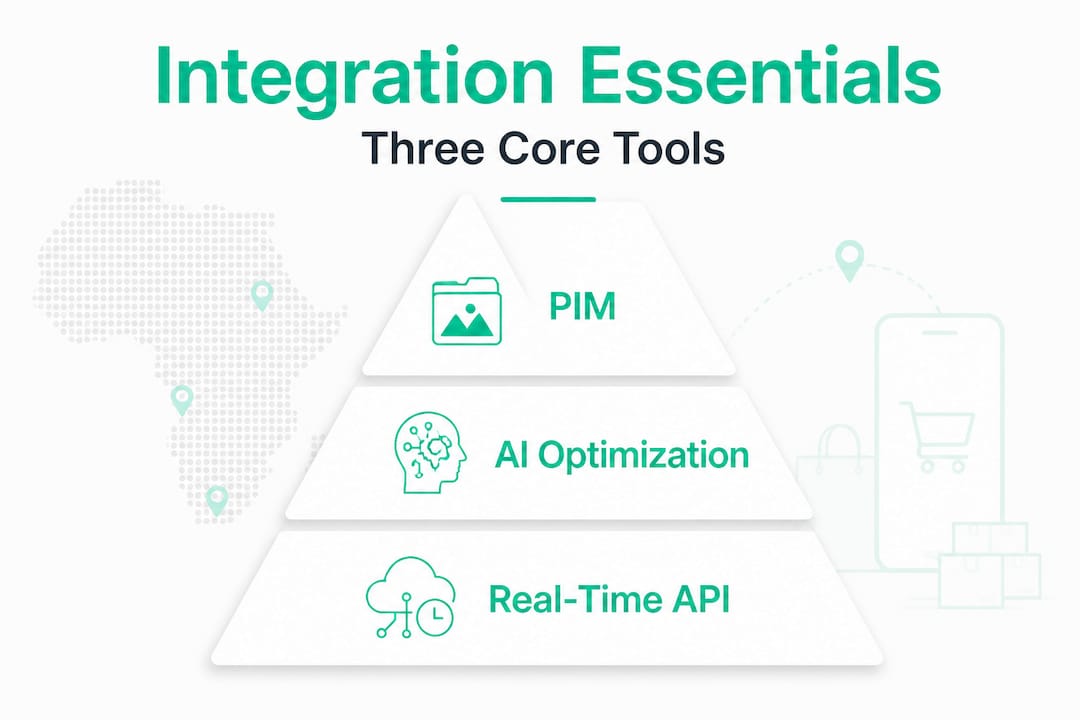
PIM (Product Information Management) systems act as the single source of truth for all your product data. A PIM stores your master product records and pushes clean, formatted data to each channel according to that channel’s specific schema. Without a PIM, you are managing multiple versions of the same product data, which is where errors and inconsistencies originate.
AI-driven content optimization is becoming increasingly relevant for African markets. AI tools can adapt product titles, bullet points, and descriptions to match local search behavior, keyword patterns, and language preferences. This is particularly valuable when your catalog spans English, French, and Swahili-speaking audiences.
Real-time API integrations are non-negotiable for high-volume or fast-moving SKUs. As cross-listing platform insights confirm, using PIM and centralized tools for multi-channel consistency, AI for title and description optimization, and real-time API over scheduled feeds to avoid stockouts, along with regional feed variants for pricing and size schemas, are the expert-recommended practices for diverse African markets. You can review how these tools connect to our fulfillment logistics solutions in practice.
Tool selection steps for African marketplace integration
- Audit your current product data quality. Before selecting any tool, identify where your catalog data is incomplete, inconsistent, or market-specific. Poor input data will produce poor outputs regardless of the tool you choose.
- Map each target marketplace’s data requirements. Takealot has different mandatory fields than Jumia. Kilimall has different image specifications. Document these requirements before building your integration.
- Select a PIM that supports regional feed variants. Your PIM must be able to output different versions of the same product for different markets, handling currency, language, and size schema variations.
- Implement real-time API connections over scheduled batch uploads. Scheduled uploads (running every few hours) create windows of inaccuracy. Real-time APIs eliminate those windows.
- Add AI content tools for localization. Once your base integration is live, layer in AI-assisted content adaptation to improve marketplace search visibility per region.
- Establish monitoring dashboards. Track sync success rates, error logs, and time-to-publish metrics. Integration is not a set-and-forget activity.
“The most overlooked aspect of multi-marketplace integration in Africa is regional schema adaptation. Brands invest heavily in technology but fail to configure region-specific pricing tiers, local size conversions, or market-appropriate descriptions. The API infrastructure can be perfect, but if the feed variants are not configured for each country’s schema, listings still fail or underperform.” This is precisely why tool selection must include regional customization as a non-negotiable feature.
Pro Tip: Always prioritize real-time API integrations for SKUs that are price-sensitive or have inventory levels that change frequently. For slow-moving, stable catalog items, scheduled syncs may suffice. Segment your catalog and apply the right integration method to each segment to optimize cost and performance.
Nuances and pitfalls: Regulatory, tax, and regional schema challenges
Even with the best technology in place, African cross-border integration has pitfalls that technology alone cannot solve. Most of them are compliance-based, not technical.
Fragmented African market research consistently shows that integration in African markets requires handling regulatory and tax variances alongside platform-specific rules. This is where many global brands make costly mistakes. They configure their global integration stack and assume it transfers seamlessly to Africa. It rarely does without significant localization.
Country-specific integration challenges to anticipate
- South Africa: Products sold via Takealot or Amazon SA may require NRCS (National Regulator for Compulsory Specifications) approval for certain categories. VAT at 15% must be reflected accurately in pricing. Listings that omit required compliance data are rejected outright.
- Nigeria: Import restrictions and HS code classification affect which products can be listed on Jumia Nigeria. Currency volatility in the Nigerian Naira requires dynamic pricing logic, not static pricing rules.
- Kenya: Kilimall and other Kenyan platforms require Swahili-friendly product descriptions for high-performance categories. Size schemas for clothing and footwear differ from international standards.
- Egypt: Arabic language requirements for listings, along with specific halal certification fields for food and personal care categories, are not optional.
- Ghana: Import duty rates change periodically, affecting landed cost calculations and the accuracy of marketplace pricing.
Our cross-border enablement strategies address each of these country-level requirements, and our African e-commerce partners network provides on-ground support for compliance verification.
Pro Tip: Ensure your integration platform or service partner supports region-based pricing, language variants, and size schema mapping as configurable features. If a tool offers these only as workarounds rather than built-in functionality, you will spend more time maintaining the workaround than growing your catalog.
Putting it all together: Steps to streamline your cross-border integration
With context, tools, and risks all understood, here is a practical sequence you can apply immediately to build a reliable cross-border integration workflow.
- Audit your existing listings across all platforms. Identify inconsistencies in product data, pricing, and compliance fields. This baseline audit reveals exactly where your current process breaks down.
- Consolidate product data into a single master catalog. Whether you use a formal PIM system or a structured data model, every product must have one authoritative record from which all marketplace feeds are generated.
- Select and configure your integration technology. Apply the tool selection steps outlined earlier. Prioritize real-time API tools and ensure regional feed variants are configured per market before going live.
- Build compliance checkpoints into the workflow. For each target market, define the mandatory compliance fields (VAT, certifications, language requirements) and configure your feed to populate them automatically.
- Run parallel testing before full deployment. Push test listings to each marketplace and verify that formatting, pricing, inventory, and compliance fields all meet platform requirements before activating your full catalog.
- Monitor performance and iterate. Track sync rates, error logs, and listing performance weekly. Integration quality degrades over time as platforms update their requirements, so scheduled reviews are essential.
The integration onboarding process at MoreShores follows this exact sequence, with dedicated support at each stage to handle the Africa-specific complexity that standard global platforms do not address.
Our take: Why most global brands underestimate integration complexity in Africa
Here is the honest reality we see repeatedly. Experienced global brands, including those with mature integration setups in North America and Europe, consistently underestimate how different Africa is when it comes to product listing integration. They arrive with a functioning tech stack, experienced operations teams, and proven processes. And they still struggle.
The reason is rarely technology. It is assumptions. These brands assume their existing data schemas will map cleanly to African marketplace templates. They assume their pricing logic handles emerging market currencies. They assume their compliance teams have visibility into country-level import regulations that change without warning. Most of these assumptions turn out to be wrong, sometimes expensively so.
What winning brands do differently is invest in local expertise before scaling their catalog. They work with cross-border best practices partners who have live knowledge of platform requirement updates, regulatory changes, and regional buyer behavior. They configure regional feed variants from day one rather than treating them as phase-two improvements. And they accept that integration in Africa is an ongoing operational discipline, not a one-time technical project.
The brands that win in African e-commerce are not always the ones with the most sophisticated global technology. They are the ones that combine good technology with on-ground knowledge and adaptive, compliant listing strategies that reflect the real diversity of the continent.
Streamline your product listing integration with MoreShores
If this guide has made one thing clear, it is that cross-border product listing integration in Africa requires more than a good software subscription. It requires regional expertise, compliance support, and a partner who understands the operational reality of each market you are entering.

MoreShores provides marketplace integration services that connect your product catalog to Takealot, Amazon SA, Jumia, Kilimall, and more, with built-in regional customization, compliance field mapping, and real-time API synchronization. Our platform also handles the broader cross-border e-commerce solutions stack: Importer of Record services, duties and VAT compliance, warehousing, and multi-courier fulfillment. You do not need to stitch together multiple vendors. Explore our full range of e-commerce solutions for Africa and book a consultation to see how we can streamline your integration from day one.
Frequently asked questions
What is product listing integration and why is it crucial for cross-border African e-commerce?
Product listing integration is the process of connecting and automating your product data, like inventory, prices, and descriptions, across multiple marketplaces. It is essential in Africa because fragmented African markets require handling regulatory and tax variances and platform-specific rules that manual processes cannot consistently manage.
Which tools best streamline product listing for multiple African marketplaces?
Centralized PIM tools, AI-optimized content management, and real-time API connections are most recommended. As multi-market integration guidance confirms, these tools together support multi-channel consistency, reduce stockouts, and handle regional pricing and size schema differences across African markets.
What’s the biggest mistake brands make in African product listings?
Many brands neglect regional compliance requirements like language, currency formatting, and tax fields. Cross-border research shows this leads to listing rejections and compliance fines that could be avoided with properly configured regional feed variants.
How can I ensure my listed products stay in sync across fast-moving African markets?
Using real-time API-based integrations instead of manual or scheduled uploads is the most reliable approach. Expert integration guidance specifically recommends real-time API over scheduled feeds to keep inventory and listing data accurate across all channels simultaneously.