Avoid NCRs and Holds: Kenya Certificate of Conformity for Exporters

A PVoC Certificate of Conformity (CoC) is mandatory for regulated goods shipped to Kenya, and it must come from a KEBS-appointed conformity assessment agent before the cargo leaves origin. Ship without one and Kenyan customs will hold, test, or reject the consignment at the border. KEBS oversees the entire Pre-Export Verification of Conformity (PVoC) program, and its appointed agents are the only bodies authorized to issue a valid CoC.
TL;DR:
- Most shipments require a KEBS-appointed agent inspection and testing, with routes B and C offering less frequent tests for registered or licensed products.
- Exemptions include products with the KEBS Diamond Mark, items manufactured within the East African Community, and certain low-value courier parcels, but verify with KEBS directly.
- Accurate and consistent shipping documents, especially invoices and packing lists, are critical to avoid non-conformity reports and delays at customs.
- The overall timeline depends on paperwork quality, with early booking of inspections improving chances for timely co-certification before departure.
- Handling the entire compliance process through a dedicated service reduces delays, manages documentation, and streamlines customs clearance effectively.
Table of Contents
- What Does Kenya’s PVoC Program Actually Cover?
- Route A, Route B, or Route C: Which One Applies to You?
- How Do You Get a Certificate of Conformity Before You Ship?
- Which Documents Trigger a Non-Conformity Report?
- Who Are the KEBS-Appointed PVoC Agents?
- What Happens During Destination Inspection?
- How an Importer of Record Cuts CoC-Related Risk
- What Should Exporters Prioritize First When Shipping to Kenya?
- Let MoreShores Handle Your Kenya Compliance Workflow
- Where to Verify the Latest CoC Requirements
- Sources
What Does Kenya’s PVoC Program Actually Cover?
The Pre-Export Verification of Conformity program requires regulated goods bound for Kenya to be inspected and tested in the country of origin, not after arrival. KEBS sets the legal basis and product scope, and the list runs wide: electrical appliances, motor vehicles and parts, food products, textiles, toys, cosmetics, and construction materials all typically fall under it.
Not everything needs a CoC. Common carve-outs include:
- Goods already bearing the KEBS Diamond Mark of quality
- Products manufactured within the East African Community (EAC)
- Certain courier parcels, depending on value and category
- Goods specifically listed as exempt in KEBS’s own schedule
Exemption rules shift from time to time, so verify status directly with KEBS before you assume your shipment qualifies. One more layer trips people up constantly: a valid CoC covers the goods, but it says nothing about the importer’s tax standing. A current KRA Tax Compliance Certificate is a separate requirement, and its absence can block clearance even when the CoC is in perfect order.
Route A, Route B, or Route C: Which One Applies to You?
KEBS runs three certification pathways, and the one that fits your shipment changes how much testing you face and how long each approval lasts.
- Route A applies to per-shipment inspection and testing. Every consignment gets checked individually, which suits one-off exporters or irregular product lines.
- Route B covers product registration for exporters shipping the same, homogenous product repeatedly. Registration is valid for one year, and once registered, shipments face far less repeat testing.
- Route C is manufacturer licensing, built for larger operations. It involves a factory audit and grants multi-year scope, but demands the heaviest upfront compliance work.
Whichever route applies, expect container sealing after inspection and sample testing before sign-off. Registered or licensed products under Route B or Route C generally see fewer physical checks per shipment, which is exactly why high-volume exporters push to register early rather than repeat Route A inspections on every load.
How Do You Get a Certificate of Conformity Before You Ship?
Getting a CoC follows a fairly predictable sequence, though the timeline depends heavily on how clean your paperwork is going in.
- Submit a Request for Certification (RFC) to a KEBS-appointed agent along with your pro forma invoice.
- Document review. The agent checks your commercial invoice, packing list, test reports, and Free Sale certificate where applicable, against the product details you’ve declared.
- Pre-shipment inspection. An inspector examines the goods, verifies quantities and packaging, and applies container seals once satisfied.
- Testing. Samples go to an accredited lab, ideally one meeting ISO/IEC 17025 standards. Where no accredited local lab exists, the agent may witness testing directly.
- CoC issuance. Once everything checks out, the agent issues the certificate before the shipment departs, following the standard flow used by providers like Intertek.
You present the CoC to Kenyan customs on arrival alongside your other clearance documents.
Pro Tip: Book your inspection slot as soon as production finishes packing, not after the vessel is already booked. Agents schedule inspections around their own workload, and a rushed booking is where sealing and testing errors creep in.
Which Documents Trigger a Non-Conformity Report?
Most Non-Conformity Reports (NCRs) trace back to paperwork, not product quality. Keep these documents consistent from quote to shipment:
- Final commercial invoice matching the inspected goods exactly
- Complete packing list with matching quantities and weights
- Bill of Lading or Air Waybill
- Test reports traceable to the specific production batch
- Free Sale certificate, where the product category requires one
- Proof of product registration, if shipping under Route B
Inspectors compare your final shipping documents against the original inspection report. A mismatched invoice or packing list is one of the most common triggers for an NCR, and HS code discrepancies between your declaration and the inspection paperwork cause the same problem. Even with a flawless CoC, a missing or expired KRA Tax Compliance Certificate can independently stall clearance at the port.
Who Are the KEBS-Appointed PVoC Agents?
KEBS contracts a network of international conformity assessment bodies to carry out the actual inspections, testing, and CoC issuance. The appointed agents commonly include Bureau Veritas, Cotecna, Intertek, SGS, China Certification & Inspection Group, and QISJ, each operating in different origin countries and product specialties.
- Agents handle document review, sampling, physical inspection, container sealing, and final CoC issuance.
- Reach out directly to the agent covering your export country for a quotation and inspection scheduling window.
- KEBS supervises the entire program; agents act under its authority, not independently.
Lead times vary by agent workload and product complexity, so request a quotation as early in your production cycle as possible.
What Happens During Destination Inspection?
Goods arriving without full documentation, or flagged for risk-based review, go through destination inspection at the Kenyan port. KEBS applies a mix of document verification, physical sampling, and lab testing depending on the risk category of the product.
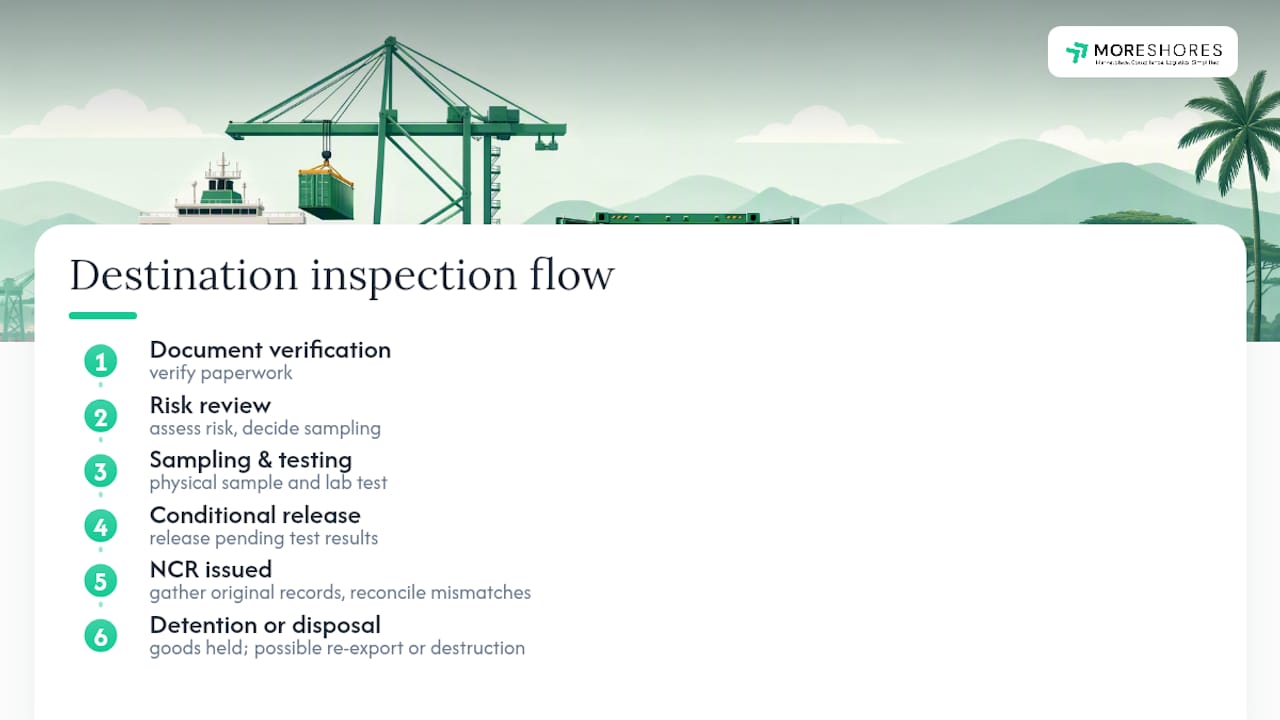
Outcomes range from conditional release pending test results, to a formal NCR, to full detention. In the worst cases, goods face re-export or destruction. If you’re handed an NCR, respond fast: gather the original inspection records, reconcile any document mismatches, and work with your agent or importer of record to resolve the discrepancy before demurrage charges pile up.
How an Importer of Record Cuts CoC-Related Risk
Acting as Importer of Record, Moreshores manages KRA tax compliance, keeps invoices and packing lists consistent across every document touchpoint, and files customs paperwork so it matches the inspection record exactly. That consistency is what keeps a CoC from getting undermined by a clerical mismatch on arrival.
Coordinating pre-shipment inspection timing, selecting accredited labs, and keeping organized shipment records all reduce NCR exposure before goods ever reach the port. For consignments facing conditional release, warehousing and fulfillment support gives importers somewhere to hold stock while testing resolves, followed by marketplace listing once clearance is complete.
What Should Exporters Prioritize First When Shipping to Kenya?
Document accuracy beats everything else on this list. Run a pre-shipment audit comparing your invoice, packing list, and HS codes before the agent ever shows up. If you ship the same product regularly, Route B registration pays for itself within a year. For anything technically complex, bring in a compliance partner before production finishes, not after the NCR arrives.
— Matt
Let MoreShores Handle Your Kenya Compliance Workflow
Coordinating a KEBS agent, a customs broker, and a tax compliance filing separately is where most CoC delays actually originate, not the certificate itself. A service consolidates that work: acting as Importer of Record, managing customs clearance, duties, and VAT, and keeping your documentation consistent from origin inspection through port arrival.
That consolidation matters most for exporters running frequent shipments into Kenya, since one team tracking your Route B registration and renewal dates catches problems before an agent flags them at inspection. Warehousing and fulfillment through a multi-courier network also means conditionally released goods have somewhere to sit without racking up port storage fees. Once cargo clears, marketplace integration gets your products listed and selling without a separate onboarding process. If you’re planning a shipment to Kenya and want the compliance side handled end to end, start with the cross-border enablement page and get a quote for your specific product category.
Where to Verify the Latest CoC Requirements
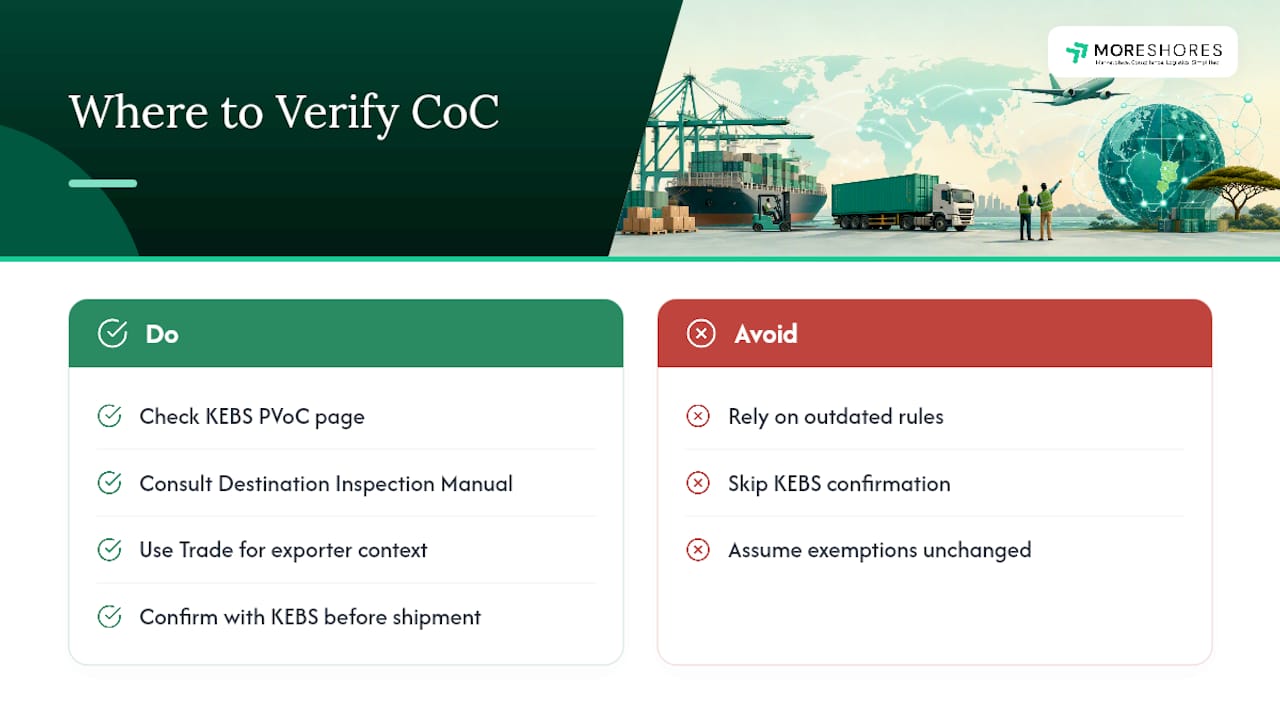
Check the KEBS PVoC program page and the Destination Inspection Manual directly for current agent lists, forms, and exemption schedules. Trade offers useful context for exporters new to the program. Rules and exemptions change, so confirm details with KEBS before finalizing any shipment.
Sources
- Pre-Export Verification of Conformity – Kenya Bureau of Standards
- Product Registration Routes – Kenya Bureau of Standards
- Trade
- Certificate of Conformity for Exports to Kenya — Intertek