Match goods to the right IE form for ITAC permits in South Africa

If you’re importing used or second-hand goods, waste, scrap, or anything on South Africa’s controlled tariff list, you need an ITAC import permit before the shipment moves. The immediate next step is registering as an importer with the South African Revenue Service (SARS), then identifying which ITAC application form matches your goods. Skip either step and your shipment stalls at the border.
TL;DR:
- Most used, second-hand, waste, and certain controlled tariff goods require an ITAC import permit before customs clearance, especially if touching multiple government departments.
- Correct application depends on matching the appropriate form with proper documentation, SARS registration, and detailed, consistent descriptions on invoices and forms.
- Average processing time is 3 to 5 working days, but delays often occur when additional approvals are needed from departments like the Department of Agriculture or NRCS.
- Submitting a complete, accurate package initially accelerates approval; common rejection causes include vague descriptions, inactive SARS codes, or document mismatches.
- Using a managed import service can streamline the process, especially for recurring shipments or complex goods involving multiple regulatory agencies.
Table of Contents
- Which Goods Need an ITAC Import Permit?
- How Do You Apply for an ITAC Import Permit?
- What Documents Does ITAC Require for Your Import?
- How Long Does an ITAC Permit Take and What Does It Cost?
- Where Do You Submit Your ITAC Application?
- What Mistakes Delay or Sink an ITAC Application?
- When Does a Managed Import Service Make Sense?
- Why the Permit Process Trips Up Even Careful Importers
- Get ITAC Permit and Customs Handled for You
- Official ITAC Resources to Bookmark
- Sources
Which Goods Need an ITAC Import Permit?
New commercial goods generally clear South African customs without an import permit. The moment your shipment involves used or second-hand items, that changes. The International Trade Administration Commission (ITAC) requires a permit for the importation of used or second-hand goods, and a number of tariff lines sit under active import control for reasons ranging from safety to environmental compliance.
Before you apply for anything, check whether your specific goods actually require control:
- Used or second-hand goods of almost any category, including electronics, machinery, and vehicles
- Waste and scrap materials, which carry their own environmental scrutiny
- Goods on specific controlled tariff lines, such as certain chemicals, textiles, and agricultural products
- Items tied to international agreements like the Montreal Protocol or Basel Convention, which restrict ozone-depleting substances and hazardous waste
Common exceptions exist. Books typically move without a permit, and bona fide personal effects can clear without one if you can document that they’re genuinely personal, not commercial in disguise. When in doubt, check the ITAC controlled goods list against your tariff code before you spend time on an application you didn’t need.
How Do You Apply for an ITAC Import Permit?
Getting the process right starts with matching your situation to the correct form. ITAC publishes four main application forms, and picking the wrong one is the fastest way to lose days.
- Register as an importer with SARS first. You need an active SARS importer code (via form IE230) before ITAC will process anything. This step trips up more first-time applicants than any other part of the process.
- Identify your form. IE461 covers commercial imports and donations. IE462 is for second-hand passenger vehicles. IE463 applies to personal-use imports. IE464 covers chemicals.
- Complete the form accurately. Descriptions on your invoice and waybill must match exactly what you write on the IE form. Vague wording like “electronics” or “spare parts” invites a query and a delay.
- Attach supporting documents and submit by email or deliver the package directly to the Import and Export Control directorate.
- Wait for the permit, then forward the approved document to your shipping line or clearing agent so customs can release the goods.
Pro Tip: Keep a digital folder with your SARS registration, invoice, and waybill ready before you start the IE form. Applicants who gather documents first almost always avoid the back-and-forth queries that stretch a five-day turnaround into three weeks.
What Documents Does ITAC Require for Your Import?
The paperwork ITAC expects depends heavily on what you’re bringing in. General applications share a common core, but certain goods trigger extra checks from other government departments entirely.
- Commercial invoice and waybill with descriptions that match your IE form exactly
- Proof of SARS importer registration
- A letter of explanation if your goods description is technical or could be read multiple ways
- SAPS registration and supporting ownership documents for second-hand passenger vehicles
- Clearance letters from the Department of Environmental Affairs, the Department of Agriculture, or the NRCS for chemicals, agricultural products, and other hazardous goods
Vehicles are the category that trips up the most first-time applicants, since SAPS registration alone can take longer than the ITAC permit itself. Chemical and agricultural imports face similar bottlenecks whenever a second department has to sign off before ITAC can move.
How Long Does an ITAC Permit Take and What Does It Cost?
Most applications move fast. ITAC’s own guidance puts standard processing time at 3 to 5 working days, though that window stretches whenever another department, such as the NRCS or Department of Agriculture, needs to weigh in before a decision.
ITAC’s FAQ page for commercial and donation permits (IE461) has flagged recent spikes in applications for personal used goods, such as cell phones and laptops, and warns those spikes can push response times beyond the normal window.
On cost, ITAC itself charges no fee to issue a permit. The customs duty and VAT you pay go to SARS at the point of clearance, calculated under the Customs and Excise Act, not by ITAC. Outcomes fall into three buckets: permit issued as requested, permit issued with conditions attached, or refusal, most often triggered by mismatched documentation, an ineligible goods category, or a missing SARS registration.
Where Do You Submit Your ITAC Application?
Submissions go through the ITAC import-control channels, and structuring your application correctly matters as much as filling it out correctly.
- Start at the ITAC import-control landing page to confirm your goods category and download the current version of your form
- Use the application-forms page to get the exact IE form, since older versions get rejected on formatting grounds alone
- Address your submission to the Directorate: Import and Export Control, and attach your SARS registration, invoice, and waybill up front rather than waiting for a request
- ITAC’s national office sits in Pretoria; check the gov.za import permit page for the current physical address and phone numbers, since these details get updated periodically
A complete package on first submission is the single biggest factor in whether your application gets triaged quickly or sits in a query queue.
What Mistakes Delay or Sink an ITAC Application?
Most rejections trace back to a handful of repeat offenders. Vague invoice descriptions top the list, followed closely by missing SARS registration and incorrect tariff classification on the IE form itself.
- Double-check that your invoice wording matches your IE form line for line
- Confirm your SARS importer code is active before you submit, not while your application is pending
- Respond to ITAC queries within the timeframe given; a slow reply resets your position in the queue
- Keep copies of every document you submit, in case a second department requests the same paperwork
Pro Tip: If your import involves vehicles, chemicals, or anything requiring a second department’s sign-off, build in extra time or bring in a compliance specialist. The complexity multiplies fast once more than one agency has to approve your shipment.
When Does a Managed Import Service Make Sense?
Handling an ITAC application yourself works fine for a one-off shipment with a straightforward tariff line. It gets harder fast once you’re moving recurring volumes of second-hand equipment, chemicals, or goods that touch multiple regulators.
That’s the gap MoreShores exists to close. Acting as Importer of Record, MoreShores manages customs clearance, duty and VAT handling, and the regulatory paperwork that trips up first-time applicants, including the SARS registration and IE form matching covered above.
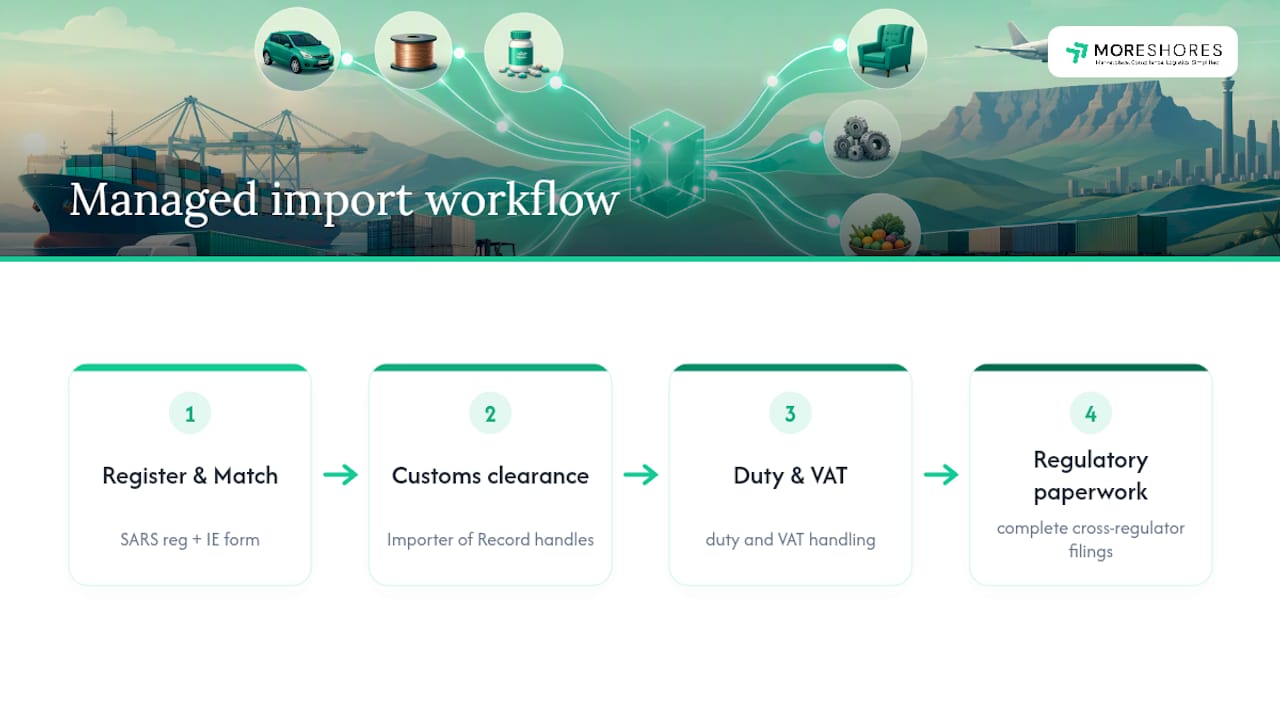
For businesses running repeat shipments rather than a single import, a managed service reduces the odds of a refusal from a mismatched form or an incomplete document set.
Why the Permit Process Trips Up Even Careful Importers
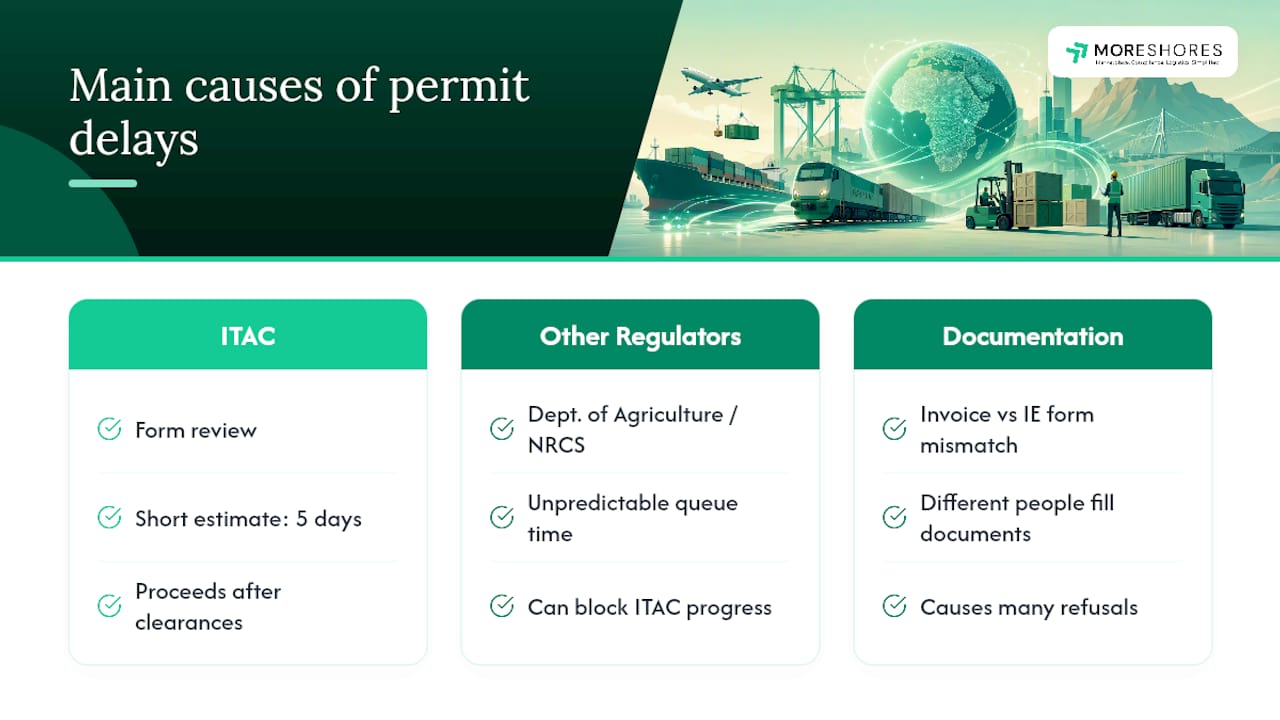
Most guides to ITAC permits treat the process like a checklist problem: fill out the right form, attach the right documents, and wait five days. The reality is messier. The actual bottleneck usually isn’t the ITAC review itself; it’s the handoff between agencies. A chemical import doesn’t fail because ITAC is slow. It fails because the Department of Agriculture or the NRCS hasn’t finished its own review, and ITAC can’t move until that clearance lands on its desk.
That distinction changes how you should plan. If your shipment touches a second regulator, budget calendar time for that agency’s queue, not ITAC’s five-day estimate. The other underestimated risk is documentation drift, where your invoice says one thing and your IE form says another, often because two different people filled out each document. That mismatch alone accounts for a meaningful share of the refusals importers blame on “ITAC being slow” when the real cause sat in their own paperwork.
— Matt
Get ITAC Permit and Customs Handled for You
Chasing down the right IE form, tracking a SARS registration, and waiting on a second department’s clearance eats real time, especially if you’re managing this alongside sourcing, fulfillment, and marketplace listings. MoreShores handles the permit and customs side directly, acting as your Importer of Record so your shipment clears without you learning ITAC’s internal review queue firsthand.
Beyond the permit itself, managed services can handle duties, VAT, and warehousing once your goods land, then connect your inventory to fulfillment through a multi-courier network and marketplace listings on platforms like Takealot and Amazon SA. If you’re bringing in recurring shipments of controlled or second-hand goods, get in touch through the cross-border enablement page to talk through what your specific import needs before your next shipment is sitting at the port.
Official ITAC Resources to Bookmark
For forms, use the ITAC application-forms page. For scope and processing details, see the ITAC import-control landing page. For registration steps and fee clarification, check gov.za’s import permit guidance. For current backlog warnings, review the IE461 FAQ page.