Stop Customs Holds: IOR vs EOR Checklist for Ecommerce Sellers
The Importer of Record (IOR) is legally accountable to the destination country’s customs authority for import filings, duties, and product compliance. The Exporter of Record (EOR) answers to the origin country’s export authorities for licensing and export documentation. Before your next shipment, confirm your Incoterm (DDP or DAP) and whether you or your counterparty can legally act as one of these two roles.
TL;DR:
- Sellers must confirm their ability to act as the Importer of Record before promising DDP shipping, or shipments may stall at customs and cause delays.
- The IOR is responsible for filing customs entries, paying duties, and ensuring product compliance, with liabilities lasting up to five years after entry.
- Choosing between local registration, hiring an IOR service provider, or shifting to DAP depends on shipment volume, control preference, and buyer requirements.
- Common mistakes include using outdated classification codes, missing importer numbers, or shipping to denied parties, which can lead to cargo seizure or fines.
- Contractually specifying who files entries, covers duties, and maintains records helps prevent legal exposure and delays in cross-border shipments.
Table of Contents
- IOR vs EOR: What Each Role Actually Requires
- How Your Contract Terms Decide Who Plays Each Role
- A Practical Checklist for Assigning IOR and EOR Roles
- What Happens When a Filing Goes Wrong
- Three Ways Sellers Actually Solve the IOR/EOR Problem
- Where Most Sellers Get This Wrong
- How Moreshores Handles IOR and Cross-Border Compliance for You
- Sources
IOR vs EOR: What Each Role Actually Requires
The IOR and EOR sit on opposite ends of the same shipment, and they report to different governments entirely. The IOR answers to the destination country’s customs agency once goods cross the border. The EOR, often called the U.S. Principal Party in Interest (USPPI) on American exports, answers to the origin country’s export control regime before the goods ever leave the warehouse.
Neither role can be handed off without real consequences. The IOR is legally responsible for the shipment upon entry, and that liability doesn’t fully transfer just because a broker files the paperwork.
An IOR’s core duties include:
- Filing entry with customs, typically through CBP Form 3461 for release and CBP Form 7501 for the formal entry summary
- Paying import duties, tariffs, and applicable taxes on time
- Confirming the goods meet local product safety and labeling rules
- Retaining entry and payment records for five years in case of audit
An EOR’s core duties run the other direction:
- Classifying goods correctly for export and filing Electronic Export Information (EEI) in the AES when the shipment value or destination requires it
- Securing any export licenses tied to controlled goods or restricted destinations
- Screening buyers and consignees against denied-party lists before goods ship
- Owning the accuracy of that data even when a freight forwarder submits it on their behalf
Delegating the paperwork to a broker or forwarder never erases the underlying legal exposure. That stays with whoever holds the title.
How Your Contract Terms Decide Who Plays Each Role
Your Incoterm effectively assigns the IOR role before anyone signs a customs form. Under Delivered Duty Paid (DDP), the seller carries import clearance and duty payment, which usually means the seller has to be the IOR or contract one. Under Delivered at Place (DAP), that burden shifts to the buyer, who clears the goods on their own end.
This split shows up constantly in e-commerce operations:
- DDP shipments require the seller to either register locally as an importer or hire an IOR service provider to stand in that role
- DAP shipments put the compliance work, and the risk of delay, on the buyer’s desk
- Marketplace fulfillment programs sometimes absorb import formalities on the seller’s behalf, but coverage varies by platform and product category, so never assume it’s automatic
- A non-resident seller offering DDP without an IOR structure in place is offering a promise it can’t legally keep
The practical takeaway: a seller advertising “delivered, duty paid” pricing on their storefront has made an implicit legal commitment. If that seller can’t act as IOR and hasn’t lined up a provider who can, the shipment stalls at the border while the buyer wonders why their DDP order suddenly needs a customs form.
A Practical Checklist for Assigning IOR and EOR Roles
Work through this before your next cross-border shipment leaves the dock, not after it gets flagged.
Before you ship:
- Confirm your legal entity status and any local trade identifiers you’ll need, such as an EORI number in EU markets or a CBP importer number in the U.S.
- Classify your top SKUs under the correct tariff codes and flag anything requiring an import license or safety certification.
- Screen every counterparty, buyer, and consignee against denied-party lists before goods move.
Deciding who takes the role:
- Weigh shipment volume and frequency. Occasional low-volume shipments rarely justify local registration.
- Compare the cost of registering locally against the cost of an IOR service fee.
- Factor in the buyer’s own priorities. Some B2B buyers prefer to clear goods themselves so they can reclaim VAT.
Locking it into the contract:
- Specify in writing who files the entry, who covers duties and taxes, and who holds power of attorney with the customs broker.
- Add an indemnity clause covering classification errors and an audit-access clause covering the five-year recordkeeping window.
Pro Tip: Run this checklist against your ten highest-volume SKUs first. If even one lacks a clean tariff classification or a valid local identifier, fix that before you scale volume on the rest.
What Happens When a Filing Goes Wrong
Getting IOR or EOR obligations wrong isn’t a paperwork inconvenience. It’s a shipment sitting in a bonded warehouse while your customer asks for a refund. Consequences range from cargo seizure and civil fines to criminal exposure on controlled exports, and customs authorities can audit records for years afterward.
Most detentions trace back to a short list of preventable mistakes:
- Wrong or outdated HTS classification codes
- No valid importer number on file for the destination country
- Inaccurate or missing EEI/USPPI data on the export side
- Shipping to a buyer or consignee that turns up on a denied-party list
If a shipment does get flagged, speed matters more than perfection. Engage a customs broker or IOR provider immediately, prepare post-entry corrections rather than disputing the hold, notify the carrier or marketplace so they don’t cancel the order automatically, and preserve every record tied to that shipment. Those records are exactly what an auditor will ask for later.
Three Ways Sellers Actually Solve the IOR/EOR Problem
Most sellers land on one of three approaches, and the right one depends on volume and how much control you want to keep.
- Register locally. This fits sellers with sustained volume and a long-term commitment to a specific market. It’s slower to set up but gives you direct control over compliance.
- Hire an IOR service provider. This is the fastest path to offering DDP without registering a foreign entity. The provider legally stands in as IOR while managing entry, duties, and documentation on your behalf.
- Shift to DAP. This works well for B2B buyers who want to clear goods themselves, often because they can reclaim import VAT that a seller-side IOR arrangement would leave on the table.
Some service providers operate in that second category, acting as IOR for brands moving goods across African and global markets while also handling warehousing, fulfillment, and marketplace integration under one roof.
Where Most Sellers Get This Wrong
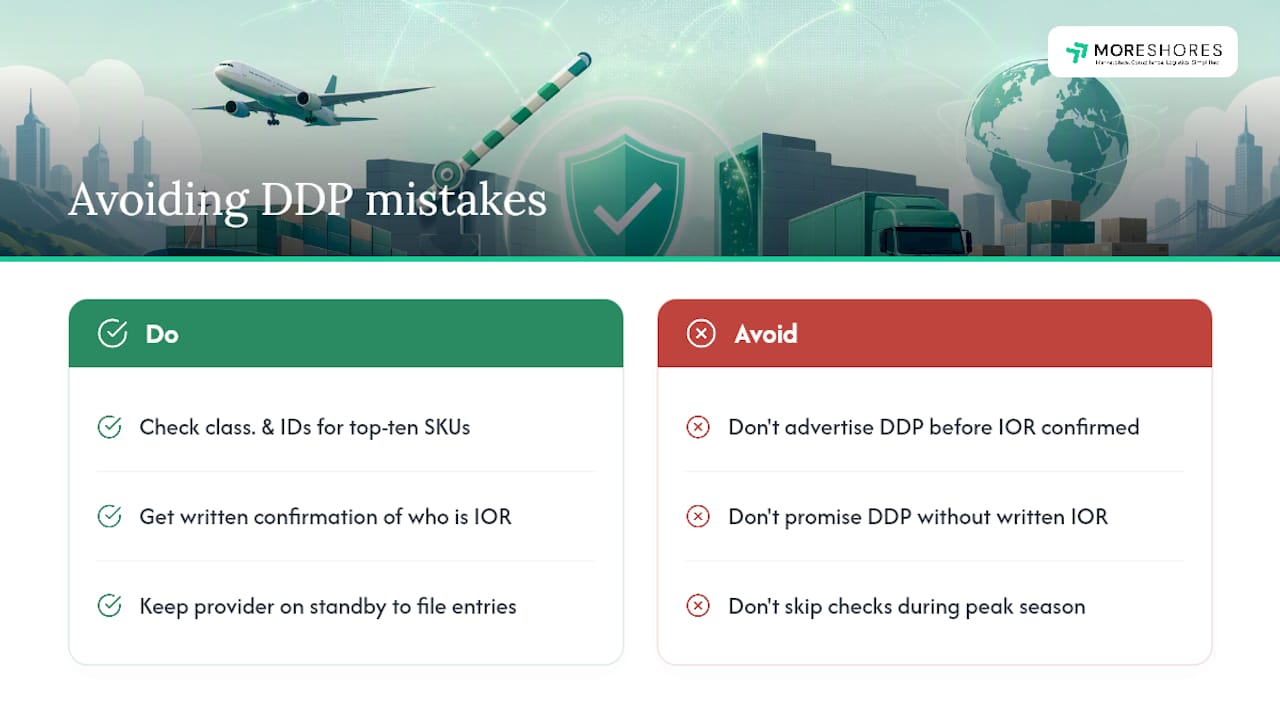
The single most common mistake we see is a seller advertising DDP pricing before confirming they can actually perform the IOR role. It looks like a customer-friendly checkout experience until the first shipment sits at customs because there’s no importer number, no local registration, and no provider on standby to file the entry.
The fix isn’t complicated, but it does take discipline: run a classification and local-identifier check on your top ten SKUs, and confirm in writing who can legally act as IOR before you promise DDP terms to a single customer. Sellers who skip this step tend to find out the hard way, usually during their highest-volume season, which is the worst possible time to discover a gap in your import setup.
— Matt
How Moreshores Handles IOR and Cross-Border Compliance for You
An alternative to registering a foreign entity from scratch is to engage a service provider that acts as your Importer of Record across African and global markets, handling customs entry, duties, and VAT while you focus on selling.
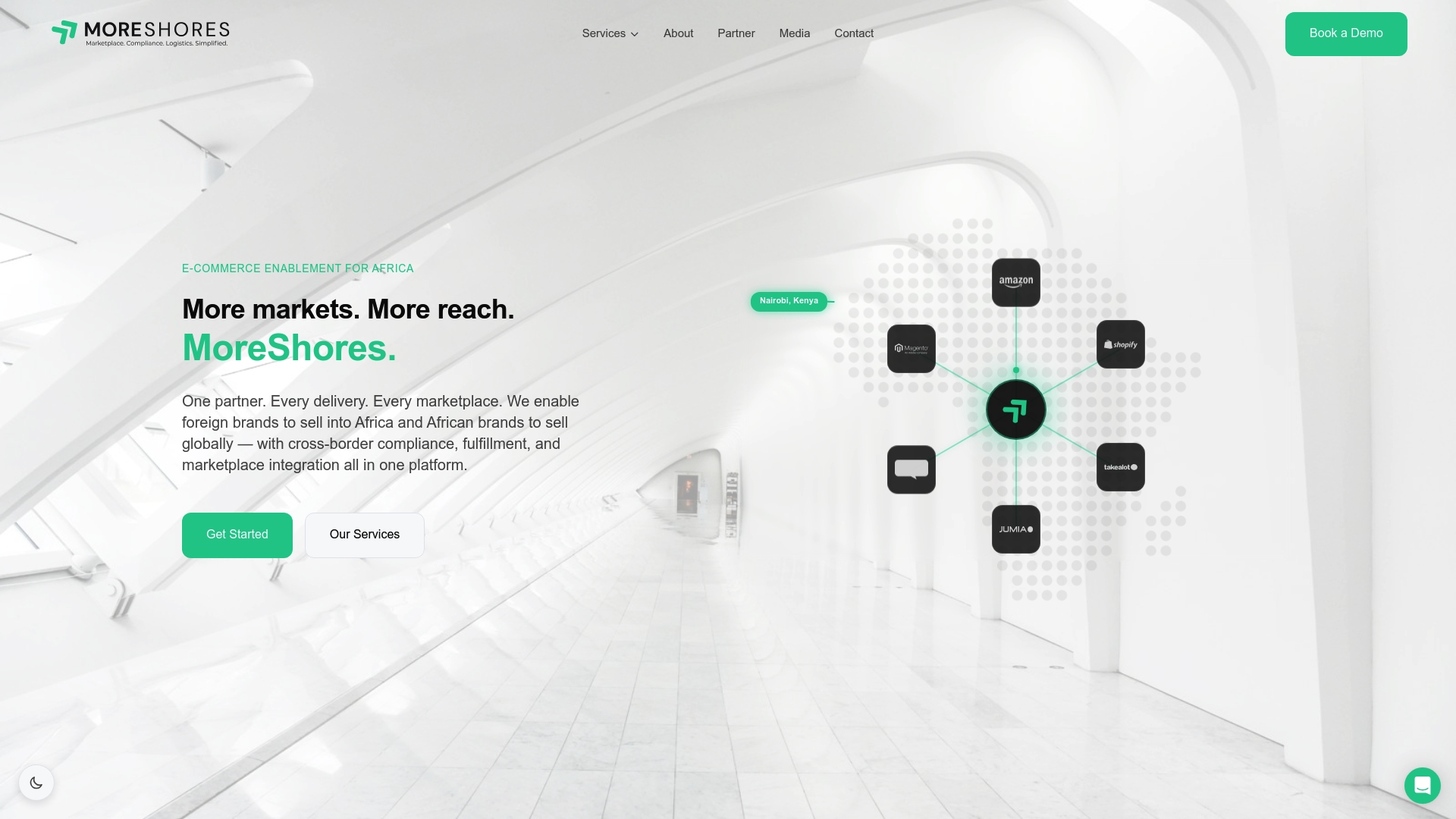
That IOR role connects directly to the rest of your operation. Moreshores pairs cross-border compliance with warehousing, multi-courier fulfillment, and marketplace listing across platforms like Takealot, Amazon SA, Jumia, and Kilimall, plus direct integration with Shopify and WooCommerce storefronts. Instead of piecing together a broker, a local registration, and a fulfillment partner separately, you get one accountable party covering entry filings, duty payment, and regulatory compliance under a single agreement.
If you’re offering DDP terms into a market where you have no local entity, or you’re simply tired of shipments stalling at customs, that’s the exact gap this fills. Check the cross-border enablement services Moreshores offers and request a quote to see what an IOR arrangement would look like for your specific product mix.
Sources
- CBP e‑commerce FAQs
- Exporter of Record vs Importer of Record: Key Differences - LegalClarity
- Incoterms and e‑commerce: Which rules work for cross‑border online sellers in 2026
- IOR numbers for Amazon FBA: key differences explained