In-House Fulfillment vs 3PL: When to Switch and Why
For most brands shipping under 200 orders a month, in-house fulfillment wins on cost and control. Cross past 500 to 1,000 monthly orders, and a third-party logistics provider (3PL) usually turns cheaper per order once you count labor, software, and shrinkage. The trigger is rarely volume alone. It’s whether your fully loaded cost per order and your need for multi-region reach still favor doing it yourself. The cost model and checklist below will help you run your own numbers.
TL;DR:
- Most brands benefit from switching to a 3PL once they process between 200 and 1,000 orders monthly, especially if multi-region reach and variable costs are factors.
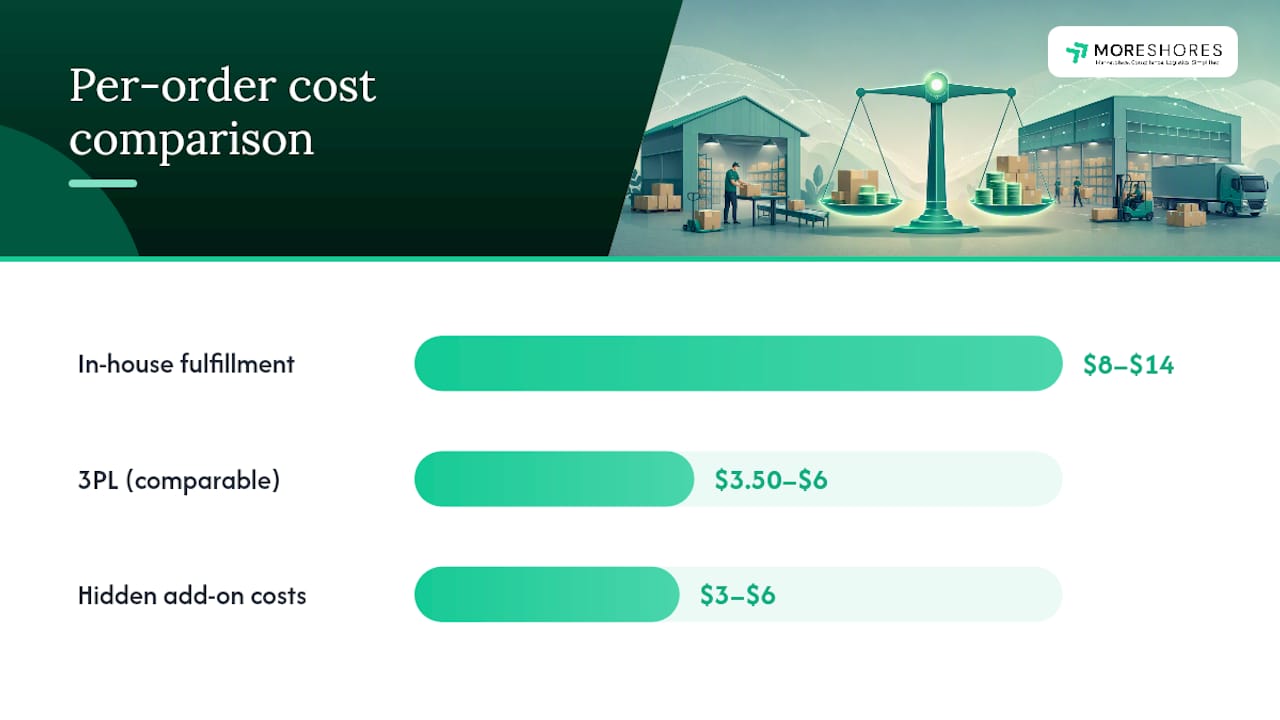
- Fully loaded in-house fulfillment costs often range from $8 to $14 per order, while 3PLs typically charge between $3.50 and $6, making the switch financially favorable beyond 500 orders.
- In-house control is essential for brands prioritizing custom packaging or unique unboxing, while 3PLs excel at handling seasonal spikes and expanding geographic reach.
- Transitioning to a 3PL usually takes 4 to 6 weeks, requiring careful selection, contract negotiation, inventory transfer, and parallel order routing to avoid stockouts.
- For cross-border markets, compliance layer issues such as customs and duties often push the outsourcing threshold earlier than domestic benchmarks.
Table of Contents
- In-House Fulfillment vs 3PL: A Quick Comparison
- What Does In-House Fulfillment Really Cost Per Order?
- When Should You Switch From In-House to a 3PL?
- How Do Brands Split Operations Between In-House and 3PL?
- How Do You Move From In-House Fulfillment to a 3PL?
- What the Data Doesn’t Tell You About This Decision
- How MoreShores Fits Into This Decision
- Sources
- FAQ
In-House Fulfillment vs 3PL: A Quick Comparison
Before running the math, most operators want a gut check. Here’s how the two models stack up across the factors that actually move the needle.
- Control: In-house fulfillment wins when you need custom unboxing, hand-written notes, or brand-specific packaging that a warehouse crew of strangers won’t replicate consistently.
- Cost structure: In-house costs are fixed-heavy (rent, salaries, equipment) regardless of order count; 3PL costs are variable, scaling up and down with volume.
- Scalability: A 3PL absorbs peak-season spikes without you hiring and training seasonal staff, converting a fixed labor problem into a variable expense.
- Geographic reach: Multi-node 3PL networks cut shipping zones and transit times; a single in-house warehouse ships everything from one point, which gets expensive fast for distant customers.
- Risk exposure: In-house risk is operational (staff turnover, compliance gaps); 3PL risk is contractual (SLA misses, hidden fees, less day-to-day visibility).
None of these factors decide anything alone. A brand with premium unboxing and only 150 orders a month should probably stay in-house even if a 3PL would be marginally cheaper, because the packaging experience is the product.
What Does In-House Fulfillment Really Cost Per Order?
The mistake almost every founder makes when comparing in-house fulfillment vs 3PL costs is pricing only rent and hourly wages. That number looks great on a spreadsheet and terrible in practice, because it leaves out the line items that quietly double your real cost.
A fully loaded in-house cost per order includes rent and utilities, loaded labor rates (wages plus payroll tax and benefits), workers’ compensation, warehouse management software, packaging materials, equipment depreciation, shrinkage, and the carrier rate you pay without volume leverage. It also includes something almost nobody puts on the spreadsheet: the opportunity cost of the founder or ops lead who spends afternoons packing boxes instead of running the business.
Once you add all of that, brands running mid-range volumes typically land between $8 and $14 per order in-house, while comparable 3PL pricing commonly falls in the $3.50 to $6 range depending on scale. Hidden costs like WMS licensing, management overhead, and unplanned overtime alone can add $3 to $6 per order to a naive rent-and-wages estimate. Much of that gap traces back to carrier rates: 3PLs negotiate volume discounts across many clients, and reducing shipping zones through multi-node distribution is often the single largest driver of savings once you outsource.
Break-even signal: Most brands see 3PL economics start competing with in-house costs around 200 to 500 orders per month, and the advantage becomes hard to ignore past 1,000 monthly orders once every cost line above is counted.
When Should You Switch From In-House to a 3PL?
The order-volume threshold isn’t a single number, it’s a band, and where you fall in it depends on your product and your team’s bandwidth.
Signs you should stay in-house:
- You’re shipping under roughly 200 orders a month and still have spare warehouse capacity.
- Your packaging or unboxing experience is a core brand differentiator that a third party can’t replicate.
- You already own the facility, equipment, and trained staff, so switching would strand sunk costs.
Signs a 3PL is worth it: 4. You’re consistently above 500 to 1,500 orders a month, the range where per-order savings usually outweigh setup friction. 5. You sell across multiple regions or face sharp seasonal spikes that would otherwise mean hiring and firing seasonal staff.
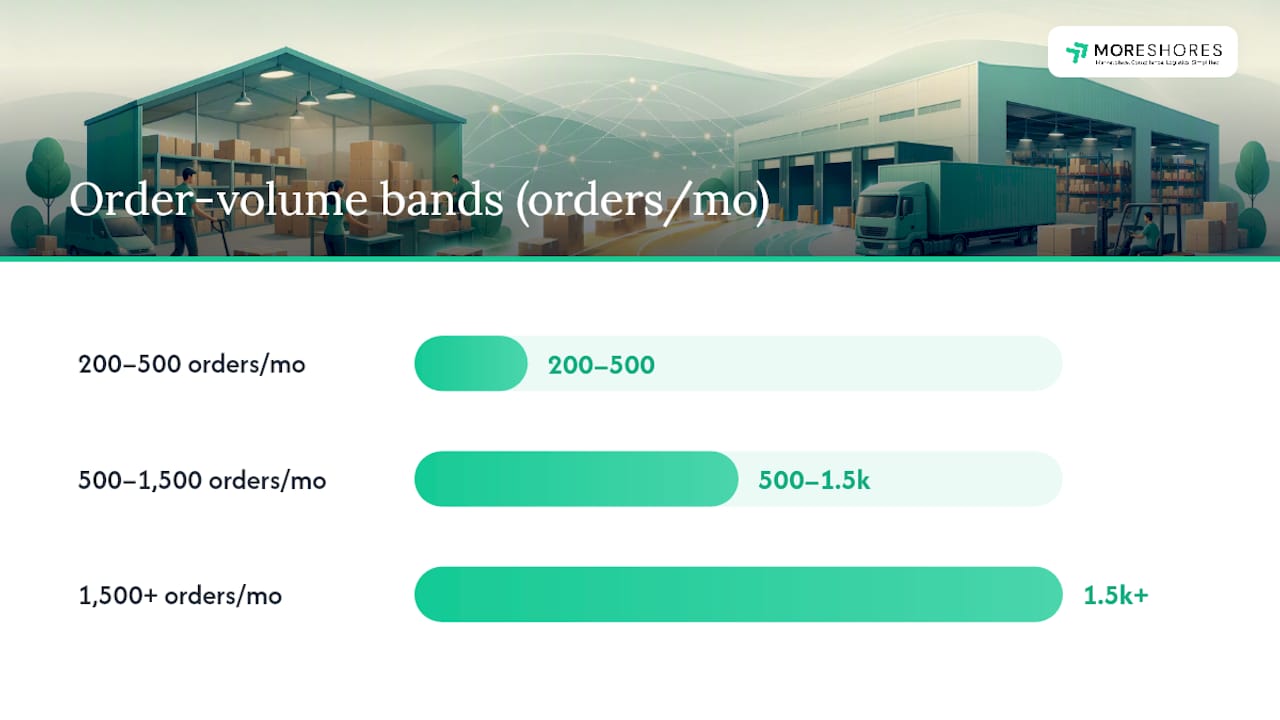
The research on order-volume thresholds shows real variance. Guides commonly cite 200 to 500 orders as the point where 3PL pricing starts competing, a 500 to 1,500 range as the zone where most brands feel the shift acutely, and 1,500-plus as the point where staying in-house usually requires a specific reason (like proprietary packaging) rather than habit.
Pro Tip: Calculate your true founder-time cost by multiplying the hours you or your team spend on fulfillment each week by your fully loaded hourly cost, not your salary alone. Most founders are shocked to find they’re paying themselves $15 an hour to do a job a 3PL would do for less.
How Do Brands Split Operations Between In-House and 3PL?
Few brands at scale run purely one model. Hybrid networks are common enough to be the default architecture once a brand crosses a few thousand monthly orders, and they take a few recognizable shapes.
- SKU split: high-touch or fragile items stay in-house; bulk, standardized SKUs ship through a 3PL network.
- Regional split: the home market stays in-house while distant or international orders route through 3PL nodes closer to the customer.
- Channel split: direct-to-consumer orders (where packaging matters for brand experience) stay in-house; wholesale and marketplace orders go through a 3PL.
Practitioner data suggests scaled brands often keep 10 to 20% of orders in-house for high-touch work while routing the remaining 80 to 90% through partners. The tradeoff is operational complexity: you now need inventory splits that reconcile across two systems, order-management routing logic, and unified reporting, plus a returns process that doesn’t confuse customers about where their package is going back to.
How Do You Move From In-House Fulfillment to a 3PL?
Switching is a project, not a flip of a switch, and rushing it is how brands end up with stockouts during the transition.
- Selection (1–2 weeks): Shortlist 3PLs by region coverage, integration compatibility, and published accuracy rates, ideally 99% or higher.
- Contracting and integration (1–2 weeks): Negotiate SLA terms, confirm system integration with your Shopify or WooCommerce storefront, and read the fee schedule line by line.
- Inventory transfer (1–2 weeks): Ship stock, verify barcodes, and confirm packaging specs match your brand standards.
- Parallel run (1–2 weeks): Route a sample of live orders through the new 3PL while keeping your in-house operation active, then reconcile inventory counts and SLA hit rates before full cutover.
Total onboarding typically runs 4 to 6 weeks for a standard brand, with some providers offering expedited 4 week timelines. Watch contracts for red flags: hidden per-item fees, minimum monthly order commitments that punish slow months, and vague liability language for lost or damaged inventory.
Pro Tip: Before you sign, ask for the exact SLA metrics they’ll report monthly, not just a verbal promise of “high accuracy.” If it’s not in writing, it’s not enforceable.
What the Data Doesn’t Tell You About This Decision
The comparison usually gets framed as a CapEx payback calculation, and that framing misses the point. The real question isn’t when a 3PL pays for itself on paper. It’s whether staying in-house is quietly consuming the hours you should be spending on product and customer acquisition, while your cash sits tied up in warehouse leases and headcount instead of inventory or growth.
Brands that get this decision wrong tend to make the same error in both directions: some cling to in-house fulfillment past the point of financial sense because switching feels like losing control, while others outsource too early, before they have the SKU volume to negotiate decent 3PL rates, and end up paying a premium for basic service. The order-volume bands here are directional guidance, not law. A brand with three fragile SKUs and complex kitting needs might stay in-house at 2,000 orders a month, while a brand with a single simple product might outsource at 300. Cross-border sellers face an added wrinkle most domestic-only guides never mention: customs compliance and Importer of Record obligations don’t scale the way domestic fulfillment does, and that alone can push the breakeven point earlier than the standard thresholds suggest.
— Matt
How MoreShores Fits Into This Decision
If your analysis points toward outsourcing, particularly for cross-border selling into African markets, the friction is rarely the fulfillment math. It’s the compliance layer that domestic-only 3PL comparisons never mention: customs clearance, duties, VAT, and the fact that most providers require a local entity before they’ll even talk to you.
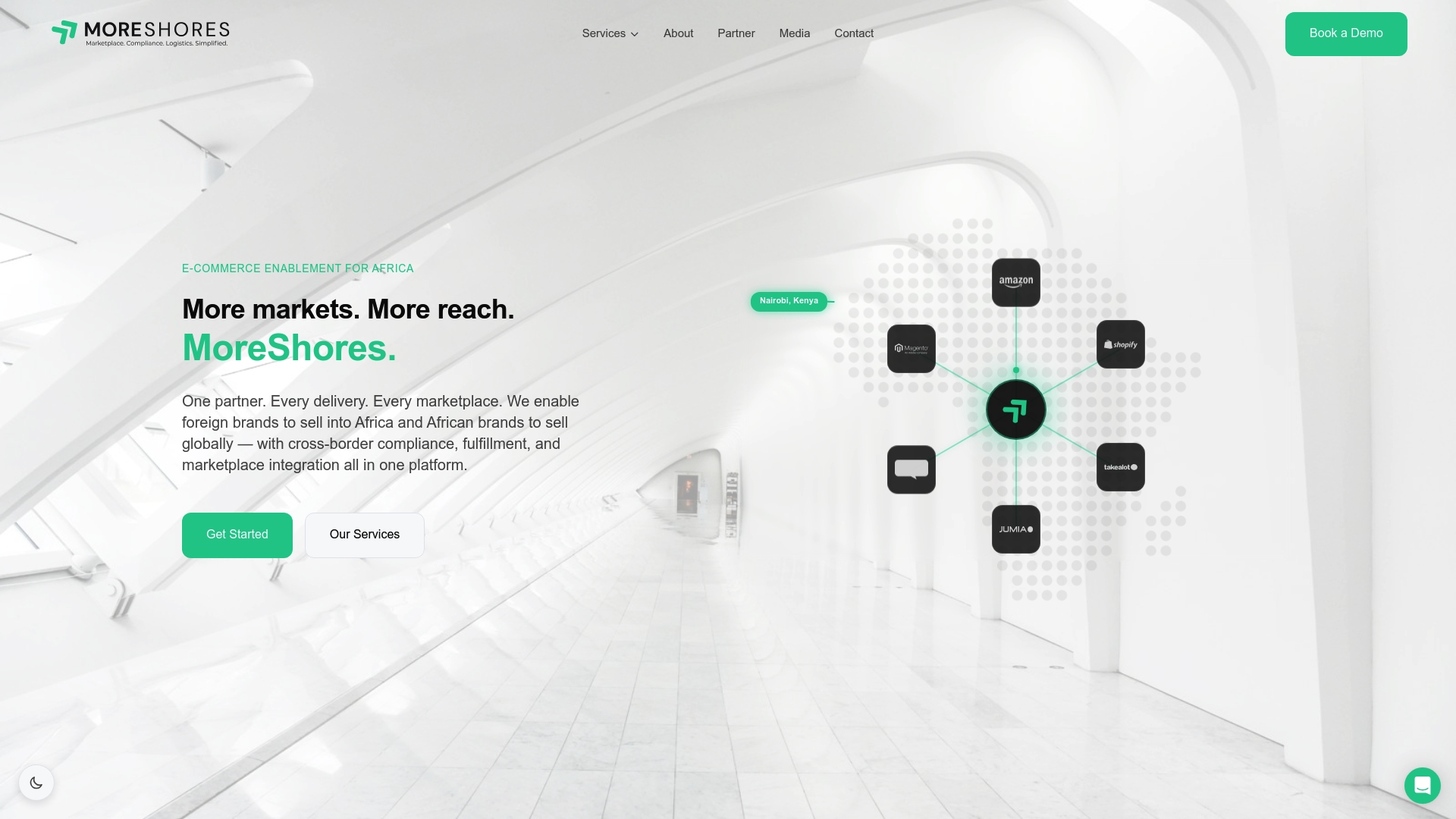
MoreShores is the alternative to piecing together separate customs brokers, warehouses, and marketplace listings. It replaces that fragmented setup with one contract covering Importer of Record and compliance, warehousing and multi-courier fulfillment, and listing integration across marketplaces like Takealot, Amazon SA, Jumia, and Kilimall, all visible from a single dashboard. You don’t need a local entity or separate agreements with brokers and couriers to get started. If the volume math above points you toward outsourcing and your growth plan includes African or cross-border markets, request pricing details on the MoreShores pricing page and see what a pilot with your SKUs would actually cost.
Sources
- In-House Fulfillment vs. 3PL: Which Is Right? (2026)
- In-House Fulfillment vs. 3PL: Which Is Right for Your Brand? | ShipMonk
- 3PL vs In-House Fulfillment: Which Is Right? | Lite Fulfillment
- Whether to Outsource Fulfillment to a 3PL or Keep In-House (Essendant)
FAQ
Is Amazon a 3PL or a 4PL?
Amazon’s FBA program functions as a 3PL because it handles physical storage, picking, packing, and shipping on behalf of sellers. It’s not a 4PL, which would mean managing your entire supply chain strategy and coordinating other logistics providers on your behalf rather than executing fulfillment directly.
What Are the Disadvantages of Using a 3PL?
The main drawbacks are reduced day-to-day control over packaging and unboxing experience, dependency on someone else’s SLA performance, and less visibility into daily warehouse operations. Contracts can also carry hidden fees or minimum order commitments that hurt during slow months.
What Is a Typical 3PL Fulfillment Fee?
Fully loaded 3PL fulfillment costs commonly fall in the $3.50 to $6 per order range, depending on order volume and service level. MoreShores charges a $950 one-time market-entry setup fee plus per-order pick, pack, and box charges starting at 18.00 ZAR for the first item, with current full pricing listed on its site.
What’s the Difference Between 3PL, 4PL, and 5PL?
A 3PL executes physical logistics like warehousing and shipping for a single client relationship. A 4PL manages and coordinates multiple logistics providers and the broader supply chain strategy on a client’s behalf. A 5PL operates at a higher level still, typically managing supply chain networks across multiple clients and industries, though the term is used less consistently across the industry.
How Many Orders a Month Justify Switching to a 3PL?
Most brands see 3PL pricing start competing with in-house costs around 200 to 500 orders per month, with the advantage becoming clear-cut past 1,000 orders once every fully loaded cost is counted. Product complexity and packaging needs can shift that threshold earlier or later for individual brands.