Avoid Voided IOR Numbers in 2026: U.S. Importer of Record Requirements
The importer of record (IOR) is the person or company legally accountable to CBP for the entry, classification, valuation, and duty payment on every shipment it brings into the country. Meeting importer of record requirements starts with three non-negotiables: a valid IOR identity on file with CBP, an adequate customs bond, and accurate entry filings backed by a signed power of attorney if a broker is involved. Enforcement tightened in 2026, and CBP now verifies importer identity data far more aggressively than it did even two years ago.
TL;DR:
- CBP now verifies importer identity data more aggressively, with the potential to void IOR numbers if inaccuracies are found, halting shipments until corrected.
- Maintaining an up-to-date Form 5106 is crucial, especially after any change in address or contact details, to avoid compliance issues or shipment delays.
- A customs bond is mandatory before entry filing, with continuous bonds preferred for regular importers to reduce paperwork and ensure coverage for multiple shipments.
- Major government agencies like FDA, EPA, CPSC, and FCC may review shipments, requiring pre-clearance or specific documentation to prevent multi-week holds.
- Expect stricter enforcement in 2026, with CBP increasing oversight of IOR data accuracy and dependence on proper recordkeeping for audit readiness.
Table of Contents
- What Are an Importer of Record’s Legal Duties?
- How Do You Register as an Importer of Record?
- Bonds, POA, and Entry Filing Deadlines
- Which Government Agencies Also Have a Say?
- What Changed With the 2026 Importer of Record Enforcement Update?
- Keeping Your Import Program Audit-Ready
- Let MoreShores Handle Your Import of Record Requirements
- Sources
- FAQ
What Are an Importer of Record’s Legal Duties?
CBP holds the IOR to a standard called “reasonable care.” That phrase carries real legal weight under 19 U.S.C. 1484, which requires the importer, not the broker, not the supplier, to use reasonable care in classifying and valuing goods and to file entry documents that hold up under audit.
Hiring a licensed customs broker does not transfer that liability. The broker prepares the paperwork; the IOR still owns the outcome. If a broker misclassifies a product or misses a required certificate, CBP pursues the importer of record first.
The most common compliance failures are predictable:
- HTS misclassification that understates duty owed
- Undervaluation of goods, often from stale or incomplete commercial invoices
- Unreported assists, meaning tools, molds, or design work a buyer supplies to a foreign manufacturer at no charge, which must be added to declared value
Pro Tip: Ask every supplier directly whether your company has furnished any tooling, artwork, or engineering support free of charge. Unreported assists are one of the most frequent findings in CBP audits, and back duties plus penalties can follow years later. This exact exposure shows up in CBP’s own valuation enforcement guidance.
Recordkeeping is not optional. The IOR must retain entry summaries, invoices, powers of attorney, and supporting valuation documents for five years from the date of entry, and CBP can request them at any point during that window under 19 CFR 24.5.
How Do You Register as an Importer of Record?
Every importer needs an identity on file with CBP before goods can clear. That happens through CBP Form 5106, which creates or updates your importer record in CBP’s Automated Commercial Environment (ACE).
- Gather your identifiers. CBP accepts an EIN, a Social Security number for sole proprietors, or a CBP-assigned number (CAIN) for entities without either.
- Complete the data fields. Form 5106 requires the legal importer name, the chosen identifier, mailing and physical addresses, and a working phone number and email.
- Submit through ABI or a CBP Center. Brokers typically file Form 5106 electronically through the Automated Broker Interface (ABI); importers without broker access can submit directly to a CBP Center of Excellence and Expertise.
- Confirm foreign-entity requirements. Overseas companies acting as IOR generally need a resident agent or a U.S. point of contact, since CBP wants a reachable party inside the country.
- File before your first entry. Form 5106 needs to be on record before, or at the very latest concurrent with, your first formal entry, or the shipment sits at the port.
Bonds, POA, and Entry Filing Deadlines
You cannot make a formal entry without a customs bond in place first. A single-entry bond covers one shipment and works for occasional importers. A continuous bond covers all entries over a 12-month period and makes sense once you’re importing regularly, since it avoids buying a new bond for every shipment. Continuous bonds carry minimum face amounts set by CBP based on projected duties, taxes, and fees, and CBP can call on that bond directly if the importer fails to pay what’s owed.
A power of attorney lets a licensed customs broker file entries on your behalf, but it changes nothing about who CBP holds liable. You sign the POA directly with the broker, not with CBP, and the broker’s authority to act for you never substitutes for your own duty to review what gets filed.
Key filing obligations and their rough windows:
- Entry/Immediate Delivery (CBP Form 3461): filed at or before arrival to release cargo
- Entry Summary (CBP Form 7501): due within 10 working days of entry, along with estimated duties
- Importer Security Filing (ISF): required for ocean shipments at least 24 hours before vessel loading; late or inaccurate filings can trigger significant penalties
Pro Tip: Set an internal deadline two days ahead of every ISF cutoff. A broker waiting on missing data from you is the most common reason ISF filings slip past the 24-hour mark.
Which Government Agencies Also Have a Say?
CBP is rarely the only regulator with a claim on your shipment. Depending on the product, one or more Participating Government Agencies (PGAs) review the entry alongside CBP, and their data has to move through ACE at the time of filing.
- The FDA reviews food, cosmetics, and medical devices, often requiring prior notice before arrival
- The EPA checks vehicles, engines, and certain chemicals for emissions and toxic substance compliance
- The CPSC enforces safety standards on consumer products, especially anything marketed to children
- The FCC requires equipment authorization data for most electronics with radio frequency components
Build a short pre-shipment checklist: confirm product-specific labeling, gather any required certificates before the goods leave origin, and check whether preclearance applies to your commodity. Missing PGA data is among the fastest ways to turn a routine entry into a multi-week hold.
What Changed With the 2026 Importer of Record Enforcement Update?
CBP’s identity verification just got a lot stricter. A Federal Register notice implementing Executive Order 14411 directs CBP to actively verify the accuracy of the data importers submit on Form 5106, with certain enforcement measures taking effect September 18, 2026.
The practical fallout: CBP can now void an importer’s IOR number outright if it finds inaccurate identity data on file. A voided number stops shipments cold until the record gets corrected and resubmitted. Expect higher bonding and disclosure demands going forward, since the regulatory direction clearly favors proving “good standing” rather than assuming it.
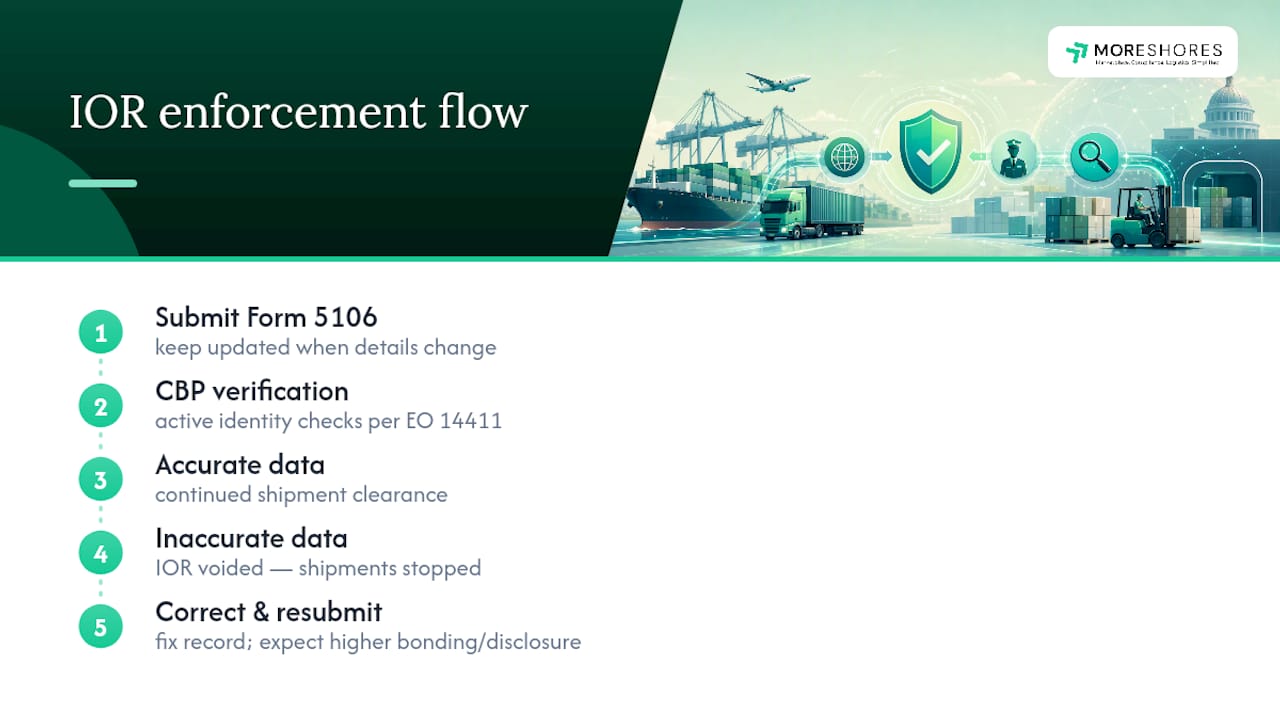
The fix is unglamorous but effective: keep Form 5106 current every time your address, contact, or entity structure changes, and treat your CBP identity record the same way you’d treat a bank account, something you check, not something you set once and forget.
Keeping Your Import Program Audit-Ready
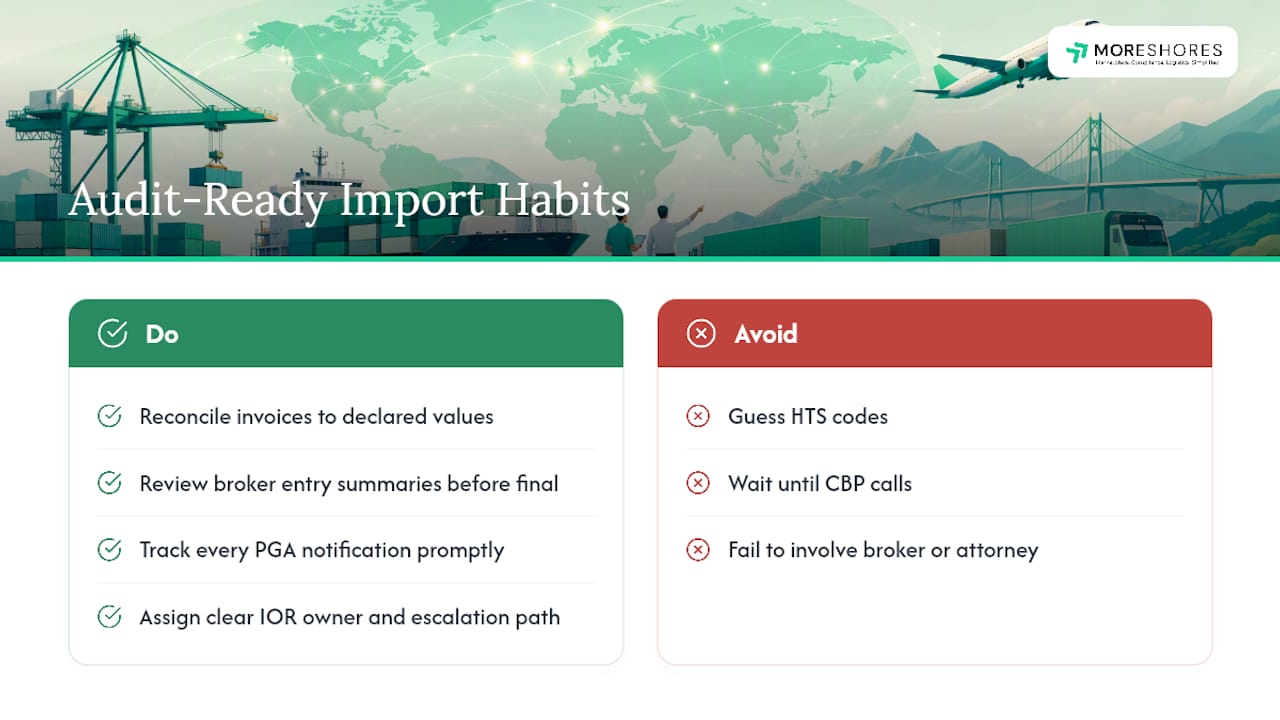
Meeting importer of record requirements is less about one big filing and more about a weekly habit. Reconcile vendor invoices against declared values, review broker entry summaries before they’re final, and track every PGA notification that lands in your inbox.
Escalate to a binding ruling or lab test whenever classification is genuinely unclear, guessing on HTS codes is how audits start. Someone in your organization, whether that’s a compliance officer or an operations lead, needs to own IOR responsibilities outright, with a clear path to pull in a customs broker or attorney when a shipment looks off. Waiting until CBP calls is the expensive way to find out you needed a checklist.
— Matt
Let MoreShores Handle Your Import of Record Requirements
Meeting every importer of record requirement in house means staffing for Form 5106 updates, bond renewals, POA management, and PGA coordination, on top of actually running your business. Some merchants prefer to centralize their compliance burden rather than managing it across multiple vendors and spreadsheets.

Acting as importer of record means MoreShores manages the entry filings, secures the appropriate bond, and handles the paperwork foreign brands often struggle with when they lack a U.S. resident agent. That same infrastructure connects directly to warehousing and fulfillment, so cleared goods move straight into inventory without a second logistics handoff, and into marketplace listings on channels like Takealot, Amazon SA, Jumia, and Kilimall. If you’re expanding into or out of African markets and want one partner covering customs clearance and compliance from entry to shelf, reach out for a compliance review of your current import setup.
Sources
- Tips for New Importers and Exporters | U.S. Customs and Border Protection
- Accuracy of importer of record data submitted to CBP | Federal Register
FAQ
Who Should Be Listed as the Importer of Record?
The IOR is the owner, purchaser, or consignee of the goods, or a licensed customs broker acting on that party’s behalf, and it must be the entity with a valid identity on file with CBP under Form 5106.
What Is the Difference Between an Importer and an Importer of Record?
“Importer” is a general term for anyone bringing goods into the country, while the importer of record is the specific, legally accountable party CBP holds responsible for entry accuracy, duty payment, and compliance under 19 U.S.C. 1484.
Can the Importer of Record Be Different Than the Consignee?
Yes. The consignee is typically the party receiving the goods, while the importer of record is the party legally responsible to CBP, and businesses often use a third-party IOR like MoreShores when they lack a U.S. presence or bonding capacity.
Is Importer of Record the Same as an EIN?
No. An EIN is one of several identifiers CBP accepts to establish an importer’s identity on Form 5106, alongside a Social Security number or a CBP-assigned number, but the IOR is the legal role itself, not the identifying number.