8 Digit South African HS Codes: Verify Check Digit Before Shipping

A South African HS code runs eight digits: the international six-digit Harmonized System code, plus two national digits South Africa adds for local duty and permit purposes, plus a separate check digit used on customs declarations. You cannot guess this from a generic HS lookup. Confirm the full code, its duty rate, and any linked permits on the SARS tariff lookup before you ship or file anything.
TL;DR:
- Confirm the full 8-digit South African HS code, including the check digit, before shipping or claiming any duty or permits.
- Use the SARS Tariff Book and official Schedule 1 tariff document for accurate classification and to identify duty rates and restrictions.
- Cross-check the South African code with the USHTS six-digit base to avoid classification errors that can lead to delays or penalties.
- Apply for a tariff determination proactively for ambiguous products to protect against reclassification delays and fines.
- Regularly review current SARS tariff updates, as amendments are issued multiple times a year and outdated codes can cause costly delays.
Table of Contents
- Where to Find South African HS Codes: Official Tools and Backups
- How the 8-Digit Format Maps to the Global HS and U.S. HTS
- How Do You Classify Goods Correctly Under South African Customs Rules?
- What Duties, VAT, and Permits Attach to Your HS Code
- A Step-by-Step Workflow for Looking Up and Filing HS Codes
- How Often Do South African Tariff Codes Change?
- How HS Codes Interact With SADC, SACU, and AGOA
- Practical Examples: Classifying Common Goods for South African Trade
- What Happens When You Declare the Wrong HS Code?
- Why HS Codes Sit at the Center of Every Customs Clearance
- Why Most Importers Underestimate Classification Risk
- How MoreShores Handles Classification So You Don’t Have To
- Sources
- FAQ
Where to Find South African HS Codes: Official Tools and Backups
The SARS Tariff Book is the only source that legally matters for a South African import or export declaration. It’s structured around 99 chapters, following the standard Harmonized System layout, and you can search it two ways: by product keyword or by the six-digit HS base if you already know your global code from a supplier invoice or a U.S. export document.
The SARS Tariff page links to the current Schedule 1 tariff document, which lists duty rates, VAT treatment, and any special notes tied to a specific tariff line. If you’re comfortable working with a long PDF, download it and use Ctrl+F to jump straight to a heading rather than scrolling chapter by chapter. Searching by material or function (“polyethylene sheeting,” “stainless steel fasteners”) usually gets you to the right chapter faster than guessing a heading number.
Third-party databases can speed up early research, especially when you’re not yet sure what chapter you’re in. A tool like hscodedb’s South Africa tariff search indexes the current schedule with duty rates and clearance notes attached to each line, which is useful for a first pass. Treat it as a starting point, not the final answer.
A few habits that save time later:
- Save the full 8-digit code plus the check digit, not just the 6-digit HS base, since customs systems reject incomplete entries.
- Screenshot or save the specific tariff line notes, since they often reference permits or exclusions that aren’t obvious from the duty rate alone.
- Cross-check any third-party result against the official schedule before it goes on a customs declaration.
How the 8-Digit Format Maps to the Global HS and U.S. HTS
Every HS code in the world starts the same way. The World Customs Organization sets a universal six-digit structure that over 200 countries and territories use as their base classification system. South Africa builds its national tariff on top of that shared foundation:
- Digits 1-2: the chapter (broad category, like “84” for machinery)
- Digits 3-4: the heading (a narrower group within that chapter)
- Digits 5-6: the subheading, which is where global harmonization ends
- Digits 7-8: South Africa’s own tariff subdivision, used for national duty rates and permit triggers
- A 9th check digit: appended for South African customs declarations, verifying the code was entered correctly
This matters most for U.S. exporters. Your Schedule B or Harmonized Tariff Schedule code shares the same first six digits as the South African version, and the USITC’s HTS search tool is a solid way to confirm that base code before you ship. But the U.S. six digits tell you nothing about South Africa’s national extension, duty rate, or whether a permit applies. Skipping that last step is where most classification errors on U.S. to South Africa shipments actually happen.
How Do You Classify Goods Correctly Under South African Customs Rules?
Classification isn’t a matter of opinion. SARS applies the General Rules for the Interpretation of the Harmonized System, a fixed sequence of six rules you work through in order, stopping as soon as one applies. Rule 1 looks at the heading text and any chapter notes. Rule 2 covers incomplete or unassembled goods. Rule 3 resolves cases where a product could fit more than one heading. The HS Explanatory Notes (HSEN) back up each rule with detailed guidance on what belongs where, right down to material composition and intended use.
For most straightforward products, a short checklist gets you there:
- Identify what the product is made of and how it’s built.
- Identify what it’s actually used for, not what it’s marketed as.
- Search the tariff by that function or material to find candidate headings.
- Read the chapter and section notes for exclusions before you commit to a code.
- If two headings still seem to fit, apply GIR 3 or escalate to SARS for a determination.
The most common mistakes aren’t exotic. Importers write vague product descriptions that leave customs officers to guess. They copy a national tariff extension straight from another country’s schedule, assuming the digits carry over. They classify by brand name or marketing language instead of function. Any of these can trigger reclassification, back duties, or a shipment held at port.
When a product genuinely sits between two headings, or the value at stake justifies the certainty, apply for a written tariff determination from SARS. A binding determination gives you a documented, defensible classification that protects against later penalties, provided you keep it on file with your import records.
Pro Tip: Apply for a tariff determination before your first shipment lands, not after customs flags it. A ruling obtained proactively carries far more weight than one requested to defend a classification that’s already under dispute.
What Duties, VAT, and Permits Attach to Your HS Code
Your HS code is the trigger for everything that follows financially. Get the code wrong and both numbers shift, sometimes significantly.
Duty rate is rarely the only thing riding on a code. Several other measures attach to specific tariff lines:
- Anti-dumping and countervailing duties on certain imported goods, particularly from specific origin countries
- Excise duties on products like alcohol, tobacco, and some fuel or vehicle categories
- Import permits from bodies like the International Trade Administration Commission (ITAC) for controlled goods
- NRCS or SABS compliance requirements for electronics, electrical goods, and certain consumer products
This trips up more first-time importers than the duty math itself. Some tariff entries carry linked notes flagging permit requirements or exclusions that don’t show up unless you read the full line, not just the headline duty percentage.
Always open the specific tariff schedule entry and read any attached notes before you commit to sourcing or pricing. That single step catches most of the surprise costs that show up at clearance.
A Step-by-Step Workflow for Looking Up and Filing HS Codes
Repeat importers eventually build a rhythm. First-timers need a checklist:
- Gather full product specs: material, function, dimensions, and intended use.
- Search SARS by keyword or by the six-digit HS base if you already have one from a supplier or U.S. export document.
- Confirm the full South African 8-digit code plus the check digit, not just the international base.
- Read the tariff line notes for permits, excise, or anti-dumping flags.
- Save the invoice, tech spec sheet, and tariff screenshot together for your records.
U.S.-based exporters researching their side of the shipment can use CROSS rulings and USITC resources to confirm the outbound HS base, but that only covers the shared six digits. The South African extension still needs its own lookup.
If you’re working with a broker or an Importer of Record, send them product photos, the technical data sheet, and the commercial invoice upfront. That’s usually enough for fast, accurate classification without back-and-forth delays. When a product is genuinely ambiguous or high-value, that’s the point to request a binding determination rather than guess and hope.
How Often Do South African Tariff Codes Change?
South Africa’s tariff schedule isn’t static. SARS issues amendments through the Government Gazette on a rolling basis, sometimes several times a year, driven by trade negotiations, ITAC recommendations, anti-dumping investigations, or WCO-driven updates to the global HS nomenclature itself. The WCO revises the international six-digit structure periodically, and when it does, every member country including South Africa has to update its national schedule to match.
The practical risk is using an outdated code from an old invoice, an old broker email, or a cached search result.
The safest habit is checking the current SARS Tariff Book at the time of each shipment, not relying on a code you used successfully six months ago. If you import the same product regularly, it’s worth a quarterly recheck even when nothing seems to have changed on your end. Amendments often get published with little advance notice, and the burden of using the correct current code sits with the importer, not with SARS. Subscribing to SARS trade notices or working with a broker who monitors gazette updates is the most reliable way to catch a change before it costs you at the port.
How HS Codes Interact With SADC, SACU, and AGOA
Your HS code doesn’t just set the duty rate. It’s also the key that unlocks preferential treatment under the trade agreements South Africa participates in.
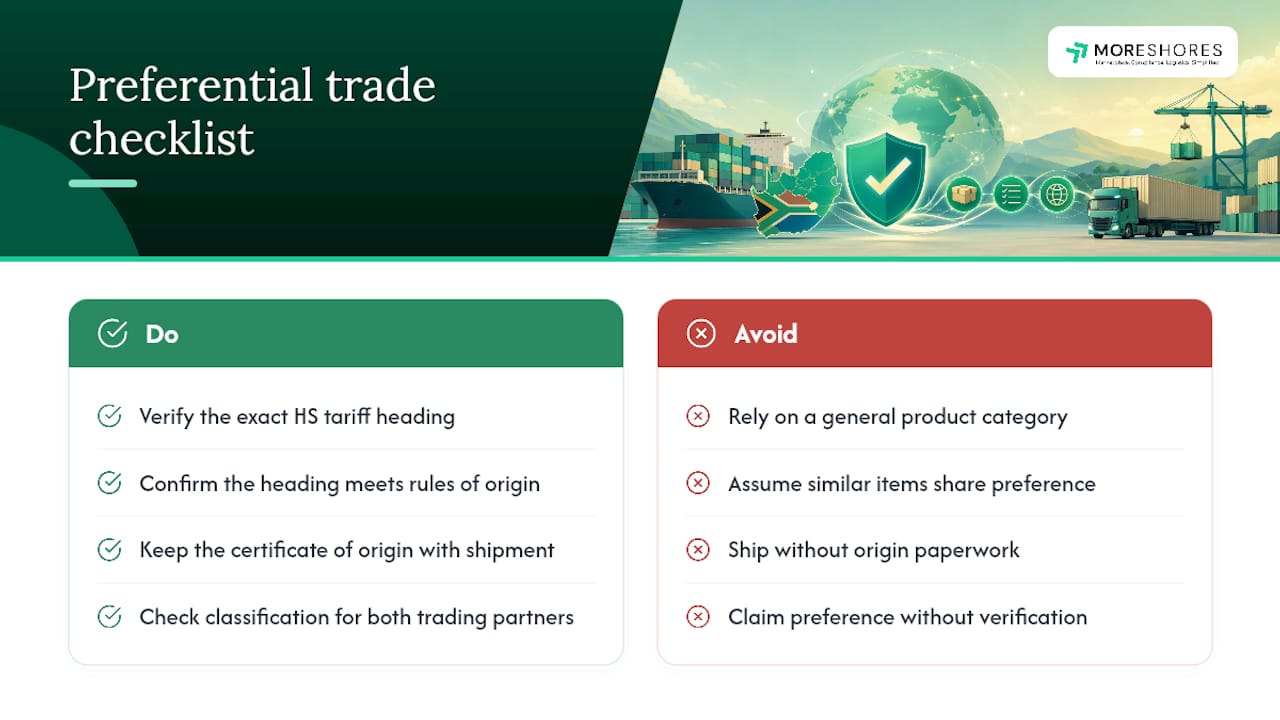
Within the Southern African Development Community (SADC) and the Southern African Customs Union (SACU), goods that meet rules-of-origin requirements can move between member states at reduced or zero duty. But that preference is tied to the specific tariff heading, not the product category in general. Two similar products in different subheadings can get different treatment even if they seem interchangeable to a non-specialist.
For U.S. exporters, the African Growth and Opportunity Act (AGOA) offers duty-free access to the U.S. market for many South African-made goods, again gated by HS classification and origin rules. Getting the tariff heading wrong on either end of that relationship can mean paying a duty you didn’t need to pay, or worse, having a shipment denied preferential treatment retroactively.
The practical takeaway: if you’re claiming a preference under any of these agreements, don’t just get the HS code right. Confirm that the specific heading you’ve landed on actually qualifies under that agreement’s rules of origin, and keep the supporting certificate of origin with your shipment documents. A correct code without the matching origin paperwork won’t get you the preferential rate.
Practical Examples: Classifying Common Goods for South African Trade
A few worked examples show how the same product logic plays out differently depending on composition and use.
Cotton t-shirts typically fall under Chapter 61 (knitted apparel), with the specific heading depending on whether they’re men’s, women’s, or unisex, and the fiber content.
Solar panels generally classify under Chapter 85, covering electrical machinery, but the exact subheading depends on whether you’re importing complete photovoltaic modules, individual cells, or mounting hardware shipped separately. Mounting hardware often falls into a completely different chapter tied to base metal fittings.
Cosmetics and skincare sit in Chapter 33, but function matters here more than packaging. A moisturizer with sunscreen claims can trigger different documentation than a plain moisturizer, since active ingredient percentages sometimes affect both classification and NRCS or health-related import requirements.
Auto parts are notoriously tricky. A single vehicle can require parts classified across several different headings in Chapter 87, and mislabeling a part as “general machinery” instead of “motor vehicle parts” is one of the more common reclassification triggers SARS catches on inspection.
The pattern across all four: composition and function decide the heading, not what the product is called on the invoice.
What Happens When You Declare the Wrong HS Code?
Misclassification carries real consequences, and they escalate the longer they go unnoticed. At the mild end, SARS reclassifies the shipment and adjusts duty owed, which can mean an unexpected bill after the goods have already cleared. At the more serious end, repeated or deliberate misclassification can trigger penalties, and customs holds the shipment at port while the dispute gets resolved, which racks up storage and demurrage fees fast.
Customs delays from an incorrect code aren’t just an inconvenience. A container sitting at a South African port while SARS re-examines the classification can cost more in storage fees over a week than the disputed duty amount itself. For e-commerce sellers running tight fulfillment timelines, that kind of delay can mean missed marketplace listing deadlines or stockouts.
If you disagree with a reclassification, South Africa’s customs framework allows for a formal dispute process, starting with an internal appeal to SARS and escalating to the Alternative Dispute Resolution process or the courts if unresolved. This process takes time, which is exactly why getting the classification right upfront, or securing a binding tariff determination in advance for ambiguous products, is so much cheaper than fighting a reclassification after the fact.
Why HS Codes Sit at the Center of Every Customs Clearance
Every customs clearance document in South Africa is built around the HS code you declare. It’s the field that determines which duty rate applies, whether VAT calculations are correct, and whether the shipment needs a supporting permit before it’s released.
The standard clearance package includes a commercial invoice, packing list, bill of lading or airway bill, and the customs declaration itself (the SAD 500 form), and the HS code appears on nearly every one of these documents. A mismatch between the code on your invoice and the code on your declaration is one of the fastest ways to trigger a manual customs review instead of automated clearance.
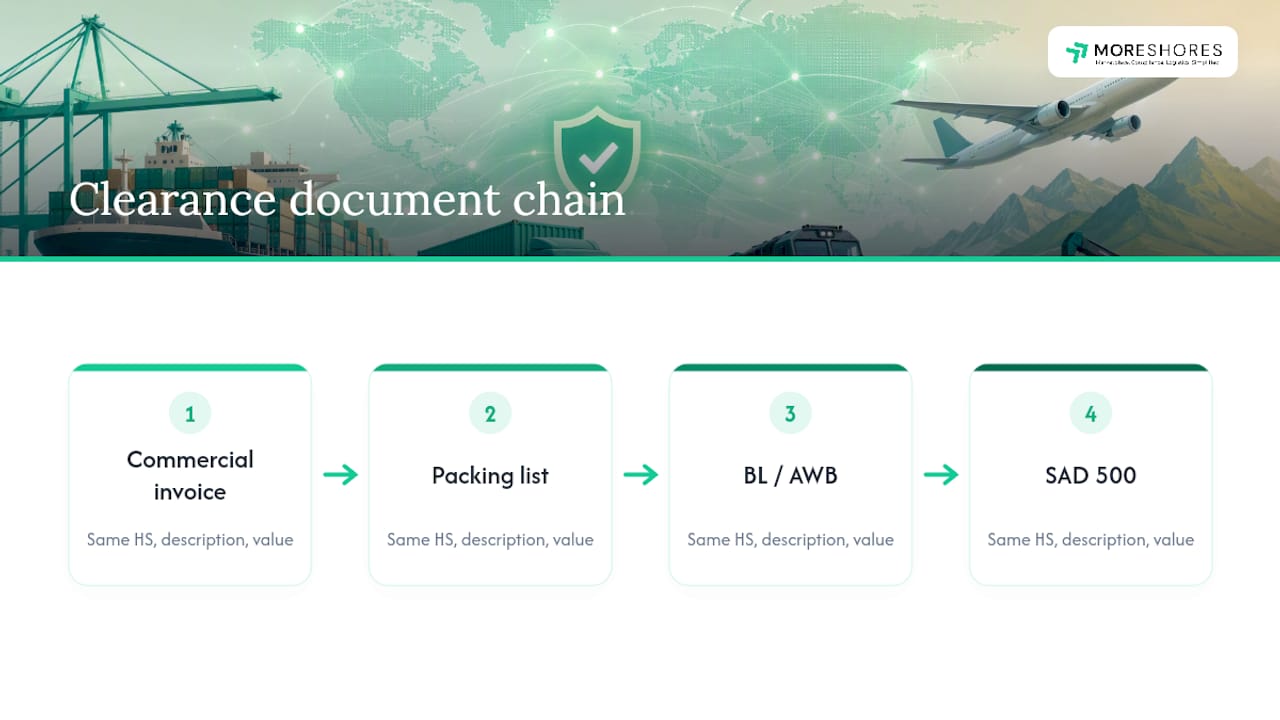
Getting the documentation chain consistent, same code, same product description, same value, across every document in the package is often what separates a same-day clearance from a multi-day hold.
Why Most Importers Underestimate Classification Risk
Most guides treat HS classification as paperwork: fill in a number, move on. That framing misses what actually happens on the ground. The code you choose sets your duty rate, decides whether a permit applies, and determines whether your goods qualify for a trade agreement preference. Get it wrong, and you’re not just fixing a form. You’re unwinding a shipment that’s already at port, sometimes with penalties attached.
The businesses that get burned aren’t usually careless. They’re moving fast, working from a supplier’s invoice description, or reusing a code that worked for a similar product last time. That’s a reasonable shortcut for repeat, low-value shipments. It’s a costly one for anything high-value, multi-component, or regulated, where a small classification difference changes the duty rate or triggers a permit requirement nobody checked for.
That’s where outsourcing makes practical sense. An Importer of Record files the classification, handles duty and VAT calculation, and manages any permit requirements on your behalf, which matters most for marketplace sellers listing across multiple countries or anyone shipping regulated products where a misstep means a held container, not just a paperwork fix.
— Matt
How MoreShores Handles Classification So You Don’t Have To
Getting an HS code wrong costs more than a corrected duty bill. It costs the week your shipment sits at port while SARS sorts out the reclassification. MoreShores acts as your Importer of Record for shipments into South Africa, handling classification, duty and VAT filings, and permit compliance so you’re not the one deciphering tariff notes at 11 PM before a shipment deadline.
That coverage extends past clearance. Once your goods land, warehousing, multi-courier fulfillment, and marketplace listing across platforms like Takealot, Amazon SA, and Jumia can be managed, so classification is one link in a chain that’s already built, not a separate problem you solve alone each time. If you’re planning a shipment into South Africa and want the HS code, duty exposure, and permit requirements checked before you commit to a purchase order, reach out to MoreShores for a classification and landed-cost review.
Sources
- Tariff | South African Revenue Service
- HS Nomenclature 2022 edition — World Customs Organization
- Harmonized Tariff Schedule (HTS) search — USITC
FAQ
How do I find an HS code in South Africa?
Search the SARS Tariff Book by product keyword or by the six-digit international HS base, then confirm the full 8-digit South African code plus check digit before filing.
How do I find a HS code in general?
Identify what the product is made of and what it’s used for, then search a national tariff schedule or a tool like hscodedb using that description; the first six digits are the same worldwide under the WCO system.
What is a tariff code in South Africa?
A South African tariff code is the country’s national extension of the international Harmonized System: the standard 6-digit HS base plus two South African digits and a check digit, totaling eight digits used on customs declarations.
Is there a customs tariff book for 2026 available?
Yes. SARS maintains a current Schedule 1 tariff document accessible through its official tariff page, updated through Government Gazette amendments as duty rates and classifications change.
Do I need a broker to classify goods correctly?
Not always for simple, low-value shipments, but complex, multi-component, or regulated products benefit from a broker or an Importer of Record who can request a binding tariff determination when the classification is genuinely unclear.