How to reduce trade costs for e-commerce expansion

TL;DR:
- Trade costs for cross-border e-commerce are driven by logistics, regulatory, and information frictions, not just tariffs.
- Optimizing corridor selection, border procedures, and digitalizing processes can significantly reduce these layered costs across African markets.
Landing your product in a customer’s hands across borders costs more than most e-commerce managers expect. Between freight quotes that shift weekly, unpredictable border delays, and compliance requirements that vary by corridor, high landed costs routinely stall expansion plans before they get traction. The good news is that trade costs are not fixed. They are a layered system of logistics, regulatory, and information frictions that respond to targeted action. This guide breaks down exactly where those costs live, which levers move the needle fastest, and how to stack operational, digital, and policy strategies for sustained savings in African and global markets.
Table of Contents
- Understand what drives trade costs
- Optimize logistics and border operations
- Leverage digital tools and automation for savings
- Exploit trade policy and facilitation improvements
- Why targeting only tariffs misses the real cost-saving opportunities
- Take action with MoreShores: Cut your cross-border trade costs
- Frequently asked questions
Key Takeaways
| Point | Details |
|---|---|
| Target all cost drivers | Address not just tariffs but also transport, logistics, and policy frictions to cut trade costs. |
| Optimize logistics first | Reducing transport delays and delivery distances can yield the fastest and largest cost savings. |
| Leverage digital solutions | Adopt AI and automation for customs, compliance, and payment to simplify cross-border trade. |
| Exploit trade reforms | Track and utilize improvements like the WTO TFA to capitalize on regulatory cost reductions. |
| Stack strategies for impact | The biggest savings come from combining logistics, digital, and policy moves, not focusing on one area alone. |
Understand what drives trade costs
With the challenge established, let’s break down exactly where trade costs originate so you can target the highest-impact components.
Most e-commerce managers equate trade costs with import duties and freight invoices. That’s only part of the picture. The WTO Global Trade Costs Index decomposes trade costs into five distinct components: transport and travel costs, information and transaction costs, ICT connectedness, trade policy and regulatory differences, and governance quality. Each one creates a different kind of drag on your landed cost, and each one responds to a different set of solutions.
“Trade costs are not a single variable. They are a system of compounding frictions across logistics, regulation, information, and governance. Targeting just one component while ignoring the rest leaves most of the saving potential untouched.”
For African e-commerce, transport and logistics costs consistently dominate the total cost structure. Poor road infrastructure, limited cold-chain options, and sparse warehousing networks all push freight costs up. But non-tariff frictions, meaning red tape, documentation requirements, customs delays, and regulatory inconsistency, can add even more to your landed cost than the tariff line itself. A product cleared quickly through a well-managed border can cost less in total than a zero-tariff shipment stuck waiting for manual inspection.
Key cost components to audit in your own supply chain:
- Transport and logistics: Freight rates, fuel surcharges, last-mile delivery costs, warehousing fees
- Border and compliance costs: Customs clearance fees, inspections, documentation preparation, broker commissions
- Information and transaction costs: Currency conversion fees, payment delays, contract management, trade finance charges
- Regulatory and policy costs: Import permit fees, standards certification, product registration requirements
- Governance and delay costs: Processing time at border posts, unpredictable inspection rates, corruption-related risks
If you want to start cutting costs immediately, audit each category against your last three shipments. You will almost certainly find that border and information costs are larger than your freight invoice suggests. Explore e-commerce solutions in Africa designed to address all five cost layers, not just transport.
Optimize logistics and border operations
Now that you understand the key cost drivers, let’s focus on the logistics and border strategies that truly move the needle.
Transport and logistics frictions, including time, border delays, and infrastructure constraints, are major drivers of landed cost on African trade corridors and can outweigh tariff gains in practice. Research across African corridors confirms that distance and processing time significantly affect import costs, not just freight rates. That means a shorter quote from a budget carrier often hides higher true costs once delays and processing fees are included.

Corridor selection matters more than freight quotes
Different trade corridors carry very different cost and time profiles. The Nairobi to Lusaka corridor, for example, involves multiple border crossings, variable infrastructure quality, and inconsistent processing times at transit posts. Choosing the right corridor at the outset saves more than negotiating down freight rates after the fact.
| Corridor | Typical transit time | Key cost driver | Risk level |
|---|---|---|---|
| Durban to Johannesburg | 1 to 2 days | Last-mile congestion | Low |
| Mombasa to Nairobi | 2 to 4 days | Port dwell time | Medium |
| Dar es Salaam to Lusaka | 7 to 14 days | Border processing delays | High |
| Lagos to Accra | 4 to 7 days | Documentation inconsistency | Medium |
Use this kind of comparison before committing to a corridor, not after your first shipment hits delays.
Steps to streamline border clearance
- Switch to paperless documentation. Electronic submission of customs declarations reduces processing time and eliminates document errors that trigger re-inspection.
- Use a licensed customs broker with corridor-specific experience. Generic brokers miss country-specific requirements, leading to holds and amendment fees.
- Apply for Authorized Economic Operator (AEO) status where available. AEO-certified traders typically receive pre-clearance privileges and faster border processing.
- Pre-clear shipments before they arrive at the border. Submit documentation packages 24 to 48 hours ahead of the physical shipment to eliminate waiting time.
- Audit your HS code (Harmonized System) classification. Misclassification is one of the most common and costly customs errors, often triggering penalty duties and delays.
Pro Tip: Design your fulfillment network around delivery distance, not just freight rates. Placing inventory in a regional warehouse closer to your core customer base reduces last-mile costs and delivery time simultaneously. Our fulfillment and logistics strategies page outlines how regional warehousing in Africa can cut last-mile costs by a meaningful margin. Pair this with better inventory management practices to reduce carrying costs as well.
You can also review how our transport network works to understand how multi-courier coordination reduces both cost and delivery variability across African routes.
Leverage digital tools and automation for savings
With logistics and borders optimized, you can amplify gains by digitalizing manual trade processes and leveraging AI.
Manual trade processes are expensive in ways that rarely appear on a single invoice. Compliance errors trigger re-inspection. Missed documentation deadlines cause shipment holds. Manual payment reconciliation delays cash flow and adds transaction fees. Digital tools and AI address each of these pain points directly.
According to WTO World Trade Report 2025, AI can reduce trade costs by automating customs clearance tasks, improving contract and language risk handling, and strengthening compliance navigation for firms of all sizes, including small and medium enterprises. Nearly 90% of firms using AI for trade tasks report tangible cost and risk management benefits.
Here is what digital automation looks like in practice for cross-border e-commerce:
- Automated customs documentation: AI tools pre-fill and validate customs declarations using product data, reducing human error and speeding up submission
- Real-time compliance screening: Software flags potential regulatory conflicts before a shipment is dispatched, eliminating costly after-the-fact corrections
- Automated payment processing: Digital payment platforms reduce forex conversion delays and lower transaction fees compared to wire transfers
- Smart contract management: Automated supplier agreements reduce dispute resolution time and cut the cost of contract administration
- Predictive freight analytics: AI models forecast freight rate changes, allowing you to lock in rates before spikes or adjust dispatch timing to avoid peak surcharges
- Inventory reorder automation: Systems that trigger reorders at optimal stock levels prevent both costly stockouts and expensive overstocking
The AI applications for B2B cross-border expansion include market entry intelligence and risk assessment, which is especially useful when entering new African markets with limited historical data.
Pro Tip: Don’t implement digital tools in isolation. Layer them on top of a redesigned corridor and fulfillment network. A well-routed shipment that also benefits from automated documentation and pre-clearance will consistently outperform a poorly-routed shipment that only has digital tools applied at the compliance step.
Connect your digital investments to a broader strategy by reviewing cross-border process automation options that coordinate compliance, payments, and logistics in a single workflow. You can also explore how to partner with platforms that provide this integrated infrastructure.
Exploit trade policy and facilitation improvements
Digital tools deliver big returns, but it’s trade policy improvements that unlock systemic cost reductions few businesses fully leverage.
Trade facilitation, covering customs simplification, red tape reduction, and regulatory transparency, is a proven cost-reduction pathway with real numbers behind it. The WTO Trade Facilitation Agreement (TFA) has delivered average worldwide trade cost reductions of 1 to 4% and is estimated to have boosted global trade by $230 billion. For individual firms, those percentages translate into material savings at scale.
“The WTO Trade Facilitation Agreement has reduced trade costs by 1 to 4% globally and added approximately $230 billion to international trade flows. For e-commerce brands operating at meaningful volume, these are not theoretical gains.”
The AfCFTA (African Continental Free Trade Area) adds another layer of opportunity. By progressively reducing tariffs across 54 African countries and harmonizing some regulatory standards, the AfCFTA is expanding accessible market size while reducing policy-driven trade costs within the continent. But it only benefits firms that actively track implementation schedules and adjust their compliance and routing strategies accordingly.
Steps to capture trade policy savings
- Monitor your corridor countries’ TFA implementation rates. The UNCTAD trade facilitation tracker shows implementation rates by country. Structurally weaker economies often lag global averages, leaving firms exposed to higher clearance frictions. Know where your corridors stand before committing to them.
- Map AfCFTA tariff schedules for your product categories. Not all categories are liberalized at the same pace. Check the current staging lists so you can time market entry to benefit from falling tariff rates.
- Engage a trade policy specialist or consultant when entering new African markets. Policy reform timelines and implementation gaps vary significantly, and a corridor that looks favorable today can shift within a quarter.
- Build regulatory intelligence into your product launch calendar. Standards approval timelines, import permit requirements, and registration processes vary by country. Factor these into your launch dates to avoid costly clearance delays on first shipments.
- Review case studies on cross-border cost reduction to understand how other e-commerce businesses have captured policy-driven savings in similar markets.
You can use regulatory simplification tools that track compliance requirements by market, so you are never caught off guard by a regulatory change mid-shipment.
Why targeting only tariffs misses the real cost-saving opportunities
Now, let’s step back and consider a hard-won lesson that’s often overlooked in trade cost discussions.
When e-commerce managers talk about reducing trade costs, the conversation almost always starts with tariffs. That instinct is understandable. Tariff rates are visible, quantified, and easy to compare. But in our experience working across African and global corridors, tariff reduction alone delivers limited value if border inefficiencies and logistics friction remain unaddressed.
Here’s the uncomfortable reality. You can negotiate a zero-tariff lane under AfCFTA and still end up with higher landed costs than a competitor paying standard duties on a faster, cleaner corridor. Why? Because a shipment delayed four days at a border post incurs warehousing charges, ties up working capital, and sometimes misses market windows entirely. None of those costs appear on the tariff schedule.
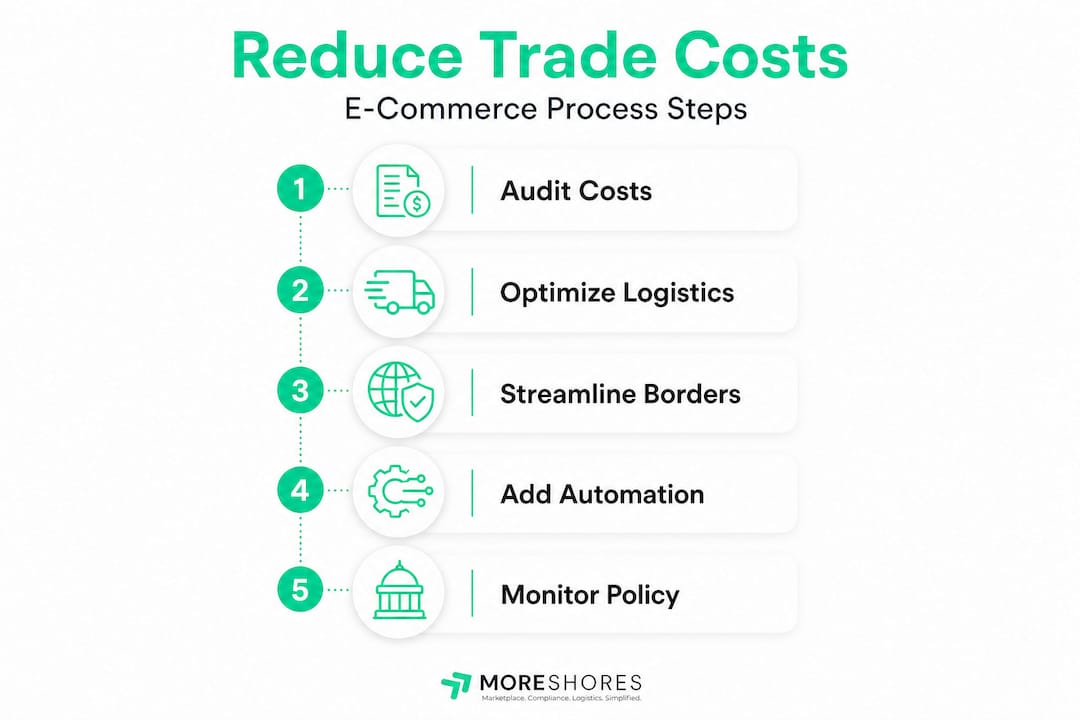
The most effective e-commerce brands we see operating across Africa take a different approach. They treat cost reduction as a stacking exercise. First, they fix what they control directly: carrier negotiation, warehouse placement, fulfillment network design, and documentation quality. These are operational moves that generate savings in weeks, not months. You can review logistics efficiency insights that outline how network design decisions affect total landed cost in African markets.
Second, they monitor and adapt to outward-facing reforms, specifically policy changes, trade agreement implementations, and corridor infrastructure upgrades. They don’t wait for reforms to be complete before planning. They track implementation timelines and position their supply chains to capture savings as reforms take effect.
Third, they digitalize the information and transaction layer. This is often the last step businesses take, but it should run concurrently with the operational and policy work.
The brands that struggle are the ones that focus exclusively on tariff rates or, at the other extreme, invest in digital tools without fixing their underlying logistics network first. Real, sustained trade cost reduction requires all three moves working together.
Take action with MoreShores: Cut your cross-border trade costs
Ready to move from planning to execution? Here’s how MoreShores can bridge the trade cost gap for your business.
Reducing trade costs is not a one-time project. It is an ongoing process of optimizing logistics, staying ahead of regulatory changes, and using the right tools to keep your operations efficient. MoreShores was built to make that process manageable for e-commerce brands operating across African and global markets.
From acting as your Importer of Record for cross-border compliance to managing warehousing, inventory, and last-mile delivery through a multi-courier network, we handle the operational complexity so you can focus on growing your brand. Our e-commerce solutions connect your products to Takealot, Jumia, Amazon SA, Kilimall, and your own Shopify or WooCommerce storefront. Whether you need to optimize a single corridor or build a multi-market fulfillment strategy from the ground up, our fulfillment and logistics team is ready to help you put this guide into action.
Frequently asked questions
What is the biggest driver of trade costs for e-commerce in Africa?
Transport and logistics frictions including border delays and infrastructure limitations are usually the largest contributors to landed cost for African e-commerce, often exceeding the impact of import duties.
How much can trade facilitation reforms reduce trade costs?
WTO trade facilitation data shows average worldwide trade cost reductions of 1 to 4% from customs simplification, regulatory transparency, and red tape reduction under the TFA.
Can AI really help reduce trade costs?
Yes, according to the WTO World Trade Report 2025, nearly 90% of firms using AI for trade tasks report measurable cost and risk management benefits, particularly in customs automation and compliance navigation.
Do all countries benefit equally from trade facilitation reforms?
No. UNCTAD tracking data shows that structurally weaker economies often have below-average TFA implementation rates, meaning some firms remain exposed to higher transaction and clearance frictions regardless of global reform progress.
What is the AfCFTA and how does it affect trade costs?
The African Continental Free Trade Area aims to lower tariffs across 54 African nations, but its full cost impact depends on managing logistics and operational frictions alongside policy reform, since high border delays can still dominate landed cost even when tariffs fall.