How to Manage Compliance in Cross-Border Trade

TL;DR:
- Managing compliance across multiple jurisdictions is a core business function that requires proactive, risk-based oversight.
- Organizations must map obligations, assign clear ownership, embed controls into workflows, and continuously monitor to prevent legal and financial risks.
When you operate across multiple jurisdictions, knowing how to manage compliance is not a background task. It is a core business function. Regulatory requirements in international trade span customs duties, VAT, product safety standards, sanctions screening, and import licensing, and getting any one of them wrong carries real financial and legal consequences. This guide gives business leaders and compliance officers a structured, risk-based framework for building and running effective compliance programs that hold up under regulatory scrutiny and scale with your operations.
Table of Contents
- Key Takeaways
- How to manage compliance: foundations and governance
- Steps to compliance management: building a risk-based program
- Monitoring, auditing, and continuous improvement
- Cross-border compliance challenges and how to address them
- My take on what actually drives compliance success
- How Moreshores helps you manage cross-border compliance
- FAQ
Key Takeaways
| Point | Details |
|---|---|
| Map obligations before acting | Identify every applicable law and regulation across your operating jurisdictions before designing any controls. |
| Use a risk-based approach | Prioritize compliance resources on high-exposure areas rather than treating every obligation equally. |
| Build evidence into operations | Link each obligation to a documented evidence source so your program is audit-ready at any time. |
| Monitor continuously, not annually | Monthly control reviews catch failures before they escalate into regulatory enforcement actions. |
| Integrate compliance into workflows | Embed compliance checks into daily business processes rather than treating them as separate checklists. |
How to manage compliance: foundations and governance
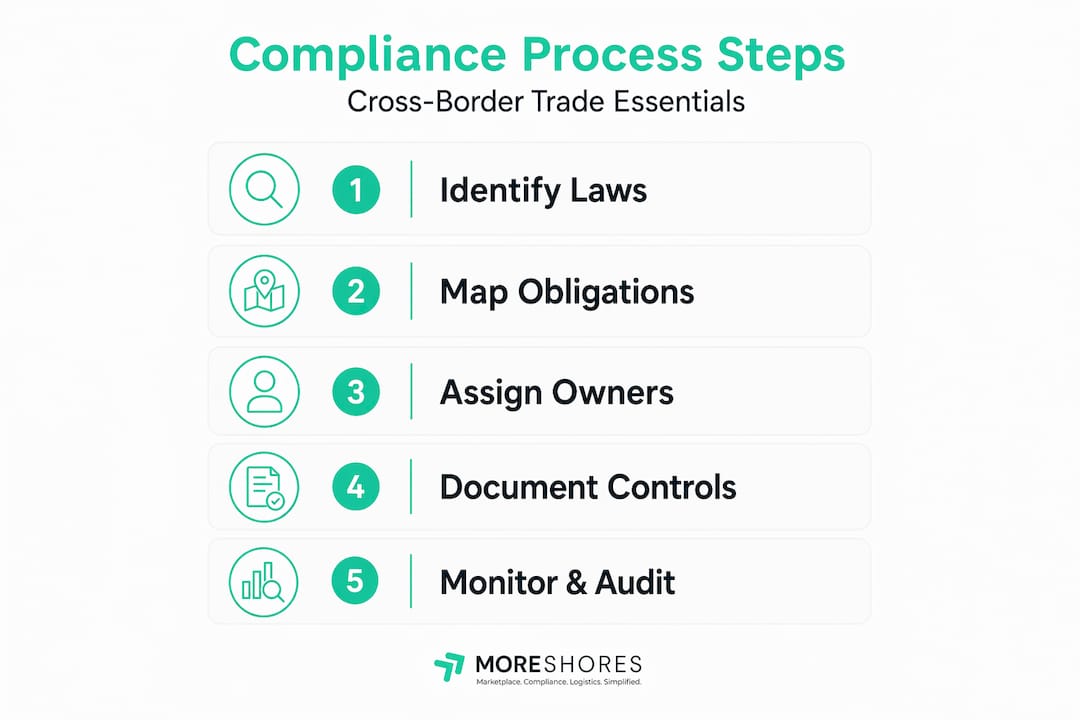
Before you design a single control or draft a policy, you need a clear picture of what you are actually required to comply with. Continuous compliance management starts with identifying all applicable laws and regulations, mapping obligations to controls with clear ownership, and building a regular review cycle into the program from day one.
For businesses operating in cross-border trade, this means cataloging obligations across every jurisdiction you sell into or source from. That includes customs regulations, import and export restrictions, product safety standards, VAT and tax rules, anti-bribery laws, and data protection requirements. The list is longer than most teams expect.
Setting up governance that actually works
Once you know your obligations, you need a governance structure that makes someone accountable for each one. Compliance governance requires documented, enforceable policies with clear roles supported by monitoring, audits, and continuous updates. Without that accountability layer, policies sit in shared drives and get ignored.
Practical governance for a cross-border operation typically includes:
- A compliance committee or steering group with representation from legal, operations, and finance
- A named compliance owner for each regulatory area (trade, tax, product safety, data privacy)
- Documented policies that reference the specific regulations they address
- A policy version control system with staff attestations to confirm awareness
DOJ guidance from 2024 makes clear that regulators assess whether compliance personnel have proper responsibility, adequate resources, and access to relevant data. A governance structure that exists on paper but lacks real authority and budget does not satisfy that standard.
Pro Tip: Create a compliance obligations register in a spreadsheet or GRC tool that lists every applicable regulation, the jurisdiction it applies to, the internal owner, and the review date. Update it every time you enter a new market.
Steps to compliance management: building a risk-based program
Governance gives you the structure. A risk-based program gives you the priorities. These steps will move you from framework to operational reality.
-
Conduct a compliance risk assessment. Map your business activities against your obligations register and score each area by likelihood of non-compliance and potential impact. Include all jurisdictions you operate in. For a business trading between Africa and global markets, this often surfaces customs classification risk, VAT registration gaps, and product certification requirements that teams had previously overlooked.
-
Design controls for your highest-risk areas first. A control is the specific action, check, or system that prevents or detects a compliance failure. For customs compliance, a control might be a pre-shipment HS code review process. For sanctions compliance, it might be an automated counterparty screening check before each transaction.
-
Assign control ownership clearly. Every control needs a named owner who is responsible for executing it and confirming it is working. Vague ownership is the most common reason controls fail during audits.
-
Design policies and procedures people can actually follow. Compliance training tailored by role with scenario-based learning improves understanding and practical application of policies. A customs classification policy written in legal language will not be followed by a warehouse team. Write procedures for the people who will use them.
-
Embed compliance checks into existing business workflows. If you add a separate compliance step that sits outside your normal order processing or procurement workflow, it will be skipped under time pressure. Build the check into the workflow itself.
-
Train staff at onboarding and when regulations change. One-time annual training does not hold up as evidence of an effective program. Use short, role-specific modules that connect the regulation to the employee’s actual job tasks.
Pro Tip: When designing controls, ask whether you can test each one independently. If you cannot demonstrate that a control is working with a documented output, a regulator will treat it as if it does not exist.
Monitoring, auditing, and continuous improvement
Designing a program is only half the job. Verifying that it works, finding gaps, and adapting to new regulations is where most organizations fall short. Proactive compliance programs that integrate ongoing risk assessment and operational support reduce regulatory and financial exposure, while programs that rely on annual reviews often miss enforcement issues until they become expensive problems.

Building an evidence map
An evidence map links each compliance obligation to its primary evidence source, validation process, and frequency. It answers the question: if a regulator asked us to prove we complied with this obligation last quarter, what would we show them and where does that document live?
Building an evidence map improves audit readiness and reduces surprises by defining exactly how your organization can produce current, control-linked evidence on demand. For trade compliance, that evidence might include customs entry records, duty payment confirmations, product test certificates, or VAT filing receipts.
Monitoring frequency and audit cycles
| Activity | Recommended frequency | Purpose |
|---|---|---|
| Control performance reviews | Monthly | Detect failures before they escalate |
| Internal compliance audits | Quarterly or biannual | Verify program design and execution |
| Obligations register review | At every market entry and annually | Capture regulatory changes |
| Staff training completion tracking | Ongoing | Confirm knowledge currency |
| Incident and exception log review | Monthly | Identify patterns and root causes |
Monthly control performance reviews help avoid small issues becoming enforcement problems by catching control failures early and confirming remediation progress. This is a practical shift from the traditional annual audit cycle.
When incidents do occur, document the root cause analysis and the corrective action taken. Regulators reviewing your program will look for evidence that you identify issues, investigate them, and fix the underlying cause rather than just closing the ticket.
Adopting a recognized framework like ISO 37301 for compliance management systems gives you a structured approach to continuous improvement that is adaptable for organizations of any size and is recognized internationally as a credible standard.
Cross-border compliance challenges and how to address them
Managing regulatory compliance across jurisdictions is harder than it looks in theory. Here are the challenges that most frequently derail programs, and what you can do about them.
-
Conflicting regulatory requirements across jurisdictions. A product that meets EU safety standards may still need separate certification for South Africa under NRCS (National Regulator for Compulsory Specifications) requirements. Document jurisdiction-specific gaps in your obligations register and assign a market entry compliance checklist for each new country.
-
Over-reliance on static pre-transaction checklists. Cross-border compliance must extend beyond screening to cover transaction operation changes post-execution, including counterparties, payments, and cargo movements. A supplier that clears your onboarding screen may change ownership or come under sanctions six months into a contract. Your monitoring program needs to catch that.
-
Ownership gaps that only surface during audits. Clear ownership and measurable controls are the biggest drivers of audit success and prevent common compliance failures. If two people both think the other is responsible for a control, it does not get done.
-
Cultural and operational differences in global teams. A compliance procedure designed for a centralized office does not automatically transfer to a distributed team across Africa, Asia, and Europe. Train locally, test locally, and appoint local compliance contacts who can flag issues in real time.
“Cross-border compliance often fails when companies under-invest in change management after deal execution, despite strong pre-transaction screening.” Sanctions Compliance in Trading, Bratschi
Post-execution change management is the single most under-resourced area in international trade compliance. Build a scheduled review of active trade relationships into your monitoring calendar, not just your onboarding process.
My take on what actually drives compliance success
I’ve spent years working through the gap between what compliance programs look like on paper and how they perform when regulators start asking questions. The honest answer is that most programs that fail do not fail because the policies were wrong. They fail because the policies were never connected to how the business actually operates.
The organizations I’ve seen handle regulatory scrutiny well treat compliance as an operational discipline. They map evidence to obligations before they need it. They review control performance monthly instead of panicking quarterly. Leadership engagement and visible commitment is key to embedding a compliance culture. When leadership treats compliance as an operational priority, the rest of the organization follows.
What genuinely moves the needle is this: knowing exactly which evidence proves each obligation is met, and being able to produce it in 24 hours. If your program cannot do that today, that is where to start.
— Matt
How Moreshores helps you manage cross-border compliance
Managing regulatory compliance across African and international markets requires more than a policy document. It requires operational infrastructure that handles the compliance work embedded in every shipment and marketplace transaction.

Moreshores acts as your Importer of Record for customs clearance, duties, VAT, and regulatory compliance, removing the obligation mapping burden from your internal team for market entry into Africa. The platform integrates compliance requirements directly into fulfillment and logistics workflows, so compliance checks happen as part of the transaction, not as a separate manual step. Whether you are a global brand entering African markets or an African brand scaling internationally, Moreshores provides the infrastructure to operate with regulatory confidence. If you are ready to reduce compliance risk in your cross-border operations, explore partnership options with the Moreshores team today.
FAQ
What are the first steps to compliance management?
Start by building an obligations register that identifies every applicable law and regulation across your operating jurisdictions. Then assign a named owner to each obligation and design testable controls for your highest-risk areas.
How do you ensure compliance in cross-border trade?
Effective cross-border compliance requires embedding controls into transaction workflows, monitoring active trade relationships continuously, and maintaining documented evidence for each obligation. Pre-transaction screening alone is not sufficient once a deal is live.
What does an effective compliance program include?
An effective compliance program includes documented policies, a risk-based governance structure, assigned control ownership, regular training, continuous monitoring, and a documented audit trail linking obligations to evidence.
How often should compliance programs be reviewed?
Internal audits should run quarterly or biannually, control performance should be reviewed monthly, and your obligations register should be updated every time you enter a new market and at a minimum once per year.
What is the biggest risk in managing international compliance?
The biggest risk is treating compliance as a pre-transaction checklist rather than an ongoing operational process. Regulatory exposure accumulates in the months and years after a deal goes live, not just at onboarding.