EXW vs FCA: 4 Questions That Decide Which Term Costs You More

For most cross-border shipments, FCA beats EXW, and the reason comes down to one handoff point. Under FCA, the seller clears the goods for export and loads them at a named place, which keeps compliance and documentation risk where it belongs. EXW still works when the buyer already has a licensed local exporter or an experienced freight team on the ground, but for a first-time cross-border deal, it usually creates more problems than it saves in cost.
TL;DR:
- FCA reduces export clearance and documentation risks for first-time cross-border deals by shifting responsibilities directly to the seller at a specified place.
- Using precise contract language, including full address and loading details, is critical to prevent disputes over risk transfer points.
- FCA is preferable for containerized or multimodal shipments and when a letter of credit is involved, due to smoother documentation and risk management.
- Buyers without local export registration or experience should avoid EXW to prevent delays and unexpected costs, especially during export declaration filing.
- Incorporating a cross-border enablement partner can streamline customs and regulatory procedures that EXW overly burdens the buyer with handling directly.
Table of Contents
- EXW vs FCA at a Glance
- EXW Explained: What the Seller and Buyer Actually Owe Each Other
- FCA Explained: Why the Named Place Changes Everything
- Where the Real Risk and Cost Differences Show Up
- How to Choose Between EXW and FCA
- Documentation and Letters of Credit: Getting the Paper Trail Right
- Common Mistakes and How to Fix Them Fast
- The MoreShores Perspective: Solving EXW’s Origin-Side Problem Directly
- Where to Verify the Rules Yourself
- The Practical Bottom Line on EXW vs FCA
- Sources
EXW vs FCA at a Glance
Both terms sit at the start of the Incoterms® 2020 rulebook, but they hand the buyer very different amounts of work.
- EXW (Ex Works): The seller makes the goods available at its own premises or another named place. The buyer arranges loading, export clearance, main carriage, and import.
- FCA (Free Carrier): The seller clears the goods for export and delivers them to the buyer’s carrier at a named place. If that place is the seller’s own site, the seller also loads the truck or container.
- Risk transfer: Under EXW, risk passes once goods are made available, before loading. Under FCA, risk passes after export clearance and loading (or once handed to the carrier at another named point).
- Best fit: EXW generally suits domestic sales or buyers with their own export licensing. FCA is better suited for containerized, multimodal, and letter-of-credit shipments.
EXW Explained: What the Seller and Buyer Actually Owe Each Other
EXW looks simple on paper. The seller’s only job is to package the goods and make them available at a named place, usually its own factory or warehouse. Everything else, including loading the truck, clearing customs for export, arranging the main transport leg, and handling import formalities, falls to the buyer.
That split works fine inside one country. It gets messy the moment a border enters the picture. Here’s what the buyer inherits under EXW:
- Arranging and paying for loading at the seller’s dock
- Filing export declarations in a country where the buyer may have no legal standing to act as exporter
- Booking and insuring the main international transport leg
- Managing import clearance, duties, and VAT at destination
The trouble usually starts with that second item. Many countries require the exporter of record to be a locally registered entity, and a foreign buyer often cannot legally file that paperwork. ICC Academy’s guidance on EXW and FCA notes that EXW originated as a domestic term, which is exactly why it creates friction the moment goods cross a border without a local intermediary in place.
Loading disputes come next. If the driver the buyer sends is inexperienced or the seller’s forklift operator refuses liability for damage during loading, nobody has clear responsibility, because risk technically transferred before loading even began.
Pro Tip: If you’re committed to EXW, confirm in writing that your buyer (or its agent) is registered to act as exporter in the seller’s country. If they can’t produce that registration, switch to FCA before you sign anything.
EXW still makes sense for domestic sales, for buyers with an established freight forwarder and export license in the seller’s country, or for repeat transactions where both sides already know exactly how loading and clearance will work.
FCA Explained: Why the Named Place Changes Everything
FCA shifts one critical task back to the seller: export clearance. The seller must clear the goods for export and deliver them to the buyer’s nominated carrier at whatever place the contract names. When that named place is the seller’s own premises, the seller also loads the goods onto the collecting vehicle.
That single shift solves most of the problems EXW creates for international deals. The seller, who already has local business registration and export licensing, handles the paperwork it’s actually equipped to handle. The buyer picks up responsibility only once goods are cleared and on the truck or in the container.
- Seller clears export, prepares documentation, and loads (if delivering from its own site)
- Buyer arranges the carrier, main transport, insurance for that leg, and import clearance
- Risk transfers once goods are loaded and handed to the buyer’s carrier at the named place
FCA also maps cleanly onto how modern freight actually moves. Containerized and multimodal shipments rarely involve the buyer physically showing up at the seller’s dock. A carrier or forwarder collects the container, trucks it to a port or rail yard, and the goods move through several transport modes before reaching the buyer. Trade bodies and freight practitioners consistently recommend FCA over EXW for exactly this reason: it fits how containers and letters of credit actually work, while EXW does not.
Pro Tip: If your deal involves a letter of credit, ask specifically about the FCA on-board bill of lading option. It solves a documentation gap that trips up a lot of first-time exporters.
Where the Real Risk and Cost Differences Show Up
The gap between EXW and FCA isn’t academic. It shows up in three places: who owns delays, who owns cost surprises, and who owns the paper trail.
- Export clearance and proof of export. Under EXW, the buyer files the export declaration, but only the seller usually has the underlying commercial records tax authorities want to see. That mismatch can delay VAT or sales-tax proof of export, sometimes for months. Government trade guidance flags this exact risk as one of the main reasons to think twice before defaulting to EXW on a cross-border deal.
- Loading and risk timing. Under FCA, risk stays with the seller through loading. Under EXW, risk transfers before loading starts, so any damage during that process becomes a dispute over whose insurance covers it.
- Cost buckets. EXW quotes look cheaper on the invoice because the seller’s price excludes freight, insurance, and export handling. Buyers without an existing freight contract or local presence often discover that arranging all of it themselves costs more than the “savings” the low EXW price implied.
Freight cost isn’t the only surprise. Industry analysis of EXW pricing traps points out that buyers frequently underestimate landed cost because they’re pricing freight and clearance for the first time, often at worse rates than an established seller could negotiate.
Contract wording matters just as much as the term itself. “FCA seller’s warehouse” is vague. “FCA 14 Industrial Road, Building C, Loading Dock 2, Incoterms® 2020” is not. Specifying the exact address and loading point removes the single biggest source of shipment disputes: disagreement over precisely where and when risk changed hands.
How to Choose Between EXW and FCA
Run through four questions before you lock in a term:
- Does the buyer have a locally licensed forwarder or exporter authorization at the seller’s location? If not, EXW puts the buyer in a position it may not be legally able to fill.
- Is a letter of credit involved? If yes, FCA with the on-board bill of lading option is almost always the smoother path.
- Is this a containerized or multimodal shipment? FCA fits that flow far better than EXW, which assumes a simple pickup.
- Is this the buyer’s first cross-border transaction with this seller? First-time deals carry more risk of miscommunication over loading and documentation, which argues for FCA.
For most cross-border shipments, especially first-time or containerized ones, FCA is the safer default. EXW remains reasonable when the buyer already runs its own logistics operation in the seller’s country and has done this exact route before.
When you write the contract, be specific. Use language like: “FCA, 22 Harbor Way, Warehouse 4, Loading Dock B, Incoterms® 2020.” Naming the full address plus the exact loading point removes ambiguity about where risk transfers, which is the detail that causes the most disputes after the fact.
Pro Tip: Never write just “FCA seller’s factory” or “EXW origin.” Incoterms® 2020 requires precision on the named place, and vague wording is one of the fastest ways to end up in a shipping dispute with no clear answer.
Documentation and Letters of Credit: Getting the Paper Trail Right
EXW creates a specific headache for letter-of-credit transactions: sellers rarely have the transport documents banks require, because the buyer arranged the carrier and never routed shipping documents back to the seller. That gap can hold up payment entirely.
FCA solves this with a specific mechanism. The FCA 2020 on-board bill of lading option lets the parties agree that the buyer’s carrier issues an on-board bill to the seller once loading is complete, giving the seller the document its bank needs to process payment under the letter of credit.
- Buyer’s bank should confirm upfront whether it will accept an FCA on-board bill before goods ship
- Seller should request the on-board bill clause be written into the sales contract, not negotiated after loading
- Both parties should agree on timing: the bill needs to reach the seller before the payment deadline in the credit
Common Mistakes and How to Fix Them Fast
Most EXW and FCA disputes trace back to the same handful of avoidable errors.
- Assuming the buyer can act as exporter under EXW. Fix: get written proof of export registration, or default to FCA.
- Writing a vague named place. Fix: always include the full street address and the specific loading point, not just “seller’s premises.”
- Overlooking insurance gaps between EXW/FCA and CIF/CIP terms. Fix: state insurance coverage explicitly in the contract rather than assuming it’s implied.
Pro Tip: If your team is switching from EXW to FCA on an existing supplier relationship, update your insurance certificates at the same time. Coverage written for an EXW risk-transfer point won’t automatically match FCA’s later handoff.
The MoreShores Perspective: Solving EXW’s Origin-Side Problem Directly
The core issue with EXW isn’t the term itself, it’s that it asks buyers to become instant experts in someone else’s customs system. An Importer of Record removes that burden by taking on customs clearance, duties, VAT, and regulatory documentation on the buyer’s behalf, which is functionally what FCA tries to achieve through contract language alone.
For brands moving goods into or out of African markets, this matters more than the Incoterm debate suggests. A buyer forcing EXW onto a seller because the quote looked cheaper often ends up paying an experienced cross-border enablement partner anyway, just later in the process and under worse time pressure. Building that support into the deal from the start, rather than defaulting to EXW and hoping the origin-side paperwork sorts itself out, tends to be the cheaper path in practice.
Where to Verify the Rules Yourself
Contract language should trace back to primary sources, not secondhand summaries. Start with the ICC Academy’s Incoterms® 2020 guidance for the official rule text, then check trade.gov’s Incoterms overview for government-level guidance on export risk, and review practical freight examples through resources like the AMCO Delivery logistics blog for operational context.
The Practical Bottom Line on EXW vs FCA
Most disputes I’ve seen over EXW versus FCA aren’t really disputes over Incoterms language at all. They’re disputes over who was supposed to know something the other party assumed was obvious, usually about export paperwork or who was standing at the loading dock when something went wrong.
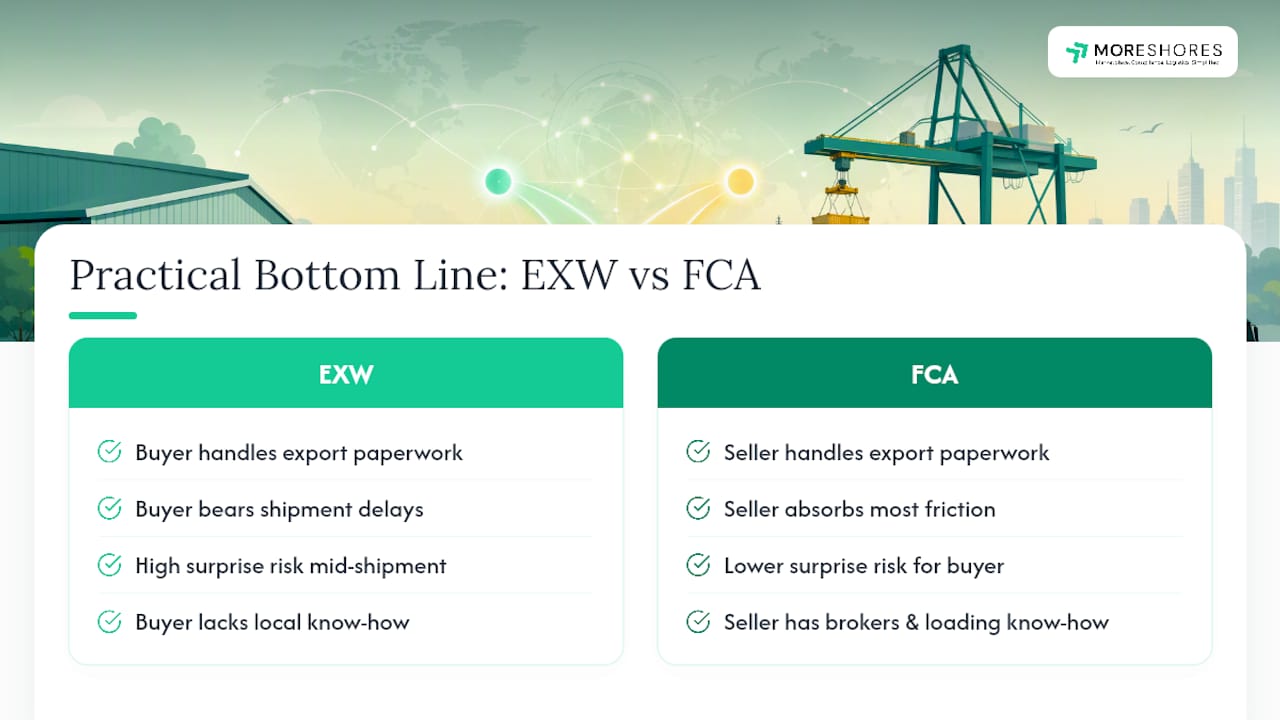
That’s the part the standard advice tends to skip. Everyone repeats “use FCA for international shipments,” which is correct, but the more useful insight is that EXW’s real cost isn’t the freight or the clearance fees. It’s the time a buyer spends discovering, mid-shipment, that it can’t actually file an export declaration in a country where it has no legal presence. By the time that surprise hits, the goods are often sitting at a dock, and every day of delay is now the buyer’s problem to solve alone.
FCA doesn’t eliminate friction. It just moves the friction to the party better equipped to handle it. Sellers already know their own country’s export rules, already have relationships with local customs brokers, and already know how to load a container correctly. Asking a foreign buyer to replicate all of that from scratch on a first shipment is asking for delay. The smarter read on “EXW vs FCA” isn’t a legal technicality. It’s a question about which party is actually positioned to do the work without guessing.
— Matt