South Africa Importers: Calculate ATV, Duty and 15% VAT
Imported goods into South Africa carry a 15% import VAT plus customs duty based on the tariff code, and both are payable before your shipment clears. Customs duty rates vary widely depending on the product category, with many goods typically attracting rates near the lower end of the range. VAT is calculated on the Added Tax Value (ATV), which includes the customs value, duty paid, and an additional uplift in some cases depending on the country of origin. There is effectively no de minimis threshold, so most shipments, regardless of value, are subject to VAT and duty if formally declared.
TL;DR:
- Customs duty rates vary significantly by category, ranging from 0% for some raw materials to over 30% for textiles and agricultural products, with no de minimis exemption.
- The calculation of VAT is based on the Added Tax Value, which includes customs value, duty paid, and a 10% uplift unless goods originate from BELN countries, making even small shipments liable for VAT.
- Accurate classification using the correct HS code and proper documentation are critical to avoid costly penalties, delays, or underpayment charges during customs clearance.
- Importers need to identify their role as the Importer of Record and secure the necessary permits, certificates, and arrangements for deferment of payment to manage cash flow effectively.
- Preferential trade agreements like SACU and SADC can reduce duty but do not impact the 15% VAT, which applies universally to all imports regardless of origin or duty savings.
Table of Contents
- Quick Rates and Landed-Cost Drivers You Must Budget For
- How Customs Value, Duty and VAT Are Calculated
- How Do You Find the Right Duty Rate for Your Product?
- What Documents Do You Need, and Who Pays When?
- Exemptions, Refunds and Common Clearance Traps
- Pre-Shipment Checklist Before You Send Goods to South Africa
- How Trade Agreements Change Your Duty Rate
- What Happens if You Get a VAT or Duty Declaration Wrong
- How Do Importers Register for VAT in South Africa?
- How Do You Manage VAT Recovery and Cash Flow?
- Why Correct Classification and IOR Handling Actually Save Money
- How MoreShores Handles Duties, VAT and Clearance for You
- Where to Verify Rates and Run Your Own Numbers
- Sources
- FAQ
Quick Rates and Landed-Cost Drivers You Must Budget For
Before you calculate anything precisely, you need a rough sense of what hits your landed cost. South Africa’s standard VAT rate is 15%, applied to nearly all imported goods at the point of entry for home consumption. That rate has held steady for several years, but VAT registration thresholds and compliance requirements do shift periodically, so check current SARS guidance before you assume last year’s rules still apply.
Customs duty is a different animal entirely. It depends entirely on the tariff heading your product falls under, and rates swing widely by category.
- Duty on many finished consumer goods sits in the 15% to 20% range.
- Raw materials and industrial inputs often carry duty at 0% to 5%, sometimes duty free.
- Textiles, footwear, and certain agricultural products can attract duty above 30%, and some categories carry specific anti-dumping duties on top of the standard rate.
- Excise duty applies separately to items like alcohol, tobacco, and fuel, regardless of the customs duty already charged.
Because there’s no de minimis exemption, a $20 phone case ordered from overseas is technically just as liable for VAT and duty as a container of machinery. In practice, low-value parcels sometimes slip through informal channels, but any formally declared shipment gets assessed. Budget for clearance, handling, and storage fees on top of duty and VAT. These add up fast if a shipment sits at port waiting on documentation.
How Customs Value, Duty and VAT Are Calculated
Everything starts with customs value, and SARS applies GATT valuation rules to determine it. There are six recognized methods, but transaction value, meaning the actual price paid or payable for the goods, is the primary method used for the overwhelming majority of imports. Only when transaction value can’t be established does SARS move to alternative methods like comparing identical or similar goods.
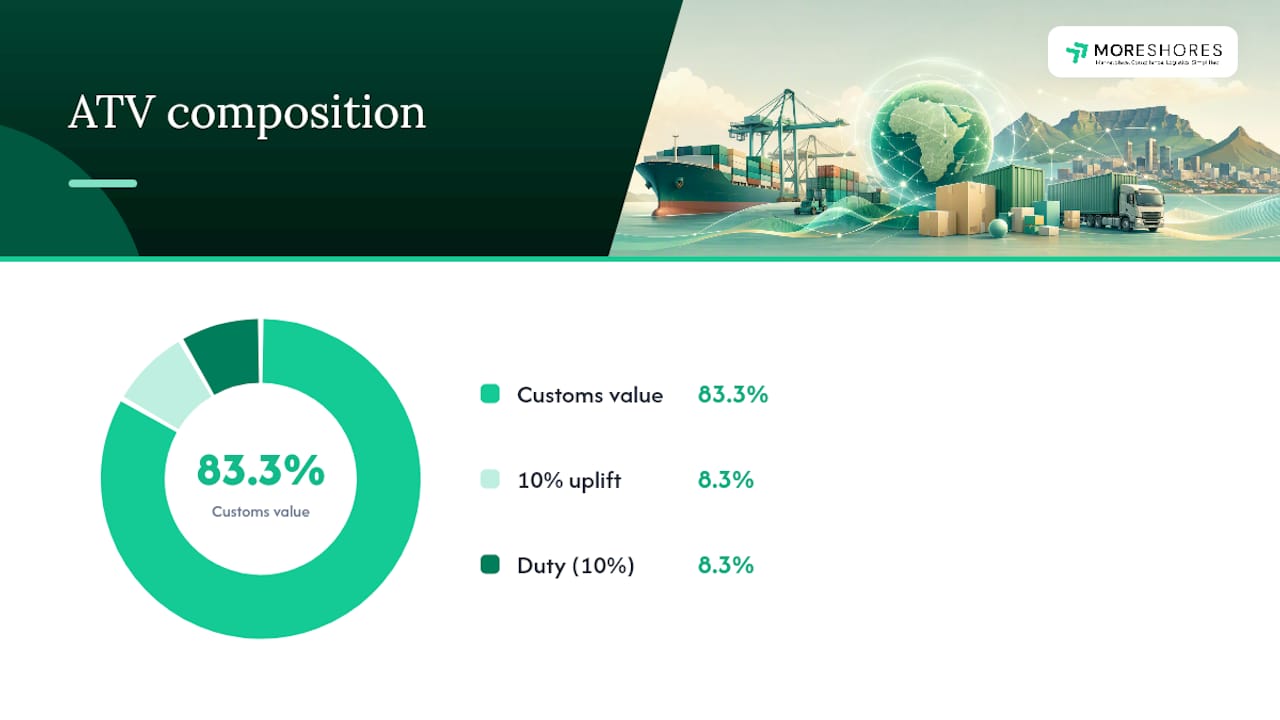
Once customs value is set, duty gets calculated first, then VAT gets layered on top using the Added Tax Value formula:
- Start with the customs value (usually the transaction value in South African rand).
- Add a 10% uplift on that customs value, unless the goods originate from a BELN country (Botswana, Eswatini, Lesotho, Namibia), which is exempt from this uplift.
- Add non-rebated customs duty already assessed on the shipment.
- That total is your ATV. Multiply it by 15% to get VAT payable.
Worked example: Say your customs value is R100,000 and the applicable duty rate is 10%.
- Duty = R100,000 × 10% = R10,000
- ATV = R100,000 plus the applicable uplift and duty
- VAT = ATV multiplied by the 15% VAT rate
- Total payable at clearance is the sum of duty and VAT calculated accordingly.
If you’re a VAT-registered vendor, that R18,000 isn’t necessarily a sunk cost. It can typically be claimed back as input tax on your VAT return, provided you hold the correct customs documentation and the goods relate to your taxable business activity.
How Do You Find the Right Duty Rate for Your Product?
Every import gets classified under a Harmonized System (HS) code, an internationally standardized numbering system that determines exactly which duty rate applies. SARS maintains its own version of this in the Tariff Book, which lists every tariff heading alongside its duty rate, applicable rebates, and any special conditions.
Finding the right code takes a bit of legwork:
- Describe your product precisely, including material composition, function, and intended use, since small differences change classification.
- Search the Tariff Book by heading and cross-check the section and chapter notes, which often carve out exceptions general descriptions miss.
- Confirm the duty column that applies to your country of origin, since preferential rates sometimes differ from the general rate.
- Check whether anti-dumping duties or excise duty apply on top of the base rate, particularly for steel, textiles, and certain chemicals.
Misclassification is one of the most common and most expensive mistakes importers make. Get it wrong and you either overpay for years without noticing, or underpay and face back duty, penalties, and interest once SARS catches it during an audit.
Pro Tip: Never guess a tariff heading from a competitor’s invoice or a generic online forum. Confirm your classification directly with SARS or a registered clearing agent before you place a large order, since the cost of a wrong guess almost always exceeds the cost of asking first.
What Documents Do You Need, and Who Pays When?
Clearance runs on paperwork, and missing even one document can strand a shipment at port for days. You’ll typically need a commercial invoice, a bill of lading or air waybill, a packing list, a certificate of origin where preferential treatment is claimed, and any product-specific permits.
Someone has to be the Importer of Record (IOR), the legal entity responsible for accuracy of the customs declaration and payment of duty and VAT. This can be the buyer directly, or a specialized service acting on the buyer’s behalf, which matters a great deal for foreign sellers without a South African legal presence.
- Confirm who holds IOR status before the goods ship, not after they land.
- VAT and duty are generally payable, or secured, before SARS releases the goods for home consumption.
- SARS permits deferment of duty and VAT for up to 30 days in eligible cases, which helps cash flow but requires approved security arrangements.
- If you’re using a clearing agent, confirm their deferment facility, fee structure, and turnaround time before your shipment departs origin.
A good clearing agent is worth the fee. A bad one turns a routine shipment into a two-week ordeal.
Exemptions, Refunds and Common Clearance Traps
Certain imports qualify for zero-rating or exemption under Schedule 1 categories, covering items like specific medical supplies, educational materials, and goods imported under diplomatic privilege. Always verify against the current schedule rather than assuming a category still qualifies.
Registered vendors can generally reclaim import VAT as input tax, but the process (commonly referencing form CR1 for refund claims) demands accurate supporting documents.
- Incorrect importer name on the declaration is the single fastest way to block a refund claim.
- Duplicate declarations for the same shipment trigger manual review and delay.
- Missing release messages from the customs system mean goods legally can’t move, even if duty and VAT are paid.
- Insufficient security for a deferment facility can suspend your entire deferment privilege, not just one shipment.
Pre-Shipment Checklist Before You Send Goods to South Africa
Run through this before you book freight, not after your goods are already on the water.
- Classify your goods under the correct HS code and estimate duty and VAT using the ATV formula.
- Confirm country of origin and secure certificates of origin if you’re claiming a preferential rate.
- Check for product-specific permits, especially for food, cosmetics, electronics, and agricultural goods.
- Arrange your Importer of Record or clearing agent, and confirm deferment eligibility and associated fees in writing.
- Prepare full documentation and build in time for possible physical inspection.
Pro Tip: Run the numbers before you commit to a purchase order, not after. A shipment that looks profitable at the invoice price can turn into a loss once duty, VAT, and clearance fees are added, and that math is much easier to fix before goods ship than after they’re stuck at port.
How Trade Agreements Change Your Duty Rate
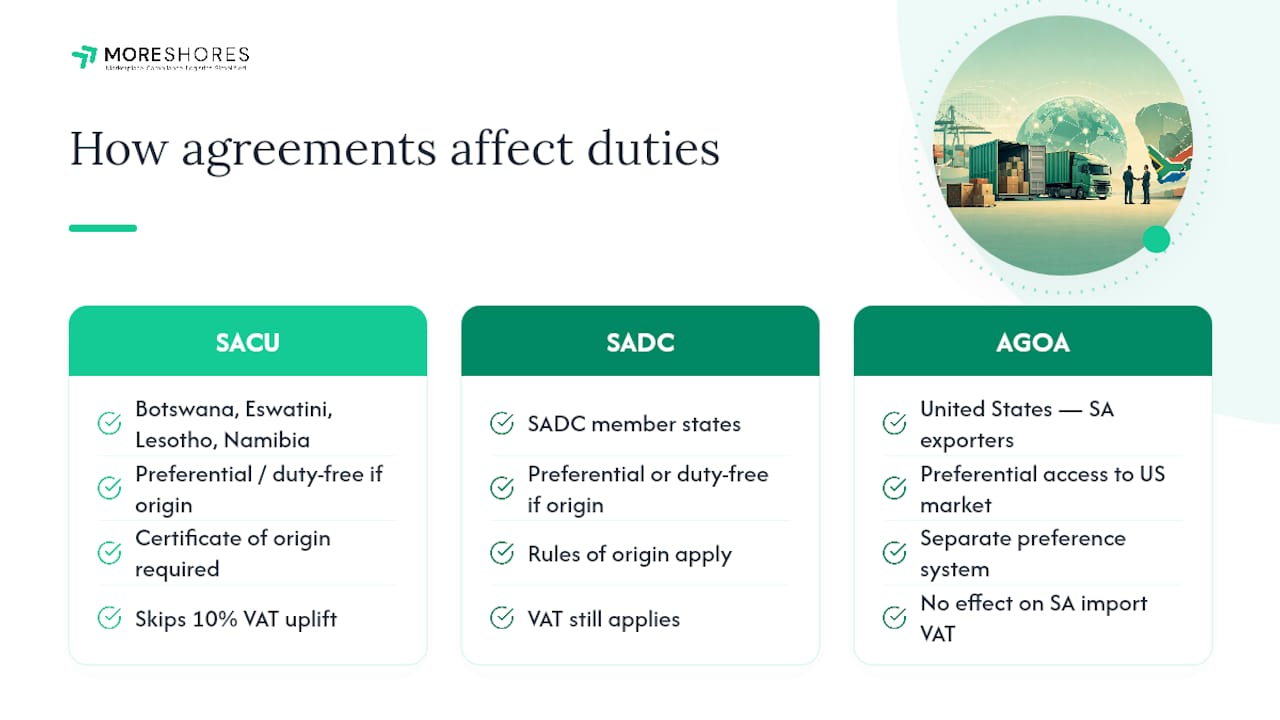
Preferential trade agreements can cut your duty bill substantially, but only if you can prove origin correctly. South Africa’s membership in the Southern African Customs Union (SACU) means goods originating in Botswana, Eswatini, Lesotho, and Namibia (the BELN countries) move largely duty free within the bloc, and as noted earlier, imports from these countries also skip the 10% VAT uplift entirely.
The broader Southern African Development Community (SADC) free trade area extends preferential or duty-free access to member states across the region, provided the goods meet the agreement’s rules of origin. That last part trips up a lot of importers. Rules of origin aren’t a formality. They typically require a minimum percentage of local content or a specific manufacturing transformation, and customs will deny the preferential rate if your certificate of origin doesn’t hold up to scrutiny.
For US-based exporters, the African Growth and Opportunity Act (AGOA) works in the opposite direction, giving eligible South African goods preferential access to the US market rather than reducing what South Africa charges on imports. If you’re a South African business exporting under AGOA while also importing components duty free under SACU, you’re managing two separate preference systems at once, and mixing up the paperwork for one with the other is a common and costly error.
None of these agreements touch the 15% VAT rate itself. Duty savings are real, but VAT still applies to the full ATV, uplift and all, unless your specific goods fall under exemptions.
What Happens if You Get a VAT or Duty Declaration Wrong
Incorrect declarations, whether from misclassification, undervaluation, or a wrong country-of-origin claim, expose you to more than just a corrected bill. SARS can levy penalties on top of the underpaid duty and VAT, charge interest from the original due date, and in cases involving deliberate misdeclaration, pursue criminal charges under the Customs and Excise Act.
Even honest mistakes carry cost. If SARS reassesses a shipment months after clearance and finds duty was underpaid, you owe the difference plus interest accrued the entire time, even though you had no way of spending money you didn’t know you owed. Repeated errors also draw scrutiny. An importer with a pattern of amended declarations tends to get flagged for more frequent physical inspection, which slows down every future shipment, not just the one that triggered the review.
The safest posture is conservative and well-documented, not aggressive. Claiming a preferential rate you can’t fully support with a valid certificate of origin, or classifying a product under a lower-duty heading because the description is ambiguous, might save money in the short term. It creates a liability that can resurface years later with interest attached. If you’re unsure whether a classification or origin claim holds up, it’s worth getting it independently confirmed before you rely on it across dozens of shipments.
How Do Importers Register for VAT in South Africa?
You don’t need to register for VAT to import goods. Non-registered individuals and businesses simply pay import VAT at clearance with no ability to claim it back. Registration only matters if you want to recover that VAT as input tax.
To register, a business generally applies through SARS eFiling or in person, providing proof of business activity, banking details, and identification for the responsible parties. Voluntary registration is available below the mandatory turnover threshold if you can show you’re carrying on an enterprise, which many importers choose specifically so they can reclaim VAT paid at the border rather than absorbing it as a cost.
Once registered, you must file VAT returns on your assigned cycle, typically every two months, and import VAT paid during that period gets offset against VAT you’ve collected on sales. If your imports significantly outpace your local sales in a given period, you can end up in a net refund position, where SARS owes you money rather than the reverse.
Foreign sellers without a South African legal entity face a structural problem here: they generally can’t register for VAT themselves, which means they can’t reclaim import VAT directly. This is one of the main reasons foreign brands route their South African imports through a local Importer of Record rather than trying to import directly, since the IOR entity can be VAT-registered even when the underlying seller isn’t.
How Do You Manage VAT Recovery and Cash Flow?
Recovering VAT efficiently is less about the tax rate and more about timing and paperwork discipline. If you’re VAT-registered, the fastest way to protect your cash position is making sure every customs document is filed and matched correctly the first time, since a rejected or incomplete claim doesn’t just delay your refund, it can push it into the following filing period entirely.
Deferment is the other major lever. Instead of paying duty and VAT at the exact moment of clearance, an approved deferment facility lets you settle within a set window, commonly up to 30 days, which keeps cash in your business a little longer on every shipment. That only works if your security arrangement with SARS is properly maintained, since a lapse can suspend the facility for your entire operation, not just the shipment in question.
Batching shipments strategically also helps. Importers who consolidate smaller orders into fewer, larger shipments often reduce the proportional weight of fixed clearance and handling fees, even though the duty and VAT calculation itself doesn’t change based on shipment size. And if your import volume is genuinely large and recurring, it’s worth reviewing your tariff classifications periodically rather than once. Duty schedules do get amended, and a rate that was accurate two years ago isn’t guaranteed to still apply today.
Why Correct Classification and IOR Handling Actually Save Money
Most importers treat classification as paperwork. It’s actually where the real financial risk lives. A tariff code chosen carelessly, or an Importer of Record arrangement set up without checking VAT registration status, doesn’t just risk a delay. It risks a retroactive bill with interest, months after you’ve already sold the goods and booked the margin.
The businesses that move fastest through South African customs aren’t the ones with the biggest shipments. They’re the ones who treated classification and documentation as decided before the goods left origin, not something to sort out on arrival.
— Matt
How MoreShores Handles Duties, VAT and Clearance for You
A service can act as your Importer of Record, taking on the customs declaration, duty payment, and VAT handling that would otherwise require a South African legal entity of your own. For foreign brands without local registration, that’s the difference between importing directly and importing at all.
Instead of juggling a clearing agent, a separate VAT registration question, and a warehousing provider, MoreShores gives you one point of contact across customs clearance and compliance, plus warehousing and multi-courier fulfillment once your goods land. That means a predictable landed cost calculated up front, not a surprise duty bill weeks after your goods clear. If you’re planning your first shipment into South Africa or scaling up volume you’re already moving, get in touch through MoreShores’s cross-border enablement page to map out your Importer of Record setup and landed-cost estimate before you book freight.
Where to Verify Rates and Run Your Own Numbers
- SARS Value-Added Tax guidance
- SARS Tariff Book
- Schedules to the Customs and Excise Act
- VAT and import duty calculator
Sources
FAQ
Who Must Pay VAT in South Africa?
Anyone importing goods for home consumption pays import VAT at clearance, whether they’re a registered business, an unregistered business, or an individual. Only VAT-registered vendors can later reclaim that VAT as input tax.
What Is the Difference Between Duty and VAT?
Customs duty is a tariff-specific charge based on the product’s HS classification, while VAT is a flat 15% tax calculated on the Added Tax Value, which includes the customs value, duty already paid, and often a 10% uplift.
What Are the Import Duties in South Africa?
Duty rates vary by tariff heading and typically range widely by product category, with many consumer goods attracting rates near the lower end of the range, according to country import guides. The exact rate for your product is set in the SARS Tariff Book.
What Is the VAT Tax Rate in South Africa?
The standard VAT rate is 15%, applied to most imported and domestically sold goods and services, with a small list of items zero-rated or exempt under Schedule 1.
Is There a Minimum Value Below Which Imports Skip Duty and VAT?
No. South Africa applies no de minimis threshold, so even low-value shipments are technically liable for duty and VAT once formally declared.