$50,000 Mistake? DDP vs DAP: IOR Checklist for US Sellers

DDP means the seller pays import duties and handles import clearance; DAP means the buyer pays and handles it instead. The choice hinges on one practical question: can the seller legally act as importer of record in the destination country? If not, DDP is not just risky, it may be impossible, and the sections below walk through when each term actually works.
TL;DR:
- Confirm if the seller can legally act as importer of record in the destination country before quoting DDP, as many regions restrict this capability.
- DDP shifts significant costs and risks onto the seller, including duties, taxes, and import clearance, which must be accurately estimated to protect margins.
- Under DDP, the seller is responsible for handling export formalities, international transport, import clearance, and delivering goods ready for unloading, making it the most demanding Incoterm.
- High-duty, high-friction markets benefit from DDP only when the seller has reliable legal and logistical capacity to clear customs successfully.
- The availability of third-party platforms that act as importer of record can enable sellers to offer DDP without establishing local operations, but verification of local rules remains crucial.
Table of Contents
- DDP vs DAP: What Does Delivered Duty Paid Actually Require?
- DDP vs DAP Incoterms: A Side-by-Side Comparison
- How Do You Decide Between DDP and DAP for a Shipment?
- Legal Constraints and Common DDP Pitfalls
- What Does a Landed-Cost Example Actually Look Like?
- What Sellers Should Check Before Agreeing to DDP
- Why the DDP vs DAP Debate Misses the Real Question
- How Moreshores Removes the DDP Registration Barrier
- Sources
DDP vs DAP: What Does Delivered Duty Paid Actually Require?
Under Incoterms 2020, DDP (Delivered Duty Paid) requires the seller to deliver goods to the named place, ready for unloading, having already cleared them through import customs and paid all duties and taxes. This is the most demanding Incoterm for a seller. Nothing else in the Incoterms 2020 rulebook puts import clearance on the seller’s plate.
Here’s what that obligation actually breaks down into:
- Handling export formalities in the country of origin
- Arranging and paying for international transport
- Completing import customs clearance at destination
- Paying import duties, VAT, and any applicable taxes
- Delivering the goods to the named place, ready for unloading
The buyer’s only remaining job is unloading the shipment once it arrives. That sounds simple for the buyer, and it is, but it shifts real financial exposure onto the seller. Estimating duties accurately across dozens of tariff codes and jurisdictions is harder than it looks, and getting it wrong eats directly into margin.
Pro Tip: Before quoting a DDP price, run the shipment’s HS codes through the destination country’s actual tariff schedule rather than a rough estimate. A miscalculated duty rate on a $50,000 industrial shipment can wipe out the entire margin on the deal.
DDP vs DAP Incoterms: A Side-by-Side Comparison
The two terms share one thing: risk transfers to the buyer at the same point, once goods arrive at the named place, ready for unloading. Everything else about who pays and who files paperwork diverges sharply.
- Import duties and taxes: Seller pays under DDP; buyer pays under DAP.
- Import customs clearance: Seller arranges under DDP; buyer arranges under DAP.
- Transport risk to named place: Seller bears risk in both terms until arrival.
- Unloading at destination: Buyer’s responsibility under both terms.
- Insurance: Neither term mandates insurance, but the party bearing risk to that point typically insures the leg they control.
- Feasibility (Importer of Record): DDP requires the seller to legally act as importer, which many countries restrict to local entities; DAP has no such restriction since the buyer imports.
Total landed cost is allocated differently depending on the term. Under DDP, the seller typically bakes duties, taxes, and clearance fees into the quoted price, often with a markup to cover estimation risk. Under DAP, the buyer absorbs those same costs separately, usually through a customs broker they hire directly.
DDP shows up most often in B2B contracts where a buyer wants price certainty, and in e-commerce checkouts where merchants want to avoid surprise fees at delivery. DAP tends to dominate industrial and wholesale trade, where buyers already run established import operations and prefer to control clearance themselves.
How Do You Decide Between DDP and DAP for a Shipment?
Choosing between DDP versus DAP comes down to legal feasibility first, cost control second, and customer experience third. Work through these in order:
- Confirm IOR eligibility. Can the seller legally register as importer of record in the destination country? If no, DDP is off the table regardless of preference.
- Assess duty predictability. If tariff classifications are stable and well documented, DDP’s estimation risk drops. If codes are ambiguous or tariffs are volatile, that risk climbs fast.
- Check the buyer’s customs capability. A buyer with an established broker relationship handles DAP smoothly; a first-time importer may stumble on clearance delays.
- Weigh tariff exposure. High-duty categories (steel, electronics, certain textiles) amplify the financial stakes of getting DDP pricing wrong.
- Decide what matters more. DDP shipping advantages favor customer experience and conversion; DAP shipping benefits favor cost control and lower seller risk.
Red flags that should steer sellers away from DDP: no local registration ability, unpredictable tariff classification, or a shipment value large enough that a duty miscalculation would erase profit.
Pro Tip: If you can’t answer “yes” to the IOR question with certainty, don’t quote DDP pricing until you’ve confirmed it with a customs specialist or an enablement partner who already holds that registration.
Legal Constraints and Common DDP Pitfalls
Some countries simply will not let a foreign company act as importer of record, full stop. The ICC Academy flags this as the single biggest reason DDP falls apart in practice, and it’s why sellers need to verify local rules before quoting duty-paid pricing rather than after.
Tariff volatility compounds the problem. DHL’s guidance on shipping options warns that sellers routinely underestimate duties, which is why many contracts now carve out exceptions:
- Contract language excluding VAT (“DDP excluding VAT”)
- Price re-openers tied to tariff rate changes
- Explicit duty caps negotiated upfront
Duty drawback adds another wrinkle: if the seller becomes importer of record under DDP, the buyer typically loses eligibility to claim drawback on any re-export, since drawback follows whoever holds importer status. One more snag worth flagging before you sign anything: carriers don’t always use these terms consistently. EasyPost’s support documentation notes that DDU and DAP get treated interchangeably by some carriers, so confirm terminology directly with whoever is moving your freight.
What Does a Landed-Cost Example Actually Look Like?
Picture a $60 consumer parcel shipped to the United States. Because the U.S. de minimis threshold sits at $800, this parcel likely clears duty-free regardless of which term you choose, so DDP adds cost without adding much benefit.
Now picture a high-value industrial part with a typical tariff. Under DDP, the seller pays duties plus clearance fees, usually folded into a marked-up quote. Under DAP, the buyer pays that same $900 directly to their broker, often with added broker fees on top.
- Low-value e-commerce parcel: DDP premium rarely justifies itself under high de minimis thresholds.
- High-duty industrial shipment: DDP shifts real financial exposure to the seller unless duty rates are locked in.
What Sellers Should Check Before Agreeing to DDP
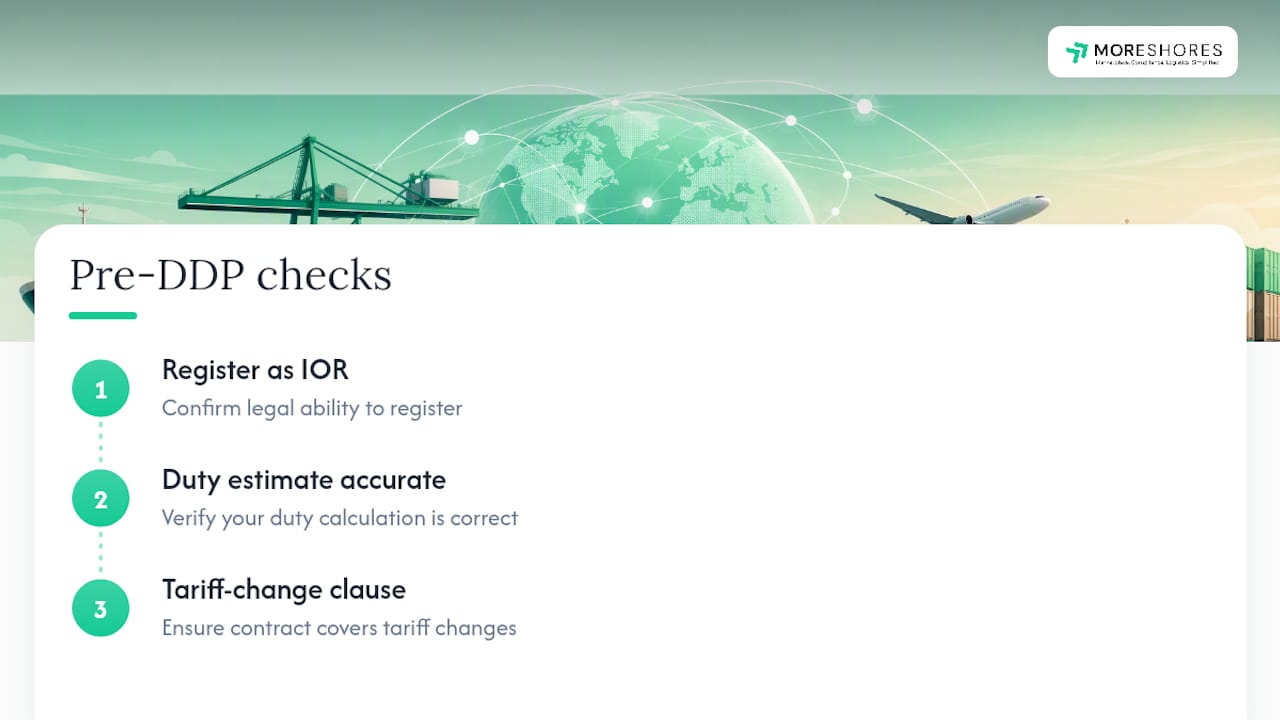
Before quoting DDP, confirm three things: legal ability to register as importer of record, accuracy of your duty estimate, and whether your contract includes a tariff-change clause. Skipping any one of these turns a pricing decision into a liability.
Third-party platforms often handle the operational side of this for sellers, acting as importer of record, managing customs clearance, and running warehousing and fulfillment so merchants can offer duty-paid delivery without registering a local entity themselves. That operational gap, more than pricing strategy, is usually what decides whether DDP is viable for a given shipment.
Why the DDP vs DAP Debate Misses the Real Question
Most advice on DDP versus DAP treats it like a pricing decision. It isn’t. It’s a legal-capability decision first, and only becomes a pricing question once you’ve cleared that bar. Sellers who skip the IOR check and go straight to comparing duty-paid quotes are solving the wrong problem in the wrong order.
The conventional wisdom also overstates DDP’s customer-experience edge. In markets with generous de minimis thresholds, that edge often shrinks to nothing, and sellers pay a markup for a benefit the buyer would barely notice. Where DDP genuinely earns its premium is in high-duty, high-friction markets where buyers have no appetite for customs paperwork.
My take: don’t ask “which term is better.” Ask “can I legally clear customs at destination, and can I price that risk accurately.” If the answer to either is shaky, DAP is the safer default, and it’s not a lesser choice. It’s often the more honest one.
— Matt
How Moreshores Removes the DDP Registration Barrier
The hardest part of offering DDP isn’t the paperwork, it’s the legal registration that most foreign sellers simply can’t get on their own. Moreshores solves that gap directly by acting as importer of record, handling customs clearance, duties, and VAT compliance on your behalf, so you can quote duty-paid pricing without opening a local entity.
Beyond clearance, some platforms run warehousing, inventory management, and multi-courier fulfillment, plus marketplace integration across platforms like Takealot, Amazon SA, Jumia, and Kilimall, along with Shopify and WooCommerce storefronts. If duty-paid delivery matters to your buyers but building local infrastructure doesn’t make sense yet, explore Moreshores’ cross-border enablement services to see how the importer-of-record setup works for your specific market.