Avoid 24 to 48 Hour Holds: HS Codes and Docs for SA Customs Clearance
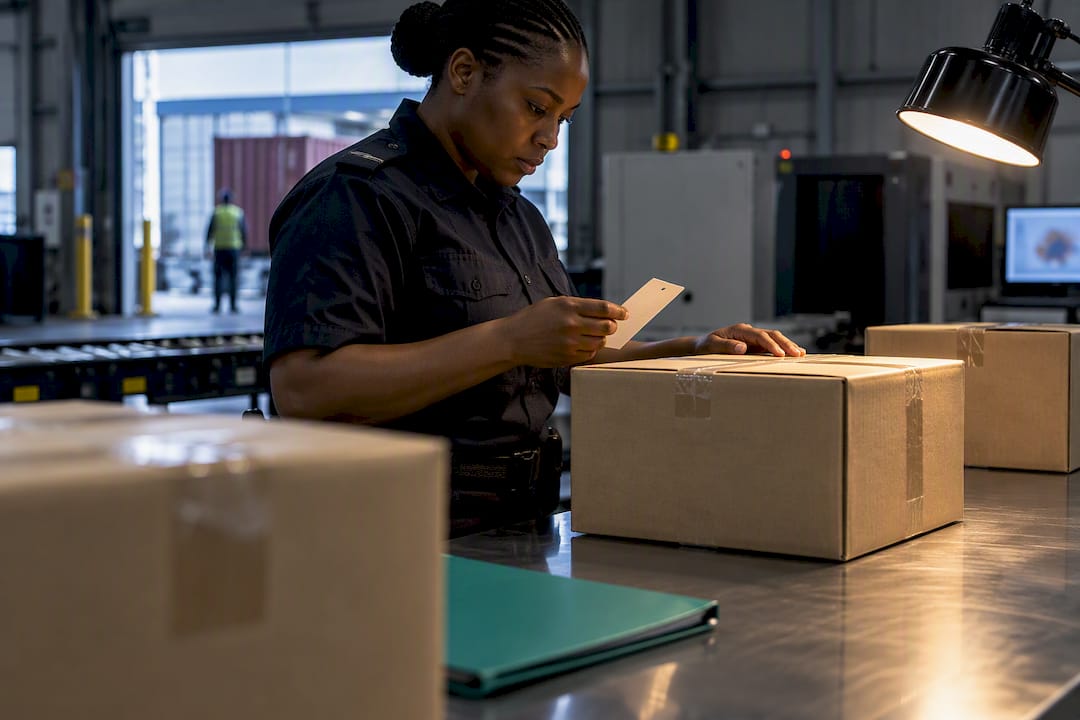
To clear goods into or out of South Africa, you must file a SAD 500 goods declaration with SARS, supply a complete commercial invoice, packing list, and bill of lading or airway bill, and pay the applicable duty plus 15% import VAT. If your documents are accurate and complete, a clean shipment normally clears within 24 to 48 hours. Gather your paperwork or contact a licensed clearing agent before your goods arrive.
TL;DR:
- Accurate and complete documentation, including the commercial invoice, packing list, and SAD 500 declaration with correct HS codes, is essential to avoid delays.
- Most shipments clear within 24 to 48 hours if SARS’s automated validation and classification checks pass successfully.
- Duty rates vary from 0% to 45% depending on the product category, with a flat 15% import VAT based on the calculated Added Tax Value.
- Incorrect HS classification or mismatched invoice details are the main causes of customs delays and inspections.
- Using a licensed clearing agent or an importer-of-record service can speed up the process and handle regulatory compliance for businesses without South African entities.
Table of Contents
- What Documents Do You Need for South African Customs Clearance?
- How Does the Customs Clearance Process Actually Work?
- What Do Customs Duties and VAT Actually Cost?
- Why Do Customs Delays Happen, and How Do You Avoid Them?
- Who Should Be the Importer of Record for Your Shipment?
- How Is Exporting From South Africa Different From Importing?
- What Practitioners Get Wrong About Customs Delays
- Let Moreshores Handle Your Customs Clearance Coordination
- Where to Verify Customs Rules and Tariff Codes
- Sources
- FAQ
What Documents Do You Need for South African Customs Clearance?
Every import or export begins with paperwork, and SARS is precise about what it expects on each page. Missing a single data field on your commercial invoice can trigger a documentary inspection that adds days to your timeline, so treat this checklist as non-negotiable rather than optional.
Your commercial invoice needs the seller and buyer names and addresses, the currency of sale, unit and total values, a clear goods description, and the agreed INCOTERMS (FOB, CIF, EX, and so on). The packing list must match the invoice line by line, down to weights, dimensions, and carton counts, because mismatches between the two documents are a common trigger for inspection.
Required documents typically include:
- Commercial invoice with full seller/buyer details, currency, and INCOTERMS
- Packing list matching invoice line items exactly
- Bill of lading (sea freight), airway bill (air freight), or road consignment note
- Completed SAD 500 goods declaration with harmonized HS tariff codes
- Certificate of origin, if claiming a preferential duty rate
- ITAC, sanitary, phytosanitary, or other permits for regulated goods
The SAD 500 itself captures the importer’s details, tariff classification, customs value, and country of origin. SARS requires this formal goods declaration for every import and processes it electronically, and declarations that arrive without complete invoice data carry a measurably higher chance of being flagged for a documentary check.
How Does the Customs Clearance Process Actually Work?
Once your goods land at a South African port or airport, the declaration moves through a defined sequence of stages. Understanding each one tells you exactly where delays happen and who is responsible for fixing them.
- Filing the SAD 500. You can file yourself if registered with SARS, but most importers use a licensed clearing agent who submits electronically on their behalf and carries the regulatory accreditation SARS expects.
- HS code classification. Every product needs an 8-digit tariff line under the South African schedule, based on the World Customs Organization’s HS nomenclature. Get this wrong and you risk the wrong duty rate, a rejected preferential claim, or an inspection.
- Automated validation. SARS runs the declaration through system checks that cross-reference invoice data against the SAD 500. Declarations that omit invoice detail are more likely to fail this check and get pulled aside.
- Channel selection. SARS assigns a green (clear for release), yellow (documentary review), or red (physical inspection) channel. Green channel shipments move fastest; red channel adds the most time.
- Duty and VAT payment. Your clearing agent calculates duty and 15% VAT and pays SARS directly, often through an established credit facility that avoids waiting on a bank transfer to clear.
- Release and collection. Once payment clears and any inspection is closed out, SARS releases the shipment and you arrange collection or onward delivery with your transporter.
A clean shipment with correct paperwork typically clears within 24 to 48 hours. A yellow or red channel selection can stretch that to several days or longer, depending on how quickly queries get resolved.
What Do Customs Duties and VAT Actually Cost?
Landed cost has three main components: customs duty, import VAT, and clearing fees, and each one is calculated differently. Duty depends entirely on your product’s HS code, and rates across the South African tariff schedule range roughly from 0% to 45% depending on the category and whether a trade agreement applies.
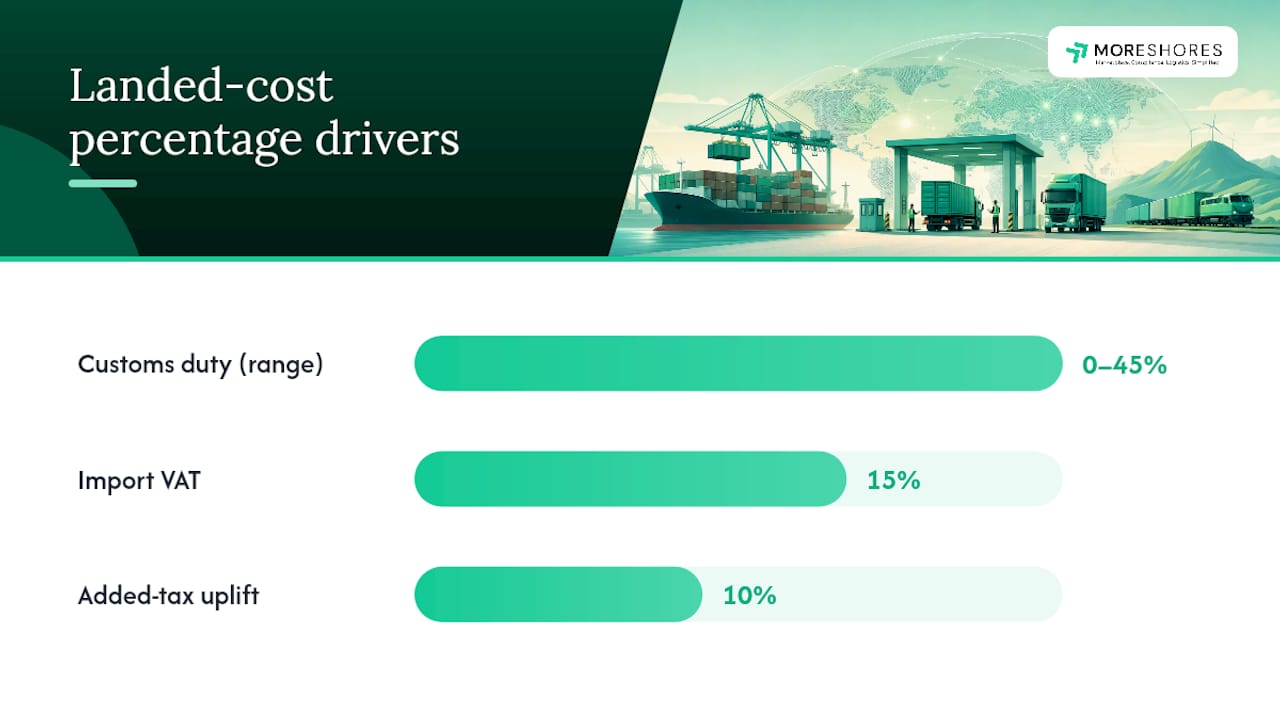
By the numbers: Import VAT in South Africa is a flat 15%, charged not on the invoice value alone but on the Added Tax Value, calculated as customs value multiplied by 1.10, plus the duty already paid. That compounding step is easy to miss when budgeting.
Beyond duty and VAT, expect these recurring costs:
- Clearing agent fees, typically a flat rate or percentage of shipment value
- Port or terminal storage charges, which accrue daily once a shipment sits past its free storage window
- Inspection-related handling fees if your shipment is pulled into the red channel
- Additional documentation or amendment fees for corrected declarations
If you hold a valid certificate of origin under a trade agreement South Africa participates in, you may qualify for a reduced or zero duty rate on that tariff line. That single document can be the difference between paying full duty and paying none at all on the same shipment.
Why Do Customs Delays Happen, and How Do You Avoid Them?
Incorrect HS classification is the single most common reason a shipment gets stuck. The wrong code doesn’t just risk a red channel inspection. It can also void a preferential duty claim you were otherwise entitled to, turning a routine clearance into an expensive correction.
The second major cause is incomplete invoice data. Since SARS validates declarations against invoice fields automatically, a missing currency code, an inconsistent goods description, or a mismatched value between the invoice and packing list can trip the same automated flags that catch genuine compliance issues.
Pro Tip: Run your own pre-departure check before the shipment leaves origin: confirm your HS code against the current tariff schedule, verify the invoice and packing list describe the goods identically, and confirm any permit requirements with the relevant regulator days in advance, not after arrival.
A short prevention checklist:
- Verify HS codes against the current schedule before booking freight
- Cross-check invoice, packing list, and SAD 500 data for consistency
- Confirm permit or certificate requirements for regulated goods early
- Use a clearing agent with an established SARS submission track record
Who Should Be the Importer of Record for Your Shipment?
Every SAD 500 needs a named importer, and who that is changes your registration burden, your liability, and whether you can reclaim VAT. You have three practical routes: import under your own registered South African entity, appoint a local importer of record, or use an importer-of-record service through a clearing agent.
SARS requires an Importer Code once you’re importing commercially and regularly, and registering it yourself means ongoing administrative responsibility for every declaration filed under your name. Using an agent’s importer-of-record service shifts that liability and paperwork to them, which suits businesses without a South African legal entity.
Before engaging any importer-of-record provider or clearing agent, ask:
- Are you registered and accredited with SARS, and can you show your Importer Code history?
- Who is legally liable if a declaration is rejected or under-declared?
- Can VAT paid on my shipments be reclaimed, and under what conditions?
- What is your average clearance time on shipments similar to mine?
How Is Exporting From South Africa Different From Importing?
Export clearance shares the same SAD 500 declaration framework but skips the duty and VAT calculations entirely, since South Africa does not levy import duty on outbound goods.
- Core documents: commercial invoice, packing list, and the SAD 500 export declaration
- No customs duty or import VAT applies to exports, though some goods still need export permits or certificates
- Inspections happen less often than on imports but can occur for regulated or high-value goods
- Confirm any destination-country import requirements before shipping, since your buyer’s customs process is separate from South Africa’s exit process
What Practitioners Get Wrong About Customs Delays
Most guidance on this topic treats classification and documentation as separate checklist items. They aren’t. A perfect commercial invoice paired with the wrong HS code still gets flagged, and a correct HS code attached to an incomplete invoice fails the same automated validation. Treat both as one problem: get your product’s tariff line right first, then build every other document around that classification, not the other way around.
The businesses that struggle most are the ones that treat South African customs as a one-time hurdle rather than a recurring compliance relationship. Frequent importers who invest in proper classification and consistent documentation see real reductions in inspection frequency over time. Moreshores works from that same principle, building pre-arrival document checks and HS classification into its importer-of-record process rather than treating clearance as a single transaction.
— Matt
Let Moreshores Handle Your Customs Clearance Coordination
Some service providers replace the patchwork of a broker, a separate importer-of-record arrangement, and a local entity with one integrated service covering customs clearance, duties and VAT handling, and fulfillment under a single platform.
Before requesting a quote, have your INCOTERM, HS codes, and a complete commercial invoice ready. Those three items determine most of what a clearing partner needs to give you an accurate landed-cost estimate and realistic timeline. Moreshores acts as Importer of Record for brands without a South African entity, coordinates the SAD 500 filing and duty/VAT payment, and connects clearance directly into warehousing and multi-courier fulfillment once your goods are released. Cross-border service runs at 10% under Moreshores’s pricing structure, with a market-entry setup fee of $950 for brands onboarding for the first time. Check current rates and request a quote on the pricing page to see exactly what your shipment will cost before it ships.
Where to Verify Customs Rules and Tariff Codes
- SARS Goods Declaration guidance for SAD 500 requirements
- SARS Customs and Excise rules and validation procedures
- Trade for classification and permits
- USITC tariff lookup (HTS) for HS code reference
Sources
- Goods Declaration | South African Revenue Service
- Customs Clearance South Africa 2026: Costs, Documents & Timelines (JLog)
- Customs and Excise | South African Revenue Service
- Trade
FAQ
How long does it take to clear customs in South Africa?
A clean shipment with complete documents typically clears within 24 to 48 hours. If SARS flags your declaration for a documentary review or physical inspection, clearance can stretch to several days or longer depending on how fast queries get resolved.
How much is the customs clearance fee in South Africa?
Clearing agent fees vary by shipment size and complexity, and customs duty itself depends on your product’s HS code, ranging roughly from 0% to 45%. Import VAT is a flat 15% calculated on the Added Tax Value, not the invoice price alone.
How long will my package be in customs clearance?
Most packages with correct paperwork move through in 24 to 48 hours, the same window that applies to commercial shipments. Incomplete invoice data, missing permits, or a red-channel inspection are the usual reasons a package sits longer.
What needs to be declared at South African customs?
You must declare the goods’ description, value, HS tariff code, country of origin, and quantity on the SAD 500 form, backed by a matching commercial invoice and packing list. Regulated items also require the relevant permit or certificate, such as ITAC approval or a certificate of origin for preferential duty treatment.
Do I need a clearing agent to import into South Africa?
You can file the SAD 500 yourself if registered with SARS and holding an Importer Code, but most businesses without a South African entity use a licensed clearing agent or an importer-of-record service like Moreshores. An agent handles classification, validation, and duty payment on your behalf, which reduces the administrative burden significantly.