15–20% Rule: Air vs Ocean Freight for Logistics Managers
Air freight wins on speed and reliability, but it charges a premium for that certainty; ocean freight wins on cost and volume, but you pay for it in weeks, not days. The rule of thumb procurement teams use: choose air when freight cost sits under roughly 15 to 20 percent of your cargo’s value, or when a deadline is truly mission critical. Otherwise, default to ocean. Standards like Incoterms and the role of a customs broker or Importer of Record, a function some cross-border platforms perform, shape which mode actually makes financial sense for a given shipment.
TL;DR:
- Air freight is justified mainly when freight costs are under 20% of cargo value or deadlines are critical; beyond that, ocean is typically more cost-effective.
- Transit times differ significantly, with air moving goods in days and ocean taking weeks, affected by congestion, delays, and route-specific factors.
- Hazardous goods, batteries, and certain chemicals face stricter regulations in air freight, requiring careful documentation and approvals versus more flexible ocean rules.
- Emissions from air freight are substantially higher, so combining modes or choosing slower shipping options can significantly reduce the carbon footprint.
- Hybrid strategies like sea-air or consolidating shipments can lower costs and reduce environmental impact without drastically sacrificing speed, especially on high-volume lanes.
Table of Contents
- Air Freight vs Ocean Freight: A Side-By-Side Comparison
- How Carriers Price Air vs Ocean Freight
- How Fast Is Air Freight vs Ocean Freight, Door to Door?
- Matching Cargo Types to the Right Freight Mode
- Regulatory Limits: Hazmat, Batteries, and Special Handling
- Carbon Footprint: Air vs Sea Transport
- A Practical Framework for Choosing Air vs Ocean
- Moreshores’ Tips for Cross-Border Sellers
- Why Testing Beats Guessing on Mode Choice
- Let a cross-border enablement platform handle the mode decision for you
- Sources
- FAQ
Air Freight vs Ocean Freight: A Side-By-Side Comparison
The two modes trade off almost every variable that matters to a shipment plan, and the gap is rarely subtle.
- Cost: Ocean freight is usually far cheaper per kilogram, especially at volume; air freight carries a heavy premium for speed.
- Transit time: Air freight moves in days; ocean freight typically takes weeks, door to door.
- Capacity: Ocean handles bulky, heavy, and high-volume cargo well; air favors lightweight, high-value, or time-sensitive goods.
- Restrictions: Air has stricter limits on hazardous goods and lithium batteries; ocean allows more bulk hazardous cargo under different rules.
- Carbon footprint: Ocean freight’s emissions per tonne kilometer run far below air freight’s.
- Reliability: Ocean freight benefits from mature, standardized infrastructure, according to DP World’s analysis of sea freight, while air freight depends more heavily on flight frequency and available capacity.
Lane variance runs highest on cost and transit time. Get quotes for your specific corridor before assuming either mode’s “typical” number applies to you.
How Carriers Price Air vs Ocean Freight
Air freight is priced by chargeable weight, also called volumetric weight, the greater of actual weight or a volume-based calculation. A shipment of light, bulky items can cost as much as one of dense, heavy items with identical actual weight. Ocean freight works differently: full container load (FCL) shipments price per container, while less than container load (LCL) shipments price per cubic meter.
Both modes layer on surcharges that catch shippers off guard:
- Fuel and bunker adjustment factors (BAF) that shift with oil prices
- Security and handling fees at origin and destination
- Demurrage and per diem charges when containers or cargo sit too long at the port or terminal
- Peak season surcharges during high-demand windows
Pro Tip: Run the math on value-to-weight ratio before requesting quotes. A $50,000 shipment of electronics weighing 200 kilograms almost always justifies air. A $50,000 shipment of furniture weighing 8,000 kilograms almost never does.
Landed cost extends beyond the freight invoice. Warehousing, inventory carrying cost, and the timing of duty payments all shift the real math, and forwarders increasingly recommend weighing that inventory carrying cost against freight cost rather than looking at the freight quote alone.
How Fast Is Air Freight vs Ocean Freight, Door to Door?
Port-to-port and airport-to-airport quotes are the numbers carriers advertise. They are not the numbers that matter. Door-to-door time includes pickup, terminal dwell, customs clearance, and last-mile drayage, and that gap between the quoted transit and the actual delivery date can run to a full month, according to DNV’s analysis of maritime delays.
- Air freight typically moves cargo in a matter of days once it’s airborne, but ground handling on both ends adds real time.
- Ocean freight typically runs several weeks port to port, and congestion or missed sailings can add more.
- Missing a flight usually means rebooking within a day or two; missing a sailing can mean waiting a full week or longer for the next vessel.
- Passenger-belly cargo capacity, which airlines rely on alongside dedicated freighters, tightens unpredictably and drives spot-rate volatility on tight lanes.
That month-long swing can decide whether inventory arrives in time for a retail season or misses it entirely.
Matching Cargo Types to the Right Freight Mode
Certain cargo almost sorts itself by mode. Perishables, pharmaceuticals, and anything with a tight expiration window belong on air freight, where speed limits spoilage risk. High-value, low-weight electronics and urgent spare parts follow the same logic. Heavy, bulky, or low-margin freight, think furniture, raw materials, or industrial equipment, belongs on ocean, where ocean freight remains the most cost-effective option for large quantities.
- FCL suits high-volume shippers who can fill a container and want predictable per-unit cost.
- LCL suits smaller shipments, and on short intra-regional lanes, express LCL can narrow the time gap with air freight.
- Palletization and consolidation directly affect chargeable weight on air and container utilization on ocean, so packing density is a cost lever, not an afterthought.
Regulatory Limits: Hazmat, Batteries, and Special Handling
Air freight applies stricter rules to hazardous goods, driven largely by lithium-ion battery fire risk and tighter limits on certain chemicals and liquids. Ocean freight allows more bulk hazardous cargo, though it comes with its own packaging, labeling, and stowage requirements.
- Lithium battery shipments often need airline-specific approval, special packaging, or outright rejection depending on charge state and quantity.
- Ocean carriers generally accept a wider range of hazmat classes but require detailed documentation and dedicated container placement.
- Documentation differs by mode. Air freight often demands more detailed dangerous goods declarations relative to shipment size; ocean freight leans on the IMDG Code for classification.
- Insurance terms and carrier liability waivers vary by mode, so confirm coverage specifics before booking, not after a claim.
Pro Tip: Loop in your freight forwarder before you finalize a purchase order, not after. A shipment refused at the airport because of undeclared batteries can cost you the entire time advantage you paid for.
Carbon Footprint: Air vs Sea Transport
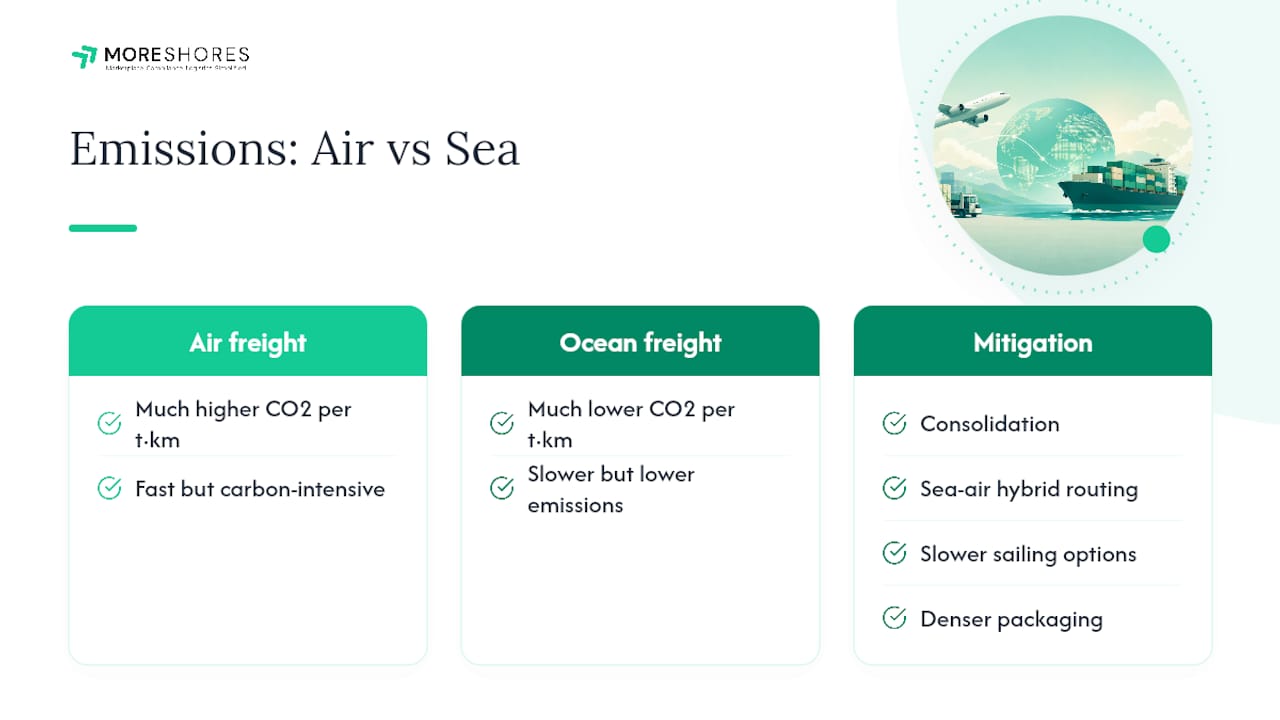
The emissions gap between the two modes is large. Air freight emits substantially more CO2 per tonne kilometer than ocean freight, making mode choice one of the more consequential levers in a company’s freight-related carbon footprint. Consolidation, sea-air hybrid routing, and slower sailing options all cut emissions without fully sacrificing speed. Denser packaging and verified carbon-reporting metrics help teams quantify the trade-off rather than guess at it.
A Practical Framework for Choosing Air vs Ocean
Run this sequence on any shipment where the mode isn’t obvious.
- Quantify the time value. Estimate lost sales, production downtime, or inventory carrying cost if the shipment arrives late. A line-down auto part might cost $10,000 per day in downtime, easily justifying air.
- Confirm cargo constraints. Check size, weight, hazard classification, and temperature sensitivity before you request quotes.
- Run lane-specific checks. Sailing frequency, port congestion, and seasonal demand spikes all affect real transit time on your specific route.
- Compute full landed cost. Add surcharges and inventory carrying cost to the freight quote, then compare against your service window. A documented lane switch from air to ocean delivered roughly 27 percent cost improvement and 28 percent lower CO2 with only a 6 percent increase in lead time, a reminder that middle options like sea-air or express LCL deserve consideration before defaulting to either extreme.
Red flags that justify paying for air: a line-down production part, a perishable good near its shelf-life limit, or a contractual penalty tied to a missed delivery date.
Moreshores’ Tips for Cross-Border Sellers
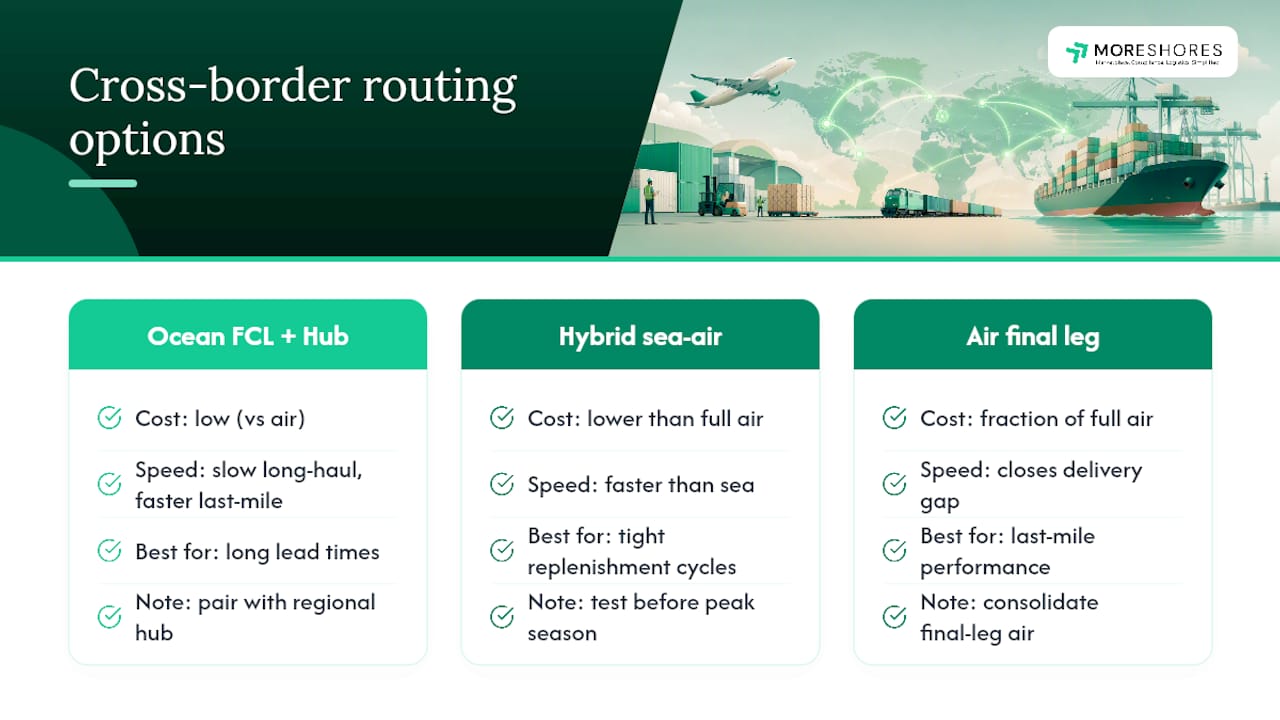
Pair ocean FCL with a regional fulfillment hub to cut last-mile speed without paying for air on the long haul. For replenishment cycles with tight margins for error, a hybrid sea-air routing or consolidated air shipment on the final leg often closes the gap at a fraction of full air cost, a technique worth testing before your next peak season order.
Why Testing Beats Guessing on Mode Choice
Air and ocean freight aren’t rivals. They’re tools, and the shippers who treat them that way outperform the ones who pick a mode once and never revisit it. Run a pilot shipment on your priority lane using both modes if the volume allows, then compare landed cost and actual delivery date, not the quoted transit time. Build contingency into your plan; a diversified modal strategy protects you when one option gets disrupted. Start with a simple landed-cost comparison on your highest-volume lane this quarter.
— Matt
Let a cross-border enablement platform handle the mode decision for you
Choosing between air and ocean freight is only half the equation. The other half is customs clearance, duties, VAT, and getting inventory into position to actually sell once it lands, and that’s where most shipments lose time nobody accounted for. Moreshores acts as your Importer of Record for cross-border shipments, handling regulatory compliance and duty payment so your freight decision doesn’t stall at the border.
Beyond clearance, Moreshores runs warehousing and fulfillment through a multi-courier network, so a cargo choice you make for the long haul connects directly to fast last-mile delivery once goods land. Pair that with marketplace integration across platforms like Takealot, Amazon SA, Jumia, and Kilimall, and your freight strategy stops being an isolated decision and becomes part of one connected supply chain. Request a shipment review with Moreshores to map your next lane’s landed cost and fulfillment path before you book.
Sources
- Choosing Between Ocean and Air Freight - DHL Global Forwarding
- Air Freight vs. Ocean Shipping: Which is Right for Your Cargo? | C.H. Robinson
- What is sea freight | DP World
- DNV insight on maritime delays and operational impacts
FAQ
Which Is Better, Air Freight or Sea Freight?
Neither is universally better. Air freight wins for speed, reliability, and time-sensitive or high-value cargo; ocean freight wins for cost efficiency on bulky or high-volume shipments.
Is Ocean Freight Cheaper Than Air Freight?
Yes, ocean freight is almost always cheaper per unit of weight or volume, particularly at scale, though air freight’s speed can offset part of that premium through lower inventory carrying costs.
What Are the 4 Types of Freight?
The main modes are air, ocean, rail, and road freight, each suited to different cargo profiles, distances, and budgets. Air and ocean dominate international cross-border shipping, while rail and road typically handle regional or domestic legs.
How Do I Decide Between Air and Ocean for a Specific Shipment?
Compare the shipment’s time value against the cost difference between modes. If freight cost stays under roughly 15 to 20 percent of cargo value and the deadline isn’t urgent, ocean freight is usually the better call.
Can I Combine Air and Ocean Freight on One Shipment?
Yes, sea-air hybrid routing and consolidated air options on the final leg let you balance cost and speed, particularly useful for replenishment shipments where a small cost premium buys meaningful time savings.