African Market Entry Strategies 2026: A Practical Guide

TL;DR:
- Africa’s large size and growth opportunities attract international brands, but success depends on a structured approach. Proper preparation, corridor-led entry, governance, and market verification are essential steps to avoid costly failures. Master one market deeply, ensure compliance, and deploy disciplined pilot testing before scaling regionally.
Africa’s size and economic growth make it one of the most compelling regions for international expansion, but it consistently punishes brands that enter without a structured plan. The continent spans 54 countries, each with distinct regulatory regimes, currency risks, and distribution realities. If your 2026 business expansion strategy doesn’t account for these specifics, you are not expanding. You are guessing. This guide gives you a practical, sequenced framework covering preparation, corridor-led entry, governance, and scaling so you can move into African markets with confidence and control.
Table of Contents
- Key Takeaways
- Market entry strategies 2026: preparation essentials
- Corridor-led entry and pilot testing
- Governance, partnerships, and avoiding gatekeeping
- Scaling and verifying your market position
- My take on disciplined market entry in Africa
- How Moreshores can support your African market entry
- FAQ
Key Takeaways
| Point | Details |
|---|---|
| Start with AfCFTA tools | Use the AfCFTA Tariff Finder to identify markets with zero or near-zero tariffs before committing resources. |
| Use corridor-based entry | Begin with two manageable logistics corridors and define stop-loss metrics before scaling. |
| Compliance is non-negotiable | ESG and regulatory compliance are now contract requirements from buyers and development finance institutions. |
| Governance prevents gatekeeping | Build audit rights and channel diversification into your partnership agreements from day one. |
| Master one market first | Deep unit economics in one market creates the foundation needed before regional expansion. |
Market entry strategies 2026: preparation essentials
Before you place a single shipment or sign a distributor agreement, your groundwork determines whether your entry is viable or expensive. The most common mistake international businesses make is underestimating non-tariff barriers, which include import licensing requirements, local content rules, standards certification, and informal delays at customs.
Leverage AfCFTA before anything else
The African Continental Free Trade Area gives you a significant advantage if you know how to use it. AfCFTA covers 1.4 billion people with zero or near-zero tariff access for qualifying goods. Use the AfCFTA Tariff Finder to compare rates across multiple target markets simultaneously. Treat the output as your first market filter, not your final decision.
Your preparation checklist should include the following:
- Tariff and duty mapping: Use TradeMap alongside AfCFTA data to model total landed cost, including non-tariff barriers like port handling fees and inspection costs.
- Regulatory monitoring: Ethiopia recently liberalized several sectors for foreign investment, including retail and wholesale trade, subject to minimum capital thresholds. Tracking these shifts helps you time entry correctly.
- Product compliance and standards: Identify which standards bodies govern your product category in each target country. KEBS in Kenya, SABS in South Africa, and SON in Nigeria each have distinct certification timelines.
- ESG and sustainability documentation: IFC-aligned ESMS systems are now a structural requirement for accessing development finance institution-backed financing and global supply chains. Prepare this documentation before you need it, not after a deal stalls.
- Intellectual property registration: File trademarks and patents in each priority market independently. Regional frameworks exist but are inconsistently enforced.
Pro Tip: Build a cost model that includes a 15-20% contingency specifically for non-tariff barriers. Port delays, standards re-testing, and informal facilitation costs are predictable in aggregate, even when specific incidents are not.
Your valuation of any African market entry should price in these friction costs from the start. Brands that discover them midway through a pilot typically underestimate capital requirements and either underfund the operation or exit prematurely.
Corridor-led entry and pilot testing
Once preparation is complete, the question becomes how you enter rather than whether you enter. The corridor approach is the most reliable market entry tactic for international businesses operating in Africa. It limits your exposure while giving you real operational data.
How to structure your entry pilot
Starting with two manageable logistics corridors and setting clear stop-loss thresholds significantly reduces risk and improves operational control. The corridors you select should reflect your existing logistics strengths, not just the markets with the largest populations.
Here is the step-by-step execution framework:
- Score and prioritize markets: Run a 30-day prioritization sprint. Score each candidate market on tariff access, regulatory openness, logistics infrastructure, and payment infrastructure. Validate corridor and partner feasibility before committing.
- Define your stop-loss metrics upfront: Set clear thresholds for days sales outstanding, service failure rates, customs clearance times, and channel concentration. If any metric breaches the defined limit during the pilot, the process pauses before further capital is deployed.
- Launch a time-bound pilot: Limit your initial pilot to 60 to 90 days with a fixed budget ceiling. Track KPIs weekly, not monthly. Early deviations are easier and cheaper to address.
- Manage currency risk actively: Use forward contracts or digital trade finance tools to lock in exchange rates for pilot transactions. East African markets in particular carry FX volatility that can erode margins without hedging.
- Engage local distributors with defined terms: Appoint distributors with clear contractual performance targets, not vague partnership language. Include audit rights and reporting obligations from the start.
Pro Tip: Do not conflate pilot success with market readiness. A successful 90-day pilot tells you the entry is viable. It does not tell you the market is ready for scale. Treat the pilot as a data collection exercise, not a sales achievement.
The table below shows key pilot metrics and the recommended measurement approach:
| Metric | What to measure | Stop-loss threshold |
|---|---|---|
| Days sales outstanding | Average payment collection time | Greater than 45 days triggers review |
| Customs clearance time | Average days from port arrival to warehouse | Greater than 10 days triggers review |
| Service failure rate | Percentage of orders with fulfillment errors | Greater than 5% triggers pause |
| Channel concentration | Percentage of revenue from single partner | Greater than 60% triggers diversification |
| Gross margin stability | Margin variance versus plan | Greater than 10% negative variance triggers review |
Digitization improvements in regulatory processing can accelerate pilot timelines significantly, with measurable impact typically visible within 12 to 18 months of reform implementation. Factor this into your market timing assumptions.
Governance, partnerships, and avoiding gatekeeping
Many international businesses with strong products and adequate capital fail in African markets not because of demand deficits, but because of distribution gatekeeping. An informal monopoly held by a single distributor or agent can block your access to end customers regardless of how competitive your offering is.

Informal gatekeeping and monopolies are among the most common failure points in African market entry. Mitigation requires governance instruments embedded in your agreements before you sign them.
Due diligence you cannot skip
Your partner due diligence process should cover financial stability, existing distribution relationships, any conflicts of interest with competing brands, and legal standing. A partner who appears capable on paper may have exclusive agreements with your competitors that were not disclosed upfront.
Key governance elements to build into every partnership structure:
- Audit rights: You must have the contractual right to inspect sales data, inventory records, and financial accounts at defined intervals.
- Escalation routes: Define in writing how disputes are resolved, including the jurisdiction, timeline, and escalation authority. Ambiguity here is expensive.
- Channel diversification requirements: Avoid single-distributor exclusivity in major markets. Divide territory by region, channel type, or customer segment to maintain competitive tension.
- Investment structure: Choose between a representative office, a joint venture, or a fully owned subsidiary based on the level of control you need versus the risk you are willing to hold.
Successful African market entry requires viewing the process as market-building, not just sales operations. Deep due diligence and governance are what separate sustainable entries from costly experiments.
Leveraging local expertise does not mean delegating governance. The most effective market entries combine a local partner’s relationship network and market knowledge with the international brand’s operational standards and reporting requirements. Both sides contribute. Neither side operates without accountability.
Understanding how to navigate channel concentration risks through diversification is an insight many logistics-focused businesses apply too late, typically after a single-partner failure creates a costly gap in coverage.
Scaling and verifying your market position
Once your pilot period concludes, the natural instinct is to expand quickly. Resist it. Prioritizing rapid regional expansion without governance readiness is a top market entry mistake. Verification before scaling is what separates a replicable model from an expensive one-off success.
Verification metrics that matter
Use the following framework to assess pilot outcomes before authorizing expansion:
| Factor | Pilot benchmark | Expansion readiness signal |
|---|---|---|
| Sales growth rate | Positive trend over 8 weeks | Consistent growth across both corridors |
| Margin stability | Within 5% of plan | Stable or improving over 12 weeks |
| Customs efficiency | Under 10-day clearance average | Repeatable without manual intervention |
| Partner performance | Meeting all contractual KPIs | KPIs met for three consecutive months |
| Compliance status | No outstanding regulatory issues | All certifications current and documented |
Once your pilot data confirms unit economics are sound, phased expansion becomes manageable. Add one market at a time. Carry your governance dashboard and compliance monitoring processes into each new corridor before deploying capital.
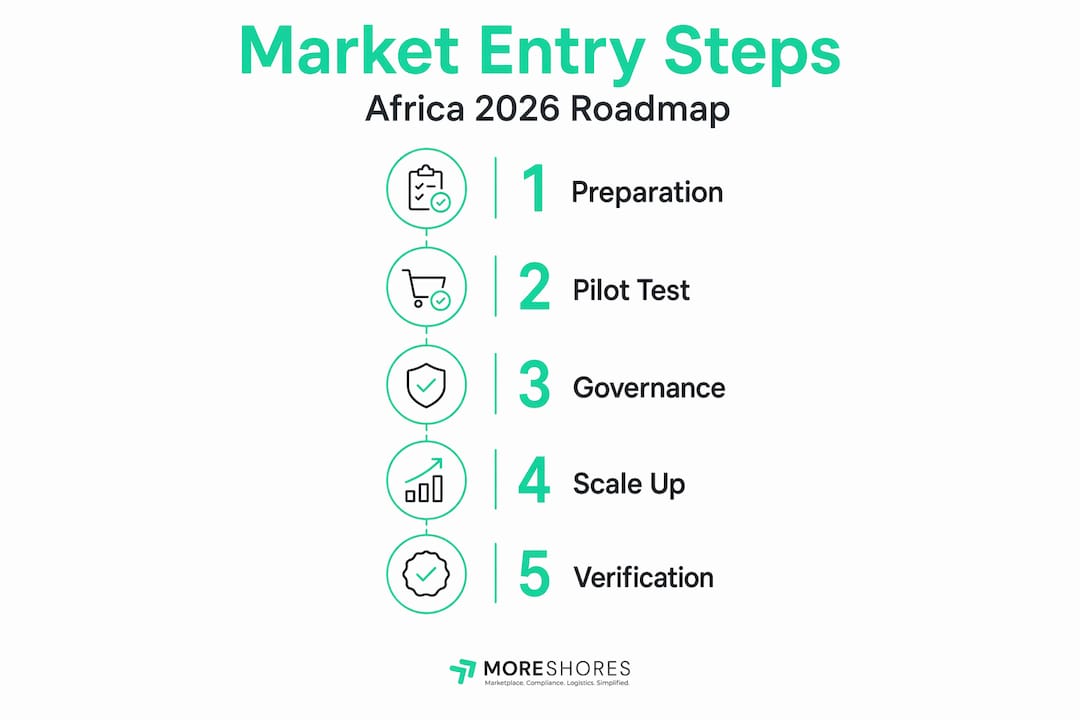
Sustainability and ESG compliance have moved from back-office functions to core market-entry requirements. Global buyers and development finance institutions increasingly demand IFC-aligned environmental and social management documentation as a condition of doing business. Addressing this before expansion removes a significant bottleneck.
If pilot data reveals underperformance in collections or channel reliability, use those findings to renegotiate distributor terms or switch corridors before scaling. The pilot is your cheapest source of strategic insight. Treat it as one.
My take on disciplined market entry in Africa
I’ve watched brands enter African markets with genuinely strong products and real capital, and still fail within 18 months. The pattern is almost always the same. They compress the preparation phase, underestimate compliance costs, and appoint one distributor who turns out to hold more leverage than they anticipated.
What I’ve learned is that the businesses that succeed treat Africa as a market to build, not a territory to claim. That distinction matters more than any tactical decision they make. It shapes how they do due diligence, how they structure partnerships, and how they decide when to scale.
The structural readiness demanded by investors now includes holding company structures, audit rights, and repeatable execution models. This is not bureaucracy. It is the architecture that makes growth replicable.
My honest advice: master one market deeply before you think about regional expansion. The brands I’ve seen scale successfully across multiple African markets all had the same thing in common. They were almost embarrassingly patient in their first market, and that patience paid dividends when they moved into markets two and three.
— Matt
How Moreshores can support your African market entry
If you are planning your entry into African markets in 2026 and want to reduce the operational complexity covered in this guide, Moreshores is built specifically for that challenge.
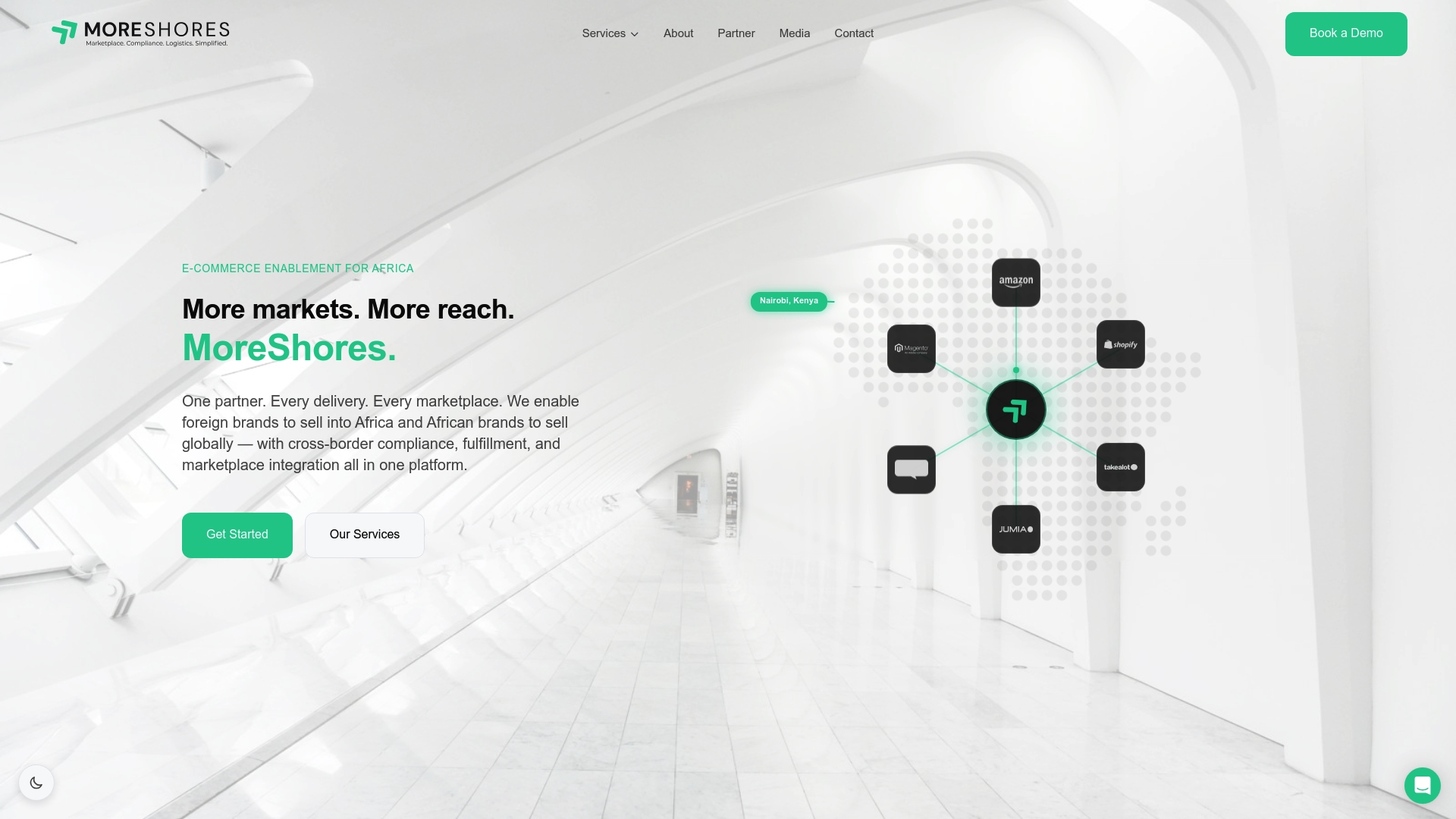
Moreshores acts as your Importer of Record for cross-border compliance, handling customs clearance, duties, VAT, and regulatory documentation so you are not navigating those processes from scratch. The platform connects your product catalog to major African marketplaces including Takealot, Jumia, Amazon SA, and Kilimall through its marketplace integration service, with direct integration into Shopify and WooCommerce storefronts.
For brands that need fulfillment coverage, Moreshores provides warehousing and logistics support through a multi-courier network that reduces delivery friction across key corridors. The end-to-end model means you can move from compliance to customer without managing multiple vendors. Explore how Moreshores works by visiting the brand onboarding guide or reach out to discuss your specific market and product requirements.
FAQ
What is the first step in African market entry for 2026?
Start with the AfCFTA Tariff Finder to identify markets with zero or near-zero tariffs for your product category. Pair that with a cost model that accounts for non-tariff barriers before committing to any corridor.
How many markets should you enter at once?
Begin with two logistics corridors maximum. Trying to enter multiple African markets simultaneously without pilot data spreads capital and attention too thin, and makes it harder to identify which variables are driving performance.
Why do international businesses fail in African markets?
Distribution gatekeeping and informal monopolies block market access more often than lack of demand. Governance design, including audit rights and channel diversification, is the most effective mitigation.
What does ESG compliance mean for African market entry?
An IFC-aligned Environmental and Social Management System is increasingly required by development finance institutions and global buyers as a condition of financing and supply chain participation, making it a practical market-entry requirement rather than an optional standard.
When is a pilot result good enough to scale?
When gross margin stability is within 5% of your plan for three consecutive months, customs clearance is repeatable without manual intervention, and your partner is meeting all contractual KPIs consistently. Unit economics must be confirmed before regional expansion begins.