African export checklist: essential steps for compliance

TL;DR:
- Getting cross-border trade right the first time is essential for expanding your African market presence and avoiding costly delays caused by documentation errors. An accurate export checklist and compliance with specific forms, HS codes, and AfCFTA rules ensure smooth customs clearance and market access. Leveraging digital customs systems and proactive certification management provides a competitive edge in Africa’s complex international trade environment.
Getting cross-border trade right the first time is not a nice-to-have — it’s the difference between growing your African market presence and watching your goods sit in a bonded warehouse collecting fees. An accurate african export checklist is what separates exporters who clear customs in 24 hours from those who lose contracts over missing permits. African trade involves specific forms, certificates of origin, HS code classifications, and AfCFTA tariff rules that trip up even experienced logistics teams. This guide walks you through every critical step, from documentation to digital systems, so you can move goods confidently across African borders.
Table of Contents
- Understand essential export documentation requirements
- Classify your products with accurate HS codes
- Meet African Continental Free Trade Area (AfCFTA) rules of origin
- Leverage digital customs systems and single windows
- Prepare for market-specific certifications and trade facilitation
- Comparison table: key export checklist items across major African markets
- Why a strategic export checklist is your best competitive edge in Africa
- Simplify your African export journey with MoreShores
- Frequently asked questions
Key Takeaways
| Point | Details |
|---|---|
| Comprehensive documentation | Prepare all essential export documents precisely to avoid clearance issues. |
| Accurate HS codes | Classify products correctly at minimum 6-digit level to ensure compliance and tariff benefits. |
| AfCFTA rules of origin | Meet 40% regional content or tariff change criteria to access preferential tariffs across Africa. |
| Digital customs systems | Leverage single window platforms to reduce processing times and costs significantly. |
| Market certifications | Secure necessary certifications and monitor regulatory changes proactively to prevent trade barriers. |
Understand essential export documentation requirements
To successfully prepare your export shipment, start by mastering the required documentation. It is the foundation of customs compliance, and missing a single form can hold your entire shipment at the port.

Universal export documents required across African trade include a commercial invoice with product value, HS codes, and Incoterms; a packing list; transport documents; and certificates of origin. Getting these right is your first line of defense against clearance delays.
Here is what every export shipment needs:
- Commercial invoice: Must list item descriptions, declared value, currency, HS codes, and Incoterms (such as FOB or CIF). Incomplete invoices are one of the top reasons customs holds shipments.
- Packing list: Must match the commercial invoice precisely in terms of weights, quantities, and dimensions. Discrepancies between these two documents trigger manual inspection.
- Transport document: A bill of lading for sea freight or an airway bill for air freight establishes legal ownership of the goods. Without it, you cannot claim your shipment.
- Certificate of Origin (CoO): Required when claiming preferential tariffs under AfCFTA or other trade agreements. Issued by the relevant national authority, this document proves where your goods were made.
- Export permits: Certain goods — minerals, agricultural products, controlled substances, and some electronics — require additional permits before they can leave the country. Requirements vary significantly by country.
For businesses that handle detailed compliance steps for logistics operators, building a checklist for exporting goods into each destination market prevents repeat mistakes.
Pro Tip: Always cross-check your commercial invoice against your packing list line by line before submission. A weight discrepancy as small as 0.5 kg per carton, multiplied across a full container, will stop your clearance.
Classify your products with accurate HS codes
Once your documents are in order, precise product classification via HS codes is the critical next step to ensure smooth customs clearance.
The Harmonized System (HS) is a globally standardized product classification framework maintained by the World Customs Organization. Every product exported from or into Africa must carry a minimum 6-digit HS code that customs authorities use to calculate applicable duties, determine eligibility for trade agreement benefits, and flag restricted goods.
Why does this matter so much? According to a 2023 WCO study, misclassification of HS codes causes 87% of customs delays. That figure should stop you in your tracks. A product described as “electronic component” without the right 6-digit code can be assessed the wrong duty rate, denied preferential tariff treatment, or flagged for physical inspection.
Key points to keep in mind:
- HS codes must be at least 6 digits, but many African countries require 8 or 10 digits for full tariff schedule alignment.
- The same physical product can have different HS codes depending on its intended use. A steel rod used in construction is classified differently from one used in manufacturing.
- Product changes — new materials, new functions, new packaging — can change the correct HS code.
- Check codes against the tariff schedule of the destination country, not just the origin country.
For guidance on procedures for preferential tariff shipments, knowing your HS code in advance is the first thing customs will ask for.
Pro Tip: Never copy HS codes from a supplier’s previous invoice without verifying them. Suppliers sometimes use outdated or incorrect codes. Always validate against the current tariff schedule of the destination country.
Meet African Continental Free Trade Area (AfCFTA) rules of origin
After classifying your goods correctly, fulfilling AfCFTA origin rules offers competitive tariff advantages that are essential for market success. AfCFTA has the potential to eliminate tariffs on 90% of goods across 54 African countries, but only if your goods actually qualify.
To qualify for AfCFTA preferential tariffs, your product must meet at least 40% regional value content or demonstrate a substantial change in tariff heading. That means you need documentation to back it up.
Follow these steps to qualify:
- Calculate your regional value content (RVC). Total the cost of all African-origin inputs divided by the ex-works price of the finished product. You need to hit 40% or above.
- Identify your tariff heading change. If your product is transformed enough during production that its HS classification changes at the 4-digit level, that counts as substantial transformation.
- Collect supplier declarations. Every African input supplier needs to confirm the origin of their materials. Keep these on file for at least five years.
- Apply for a Certificate of Origin. Register as an exporter with SARS or your national customs body at least 72 hours before shipment. Processing typically takes 3 to 14 days and comes with a modest fee.
- Use cumulation to your advantage. AfCFTA allows inputs sourced from multiple African countries to count cumulatively toward your origin threshold. A Kenyan manufacturer using South African steel and Ghanaian textiles can combine all three toward their 40% requirement.
Important compliance notes:
- Non-compliance means your goods are assessed at the most-favored-nation (MFN) tariff rate, which is often significantly higher.
- A CoO rejected at the border creates delays and potential fines even if your goods are technically eligible.
Pro Tip: Build a supplier declaration template and send it to all your African-origin input suppliers before your first shipment. Getting this paperwork in advance saves weeks of back-and-forth at clearance time.
Leverage digital customs systems and single windows
To complement compliance and documentation accuracy, utilizing digital customs systems dramatically speeds up export operations.
The era of paper-based customs submissions is ending across Africa, but the pace of adoption varies widely. Nigeria’s National Single Window Platform centralizes all export documentation into one submission portal, with the goal of cutting clearance times from several weeks down to 24 to 48 hours. South Africa’s eFiling system through SARS achieves similar results. According to a 2025 UNCTAD ASYCUDA report, digital customs systems have reduced processing times by up to 67% for transit declarations and centralized enquiry points that provide reliable support to traders.
Here is what digital single windows give you:
- One-stop document submission: Upload commercial invoice, packing list, transport documents, and permits in one place rather than across multiple agencies.
- Faster clearance: Compliant submissions are cleared in 24 to 48 hours rather than days or weeks.
- Real-time tracking: You can monitor where your declaration stands, reducing uncertainty and allowing proactive problem-solving.
- Lower demurrage risk: Faster processing means your goods leave the port before storage fees accumulate.
- Audit trails: Digital records protect you in dispute resolution.
| Country | Digital system | Clearance time (compliant) | Key feature |
|---|---|---|---|
| South Africa | SARS eFiling / SARS-eCustodian | 24-48 hours | Integrated VAT and duty processing |
| Nigeria | National Single Window Platform | 24-48 hours | Consolidated multi-agency submissions |
| Kenya | KRA iCMS | 2-3 days | Integrated KEBS certification tracking |
For exporters exploring the role of digital platforms in export processing, integrating your internal systems with these national platforms is well worth the initial setup investment.
Pro Tip: If your destination country has a Single Window platform, register and test your login credentials well before your first shipment. Technical issues during an active shipment are costly and avoidable.
Prepare for market-specific certifications and trade facilitation
Beyond customs and tariffs, securing relevant market certifications protects your shipment from costly non-tariff barriers, which are often more expensive than the tariffs themselves.
As one export readiness analysis puts it plainly: one non-compliant batch can permanently close market access. That is not an exaggeration. A single rejected shipment to an EU buyer, for example, can trigger enhanced border controls on all future consignments from your country of origin.
Non-tariff barriers cost more than tariffs in 88% of countries according to WTO Deputy Director-General Jean-Marie Paugam. This includes phytosanitary standards, maximum residue limits (MRL) for agricultural goods, technical product standards, and labeling requirements.
How to stay ahead of these barriers:
- Identify all required certifications for your target market before you produce your first batch. EU imports require MRL testing and HACCP compliance for food products. Gulf markets require Halal certification. Confirm requirements early.
- Register on the ePing platform. WTO’s ePing tool sends automatic notifications about changes to sanitary, phytosanitary (SPS), and technical barriers to trade (TBT) regulations in your target markets.
- Engage with national trade facilitation committees. These bodies provide early warnings about upcoming regulatory changes and give exporters a channel to raise compliance concerns.
- Maintain updated certification documentation. Certifications expire. Build a renewal calendar for ISO, KEBS, SABS, and market-specific accreditations so you are never caught with lapsed paperwork.
- Budget for certification time. Some certifications take 6 to 12 weeks to obtain. Factor this into your product launch timeline.
“The most successful African exporters treat certifications as a market entry investment, not a compliance tax. The brands that win long-term are those who secure market access credentials before they need them, not after a rejection.”
For a full review of export compliance procedures, understanding non-tariff barriers is as important as understanding tariff schedules.
Comparison table: key export checklist items across major African markets
To put these checklist elements in perspective, here is a comparison of key export requirements and processing details across three major African markets.
| Requirement | South Africa | Nigeria | Kenya |
|---|---|---|---|
| Key customs form | SC-CF-55 form + commercial invoice | National Single Window submission | KRA iCMS declaration |
| Packing list required | Yes | Yes | Yes |
| Transport document | Bill of lading or airway bill | Bill of lading or airway bill | Bill of lading or airway bill |
| Special permits | ITAC permits for controlled goods | NAFDAC, SON for regulated products | KEBS certification for standards-regulated goods |
| Certificate of Origin | SARS-issued for AfCFTA | Issued by Nigeria Customs Service | Kenya Revenue Authority |
| Clearance time (compliant) | 24-48 hours | 24-48 hours | 2-3 days |
| Digital platform | SARS eFiling | National Single Window | KRA iCMS |
| SPS/TBT monitoring | ePing, DAFF notifications | NAFDAC updates | ePing, KEBS bulletins |
Each country has its own regulatory personality. South Africa is methodical and form-driven. Nigeria has made significant strides with digital consolidation. Kenya leans heavily on standards enforcement through KEBS. Knowing these differences before you ship prevents costly surprises.
Why a strategic export checklist is your best competitive edge in Africa
Most exporters treat the african export checklist as a once-and-done task. Fill in the forms, ship the goods, move on. That approach works until it does not, and when it fails, the costs are significant: demurrage fees, license suspensions, or losing a buyer who needed on-time delivery.
The real competitive edge comes from treating the checklist as a living operational system. Documentation errors are not random. They cluster around the same points: mismatched packing lists, wrong HS codes carried over from old shipments, expired certifications, and certificates of origin submitted after the deadline. Once you map your failure points, you can build automated checks that catch them before submission.
Centralized enquiry points managed by customs administrations provide precise responses 71% more reliably than multi-agency setups. That data reinforces a strategic point: the exporters who invest in understanding single window platforms and establishing direct relationships with customs enquiry points resolve disputes faster than those who rely on freight forwarders alone.
Think regionally, not just bilaterally. AfCFTA’s cumulation rules let you build supply chains that draw on inputs from multiple African countries while still qualifying for preferential tariffs. A Rwandan exporter using Ugandan materials and Ethiopian packaging components can structure their sourcing to hit the 40% regional content threshold more easily than by relying on one country alone. Most exporters never model this. The ones who do gain a cost advantage their competitors cannot easily replicate.
One more thing worth saying directly: digital integration is no longer optional for high-volume exporters. The digital tools reducing export times available today let you submit declarations, track clearance status, and receive regulatory alerts in real time. Businesses still relying on manual processes are leaving both time and money at the border.
The African export checklist is not bureaucratic overhead. It is your market access plan.
Simplify your African export journey with MoreShores
With a solid understanding of the African export checklist, the next step is putting it into practice without building an internal customs team from scratch.
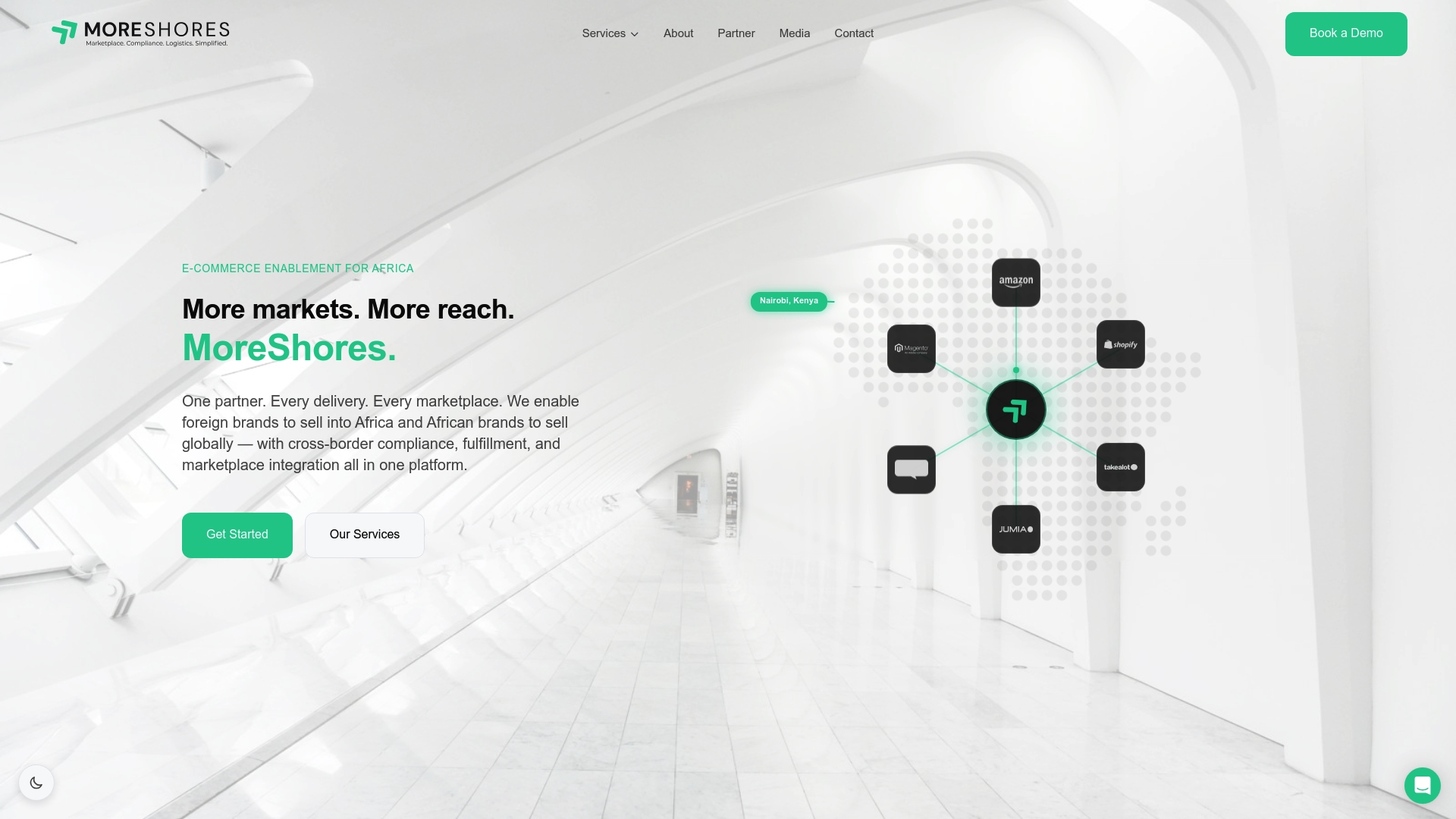
MoreShores is built specifically for brands and businesses navigating cross-border trade in Africa. Our cross-border enablement services handle Importer of Record functions, duties, VAT, and regulatory compliance so your goods clear without delays. Our e-commerce solutions for Africa connect your product catalog to Takealot, Jumia, Amazon SA, Kilimall, Shopify, and WooCommerce in one integrated workflow. And our fulfillment and logistics services manage warehousing, inventory, and multi-courier delivery across African markets. Whether you are an international brand entering Africa or an African business expanding globally, MoreShores gives you the infrastructure to move faster and comply fully.
Frequently asked questions
What are the most important documents for exporting from Africa?
Key export documents include a commercial invoice with HS codes and Incoterms, a packing list that matches invoice details exactly, transport documents such as a bill of lading, and certificates of origin when claiming preferential tariffs under AfCFTA or bilateral trade agreements.
How do I qualify my product for AfCFTA preferential tariffs?
You must prove at least 40% African content or a substantial tariff heading change, submit a Certificate of Origin issued by your national customs authority, and maintain supplier declarations and value-add documentation for audit purposes.
What is the benefit of using a National Single Window platform?
It centralizes all export documentation into one portal, reducing clearance times from weeks to 24-48 hours while cutting demurrage costs and providing a single point of contact for compliance queries and dispute resolution.
Why is accurate HS coding critical for African exports?
Accurate HS codes determine your correct duty rates and rules of origin eligibility, while misclassification causes 87% of customs delays according to 2023 WCO data, making it one of the highest-impact compliance actions you can take.
How can I stay updated on changing import regulations in target markets?
Use WTO’s ePing platform to receive automatic notifications on SPS and TBT regulatory changes in your target markets, helping you adjust certifications and product specifications before a shipment is rejected at the border.