
A 3PL executes logistics tasks like warehousing, transport, and fulfillment; a 4PL orchestrates your entire supply chain and takes accountability for outcomes across multiple partners. Choose a 3PL when you need execution on specific lanes with a handful of providers. Choose a 4PL when provider count, visibility gaps, or internal bandwidth make coordination itself the bottleneck.
TL;DR:
- Companies with more than eight providers across multiple regions should evaluate 4PL for better orchestration and visibility.
- A 4PL’s control tower technology consolidates data from all partners, providing real-time tracking and exception management in one dashboard.
- The decision to switch depends on internal capacity drain and projected growth, especially if coordination costs exceed management fees.
- Pilot projects should focus on already problematic corridors and include clear SLAs, data integrations, and governance roles before full transition.
- Clear KPI monitoring, such as OTIF, inventory accuracy, and exception resolution times, ensures accountability in either logistics model.
Table of Contents
- What Is a 3PL and When Does It Make Sense?
- What Is a 4PL and What Does Orchestration Actually Mean?
- 3PL vs 4PL: The Decision-Relevant Differences
- The Diagnostic Checklist: Is It Time to Evaluate a 4PL?
- How to Pilot, Contract, and Transition to a 4PL Model
- Costs, KPIs, and Governance That Keep Providers Accountable
- How MoreShores Maps to 3PL and 4PL Needs
- Why Governance Fails More Often Than Technology Does
- How MoreShores Helps You Move From Fragmented to Coordinated
- Sources
What Is a 3PL and When Does It Make Sense?
A third-party logistics provider handles the physical and operational work of moving goods. That means warehousing, order fulfillment, transportation, returns processing, and often customs brokerage for cross-border shipments. You hand a 3PL a defined job. It executes that job, usually within its own facilities and network.
Pricing tends to follow what you actually use. Most 3PL contracts run transactional: per-pallet storage fees, per-order fulfillment charges, or per-shipment transport rates. This makes 3PL economics predictable at low volume and painful to forecast once your order mix gets complicated across regions or seasons.
A 3PL fits best when you’re running a manageable number of provider relationships. A single-market e-commerce brand shipping through one or two carriers, or a manufacturer sending pallets to one regional distribution hub, rarely needs anything more complex. The tell is simple: if you can name every provider in your network without checking a spreadsheet, a 3PL setup is probably still the right scale.
Common 3PL services include:
- Warehousing and inventory storage
- Pick-and-pack and kitting for order fulfillment
- Cross-docking for high-velocity, low-storage-time freight
- Domestic and cross-border transportation
- Returns processing
- Customs brokerage and import documentation
Most 3PLs run on a warehouse management system (WMS) for inventory accuracy and a transportation management system (TMS) for routing and carrier selection. These tools support execution well. They were never built to give you a single view across five different providers using five different systems, which is where the model starts to strain.
What Is a 4PL and What Does Orchestration Actually Mean?
A 4PL doesn’t move boxes. It manages the people and systems that move boxes. That distinction sounds abstract until your network hits a certain size, at which point it becomes the difference between a working supply chain and a daily fire drill.
Where a 3PL executes, a 4PL orchestrates the entire chain, often across multiple 3PLs, carriers, and regional partners. You get one point of contact instead of five. That contact owns the outcome, not just their slice of it.
The technical core of a 4PL is the control tower: a consolidated dashboard that pulls data from every partner in your network into one view. Real-time shipment tracking, inventory positions across warehouses, and exception alerts all surface in a single place instead of living in five separate portals you have to check manually every morning.
Control tower functions typically include:
- Consolidated data feeds from every 3PL and carrier in the network
- Real-time visibility into inventory, orders, and shipments
- Exception management, meaning automated flags when something deviates from plan
- Performance reporting across the entire network, not just one provider’s slice
A 4PL manages multiple 3PLs on your behalf and, unlike a broker, assumes accountability for whether the whole system hits its targets. If a shipment misses its window because a carrier the 4PL selected underperformed, that’s the 4PL’s problem to fix, not yours to chase down.
Pro Tip: Before signing anything, ask a prospective 4PL to walk you through a real exception event from a past client, start to finish. If they can’t describe how their control tower flagged it and who resolved it, you’re likely looking at a rebranded 3PL, not real orchestration.
Organizations typically start evaluating 4PL when they’re operating across multiple regions, managing more provider relationships than one team can track, or need integrated visibility that no single 3PL can offer alone. Gartner has flagged that the 4PL label gets applied loosely across the market, so verify a provider actually delivers outcome accountability and orchestration rather than enhanced execution wearing a new label.
3PL vs 4PL: The Decision-Relevant Differences
The two models split cleanly along five dimensions once you look past the marketing language.
- Accountability and risk allocation. A 3PL is accountable for its own performance within its scope, warehouse accuracy, on-time pickup, and little else. A 4PL is accountable for the network’s outcome, even for failures that originate with a partner it selected on your behalf.
- Asset ownership and operational control. 3PLs typically own or lease the warehouses, trucks, and systems doing the physical work. 4PLs are often asset-light, owning the orchestration layer and technology rather than the trucks and buildings underneath it.
- Scope of services and governance. 3PL scope is transactional and task-based. 4PL scope covers strategy, network design, and governance across every provider in the chain, including planning and demand functions in newer 4PL models.
- Technology and visibility. 3PL technology (WMS, TMS) is optimized for execution within one node. 4PL technology is a control tower designed to unify visibility across every node at once.
- Best-fit company profile. A single-region SMB with one or two provider relationships fits 3PL. A multi-region enterprise juggling eight or more partners, or a fast-growing brand expanding into new marketplaces and territories, fits the 4PL evaluation.
| Dimension | 3PL | 4PL |
|---|---|---|
| Scope of responsibility | Execution of a specific function | End-to-end orchestration |
| Asset ownership | Owns warehouses, fleets, systems | Often asset-light |
| Accountability | For its own task performance | For total network outcomes |
| Technology & visibility | WMS/TMS within its own network | Control tower across all partners |
| Best for | SMBs, single-region, few partners | Multi-region, complex, many partners |
| Typical cost shape | Transactional, per-unit | Management fee plus network costs |
The Diagnostic Checklist: Is It Time to Evaluate a 4PL?
Most companies don’t decide to move from 3PL to 4PL. They get pushed there by symptoms that accumulate quietly until someone finally tallies the cost of coordination itself.
Run your network against these five signals:
- Provider count and spread. Three to five providers in one or two regions is generally manageable in-house. Eight or more spread across regions is usually the threshold where orchestration overhead outweighs the cost of paying someone to own it.
- Visibility gaps and WISMO volume. If your team fields frequent “where is my order” tickets because no single system shows the full shipment journey, that’s a control tower problem, not a customer service problem.
- Internal capacity drain. Track how many hours your logistics team spends chasing status updates across providers versus planning strategy. If coordination is eating the majority of that time, you’re already paying for a 4PL function, just without the control tower to make it efficient.
- Projected complexity growth. A network that’s manageable today but expected to double its provider count or enter three new markets within 18 to 24 months should evaluate 4PL before the growth arrives, not after.
- True cost of coordination. Add up internal headcount, the tools you’ve patched together, and the hours lost to firefighting. Compare that total to a 4PL management fee before assuming the fee is the more expensive option.
The 4PL market has been expanding globally, a signal that more companies are hitting this exact threshold and choosing orchestration over continued in-house coordination. Skipping this evaluation carries real cost: Kuehne+Nagel notes sticking with fragmented 3PL relationships past the point of manageable complexity produces accountability gaps that show up as stockouts and customer failures.
How to Pilot, Contract, and Transition to a 4PL Model
Nobody should flip their entire network to 4PL orchestration overnight. The staged approach works better and gives you real performance data before you commit budget at scale.
- Pick a pilot corridor with known friction. Choose a specific SKU set, region, or trade lane where visibility gaps or provider coordination already cause measurable pain. A clean, low-complexity lane won’t reveal much.
- Write SLAs around outcomes, not activities. Specify on-time-in-full rates, exception resolution windows, and reporting cadence, not just “will provide tracking updates.”
- Build the data integration checklist before day one. List every ERP connection, TMS/WMS feed, and EDI or API endpoint the control tower needs to ingest. Missing integrations are the single most common reason pilots stall.
- Assign internal governance roles. Someone on your team needs to own the relationship, review dashboards weekly, and escalate exceptions. A 4PL without an engaged counterpart on your side underperforms no matter how good its technology is.
- Set a fixed evaluation window and criteria. Ninety days is typical. Measure against the SLAs you wrote in step two, then decide whether to scale, adjust, or walk away.
Pro Tip: Run your pilot corridor in parallel with your existing 3PL setup for the first month rather than cutting over immediately. It costs a little more short-term but gives you a clean before-and-after comparison instead of a guess.
Costs, KPIs, and Governance That Keep Providers Accountable
Cost comparisons between the two models only make sense when you account for what each fee actually buys. A 3PL’s transactional pricing looks cheaper line by line. A 4PL’s management fee often replaces internal coordination costs you’re already paying, just less visibly.
Build your business case with the full total cost of ownership: internal headcount hours spent on coordination, the patchwork tools filling your visibility gaps, and the fulfillment failures those gaps cause, weighed against the 4PL fee.
Whichever model you choose, require these KPIs in the contract:
- On-time-in-full (OTIF) rate, tracked by lane and provider
- Inventory accuracy across all storage locations
- Average exception resolution time
- WISMO ticket volume, trending down over successive quarters
Pair those KPIs with real governance: quarterly business reviews, clear data ownership rights, and contractual penalties or rewards tied to performance against the SLA. A KPI without a consequence attached rarely moves provider behavior.
How MoreShores Maps to 3PL and 4PL Needs
MoreShores functions across both models depending on what a cross-border brand actually needs. Its warehousing, inventory management, and multi-courier fulfillment cover core 3PL execution. Its role as Importer of Record, handling customs, duties, VAT, and regulatory compliance, plus marketplace integration across Takealot, Amazon SA, Jumia, and Kilimall, functions closer to 4PL-style orchestration for brands entering multiple African markets at once.
The platform is suited for brands expanding across borders or channels simultaneously rather than those operating within a single market with limited logistics needs.
Why Governance Fails More Often Than Technology Does
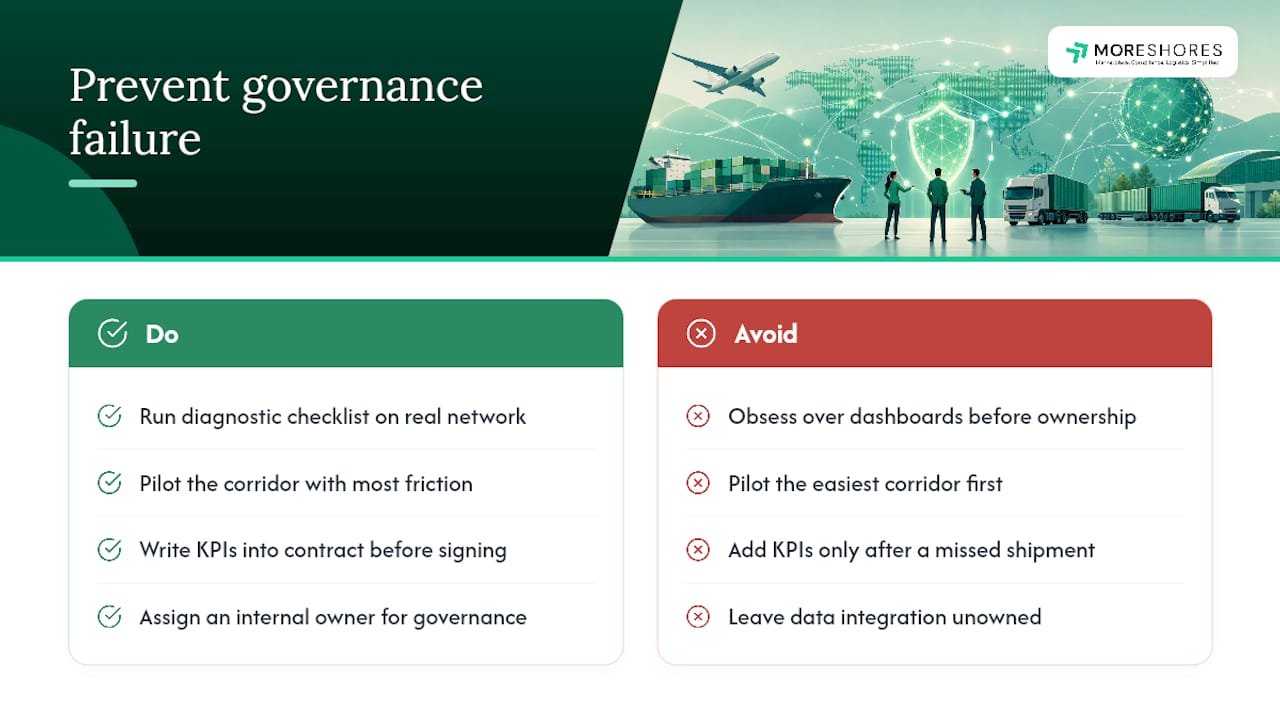
Companies obsess over which control tower dashboard looks best and skip the harder question of who inside their own organization actually owns the relationship day to day. That’s backwards. I’ve seen the diagnostic checklist above work precisely because it forces a number onto something companies usually just feel: too many providers, too little visibility, too much internal time lost to chasing status updates.
My honest recommendation: run the checklist against your real network before you shop for a solution. Pilot on the corridor with the most friction, not the easiest one. Write KPIs into the contract before you sign, not after the first missed shipment. Most 4PL relationships that fail didn’t fail on technology. They failed because nobody on the buyer’s side owned the data integration or showed up to the quarterly review. Start your RFP process with governance questions first and technology questions second.
— Matt
How MoreShores Helps You Move From Fragmented to Coordinated
If managing multiple providers across borders consumes significant time, a consolidated platform can serve as a single partner for key cross-border commerce functions. Instead of working with separate customs brokers, warehouses, and marketplace listings for each African market, brands can use one platform that manages Importer of Record responsibilities, duties and VAT, fulfillment through multi-courier networks, and listing synchronization across major African marketplaces.
That consolidation matters most for brands scaling into multiple markets or channels at once, exactly the complexity level where the diagnostic checklist above points toward orchestration. Whether you’re a foreign brand entering African e-commerce or an African brand expanding internationally, the cross-border enablement services cover compliance, logistics, and marketplace distribution under one contract instead of five. If your provider count is already past the point your team can track cleanly, start with a discovery conversation and see what a pilot corridor looks like on your own network.
Sources
- 3PL vs. 4PL: choosing the right logistics model | Kuehne+Nagel United States
- 3PL vs. 4PL: What’s the difference & why you should care | DHL
- The difference between 3PL vs 4PL | Maersk
- 3PL vs 4PL: What You Need to Know | Ryder Supply Chain