Why streamline marketplace management for African e-commerce

TL;DR:
- Expanding into African markets requires a tailored, streamlined operational approach due to high logistics costs and regional complexity.
- Localized systems, reliable logistics partnerships, and phased market entry are essential for sustainable growth and cost control in Africa.
Expanding into African markets looks compelling on paper, yet many global e-commerce brands hit a wall fast. The reason is rarely product quality or brand recognition. It is operational complexity. Logistics costs reach 40-60% of product value across African markets, compared to just 6-8% globally. That single gap explains why copy-paste marketplace strategies collapse before they generate meaningful revenue. If you manage cross-border e-commerce for an international brand, you need a fundamentally different framework for Africa. This article walks you through what that framework looks like and why streamlining is the foundation of any successful expansion.
Table of Contents
- The high stakes of marketplace management in Africa
- What does streamlining marketplace management mean?
- Direct benefits of streamlined marketplace management
- Key challenges to streamlining: pitfalls and how to avoid them
- How to get started: building your roadmap for streamlined management
- Why most marketplace expansion strategies fail in Africa and how to avoid the trap
- Accelerate your e-commerce expansion with MoreShores
- Frequently asked questions
Key Takeaways
| Point | Details |
|---|---|
| Local challenges demand adaptation | Efficient marketplace management in Africa requires tailored systems for distinct infrastructure and trust issues. |
| Streamlining boosts profitability | Integrated management reduces costs, accelerates time-to-market, and improves user satisfaction. |
| Learn from case studies | Successes like CoinAfrique demonstrate that localizing platforms and processes drives growth across regions. |
| Pitfalls can be avoided | Common mistakes—such as ignoring local payment options or logistics partners—can be mitigated with a strategic approach. |
| Start small, scale smart | Pilot streamlined solutions in one market before expanding for manageable, sustainable growth. |
The high stakes of marketplace management in Africa
To understand why a streamlined approach is vital, first consider the unique marketplace risks and costs in Africa.
Africa is not one market. It is 54 countries with different currencies, regulatory environments, infrastructure quality, and consumer behaviors. Managing marketplace operations across even two or three of these markets simultaneously creates compounding complexity that erodes margins quickly.
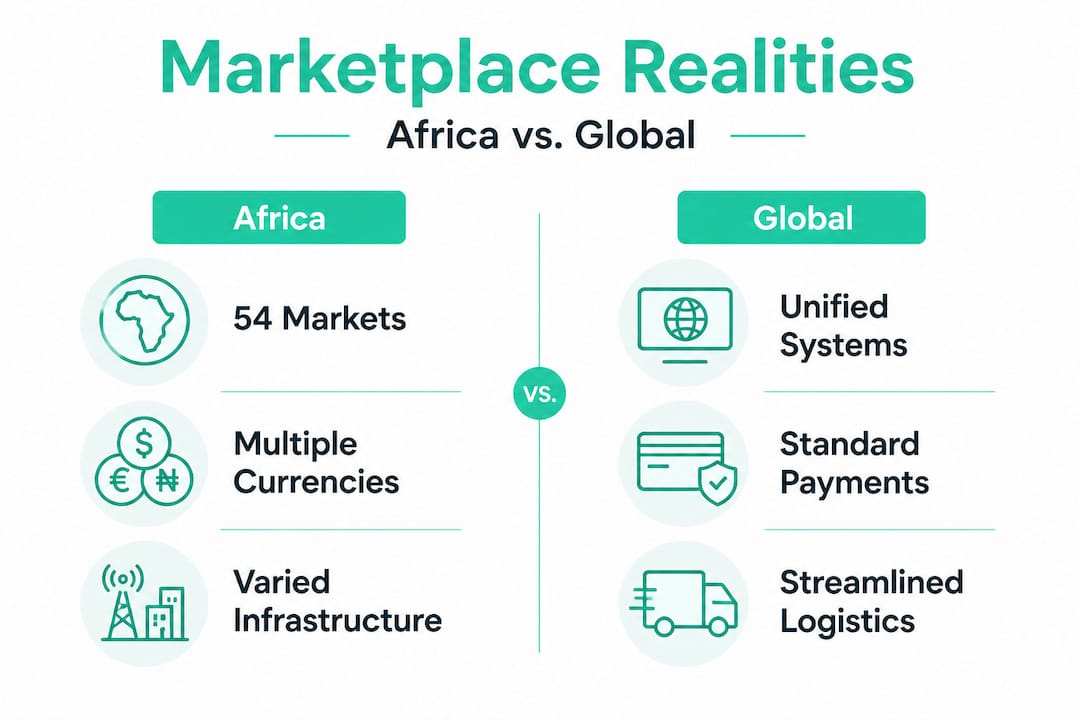
The logistics costs in Africa are not a minor line item. When nearly half your product value disappears into transportation, customs clearance, warehousing delays, and last-mile delivery challenges, your pricing strategy breaks down entirely. Global benchmarks simply do not apply here.
Key risk factors that every e-commerce manager must account for include:
- Unreliable road and port infrastructure that extends transit times and increases damage rates
- Customs delays that can hold shipments for weeks, tying up working capital and disrupting inventory cycles
- Trust deficits among consumers who prefer cash-on-delivery or informal markets over online transactions
- Currency volatility in markets such as Nigeria, Ethiopia, and Zimbabwe that makes multi-currency pricing unpredictable
- Fragmented logistics providers with inconsistent service levels across regions
- Low digital penetration in rural areas that limits addressable market size for digital-first strategies
“Without localized streamlining, scaling in Africa means absorbing disproportionate costs while competing against informal markets that operate with far lower overhead. The math simply does not work otherwise.”
Exploring proven e-commerce solutions in Africa and building fulfillment logistics strategies around local realities is not optional. It is the price of entry. Understanding marketplace transport costs in specific regions helps you build accurate cost models before committing capital.
What does streamlining marketplace management mean?
Given these risks, it is essential to clarify what “streamlining marketplace management” really entails for e-commerce expansion. It is not simply automating your current workflows. Automation applied to a broken process just produces faster failures.
Streamlining means the coordinated simplification and integration of systems, processes, and vendor relationships so that your team can manage multi-market operations without multiplying headcount or overhead proportionally. It requires redesigning how you operate, not just what tools you use.
The Shoprite case is instructive here. Shoprite withdrew from 6 African countries due to currency volatility, high operational costs, COVID-era disruptions, and strong consumer preference for informal markets. Shoprite had scale, brand recognition, and capital. What it lacked was a sufficiently localized operating model. The lesson for e-commerce brands is clear: size and global credibility do not substitute for local adaptation.
Streamlining in practice covers these interconnected elements:
- Payment localization: Integrating mobile money (M-Pesa, MTN MoMo), local bank transfers, and cash-on-delivery alongside card payments
- Marketplace selection and integration: Choosing the right platforms for each market, whether Jumia, Takealot, Kilimall, or Amazon SA, and managing listings centrally
- Logistics partner coordination: Building a multi-courier network that covers urban and peri-urban areas reliably
- Compliance and regulatory management: Handling duties, VAT, and product certification requirements per country
- Inventory positioning: Placing stock closer to demand centers to cut last-mile costs
- Platform technology: Using integrations with Shopify or WooCommerce to sync orders, inventory, and pricing across channels automatically
Here is a practical comparison of operational steps before and after streamlining:
| Operational area | Before streamlining | After streamlining |
|---|---|---|
| Order processing time | 3-5 days manual review | Same-day automated sync |
| Customs clearance | Ad hoc, delays of 2-3 weeks | Importer of Record model, predictable timelines |
| Marketplace listings | Separate management per platform | Centralized dashboard, single update |
| Payment reconciliation | Manual across 4-6 methods | Automated multi-currency reconciliation |
| Returns handling | No clear process, high loss rate | Defined SLA with local partner network |
| Compliance tracking | Reactive, after-the-fact | Built-in per-market compliance checks |
Leveraging marketplace integration tools and following a structured onboarding guide significantly reduces the setup time for each new market you enter.
Pro Tip: Before selecting your integration tools, map every manual step your team currently handles. Then identify which steps could be consolidated or eliminated entirely. You will likely find that 30-40% of effort goes into tasks that a well-integrated platform can handle automatically.
Direct benefits of streamlined marketplace management
With a clear definition in place, let’s examine the measurable benefits realized by companies that have optimized their marketplace management.
The CoinAfrique example gives you a concrete benchmark. CoinAfrique scaled to 5M+ users and attracted $3.1M in investment while operating across 16 African countries. The platform achieved this growth through two specific technical and operational decisions: low-bandwidth optimization for users on 2G and 3G networks, and multi-vendor platform architecture that allowed diverse seller types to participate without complex onboarding requirements.
The takeaway for your brand is not to replicate CoinAfrique’s product. It is to adopt the same mindset: adapt the operating model to fit how African consumers and infrastructure actually function, rather than expecting them to conform to global norms.
Here are the measurable benefits you can expect from streamlined marketplace management:
- Faster time-to-market: Centralized listing management reduces new product launch time from weeks to days across multiple platforms
- Lower cost-per-order: Consolidated logistics partnerships and automated order routing cut per-order fulfillment costs by 20-35% compared to managing couriers independently
- Higher customer satisfaction scores: Predictable delivery timelines and clear tracking information improve post-purchase experience significantly
- Faster market adaptation: When a single regulatory change or platform policy update affects one market, a centralized system lets you respond in hours rather than days
- Improved inventory accuracy: Real-time sync between warehouse management and marketplace listings reduces stockouts and overselling, both of which damage seller ratings
| Metric | Traditional management | Streamlined management |
|---|---|---|
| Marketplace listing updates | 2-3 days per platform | Under 4 hours, all platforms |
| Order-to-dispatch time | 48-72 hours | Under 24 hours |
| Cross-border compliance errors | Frequent, costly | Reduced by systematic checks |
| Multi-market visibility | Fragmented, siloed | Single dashboard view |
Cross-border enablement platforms make these outcomes achievable without requiring you to build the infrastructure yourself. Partnering with providers that offer express delivery for marketplaces also reduces the last-mile cost pressure that eats into margins.

Pro Tip: Track cost-per-order as your primary efficiency metric, not just gross revenue. In African markets especially, revenue growth without cost control leads to losses at scale. Cost-per-order tells you whether your streamlining investments are actually working.
Key challenges to streamlining: pitfalls and how to avoid them
Even the best plans face obstacles. Understanding these barriers makes it easier to chart a successful course forward.
The most damaging pitfalls are not always the obvious ones. Many brands identify currency volatility and customs delays early. What catches them off guard is the combination of regulatory complexity varying by country, the depth of informal market competition, digital access gaps in key population centers, and the fragmented nature of logistics coverage outside major cities.
Common mistakes that derail streamlining efforts:
- Ignoring local payment options: Brands that offer only card payments in markets where mobile money is dominant lose 40-60% of potential transactions immediately
- Neglecting informal markets: In many African countries, informal trade accounts for the majority of commerce. Online platforms that do not accommodate informal seller behaviors fail to capture real market volume
- Underinvesting in last-mile logistics: The first mile from your warehouse to the courier hub is manageable. The last mile to the consumer is where costs and failures concentrate, particularly outside major urban centers
- Centralizing decision-making too early: Managing everything from headquarters before you have local market knowledge leads to slow, inaccurate responses to market changes
- Skipping compliance checks per country: VAT registration requirements, import duty rates, and product certification rules differ significantly between South Africa, Kenya, Nigeria, and Ghana. A blanket compliance approach will create liability
“The brands that succeed long-term in African markets are those that invest in local relationships and local knowledge before scaling their technology. Technology amplifies what is already working. It cannot replace what is missing.”
The logistics costs data reinforces this point. High costs are partly structural, but they are also partly the result of brands not having the right e-commerce logistics partnerships in place. Using established technology for logistics coordination reduces fragmentation and lowers the cost exposure.
Pro Tip: In every new African market, identify and formalize relationships with at least two local logistics providers and one local compliance advisor before you list your first product. Local partners surface problems early and solve them faster than any remote team can.
How to get started: building your roadmap for streamlined management
Armed with an understanding of both challenges and opportunities, here’s how you can take practical next steps.
A structured roadmap prevents the most common mistake: launching across too many markets simultaneously before your operational systems are proven. Scalability comes after reliability, not before.
Here is a step-by-step framework:
- Conduct a market assessment: Identify two or three target markets based on product fit, regulatory accessibility, digital penetration rates, and logistics infrastructure quality. South Africa, Kenya, and Nigeria are the most common starting points for international brands due to relative digital maturity and market size
- Select your marketplace channels: Match your product category to the strongest platforms in each market. Takealot and Amazon SA for South Africa, Jumia for Nigeria and Kenya, Kilimall for East Africa. Avoid listing on every platform simultaneously until operations are stable
- Adapt your vendor and logistics partners: Work with couriers and warehousing providers who have proven local coverage and track records. Consolidate where possible to reduce coordination overhead
- Integrate your payment options: Ensure your checkout supports the dominant payment methods in each market before launch, not as a follow-on improvement
- Complete technology and compliance checks: Use a centralized platform to manage listings, inventory, and orders. Verify that your Importer of Record arrangements, VAT registration, and product certifications are in place for each market. This step is non-negotiable
- Run a pilot in your primary market: Launch in one market fully before expanding. Use real transaction data to refine your cost-per-order targets, delivery SLAs, and customer service processes
- Scale with data: Use pilot results to build the operational playbook for your second and third market entries. CoinAfrique’s expansion across 16 countries followed a similar logic: prove the model locally, then replicate it regionally with platform architecture that was designed to scale
The brand onboarding process at MoreShores follows exactly this sequence, reducing setup time and compliance risk for brands entering Africa. Detailed Africa marketplace entry solutions are available to support each stage of your roadmap. For reliable delivery execution, courier delivery solutions tailored to African routes help you build realistic SLAs from day one.
Pro Tip: Your pilot market should be your best-case scenario, meaning the market where you have the most confidence in product fit and logistics coverage. Proving the model in a favorable environment first gives you cleaner data and a stronger case for internal investment approval for wider expansion.
Why most marketplace expansion strategies fail in Africa and how to avoid the trap
Many global e-commerce brands enter African markets with the same playbook they used in Southeast Asia or Eastern Europe. They centralize operations, standardize their tech stack, and project revenue targets based on population data. Then reality arrives.
The core error is treating Africa as a single market with localized surface differences. In practice, the regulatory environment in South Africa, the mobile money dependency in Kenya, the infrastructure gaps in Nigeria, and the currency instability in Zimbabwe represent fundamentally different operating contexts. A strategy calibrated for one does not transfer cleanly to another.
We have seen this pattern repeatedly. Brands that invest in relationships first, meaning local logistics partners, local compliance advisors, and local marketplace managers, consistently outperform brands that lead with technology. The technology matters. But cross-border adaptation insights show that trust between your brand and local partners is the actual driver of execution quality, especially when something goes wrong.
The uncomfortable truth is that starting small is not a compromise. It is the strategically correct choice. A brand that controls its cost-per-order in one African market, builds reliable delivery SLAs, and earns strong seller ratings on one platform has a compounding advantage when it expands. A brand that launches across five markets simultaneously with unproven systems usually ends up retreating, at significant cost.
Streamlining does not mean doing less. It means doing what works, repeatedly and consistently, before layering on complexity.
Accelerate your e-commerce expansion with MoreShores
For brands seeking expert support on this journey, here’s how MoreShores can help.
Entering African markets without the right infrastructure behind you is expensive and slow. MoreShores was built specifically to remove that barrier for international brands. We act as your Importer of Record, handle VAT and regulatory compliance, manage multi-courier fulfillment, and integrate your product listings across Takealot, Amazon SA, Jumia, and Kilimall from a single platform.
Whether you are entering Africa for the first time or optimizing an existing presence, our cross-border enablement solutions and marketplace integration services are designed to reduce your time-to-market, lower your cost-per-order, and ensure compliance from day one. Explore our comprehensive e-commerce solutions or contact the MoreShores team directly to discuss a strategy tailored to your brand and target markets.
Frequently asked questions
Why are logistics costs so high in African markets?
Logistics costs reach 40-60% of product value in Africa due to poor infrastructure, customs delays, and low consumer trust, compared to just 6-8% globally. These structural challenges require localized logistics strategies rather than standard global approaches.
Can global brands use standard marketplace strategies in Africa?
Standard strategies often fail because Shoprite’s withdrawal from 6 countries illustrates exactly how currency volatility, informal market competition, and high costs can overwhelm even well-resourced brands. Africa requires a localized, flexible operating model.
What are the first steps to streamline marketplace management?
Start by assessing local market needs and selecting two or three target markets, then build logistics and compliance partnerships before listing products. CoinAfrique’s model of low-bandwidth optimization and multi-vendor architecture shows that platform decisions made early define scalability later.
How does localizing payment options affect marketplace success?
Supporting mobile money, cash-on-delivery, and local bank transfers alongside card payments increases consumer trust and significantly improves conversion rates. In markets where mobile money is the dominant payment method, ignoring it means losing the majority of your addressable transactions.