
South Africa’s B2C e-commerce market is projected to reach US$11.66 billion by 2029, growing at 8.3% annually from US$7.72 billion in 2024. While many international brands focus exclusively on saturated Western markets, South Africa offers a compelling alternative with rising digital adoption, strong consumer demand for foreign goods, and infrastructure ready to support cross-border trade. This guide breaks down why South Africa matters for your export growth strategy and how to capitalize on this opportunity with confidence.
Table of Contents
- Understanding South Africa’s e-commerce opportunity
- What makes South Africa an attractive export destination?
- How cross-border logistics and compliance work in South Africa
- Maximizing commercial success: E-commerce strategies for South Africa
- Unlock South Africa’s potential with cross-border e-commerce solutions
- Frequently asked questions
Key Takeaways
| Point | Details |
|---|---|
| Rapid market growth | South Africa’s e-commerce market is expanding at 8.3% annually, presenting a major export opportunity. |
| High demand for imports | Consumers want foreign electronics, fashion, and machinery, with imports topping R146 billion in early 2026. |
| Strategic compliance required | Exporters must manage VAT, duties, and local regulations for smooth market entry. |
| Adapting operations wins | Tailoring logistics, payment methods, and customer service accelerates success in the South African market. |
Understanding South Africa’s e-commerce opportunity
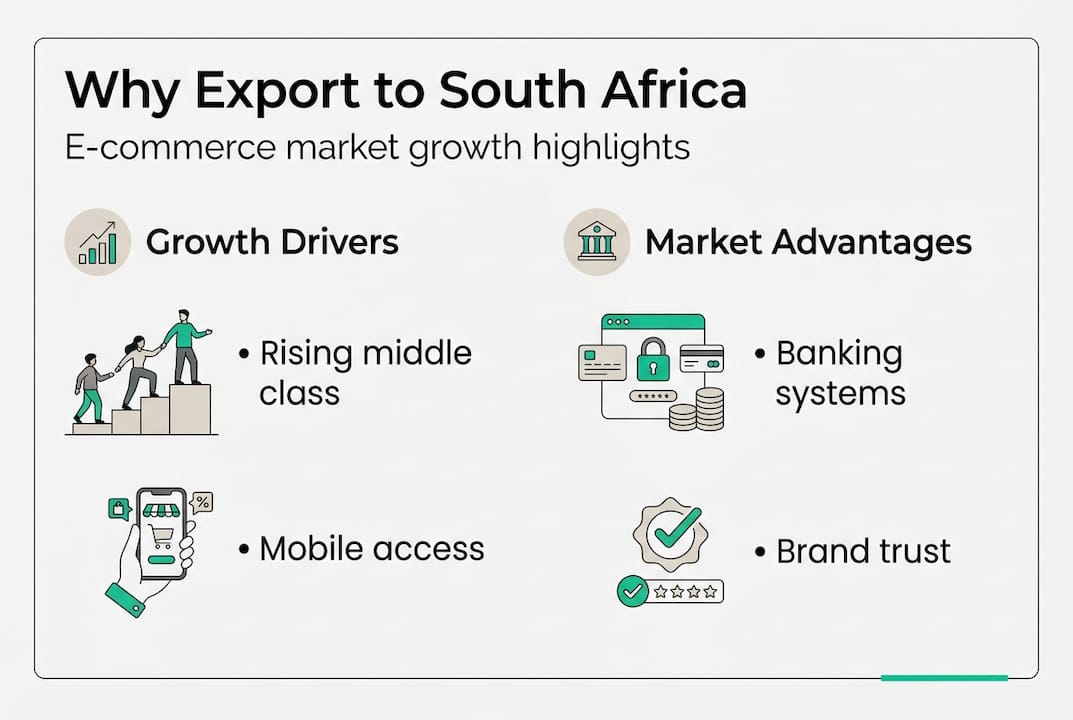
South Africa’s digital retail landscape is expanding faster than many developed markets. The e-commerce sector is growing at 8.3% CAGR, with online retail surpassing R130 billion in 2025, representing 8 to 10% of total retail sales. This growth trajectory signals a market transitioning from early adoption to mainstream acceptance.
The consumer demographics driving this expansion are equally compelling. South Africa’s growing middle class demonstrates increasing purchasing power and digital literacy. Urbanization continues to accelerate, concentrating consumers in areas with reliable logistics infrastructure. Smartphone penetration has reached critical mass, enabling mobile commerce across income segments.
Market Growth Indicators
| Metric | 2024 Value | 2029 Projection | Growth Rate |
|---|---|---|---|
| Market Size | US$7.72B | US$11.66B | 8.3% CAGR |
| Online Retail | R120B | R180B+ | 8-10% of total retail |
| Import Volume | R146B/month | Growing | Steady increase |
Compared to other emerging markets, South Africa offers distinct advantages. The country maintains sophisticated banking systems, established courier networks, and regulatory frameworks that, while requiring compliance, provide predictability for international sellers. Electronics, fashion, and machinery consistently rank among top import categories, reflecting consumer appetite for quality foreign brands.
Pro Tip: Focus your initial market entry on product categories where South African consumers already demonstrate strong preference for imported goods. This reduces the educational burden and accelerates time to revenue.
The South African e-commerce solutions landscape supports multiple entry strategies, from direct-to-consumer models to marketplace integration. Understanding which approach aligns with your brand positioning and operational capacity determines your success trajectory.
What makes South Africa an attractive export destination?
South Africa’s import profile reveals clear consumer preferences. China supplies 23.5% of imports, followed by the US at 6.1% and Germany at 6.6%. These figures indicate established trade routes and consumer familiarity with foreign brands across multiple product categories.

The monthly import volume of R146 billion demonstrates consistent demand and rapid trade flows. This isn’t speculative potential, it’s active commerce happening right now. International brands that position themselves strategically within these established channels gain immediate access to receptive buyers.
Top Import Categories by Consumer Demand:
- Electronics and technology: Smartphones, laptops, accessories, and smart home devices command premium positioning
- Fashion and apparel: International clothing brands enjoy strong brand loyalty and willingness to pay for quality
- Machinery and equipment: Both consumer and commercial segments show consistent import demand
- Beauty and personal care: Growing category with preference for international formulations and brands
- Home and lifestyle products: Furniture, decor, and kitchen items from established foreign manufacturers
South African consumers demonstrate notable trust in international brands, particularly in categories where local manufacturing is limited. This trust translates to higher conversion rates and stronger customer lifetime value for foreign sellers who deliver consistent quality and reliable fulfillment.
The marketplace integration for exporters provides structured pathways to reach these consumers through established platforms like Takealot, Amazon SA, and specialized vertical marketplaces. Each platform brings built-in traffic and consumer trust that accelerates market penetration.
Import Source Comparison
| Country | Import Share | Key Categories | Market Position |
|---|---|---|---|
| China | 23.5% | Electronics, fashion, machinery | Dominant volume leader |
| Germany | 6.6% | Automotive, machinery, chemicals | Premium positioning |
| United States | 6.1% | Technology, fashion, consumer goods | Brand strength |
Pro Tip: Research which source countries dominate your specific product category. If your category shows low import penetration from your region, you may face less competition but need stronger market education efforts.
How cross-border logistics and compliance work in South Africa
Navigating South African import regulations requires understanding recent policy changes. Since 2024, no de minimis threshold exists, meaning all shipments face 15% VAT on CIF value plus applicable duties. This eliminates the previous advantage of small-value shipments avoiding taxation.
The compliance process follows a clear sequence:
- Register as an exporter with SARS to establish your legal standing for cross-border trade
- Classify products using HS codes to determine applicable duty rates for each item category
- Calculate total landed cost including CIF value, 15% VAT, and product-specific duties
- Prepare compliant documentation covering commercial invoices, packing lists, and certificates of origin
- Partner with registered customs brokers who handle clearance procedures and regulatory submissions
- Establish fulfillment infrastructure through local warehousing or trusted logistics partners
Duty rates vary significantly by HS code classification. Electronics might face 0 to 10% duties, while textiles can reach 40% or higher. Accurate classification isn’t optional, it directly impacts your pricing strategy and profit margins.
“Understanding your total landed cost before entering the market prevents the common mistake of underpricing products and discovering too late that duties eliminate profitability.”
The removal of de minimis thresholds means every shipment requires proper customs clearance. This increases operational complexity but also levels the playing field, as all competitors face identical compliance requirements. Brands that master these processes gain sustainable competitive advantages.
Common pitfalls include misclassifying products to reduce duties, undervaluing shipments, and failing to maintain proper documentation. South African customs authorities actively enforce compliance, and violations result in shipment delays, fines, and potential loss of import privileges.
Pro Tip: Build compliance costs into your pricing model from day one. The brands that succeed long-term in South Africa treat regulatory requirements as standard operating procedure, not obstacles to work around.
The onboarding guide for exporters walks through each compliance step systematically, while customs fulfillment process solutions handle the operational execution that keeps shipments moving smoothly.
Maximizing commercial success: E-commerce strategies for South Africa
Successful market entry requires choosing the right commercial model. Direct-to-consumer approaches offer maximum brand control and customer relationships but demand significant investment in marketing and logistics infrastructure. Marketplace integration provides immediate access to established traffic and trust but involves platform fees and reduced brand differentiation.
Many international brands find hybrid models most effective. Launch through marketplaces to validate demand and build initial customer base, then expand to owned channels as volume justifies the infrastructure investment. This staged approach manages risk while building market knowledge.
Critical Success Factors:
- Payment localization: Support major South African payment methods including EFT, credit cards, and mobile payment options
- Fulfillment speed: South African consumers expect delivery within 3 to 7 business days for domestic fulfillment
- Customer service: Provide support during local business hours with understanding of regional preferences and concerns
- Pricing transparency: Display all-in pricing including VAT and duties to eliminate checkout surprises
- Returns management: Establish clear, fair return policies that build consumer confidence
The data shows consistent import demand across multiple categories, but success requires more than just shipping products. You need localized customer experience that respects South African consumer expectations while maintaining your brand standards.
Working with established logistics and technology partners dramatically reduces your learning curve. These partners bring existing infrastructure, regulatory knowledge, and operational systems that would take years to build independently. The cost of partnership is almost always lower than the cost of mistakes during independent market entry.
Pro Tip: Start with a focused pilot targeting one or two product categories and a single marketplace. Measure conversion rates, customer acquisition costs, and repeat purchase rates for 90 days before scaling. This data-driven approach prevents overcommitment to strategies that don’t match market reality.
The African logistics fulfillment infrastructure and trusted local partners provide the operational foundation that turns market opportunity into sustainable revenue growth.
Unlock South Africa’s potential with cross-border e-commerce solutions
You’ve seen the market data, understood the compliance requirements, and learned the strategic approaches that drive success. The question now is how to execute without the years of trial and error that drain resources and momentum.
MoreShores specializes in removing the operational barriers that prevent international brands from capitalizing on African market opportunities. We act as your Importer of Record, handling customs clearance, VAT, duties, and regulatory compliance so you can focus on your core business. Our warehousing and fulfillment network ensures your products reach South African consumers with the speed and reliability they expect.
Our African e-commerce solutions integrate your product catalog across major marketplaces including Takealot, Amazon SA, Jumia, and Kilimall, while our fulfillment and logistics services manage the entire supply chain from international shipping to last-mile delivery. The cross-border enablement platform connects all these functions into a single operational system that scales with your growth.
Whether you’re testing the South African market for the first time or scaling an existing presence, we provide the infrastructure, expertise, and local knowledge that turns market potential into measurable results. Book a consultation to discuss your specific requirements and learn how we can accelerate your South African market entry.
Frequently asked questions
What goods are most in demand for export to South Africa?
Electronics, fashion, and machinery lead import categories, with strong consumer demand for quality international brands in these segments.
Do I need a local partner to start exporting to South Africa?
A local partner isn’t legally required, but using local expertise for logistics and compliance significantly improves success rates and reduces operational risks.
What taxes and duties apply to cross-border exports?
All shipments face 15% VAT on CIF value plus duties based on HS code classification, with no minimum threshold exemptions since 2024.
Is South Africa’s e-commerce market growing faster than other regions?
Yes, South Africa’s 8.3% CAGR outpaces many developed markets, making it an attractive growth opportunity for international brands.