Why brands go global: Key strategies for international success

TL;DR:
- International expansion offers higher returns and diversification for mid-sized brands.
- Proven strategies include joint ventures, franchising, localization, and digital-first approaches.
- Success in Africa depends on local partnerships, cultural adaptation, and tailored product strategies.
International expansion is not a strategy reserved for Fortune 500 giants. Mid-sized and emerging brands that enter the right international markets consistently outperform their domestic-only counterparts, sometimes by a wide margin. Cross-border M&A deals deliver an average 2-year relative total shareholder return (rTSR) of 1.2%, compared to -0.9% for purely domestic deals. That gap matters. This article walks you through the core reasons brands pursue global growth, the strategies that actually work, the pitfalls to avoid, and a practical playbook for entering African markets with confidence.
Table of Contents
- The core reasons brands pursue global expansion
- Proven strategies: How brands succeed on the global stage
- Common pitfalls and edge cases in international expansion
- Winning in Africa: Entry strategies, challenges, and best practices
- The uncomfortable truth about global expansion most brands ignore
- How MoreShores supports global brand success
- Frequently asked questions
Key Takeaways
| Point | Details |
|---|---|
| Diversification advantage | Global expansion helps brands reduce domestic risk and access new growth opportunities. |
| Localization is vital | Deep local adaptation outperforms superficial tweaks, especially in emerging markets. |
| Tailored strategies for Africa | Joint ventures, local partnerships, and cultural understanding drive African market success. |
| Operational discipline trumps speed | Brands that invest in resilience and local intelligence outperform those chasing rapid global scale. |
The core reasons brands pursue global expansion
Growth at home eventually plateaus. Markets saturate, competition intensifies, and consumer spending shifts. International expansion gives your brand access to entirely new demand pools, and the data backs this up.
Brands go global primarily to access larger markets, achieve revenue diversification, leverage economies of scale, reduce risks from domestic market saturation, and capitalize on growth opportunities in emerging regions. These are not abstract benefits. They translate directly into stronger margins, more resilient revenue, and a competitive position that is harder for local rivals to erode.
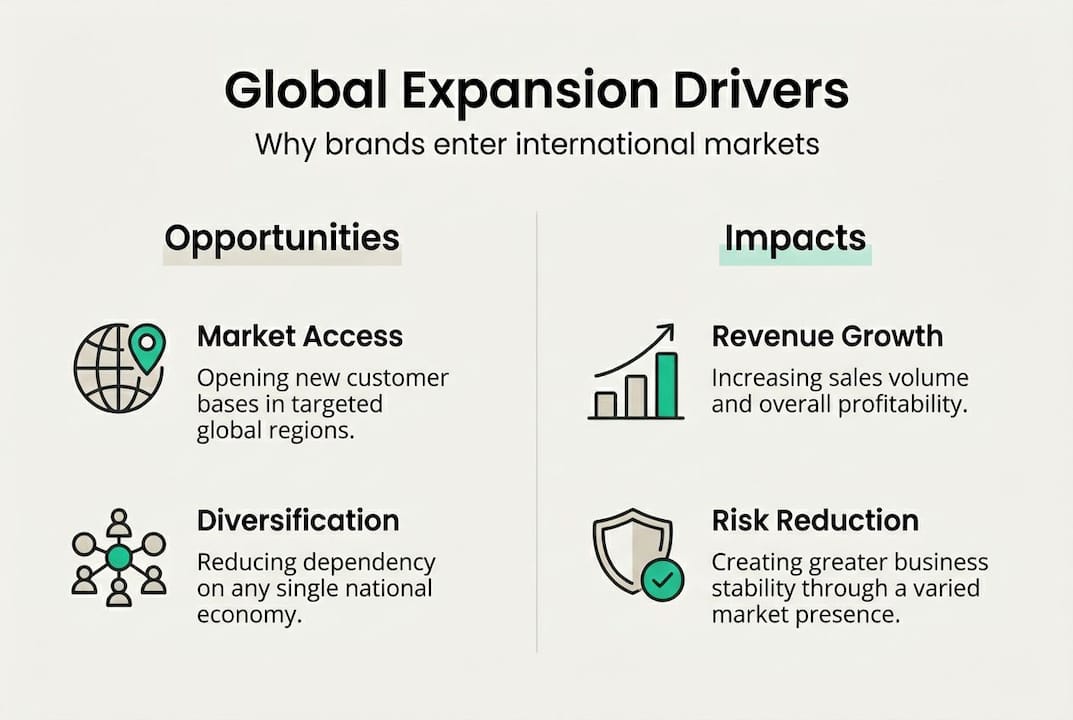
Here is a summary of the primary drivers:
| Expansion driver | Business impact |
|---|---|
| Market access | Reach new customer segments and geographies |
| Revenue diversification | Reduce dependence on a single economy |
| Economies of scale | Lower per-unit costs through higher volume |
| Risk mitigation | Offset domestic downturns with international revenue |
| Emerging market growth | Capture high-growth consumer bases early |
The risk mitigation angle is often underestimated. When one market contracts, another may be growing. Brands with diversified geographic revenue are structurally more stable than those tied to a single economy.
Key benefits at a glance:
- Larger addressable market: Domestic markets have a ceiling; international expansion raises it significantly.
- Brand equity growth: Global presence reinforces brand credibility and perceived value.
- Talent and innovation access: Operating in multiple markets exposes you to new ideas, talent pools, and consumer behaviors.
- Pricing power: In some markets, your product commands a premium simply because it is imported.
Statistic to note: Cross-border deals outperform domestic deals by over 2 percentage points in 2-year rTSR on average. That is not a marginal difference.
For brands exploring cross-border enablement, understanding these fundamentals is the starting point. After setting the stage with why brands consider going international, it is vital to understand the proven methods and frameworks that drive global success.
Proven strategies: How brands succeed on the global stage
Understanding the rationale is the first step. Now, let us look at which strategies actually work and which deliver the highest returns.
Key methodologies include brand extensions, joint ventures, franchising, localization, market research, and digital-first strategies. Each has a different risk profile and capital requirement. Choosing the right one depends on your product category, target market, and operational capacity.
Here is a comparison of the most common entry models:
| Strategy | Best for | Risk level | Capital required |
|---|---|---|---|
| Direct investment | High-confidence markets | High | High |
| Joint venture | Regulated or complex markets | Medium | Medium |
| Franchising | Scalable consumer brands | Low to medium | Low |
| Digital-first | E-commerce, SaaS, digital goods | Low | Low to medium |
| Localization | Any market with distinct culture | Varies | Varies |
Real-world outcomes reinforce these choices. Netflix grew from 203 million to 222 million subscribers largely through aggressive localization, investing in local-language content that resonated with regional audiences. Starbucks used joint ventures to drive growth in China, partnering with local operators who understood consumer behavior, real estate, and regulatory nuance.
A step-by-step approach to layering strategies:
- Start with market research. Identify demand signals, competitor gaps, and regulatory requirements before committing capital.
- Choose your entry model. Match the model to your risk tolerance and the market’s complexity.
- Localize before you launch. Adapt pricing, packaging, messaging, and customer support to local expectations.
- Build a local team or partner. Operational success depends on people who understand the market from the inside.
- Measure and iterate. Track market-specific KPIs and adjust your approach based on real performance data.
Pro Tip: Even if your brand has strong global equity, localization is not optional. Consumers in new markets will not automatically connect with messaging designed for your home market. Invest in local consumer research before your first campaign.
For brands evaluating e-commerce global solutions, the digital-first model is particularly attractive because it reduces upfront capital while generating real market data quickly. Explore the brand onboarding process to understand how structured entry can accelerate your timeline.

You can also review foreign market entry case studies to see how brands across industries have navigated these decisions.
Common pitfalls and edge cases in international expansion
Learning what works also means understanding what to avoid and the nuances that separate success from costly mistakes.
The most common error is treating localization as a translation exercise. Changing the language on your website is not the same as adapting your product, pricing, and customer experience to a new market. Superficial localization fails in markets where cultural and regulatory mandates run deep. Brands that get this right, particularly in high-growth arenas like AI and digital services, generate 11% annual revenue growth compared to just 1% for brands operating outside these arenas.
Other pitfalls to watch for:
- Regulatory blind spots: Data sovereignty laws, local content requirements, and import restrictions can derail a launch if not identified early.
- Underestimating competition: Local players often have structural advantages in distribution, relationships, and consumer trust.
- Overextending too fast: Entering multiple markets simultaneously stretches teams and budgets, reducing execution quality in each.
- Ignoring geopolitical risk: Multipolarity and geopolitics are actively shifting foreign direct investment (FDI) flows, and brands that ignore this expose themselves to sudden market access disruptions.
“The brands that thrive in a multipolar world are not the ones chasing lowest cost. They are the ones building resilience into every layer of their supply chain and market strategy.”
High-growth sectors like next big arenas in technology and digital commerce offer outsized rewards, but they also attract intense regulatory scrutiny and competitive pressure. Entering these spaces requires more preparation, not less.
Pro Tip: Build regulatory intelligence into your market entry plan from day one. Whether you handle it in-house or through a local partner, understanding the compliance landscape before launch will save significant time and cost later.
Strong fulfillment strategies and reliable marketplace integration are two operational pillars that brands often underinvest in during the planning phase, only to face costly delays post-launch.
Winning in Africa: Entry strategies, challenges, and best practices
While there are universal lessons, success in Africa demands a highly tailored approach. Here is how the best brands get it right.
Success in Africa hinges on joint ventures, local partnerships, and deep cultural adaptation. Brands like Walmart, Carrefour, and Shoprite have demonstrated that retail success on the continent requires more than a strong global brand. It requires local operational knowledge, community trust, and regulatory fluency.
A practical entry framework for African markets:
- Identify your target market within Africa. The continent has 54 countries with distinct regulatory environments, consumer behaviors, and infrastructure realities. South Africa, Nigeria, Kenya, and Egypt are common starting points.
- Choose a local partner. Joint ventures and distribution partnerships reduce risk and accelerate market access.
- Navigate regulatory requirements. Import duties, product compliance standards, and VAT structures vary significantly by country.
- Adapt your product and pricing. Purchasing power, consumer preferences, and competitive pricing differ substantially from Western markets.
- Invest in digital and mobile channels. Mobile penetration is high across Africa, and e-commerce is growing rapidly.
Pro Tip: Leverage local fintech and telco platforms for distribution and payment inclusion. Mobile money platforms like M-Pesa have transformed how consumers transact in East Africa, and integrating with these systems dramatically expands your addressable market.
Fintech and telco partnerships have already driven $2.6 billion in FDI and supported over 110,000 jobs across the continent, demonstrating the scale of what is possible when brands align with local infrastructure.
| Country | Key opportunity | Recommended entry model |
|---|---|---|
| South Africa | Established e-commerce, strong logistics | Direct or platform-based |
| Nigeria | Large consumer base, mobile-first | Local partnership or JV |
| Kenya | Fintech leadership, growing middle class | Digital-first, fintech integration |
| Egypt | Gateway to North Africa, manufacturing hub | Joint venture or franchise |
For brands ready to explore e-commerce in Africa, the infrastructure and marketplace ecosystem are more developed than many assume. You can also find local partners to accelerate your entry and reduce operational risk. Additional African expansion studies provide deeper context on what separates successful entrants from those who struggle.
The uncomfortable truth about global expansion most brands ignore
Here is what most expansion playbooks leave out: many brands pursue global growth for the wrong reasons. Prestige, competitive pressure, and investor expectations drive decisions that should be driven by operational readiness and genuine market fit.
The brands that build lasting international presence are not the ones that move fastest. They are the ones that invest in understanding their markets deeply, build flexible supply chains, and treat regulatory compliance as a strategic asset rather than a bureaucratic hurdle.
Multipolarity and resilience are overtaking efficiency as the primary drivers of FDI decisions. That is a fundamental shift. It means the old model of chasing the lowest-cost production base is giving way to a model that prioritizes adaptability and cross-border resilience.
In Africa specifically, the brands that succeed are those willing to reinvest in market knowledge at every stage. They do not treat the continent as a single market. They do not assume that what worked in Southeast Asia will work in West Africa. They hire locally, partner strategically, and stay patient through the early phases of market development.
The practical lesson is straightforward: treat every new market as a learning investment, not just a revenue opportunity. The brands that do this consistently outperform those chasing short-term wins.
How MoreShores supports global brand success
For brands seeking practical support as they expand, MoreShores bridges the gap from strategy to successful execution.
MoreShores specializes in helping international brands enter African markets and supporting African brands as they scale globally. From acting as your Importer of Record to managing customs clearance, duties, VAT, and regulatory compliance, we handle the operational complexity so you can focus on growth.
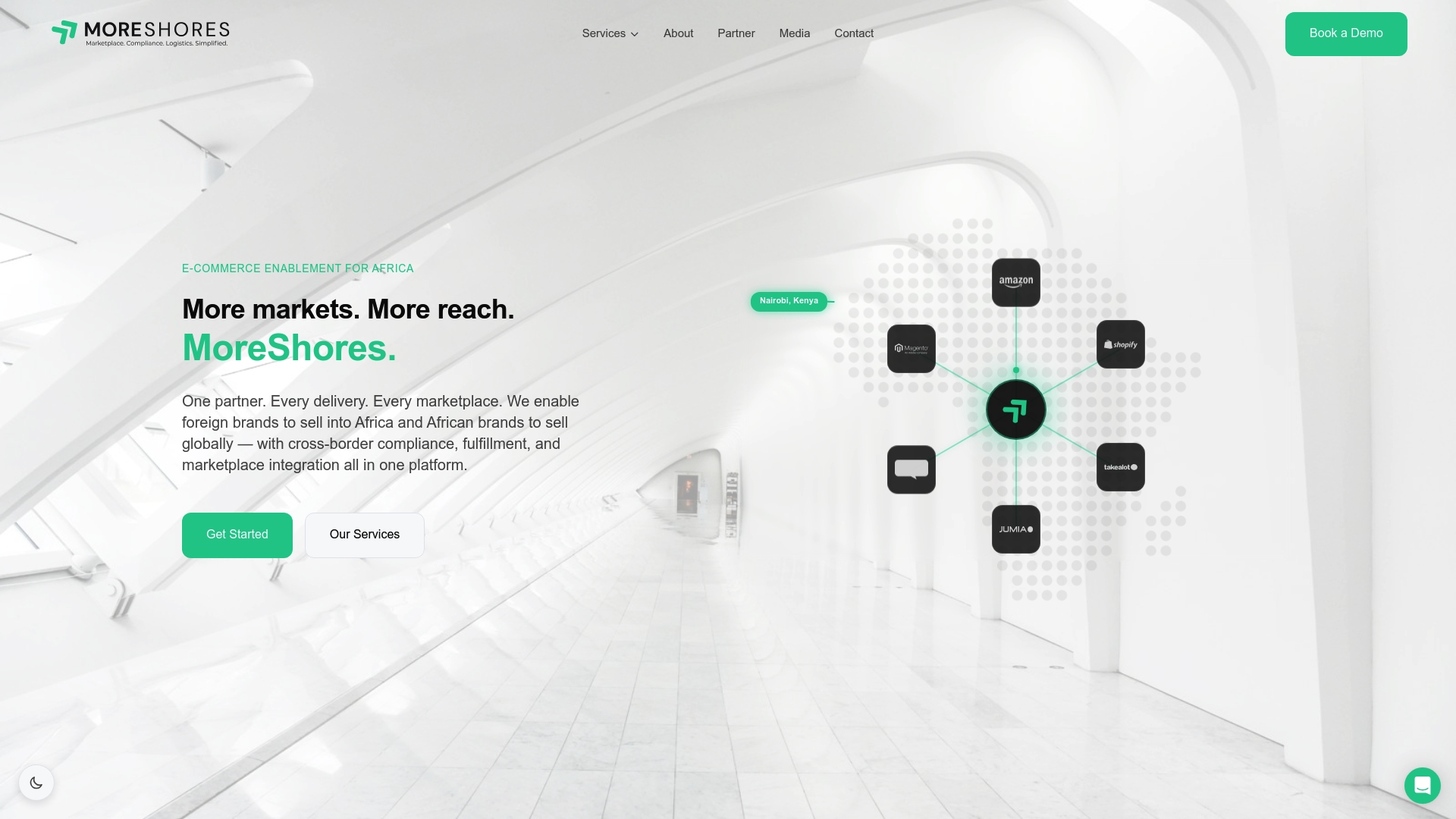
Our cross-border enablement services cover everything from warehousing and fulfillment to marketplace integration across platforms like Takealot, Jumia, and Amazon SA. Whether you are building your e-commerce for Africa strategy or looking to partner with MoreShores for end-to-end market entry support, we are ready to help you move from planning to execution with confidence.
Frequently asked questions
What are the main benefits of global expansion for brands?
Global expansion lets brands access new customers, diversify revenue, and reduce risk from local market changes, usually driving growth and higher returns. It also builds brand equity and opens access to new talent and innovation.
How can brands avoid common mistakes when entering new markets?
Brands should prioritize deep localization, understand regulations, and partner with local experts. Superficial localization fails consistently, and regulatory blind spots are among the most expensive mistakes to fix after launch.
What makes African markets unique for international brands?
Africa’s diverse regulations, rapid digital growth, and need for local partnerships require tailored strategies. Success via joint ventures, localization, and regulatory navigation is well documented across the continent’s most competitive markets.
Which expansion strategy works best for fast-growing markets?
Joint ventures and digital strategies are proven to be most effective in emerging markets, offering a balance of local knowledge and scalable infrastructure without requiring full direct investment upfront.
How do brands measure success after going global?
They track metrics like revenue growth, market share, and risk-adjusted returns, benchmarking against both local and international competitors. Tracking rTSR and market share post-entry gives a clear picture of whether the expansion is delivering real value.