
Many e-commerce professionals underestimate how strategic sourcing becomes when expanding into African markets. It’s not just about finding suppliers and placing orders. Cross-border sourcing requires navigating complex compliance frameworks like AfCFTA rules of origin, managing multi-country logistics networks, and ensuring every product meets regional regulatory standards. The difference between profitable expansion and costly delays often comes down to how well you understand and execute your sourcing strategy. This guide clarifies what sourcing truly entails for e-commerce businesses targeting African markets and provides actionable frameworks to help you source smarter, comply faster, and scale efficiently across borders.
Table of Contents
- Understanding Sourcing In E-Commerce: Core Concepts
- Navigating Cross-Border Sourcing Challenges For African Markets
- Comparing Sourcing Methods And Supplier Evaluation Frameworks
- Integrating Sourcing With Logistics And Marketplace Strategies For Success
- How Moreshores Enables Your Cross-Border Sourcing And Logistics
- Frequently Asked Questions
Key takeaways
| Point | Details |
|---|---|
| Strategic procurement | Sourcing is the systematic process of identifying, evaluating, and procuring products to ensure quality, compliance, and profitability in target markets. |
| AfCFTA compliance | Understanding regional value content requirements unlocks duty-free access across 54 African countries, dramatically reducing costs. |
| Logistics integration | Successful cross-border sourcing depends on coordinating supplier timelines with customs clearance, warehousing, and fulfillment networks. |
| Supplier evaluation | Systematic assessment of compliance capabilities, quality standards, and lead times mitigates risk and ensures reliable supply chains. |
| Competitive advantage | Mastering sourcing nuances positions your business to capture market share faster than competitors struggling with compliance and logistics. |
Understanding sourcing in e-commerce: core concepts
Sourcing in e-commerce is the strategic process of identifying, evaluating, and procuring products from suppliers to meet market demands while ensuring quality, compliance, and profitability. This goes far beyond simply buying inventory. Effective sourcing shapes your entire value chain, from product selection to customer satisfaction.
The sourcing process unfolds in distinct stages. First, you identify potential suppliers who can manufacture or provide products that match your market requirements. Next, you evaluate these suppliers against criteria like production capacity, quality standards, pricing structures, and compliance capabilities. Finally, you establish procurement agreements that define terms, quantities, delivery schedules, and quality benchmarks.
Three core drivers make sourcing decisive for e-commerce success:
- Quality directly impacts customer satisfaction and return rates
- Compliance determines whether products can legally enter and sell in target markets
- Profitability depends on negotiating favorable terms while maintaining acceptable margins
When you move beyond domestic markets, sourcing complexity multiplies exponentially. You must account for international shipping logistics, customs regulations, currency fluctuations, and varying product standards across jurisdictions. African markets add another layer with continent-specific trade agreements and infrastructure considerations.
Successful sourcing creates synergy with logistics and marketplace integration. Your supplier selection affects shipping times, warehousing requirements, and inventory management strategies. Choosing suppliers who understand export documentation and can coordinate with brand onboarding processes streamlines your entire operation.
“The best sourcing decisions balance cost optimization with operational reliability. Cheap suppliers who can’t meet compliance requirements or delivery deadlines ultimately cost more than premium partners who execute flawlessly.”
This foundation becomes critical when you’re sourcing specifically for African e-commerce markets, where regulatory frameworks and logistics networks differ significantly from Western markets.
Navigating cross-border sourcing challenges for African markets
Expanding into African e-commerce markets introduces specific compliance and logistics considerations that domestic sourcing never requires. The African Continental Free Trade Area agreement fundamentally changes how you should approach supplier selection and product procurement for this region.

AfCFTA rules of origin determine whether products qualify for duty-free treatment across 54 member countries. To gain these benefits, products must meet substantial regional value content thresholds. This means a certain percentage of the product’s value must originate from AfCFTA member states through manufacturing, processing, or materials.
Different product categories face different thresholds. Textiles and apparel typically require 40% to 50% regional value content to qualify as originating goods. Electronics and machinery might have different requirements based on tariff classifications. Understanding these nuances before selecting suppliers can save thousands in duties and dramatically improve your competitive pricing.
Logistics challenges in African markets require careful planning:
- Customs clearance procedures vary significantly between countries despite AfCFTA harmonization efforts
- Transportation infrastructure limitations affect delivery times and require buffer inventory
- Warehousing facilities meeting international standards exist primarily in major commercial centers
- Documentation requirements for import compliance demand meticulous attention to detail
The table below illustrates the tariff impact of AfCFTA compliance for common e-commerce product categories:
| Product Category | Standard Tariff Rate | AfCFTA Qualifying Rate | Annual Savings (10,000 units at $50 each) |
|---|---|---|---|
| Consumer Electronics | 15% | 0% | $75,000 |
| Apparel & Textiles | 20% | 0% | $100,000 |
| Home & Kitchen Goods | 10% | 0% | $50,000 |
| Health & Beauty Products | 12% | 0% | $60,000 |
These savings compound over time and directly improve your profit margins or allow more competitive pricing.
Pro Tip: Conduct supplier audits focused specifically on compliance documentation capabilities before signing contracts. A supplier who can’t provide proper certificates of origin, commercial invoices with correct HS codes, and packing lists meeting African customs standards will cause expensive delays regardless of product quality. Partner with cross-border enablement services that understand these requirements and can verify supplier compliance before you commit to large orders.
Working with fulfillment & logistics services experienced in African markets helps you navigate customs procedures, manage warehousing in strategic locations, and coordinate last-mile delivery across diverse infrastructure environments. This operational support transforms sourcing from a transactional activity into a strategic advantage.
Comparing sourcing methods and supplier evaluation frameworks
E-commerce businesses have multiple sourcing approaches available, each with distinct advantages and trade-offs. Selecting the right method depends on your product categories, volume requirements, and operational capabilities.
Direct sourcing involves establishing relationships directly with manufacturers or producers. You negotiate terms, place orders, and manage the entire procurement process without intermediaries. This approach offers the best pricing and quality control but requires significant time investment and expertise in international trade.
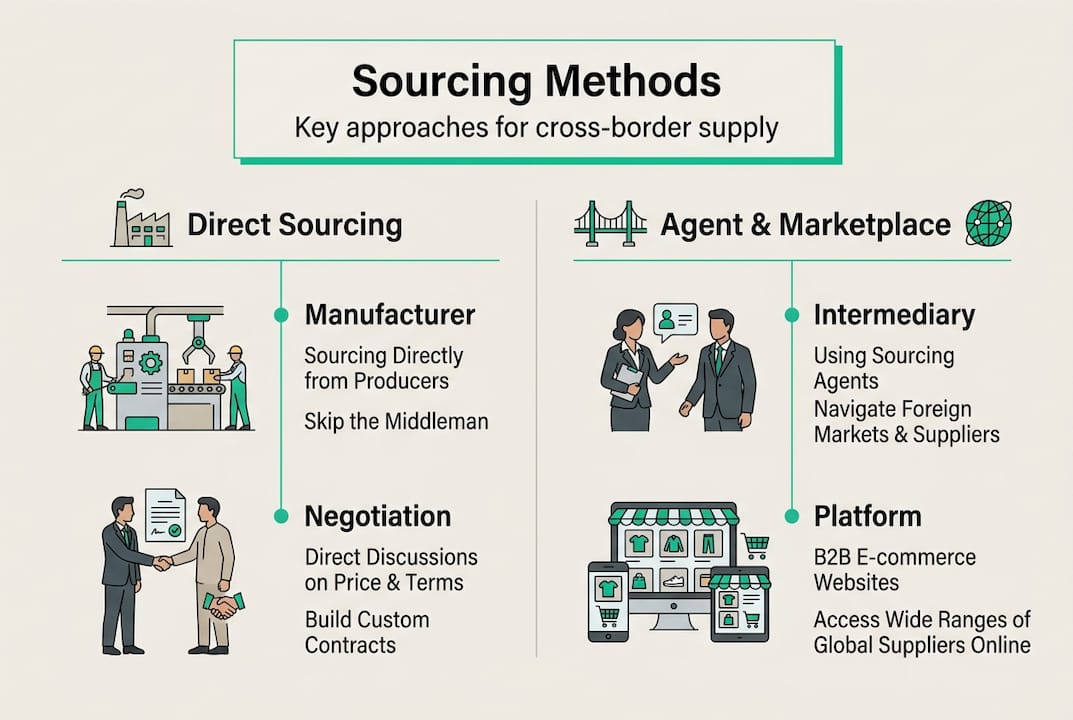
Agent sourcing uses intermediaries who connect you with suppliers and manage procurement logistics. Agents typically operate in source countries and leverage local knowledge to identify reliable manufacturers, negotiate on your behalf, and oversee production. This reduces your operational burden but adds commission costs and creates distance between you and the actual production process.
Marketplace procurement leverages B2B platforms like Alibaba, Global Sources, or regional African trade platforms. These marketplaces provide supplier directories, transaction protection, and standardized processes. They’re efficient for testing new products or suppliers but offer less customization and relationship depth than direct sourcing.
The comparison table below summarizes key considerations:
| Sourcing Method | Cost Efficiency | Quality Control | Compliance Management | Setup Time | Best For |
|---|---|---|---|---|---|
| Direct Sourcing | Highest | Excellent | Your responsibility | 3-6 months | High-volume, established products |
| Agent Sourcing | Moderate | Good | Shared responsibility | 1-2 months | Market entry, complex products |
| Marketplace Procurement | Variable | Limited | Platform dependent | Immediate | Product testing, low volumes |
Supplier evaluation requires strategic assessment of multiple factors to ensure quality, compliance, and profitability. Use this five-step framework for systematic evaluation:
- Verify compliance capabilities by requesting certificates of origin, quality certifications, and export documentation samples to confirm the supplier understands African market requirements
- Assess production capacity and scalability to ensure they can meet your current volumes and accommodate growth without quality degradation
- Evaluate quality management systems through factory audits, sample testing, and references from other international clients
- Analyze cost structures comprehensively including unit prices, minimum order quantities, payment terms, and shipping arrangements to calculate true landed costs
- Test communication and responsiveness by evaluating how quickly and clearly suppliers respond to inquiries, handle problems, and provide updates
When sourcing for African markets specifically, prioritize suppliers who already export to the region or demonstrate willingness to learn compliance requirements. Experience with AfCFTA documentation and understanding of regional logistics networks significantly reduces your operational risk.
Partnering with a logistics platform that can validate supplier capabilities and manage the compliance bridge between your suppliers and African markets adds a crucial layer of security to your sourcing decisions.
Integrating sourcing with logistics and marketplace strategies for success
Sourcing decisions don’t exist in isolation. Your supplier selection directly impacts fulfillment speed, inventory management efficiency, and marketplace performance. Successful e-commerce businesses integrate these functions to create seamless operations that delight customers and maximize profitability.
Linking sourcing timelines with fulfillment plans starts with understanding total lead times. Calculate the complete cycle from placing a purchase order through production, international shipping, customs clearance, warehousing, and final delivery to customers. This end-to-end visibility allows you to set realistic marketplace listings, manage customer expectations, and maintain adequate inventory buffers.
Marketplace integration provides powerful benefits when coordinated with sourcing:
- Synchronized inventory tracking across multiple sales channels prevents overselling and stockouts
- Automated compliance documentation ensures product listings meet platform requirements and regulatory standards
- Centralized order management routes fulfillment requests to optimal warehouses based on customer location and inventory availability
- Real-time data on sales velocity informs reorder points and helps you adjust sourcing quantities dynamically
Implement these integration steps to connect suppliers, logistics, and sales channels effectively:
- Establish digital communication protocols with suppliers for order confirmations, production updates, and shipping notifications that feed directly into your inventory management system
- Create standard operating procedures for customs documentation that your suppliers, freight forwarders, and warehousing partners all follow consistently
- Set up automated alerts for inventory thresholds that trigger reorder workflows before stockouts occur
- Develop performance dashboards tracking supplier delivery accuracy, quality metrics, and compliance issues alongside marketplace metrics like conversion rates and customer satisfaction scores
- Schedule regular review meetings with logistics partners to identify bottlenecks and optimize the entire supply chain collaboratively
Pro Tip: Technology platforms that provide real-time tracking and automated paperwork dramatically reduce the manual coordination burden of cross-border operations. Look for solutions that integrate with your existing e-commerce stack and offer API connections to both supplier systems and marketplace platforms. This digital infrastructure becomes increasingly valuable as you scale across multiple African markets.
Integration reduces risk by creating transparency across your entire operation. When everyone from suppliers to logistics providers to marketplace managers works from the same data, problems get identified and resolved faster. Speed to market improves because you eliminate handoff delays and miscommunication. Customer satisfaction increases because you can provide accurate delivery estimates and consistent product availability.
The cross-border e-commerce solutions that succeed in African markets are those that treat sourcing as one component of an integrated system rather than an isolated procurement function. Marketplace integration services become force multipliers when they connect seamlessly with your sourcing and logistics operations. This holistic approach, supported by comprehensive brand onboarding, positions your business to capture market opportunities faster and more reliably than competitors still managing these functions separately.
How MoreShores enables your cross-border sourcing and logistics
Navigating the complexities of cross-border sourcing for African markets becomes significantly simpler with the right partner. MoreShores specializes in connecting e-commerce businesses with the integrated infrastructure needed to source, import, and sell successfully across African markets.
Our cross-border enablement services handle the compliance burden that makes African expansion challenging. We act as your Importer of Record, managing customs clearance, duties, VAT, and regulatory requirements so you can focus on growing your business rather than decoding trade regulations. Our fulfillment & logistics services provide warehousing, inventory management, and multi-courier delivery networks strategically positioned across key African markets.
When you partner with MoreShores, you gain access to an integrated platform that connects your sourcing decisions with marketplace performance. We help you validate supplier compliance, coordinate shipping logistics, manage inventory across multiple warehouses, and integrate seamlessly with major African marketplaces like Takealot, Jumia, and Amazon SA. This end-to-end support transforms cross-border complexity into competitive advantage, allowing you to enter African markets faster and operate more profitably than attempting to build these capabilities independently.
Frequently asked questions
What is sourcing for e-commerce in Africa?
Sourcing for e-commerce in Africa involves identifying and procuring products from suppliers while navigating continent-specific regulations like AfCFTA rules of origin and coordinating with logistics networks capable of handling cross-border trade complexities. Success requires balancing cost optimization with compliance requirements and operational reliability. MoreShores simplifies this process by providing integrated compliance, logistics, and marketplace services specifically designed for African market expansion.
How do AfCFTA rules affect e-commerce product sourcing?
AfCFTA rules determine whether products qualify for duty-free treatment across 54 member countries based on regional value content thresholds. Products must contain a specified percentage of value originating from AfCFTA member states through manufacturing, processing, or materials to gain tariff benefits. Understanding and structuring your sourcing to meet these requirements can eliminate 10% to 20% tariff costs, dramatically improving your competitive pricing and profit margins.
What logistics challenges arise from cross-border sourcing in Africa?
Customs clearance procedures vary between African countries despite harmonization efforts, requiring meticulous documentation and often causing delays if paperwork isn’t perfect. Limited transportation infrastructure in some regions affects delivery reliability and requires maintaining buffer inventory. Warehousing facilities meeting international standards concentrate in major commercial centers, requiring strategic location decisions. Partnering with experienced logistics providers who understand these challenges and maintain established networks across African markets mitigates these risks significantly.
How can I evaluate suppliers effectively for African markets?
Focus your evaluation on compliance capabilities, quality management systems, production capacity, and communication responsiveness. Request samples of export documentation, certificates of origin, and quality certifications to verify suppliers understand African market requirements. Conduct factory audits or hire third-party inspection services to assess production environments and quality control processes. Prioritize suppliers with existing African export experience or demonstrated willingness to learn regional compliance requirements, as this experience dramatically reduces your operational risk and speeds up market entry.