
Selling products across multiple online marketplaces simultaneously has become standard practice, with 92% of cross-border businesses using this approach. Yet 35% struggle with complex compliance issues, revealing a gap between adoption and execution. For African brands expanding globally, multi-marketplace selling offers tremendous opportunity but demands strategic logistics, compliance expertise, and integrated technology. This guide clarifies how to navigate these challenges effectively.
Table of Contents
- Introduction To Multi-Marketplace Selling
- Growth Trends In African Cross-Border E-Commerce
- Logistics And Compliance Challenges
- Technology And Integration In Multi-Marketplace Selling
- Key Marketplaces For African Multi-Marketplace Selling
- Common Misconceptions In Multi-Marketplace Selling
- Case Studies And Practical Steps For Implementation
- Explore Moreshores Cross-Border Solutions
Key takeaways
| Point | Details |
|---|---|
| Multi-marketplace selling expands reach | Listing on multiple platforms accesses diverse international customers and creates new revenue streams for African brands. |
| Logistics and compliance are critical | Customs clearance, duties, VAT, and multi-courier fulfillment require expert management to avoid costly errors and delays. |
| Technology integration streamlines operations | Automated inventory synchronization and compliance tools reduce operational friction and prevent overselling across platforms. |
| African and global marketplaces complement each other | Combining regional platforms like Jumia with global ones like Amazon South Africa optimizes market penetration and logistics efficiency. |
| Strategic implementation drives growth | African brands using multi-marketplace strategies have achieved 20-50% export sales increases within one year. |
Introduction to multi-marketplace selling
Multi-marketplace selling enables businesses to list and sell products simultaneously across multiple e-commerce platforms like Amazon, Jumia, Takealot, and Kilimall. This approach transforms how brands reach customers by eliminating reliance on a single sales channel.
For African sellers targeting global markets, this strategy matters because it unlocks access to diverse international customer bases while spreading business risk across multiple revenue streams. A product that underperforms on one marketplace might thrive on another due to different customer demographics, pricing expectations, or regional preferences.
The scope extends beyond simple product listings. Successful multi-marketplace selling requires coordinating cross-border enablement services including inventory management, pricing synchronization, and fulfillment logistics across borders. Each marketplace has unique technical requirements, customer service standards, and seller performance metrics.
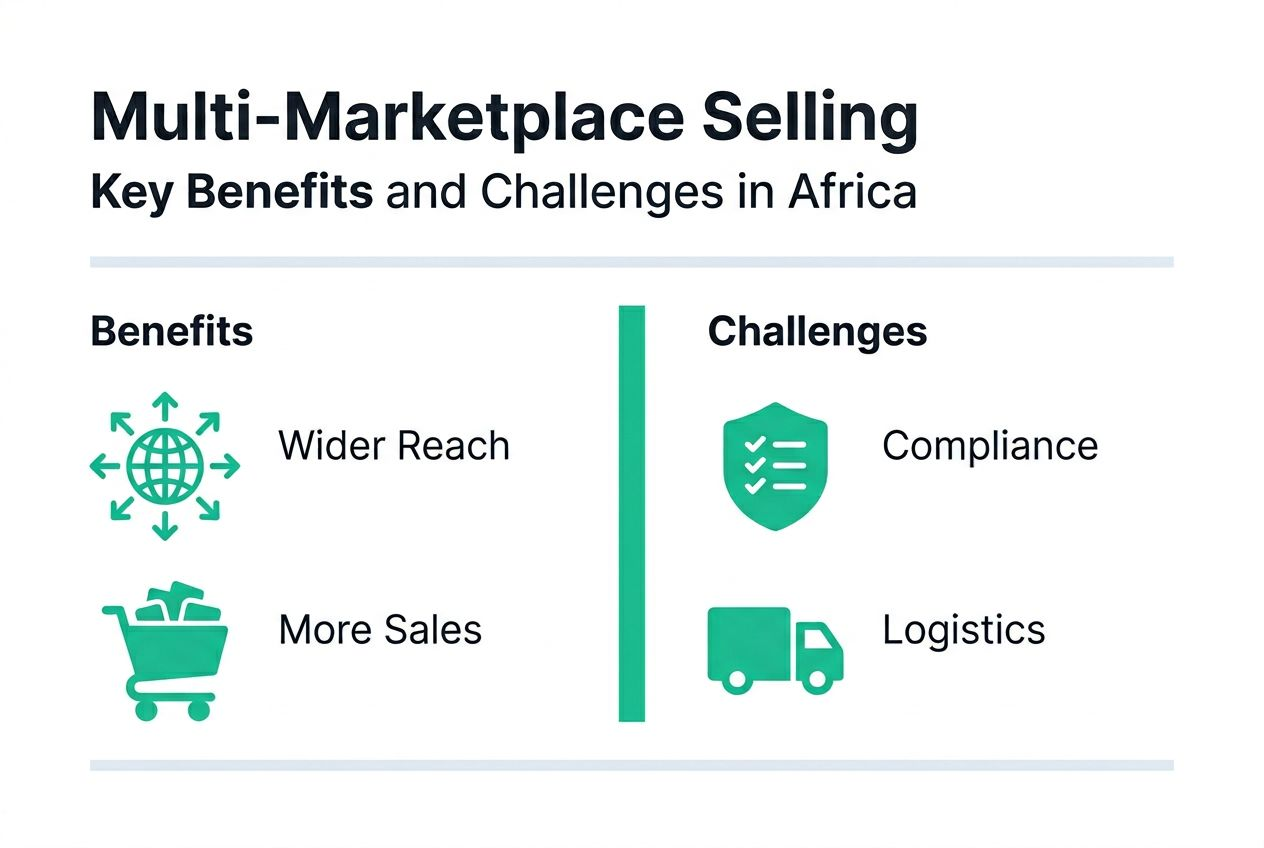
Key benefits of multi-marketplace selling include:
- Expanded geographic reach into new international markets with established customer trust
- Revenue diversification reducing vulnerability to single-platform policy changes or market shifts
- Competitive positioning allowing price testing and brand positioning across different customer segments
- Scalability enabling growth without proportional increases in marketing spend
- Data insights from multiple platforms revealing customer preferences and market trends
The challenges, however, are substantial. Customs regulations, tax compliance, warehousing logistics, and technology integration create complexity that causes many sellers to stumble. Understanding these obstacles upfront allows brands to build resilient strategies from the start.
Growth trends in African cross-border e-commerce
African e-commerce is experiencing explosive growth that makes multi-marketplace selling increasingly strategic. The market is expected to rise from $1.4 billion in 2024 to $5.7 billion by 2033, representing a 17% annual growth rate. This expansion outpaces many mature markets and signals tremendous opportunity.

Digital marketplaces are driving this transformation. Mobile internet penetration, improved payment infrastructure, and growing consumer confidence in online shopping have created conditions for rapid marketplace adoption. Young, tech-savvy populations across Nigeria, South Africa, Kenya, and Egypt are embracing e-commerce at accelerating rates.
Africa’s share of global cross-border sales continues expanding as international brands recognize the continent’s potential and African sellers gain capabilities to compete globally. The growth isn’t just about imports. African brands are increasingly exporting products, particularly in categories like fashion, beauty, crafts, and specialty foods.
Key drivers behind this growth include infrastructure improvements in logistics networks, government initiatives supporting digital commerce, rising middle-class purchasing power, and technology platforms simplifying cross-border trade complexities. The African cross-border e-commerce growth trajectory suggests the next decade will see African marketplaces mature into major players in global commerce.
| Region | 2024 Market Size | 2033 Projection | Annual Growth Rate | Primary Driver |
|---|---|---|---|---|
| Africa | $1.4 billion | $5.7 billion | 17% | Mobile adoption and digital payment infrastructure |
| Global Average | Mature markets | Moderate growth | 8-10% | Market saturation and competition |
| Africa vs Global | Emerging | High potential | 70% faster | Infrastructure development and untapped consumer base |
This data reveals why forward-thinking brands are establishing multi-marketplace presence in Africa now, positioning themselves ahead of intensifying competition as markets mature.
Logistics and compliance challenges
The operational realities of cross-border multi-marketplace selling present significant hurdles that separate successful sellers from those who struggle. Customs clearance and importer of record responsibilities create the first major barrier. Each country has unique documentation requirements, prohibited items lists, and clearance procedures that must be navigated correctly to avoid shipment delays or confiscation.
Tariffs, VAT, and duty calculations add complexity that directly impacts pricing strategy and profit margins. 75% of businesses report difficulty with HS code compliance, while 42% cite tariffs and duties as top concerns. Miscalculations lead to unexpected costs, customer dissatisfaction when duties-on-delivery surprise buyers, or compliance violations triggering fines.
Multi-courier fulfillment coordination becomes essential but challenging when selling across marketplaces serving different regions. Managing relationships with multiple shipping providers, each with different rate structures, delivery timeframes, and tracking systems, demands sophisticated logistics planning. The wrong courier choice can destroy unit economics on certain product categories.
Warehousing strategy significantly impacts delivery speed and customer satisfaction. Local fulfillment hubs positioned near major customer concentrations reduce shipping times from weeks to days, dramatically improving conversion rates and repeat purchases. However, maintaining inventory across multiple warehouses while preventing stockouts requires precise demand forecasting.
Top logistics and regulatory hurdles for African sellers include:
- Inconsistent customs clearance timeframes creating unpredictable delivery windows
- Complex VAT registration requirements in multiple jurisdictions
- Currency fluctuation impact on pricing and profitability calculations
- Import/export licensing and restricted goods regulations varying by country
- Returns and reverse logistics costs that can exceed original shipping expenses
Pro Tip: Partner with specialized brand onboarding logistics providers who handle importer of record services, manage customs relationships, and maintain compliance expertise across multiple African countries. This reduces risk while freeing your team to focus on sales and marketing.
The cross-border logistics challenges extend beyond initial setup. Ongoing monitoring of regulation changes, tax law updates, and marketplace policy shifts requires dedicated resources. E-commerce logistics solutions that integrate compliance management with fulfillment operations provide the most effective approach for scaling sustainably.
Technology and integration in multi-marketplace selling
Integrated technology platforms transform multi-marketplace selling from an operational nightmare into a manageable, scalable business model. These systems serve as the central nervous system connecting inventory, pricing, orders, and compliance across all marketplaces simultaneously.
The vital role of integrated e-commerce platforms centers on eliminating manual processes that cause errors and consume excessive time. Without integration, sellers must log into each marketplace separately to update inventory, adjust prices, process orders, and monitor performance. This approach becomes impossible at scale.
Inventory and pricing synchronization prevents the costly problem of overselling products that are actually out of stock on one marketplace because they sold on another. Real-time synchronization ensures accurate availability across all channels. Price optimization becomes dynamic, allowing strategic pricing adjustments based on marketplace-specific competition, fees, and customer behavior.
Compliance automation represents perhaps the greatest technology value. Automated customs duties and VAT calculations reduce operational costs by up to 30% through integrated services managing importer of record requirements, customs documentation, VAT registration, and regulatory reporting. Manual compliance management creates error rates that lead to fines, shipment delays, and damaged customer relationships.
Key technology features supporting multi-marketplace sellers include:
- Centralized inventory management with automatic stock level updates across all platforms
- Order aggregation pulling purchases from all marketplaces into single fulfillment queue
- Automated pricing rules adjusting for currency, marketplace fees, and competitive positioning
- Compliance engines calculating duties, taxes, and generating required customs documentation
- Analytics dashboards comparing performance metrics across marketplaces
- API integrations connecting warehouses, couriers, and financial systems
Pro Tip: Prioritize marketplace integration services that offer pre-built connections to your target marketplaces rather than custom-coded integrations. Pre-built integrations receive regular updates when marketplaces change APIs, preventing system failures.
The decision to partner with MoreShores platform or similar integrated solutions should consider the total cost of ownership including setup, ongoing subscription fees, and the opportunity cost of building custom systems. For most African sellers, leveraging existing platform infrastructure accelerates time to market while reducing technical risk.
Key marketplaces for African multi-marketplace selling
Selecting the right marketplace mix determines market reach, operational complexity, and growth trajectory. African and global platforms offer complementary strengths that smart sellers combine strategically.
Jumia operates as Africa’s largest e-commerce marketplace, with strong presence across Nigeria, Egypt, Kenya, Morocco, and several other African countries. Its payment infrastructure accommodates cash-on-delivery preferences prevalent in many African markets, while its logistics network reaches areas other platforms don’t serve. Jumia works best for sellers targeting mass-market African consumers with price-sensitive positioning.
Kilimall focuses on East Africa, particularly Kenya, Uganda, and Tanzania. This marketplace has built expertise in last-mile delivery across challenging infrastructure environments. Kilimall’s seller support and lower barrier to entry make it attractive for smaller African brands testing cross-border expansion.
Amazon South Africa brings global marketplace credibility with sophisticated fulfillment infrastructure. The platform attracts higher-income consumers willing to pay premium prices for quality and convenience. Amazon’s stringent seller performance standards require operational excellence but reward it with access to customers who value reliability.
Shopify and WooCommerce represent owned-channel approaches rather than traditional marketplaces. These platforms allow brands to build direct customer relationships while integrating with marketplace selling. The combination provides brand control alongside marketplace reach.
91% of businesses sell internationally via marketplaces combining local and global platforms, recognizing that no single marketplace serves all customer segments or geographic regions effectively.
| Marketplace | Regional Strength | Integration Ease | Logistics Support | Payment Options | Best For |
|---|---|---|---|---|---|
| Jumia | Pan-African | Medium | Extensive local networks | Cash-on-delivery, mobile money, cards | Mass-market African consumers |
| Kilimall | East Africa | High | Growing coverage | Mobile money, cash-on-delivery | Emerging African markets |
| Amazon SA | South Africa, global | High | World-class FBA | Credit/debit cards | Premium positioning |
| Shopify | Global | Very High | Third-party integrations | All major methods | Brand-building focus |
| WooCommerce | Global | High | Third-party integrations | Highly customizable | Technical control needs |
Strategic marketplace selection considers your brand’s current capabilities and growth objectives. Smaller brands typically start with one or two platforms to master operations before expanding. Established brands benefit from simultaneous multi-marketplace presence that maximizes visibility.
The combination of local African marketplaces for regional reach and global platforms for international expansion optimizes market penetration. MoreShores cross-border solutions simplify managing this complexity through unified marketplace integration services that handle technical connections and compliance requirements across all major platforms.
Common misconceptions in multi-marketplace selling
Several persistent myths cause African sellers to approach multi-marketplace selling with flawed strategies that lead to avoidable failures. Understanding these misconceptions helps avoid costly mistakes.
The first misconception is that simply listing products across multiple marketplaces automatically generates sales. Product listings are necessary but insufficient. Success requires marketplace-specific optimization including titles, images, descriptions, and pricing tailored to each platform’s search algorithms and customer expectations. A listing that performs well on Jumia may need significant modification for Amazon’s different customer base.
Many sellers drastically underestimate customs duties, VAT, and compliance complexities. They calculate profit margins based on product cost and marketplace fees while forgetting that 35% of businesses struggle to calculate duties and taxes accurately. These unexpected costs erode profitability or force pricing adjustments that kill competitiveness. Compliance violations trigger fines, account suspensions, or shipment seizures that can destroy a business.
The belief that technology integration adds unnecessary complexity represents another dangerous misconception. Some sellers attempt manual management across marketplaces to avoid integration costs. This approach fails as volume grows. Manual inventory updates lag, causing overselling and cancellations that damage seller ratings. Order processing delays frustrate customers. The time spent on manual tasks prevents focus on strategic growth activities.
Top misconceptions and corrections include:
- Misconception: More marketplaces always mean more sales. Reality: Strategic marketplace selection based on target customers and operational capabilities outperforms scattered presence.
- Misconception: Compliance is just paperwork that can be figured out later. Reality: Compliance mistakes cause business-destroying consequences including legal liability, frozen funds, and marketplace bans.
- Misconception: Technology platforms are expensive luxuries. Reality: Integrated platforms reduce operational costs and errors while enabling scalability that manual management prevents.
The truth is that successful multi-marketplace selling requires holistic strategy integrating product positioning, logistics excellence, compliance expertise, and technology enablement. E-commerce solutions for compliance address these interconnected requirements through comprehensive platforms rather than piecemeal approaches.
Case studies and practical steps for implementation
Real African brands demonstrate that strategic multi-marketplace selling delivers measurable results. African brands using multi-marketplace selling strategies have achieved 20-50% increases in export sales within one year by systematically overcoming logistics and compliance barriers.
A South African beauty brand expanded from domestic Takealot sales to Jumia Nigeria and Amazon SA simultaneously. By partnering with a logistics provider handling importer of record services and warehousing in multiple countries, they reduced delivery times from 3-4 weeks to 5-7 days. Customer satisfaction scores improved dramatically, driving repeat purchase rates up 35%. Export sales grew from zero to 28% of total revenue within 14 months.
A Kenyan fashion accessories seller started on Kilimall locally before expanding to Jumia across East Africa and eventually Amazon SA. Integrated inventory management prevented the overselling problems they initially experienced when manually updating stock levels. Technology automation freed the founder to focus on product development and marketing rather than operational firefighting.
Practical implementation steps for starting or improving multi-marketplace selling:
- Conduct marketplace research to identify 2-3 platforms aligned with your target customers, product category strengths, and current operational capabilities.
- Evaluate and select logistics partners who provide importer of record services, multi-country warehousing, customs expertise, and established carrier relationships.
- Implement technology integration connecting your inventory system, chosen marketplaces, and logistics providers through API-based platforms or comprehensive enablement solutions.
- Establish compliance processes including VAT registration in target markets, HS code classification for products, and documentation workflows for customs clearance.
- Create marketplace-specific product listings optimized for each platform’s search algorithms, customer demographics, and competitive landscape.
- Set up performance monitoring dashboards tracking sales, inventory turns, delivery times, customer satisfaction scores, and compliance status across all marketplaces.
- Develop continuous improvement cycles testing pricing strategies, expanding product assortments, and optimizing logistics routes based on data insights.
Simplifying compliance and logistics through technology partnerships proves more cost-effective than building internal capabilities from scratch. The startup costs and learning curves associated with customs expertise, multi-country warehousing, and marketplace integrations create barriers that specialized platforms have already overcome.
Continuous monitoring and adaptation remain essential for sustainable success. Marketplace algorithms change, customer preferences shift, and competitors adjust strategies. Regular performance analysis identifies opportunities to expand into new marketplaces, discontinue underperforming platforms, or adjust product positioning.
Leveraging how MoreShores brand onboarding works or similar comprehensive solutions accelerates successful scaling by providing integrated infrastructure that would take years to build independently. The decision to partner with MoreShores platform should be evaluated based on the opportunity cost of delayed market entry versus the investment in platform services.
Explore MoreShores cross-border solutions
Navigating multi-marketplace selling across African and global markets becomes significantly simpler with the right partner. MoreShores provides comprehensive cross-border enablement services designed specifically for brands expanding between Africa and international markets. Their integrated platform handles importer of record responsibilities, customs clearance, duty and VAT calculations, warehousing, and fulfillment through established multi-courier networks.

The platform’s marketplace integration services connect seamlessly with Takealot, Amazon SA, Jumia, Kilimall, Shopify, and WooCommerce, providing centralized inventory management, order processing, and compliance automation. This eliminates the operational complexity that causes many multi-marketplace sellers to struggle. If you’re ready to scale your cross-border e-commerce efficiently while maintaining compliance across multiple markets, explore how to partner with MoreShores platform to access infrastructure built for African cross-border success.
FAQ
What is multi-marketplace selling?
Multi-marketplace selling means listing and selling your products simultaneously across multiple e-commerce platforms like Amazon, Jumia, Takealot, and Kilimall. This approach expands your customer reach and diversifies revenue streams. Success requires integrated logistics and compliance management, particularly for cross-border operations between African and global markets.
What are the biggest challenges in African multi-marketplace selling?
The primary challenges include managing customs clearance, calculating and paying duties and VAT correctly, and coordinating logistics across multiple couriers and fulfillment centers. Synchronizing inventory and orders efficiently across platforms prevents overselling and stockouts. Many sellers struggle with compliance complexity, which causes shipment delays, fines, and marketplace account suspensions.
How can technology help in multi-marketplace selling?
Technology platforms automate inventory and pricing synchronization across all marketplaces, preventing overselling and enabling dynamic pricing strategies. Marketplace integration services streamline customs documentation, duties, and VAT compliance through automated calculations and reporting. Integrated order management reduces operational friction by consolidating purchases from multiple platforms into unified fulfillment workflows.
Which marketplaces are best for African sellers expanding globally?
Regional marketplaces like Jumia and Kilimall offer strong access to African consumers with payment and logistics infrastructure suited to local preferences. Global platforms like Amazon South Africa, Shopify, and WooCommerce provide broader international reach and access to premium customer segments. The most effective strategy combines both marketplace types to optimize market penetration, logistics efficiency, and revenue diversification across MoreShores cross-border solutions.