
Most brands entering African e-commerce assume marketplace management means uploading product listings and waiting for sales. This misconception costs them dearly. True marketplace management integrates listings, compliance, logistics, and technology to unlock up to 40% cost savings and sustainable growth. For international brands targeting Africa’s fragmented markets, understanding this scope isn’t optional. It’s survival.
Table of Contents
- Understanding Marketplace Management in E-Commerce
- Key Challenges of Marketplace Management in African Markets
- Core Operational Components of Marketplace Management
- Technology Solutions Supporting Marketplace Management
- Common Misconceptions About Marketplace Management
- Comparative Frameworks and Best Practices for African Market Entry
- Practical Steps to Implement Effective Marketplace Management
- Conclusion: Unlocking African E-Commerce Growth Through Marketplace Management
- Streamline Your African Marketplace Entry with MoreShores
- Frequently Asked Questions
Key Takeaways
| Point | Details |
|---|---|
| Marketplace management is comprehensive | It integrates product listings, regulatory compliance, logistics coordination, and technology platforms specifically for African markets. |
| African markets demand tailored strategies | Regulatory and infrastructure variations across countries require localized operational approaches and expertise. |
| Technology and IoR streamline operations | Automated platforms handling Importer of Record duties reduce manual errors and accelerate customs clearance processes. |
| Cost reduction potential is significant | Effective marketplace management can cut operational costs by 40% while improving sales performance by 15 to 25%. |
| Common misconceptions create failures | Underestimating complexity leads brands to overlook critical logistics, compliance, and technology integration requirements. |
Understanding Marketplace Management in E-Commerce
Marketplace management in African e-commerce extends far beyond posting products on Takealot or Jumia. It encompasses the entire operational ecosystem required to sell successfully across multiple African countries. This includes managing product listings, controlling inventory across channels, coordinating logistics networks, and ensuring legal compliance with each country’s unique regulations.
For brands entering Africa, this discipline differs fundamentally from general e-commerce operations. You need granular local market knowledge to navigate customs procedures in South Africa versus Nigeria versus Kenya. Each marketplace has distinct technical requirements, customer expectations, and fulfillment standards. Multi-channel synchronization becomes critical when your inventory must update in real time across Amazon SA, Kilimall, and your Shopify storefront simultaneously.
The stakes are high in Africa’s fragmented but rapidly growing e-commerce landscape. Without proper marketplace integration, brands face stockouts, compliance penalties, and customer dissatisfaction that derail expansion plans. Effective management creates the foundation for scaling across Africa’s diverse markets.
Core components include:
- Product listing optimization tailored to each marketplace’s search algorithms and customer preferences
- Real-time inventory synchronization preventing overselling and stockouts across all sales channels
- Customs clearance and VAT handling through Importer of Record arrangements
- Multi-courier fulfillment coordination managing last-mile delivery complexity
- Regulatory compliance monitoring across varying African country requirements
- Performance analytics tracking sales, inventory turnover, and customer satisfaction metrics
Brands that master these components gain competitive advantages in cross-border e-commerce enablement. Those that don’t struggle with operational chaos and mounting costs.
Key Challenges of Marketplace Management in African Markets
African markets present unique hurdles that demand specialized marketplace management approaches. Regulatory diversity tops the list. South Africa’s customs procedures differ dramatically from Egypt’s or Ghana’s. VAT rates, import duties, and documentation requirements vary by country, creating compliance complexity that overwhelms brands without local expertise.
Logistics fragmentation compounds these challenges. Africa’s infrastructure varies widely between urban centers and rural areas. Last-mile delivery costs can consume 30 to 50% of total logistics budgets. Courier reliability differs by region, forcing brands to work with multiple providers simultaneously. This fragmentation makes fulfillment coordination exponentially more complex than in developed markets.

Technology adoption creates another barrier. While South Africa and Kenya lead in e-commerce platform sophistication, many African countries lag behind. Integrating inventory systems across marketplaces with varying technical capabilities requires flexible platforms and patient troubleshooting. Payment processing, returns management, and customer communication systems all need customization for African contexts.
Operational risks escalate without localized expertise. Brands entering Africa often underestimate these challenges, leading to:
- Customs delays costing weeks and thousands in storage fees
- VAT compliance errors triggering penalties and shipment holds
- Inventory mismatches causing customer complaints and negative reviews
- Fulfillment failures damaging brand reputation permanently
These obstacles explain why brands need comprehensive marketplace management rather than basic listing services. Success requires understanding not just what to sell, but how to navigate Africa’s complex operational environment. The brand onboarding guide at MoreShores addresses these systematic challenges with proven frameworks.
Core Operational Components of Marketplace Management
Effective marketplace management in Africa rests on four operational pillars working in concert. Understanding each component helps brands build robust systems for sustained growth.
The Importer of Record (IoR) role forms the legal foundation. IoR entities handle customs clearance, pay import duties and VAT, and assume liability for regulatory compliance. For international brands, partnering with an established IoR eliminates the need to register entities in every African country. This dramatically reduces time to market and compliance risk.
Multi-marketplace listing synchronization prevents operational disasters. Your product catalog, pricing, and inventory levels must update simultaneously across Takealot, Amazon SA, Jumia, and your Shopify store. Manual updates create errors, overselling, and customer disappointment. Automated synchronization platforms maintain consistency across channels, protecting your brand reputation.
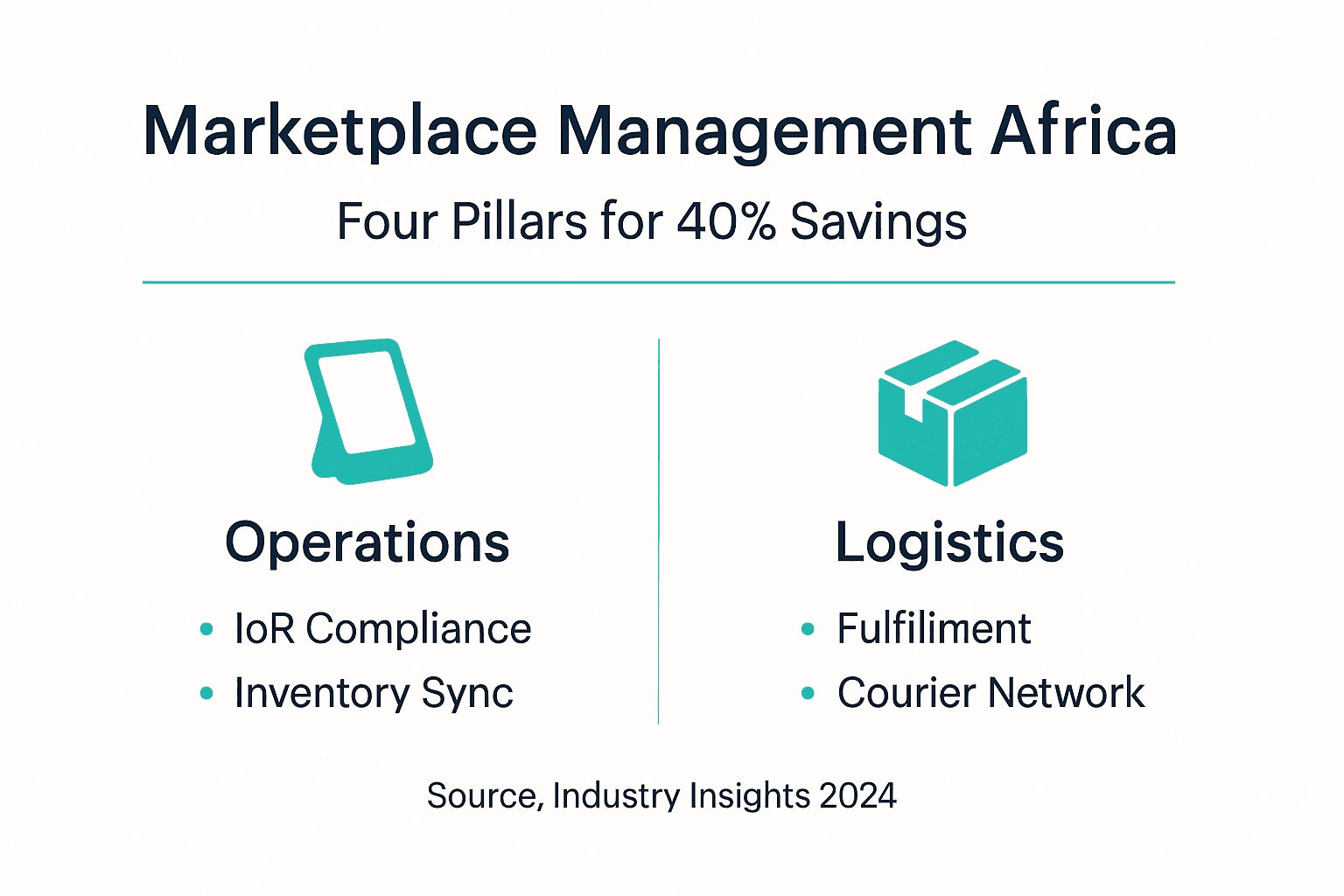
Inventory management balances supply and demand across geographies and channels. You need visibility into stock levels at warehouses in Johannesburg, Lagos, and Nairobi. Predictive analytics help anticipate demand spikes during holidays or promotional periods. Smart allocation algorithms ensure products reach customers efficiently without tying up capital in excess inventory.
Fulfillment orchestration leverages multi-courier networks to optimize delivery. Given Africa’s last-mile complexity, brands must work with regional specialists. Some couriers excel in South African metros, others in Nigerian rural areas. Intelligent routing systems select the best carrier for each order based on destination, cost, and reliability data.
Pro Tip: Prioritize platforms that automate IoR duties and inventory synchronization simultaneously. This integration eliminates manual handoffs where errors multiply. Brands using integrated systems report 60% fewer fulfillment mistakes and 40% faster order processing times.
These components don’t operate in isolation. The magic happens when they integrate seamlessly. Your multi-courier fulfillment and logistics system should trigger automatic inventory updates, which in turn adjust marketplace listings, all while the IoR ensures compliant customs documentation flows correctly.
Technology Solutions Supporting Marketplace Management
Technology platforms transform marketplace management from overwhelming to manageable in African e-commerce. Integrated systems aggregate multiple marketplaces into unified dashboards where you control product listings, inventory, and performance metrics across Takealot, Jumia, Amazon SA, and Kilimall simultaneously.
Automation removes friction from customs and compliance processes. Modern platforms generate customs documentation automatically, calculate duties and VAT accurately, and submit clearance requests electronically. This reduces customs processing time from weeks to days while minimizing costly errors. Human intervention becomes exception handling rather than routine task execution.
Data analytics capabilities provide insights that drive better decisions. You can track which products sell best on which marketplaces, identify optimal pricing strategies by country, and forecast inventory needs with statistical precision. These insights help you allocate marketing budgets effectively and adjust product mix based on real performance data.
Key technology features for African marketplace management include:
- Real-time inventory synchronization across all sales channels and warehouse locations
- Automated customs documentation generation and submission systems
- Multi-currency pricing management handling fluctuating exchange rates
- Performance dashboards tracking sales, margins, and fulfillment metrics by marketplace
- Integration with Shopify, WooCommerce, and major African marketplaces
- Multi-courier coordination systems optimizing carrier selection per delivery
Fulfillment orchestration tools coordinate complex multi-courier networks. Smart algorithms route orders to the optimal carrier based on destination, package size, cost, and historical delivery performance. This improves delivery reliability while controlling costs in Africa’s challenging last-mile environment.
Pro Tip: Choose technology platforms with built-in African regulatory compliance features. Generic e-commerce platforms lack the specialized customs, VAT, and marketplace integration capabilities African markets demand. Purpose-built solutions save months of customization effort and prevent compliance failures.
The best platforms combine marketplace integration, IoR services, and fulfillment coordination in one ecosystem. This eliminates data silos and manual transfers between systems. When you partner with MoreShores, you access this integrated technology stack designed specifically for African cross-border commerce.
Common Misconceptions About Marketplace Management
Misconceptions about marketplace management cause predictable failures for brands entering African e-commerce. Let’s correct the most damaging myths.
Misconception: Marketplace management equals product listing. Upload your catalog, set prices, and sales follow automatically.
Reality: Listings represent perhaps 20% of marketplace management work. The heavy lifting involves logistics coordination, customs compliance, inventory synchronization, pricing optimization, customer service, and performance analysis. Brands focusing only on listings fail when operational complexity overwhelms them.
Misconception: Only established brands need comprehensive marketplace management. Small or new brands can start simple and add complexity later.
Reality: Smaller brands actually need marketplace management more critically. You lack resources to recover from customs delays, VAT penalties, or fulfillment failures. Getting operations right from day one prevents catastrophic mistakes. African markets punish operational incompetence harshly regardless of brand size.
Misconception: Logistics and customs are minor concerns. Focus on marketing and product selection instead.
Reality: Logistics and customs constitute 35 to 50% of total e-commerce costs in Africa. Poor customs management creates weeks of delays and thousands in unexpected fees. Inefficient fulfillment destroys customer satisfaction faster than any marketing campaign can build it. Operational excellence is your competitive advantage.
Misconception: One approach works across all African markets. Replicate your South African strategy in Nigeria or Kenya.
Reality: African countries differ dramatically in regulations, infrastructure, consumer behavior, and marketplace maturity. What works in Johannesburg fails in Lagos. Each market demands tailored strategies for customs, fulfillment, pricing, and customer communication. Treating Africa as homogeneous guarantees expensive mistakes.
These misconceptions stem from underestimating African market complexity. Over 60% of brand managers admit they initially misjudged the operational tasks beyond listing products. Those who learn this lesson cheaply by researching first succeed. Those who learn through expensive failures often abandon African expansion altogether.
Comparative Frameworks and Best Practices for African Market Entry
Choosing the right marketplace management framework determines your success trajectory in African e-commerce. Two primary dimensions shape your approach: centralization versus localization, and in-house versus outsourced IoR.
Centralized marketplace management consolidates operations in one hub serving multiple African countries. This approach offers economies of scale, unified processes, and simpler management structures. However, it risks slower response to local market changes and potential disconnect from on-the-ground realities.
Localized marketplace management establishes operations in each target country with local teams and infrastructure. This provides superior regulatory compliance, faster delivery, and better cultural alignment. The tradeoff is higher operational complexity and cost as you replicate systems across markets.
For Importer of Record decisions, in-house IoR gives you maximum control over compliance and customs processes. You build internal expertise and own the entire value chain. This requires significant investment in legal entities, compliance teams, and regulatory knowledge across multiple African countries.
Outsourced IoR transfers customs and compliance responsibility to specialist partners. This reduces risk, accelerates market entry, and leverages established expertise. You sacrifice some control but gain flexibility and lower upfront investment.
| Framework | Advantages | Disadvantages | Best For |
|---|---|---|---|
| Centralized Management | Lower costs, unified processes, economies of scale | Slower local responsiveness, potential compliance gaps | Established brands with high volumes |
| Localized Management | Better compliance, faster delivery, market alignment | Higher costs, complex coordination | Premium brands prioritizing service |
| In-house IoR | Maximum control, internal expertise, long-term cost savings | High initial investment, slow setup | Large enterprises with dedicated resources |
| Outsourced IoR | Fast market entry, lower risk, expert compliance | Ongoing fees, less control | Most brands entering African markets |
Best practices recommend starting with outsourced IoR and centralized management, then localizing selectively as volumes justify investment. This balances speed to market with cost control. Assess each target country’s regulatory complexity, logistics infrastructure, and market size before committing to localization.
The logistics challenges in Africa vary so dramatically between countries that rigid frameworks fail. Successful brands maintain strategic flexibility, adapting their approach as they gain market knowledge and scale.
Practical Steps to Implement Effective Marketplace Management
Implementing marketplace management systematically prevents costly missteps. Follow this proven sequence for African market entry.
-
Assess regulatory and customs requirements for each target country. Research import duties, VAT rates, restricted products, and documentation needs. South Africa, Nigeria, Kenya, and Egypt have distinct requirements that impact your operations and costs fundamentally.
-
Choose multi-marketplace integration platforms with robust IoR capabilities built specifically for African markets. Generic e-commerce platforms lack the customs automation and compliance features you need. Evaluate platforms based on marketplace coverage, IoR services, and fulfillment network strength.
-
Set up Importer of Record arrangements for customs and VAT compliance in target countries. Partner with established IoR providers who already have legal entities, customs relationships, and regulatory expertise. This eliminates months of entity registration and compliance learning curves.
-
Implement real-time inventory synchronization across all sales channels. Your stock levels must update simultaneously on every marketplace, preventing overselling disasters. Choose systems with automatic reorder triggers based on velocity and lead times.
-
Partner with multi-courier fulfillment providers optimized for African last-mile delivery. Single-carrier strategies fail given Africa’s infrastructure variation. Multi-courier networks route orders intelligently based on destination, ensuring reliable delivery across diverse geographies.
-
Monitor key performance indicators continuously to identify and resolve issues quickly. Track metrics including order processing time, customs clearance duration, delivery success rates, customer satisfaction scores, and inventory turnover by marketplace and country.
Pro Tip: Engage local experts early to navigate regulatory and logistical variances smoothly. African markets punish assumptions. Local expertise helps you avoid compliance penalties, choose optimal fulfillment partners, and adapt marketing to cultural preferences. This investment pays for itself many times over in prevented mistakes.
Implementation timelines vary by market complexity. South Africa typically requires 4 to 6 weeks from decision to first sale. Nigeria or Kenya might need 8 to 12 weeks given additional regulatory steps. Build realistic timelines into your expansion planning.
Partnering with the right marketplace management provider ensures seamless compliance and fulfillment. Cross-border enablement platforms handle the operational heavy lifting while you focus on product selection, marketing, and customer relationships.
Conclusion: Unlocking African E-Commerce Growth through Marketplace Management
Marketplace management integrates complex operational, regulatory, and technological components essential for African e-commerce success. This isn’t optional complexity. It’s the foundational capability separating thriving brands from failed market entries.
The economics are compelling. Effective marketplace management reduces operational costs by up to 40% through automated customs processing, optimized fulfillment routing, and inventory efficiency. Simultaneously, proper management improves sales performance by 15 to 25% through better product availability, faster delivery, and superior customer experience.
Brands that embrace tailored marketplace management scale rapidly across Africa’s diverse markets. Those treating it as a minor operational detail struggle with compliance failures, fulfillment disasters, and mounting losses. The difference isn’t luck. It’s systematic operational excellence applied to African market realities.
Future cross-border e-commerce growth in Africa depends on mastering these marketplace management strategies. As African markets mature and competition intensifies, operational advantages become insurmountable competitive moats. Start building yours now.
Streamline Your African Marketplace Entry with MoreShores
Ready to implement these marketplace management insights without operational overwhelm? MoreShores provides the integrated platform brands need for African e-commerce success. Our Cross-Border Enablement Services handle Importer of Record duties, customs clearance, and VAT compliance across African markets. You focus on growth while we manage operational complexity.
Our multi-courier fulfillment network delivers reliably across Africa’s challenging last-mile environment. We integrate seamlessly with Takealot, Amazon SA, Jumia, Kilimall, Shopify, and WooCommerce, synchronizing inventory and orders in real time. This eliminates manual work and prevents costly errors. Brands working with MoreShores report 40% lower operational costs and 20% faster market entry times. Partner with MoreShores to access expert marketplace integration solutions purpose-built for African cross-border commerce.
Frequently Asked Questions
What is an Importer of Record and why is it important?
An Importer of Record is the legal entity responsible for customs clearance, paying duties and VAT, and ensuring regulatory compliance when goods enter a country. For international brands, IoR partnership eliminates the need to register business entities in every African market. This accelerates market entry from months to weeks while transferring compliance risk to expert partners who navigate African customs systems daily.
How do technology platforms improve marketplace management in Africa?
Integrated platforms automate inventory synchronization across multiple marketplaces, generate customs documentation, coordinate multi-courier fulfillment, and provide performance analytics. This automation eliminates manual errors that plague marketplace operations. Brands using specialized African e-commerce platforms report 60% fewer operational mistakes and 40% faster order processing. The technology handles routine tasks while your team focuses on strategic growth decisions.
What key challenges do brands face with African customs and VAT?
African countries impose varying duty rates, VAT percentages, and documentation requirements that change frequently. Misclassifying products or submitting incorrect paperwork triggers customs holds, storage fees, and penalties. Without local expertise, brands often face weeks of delays and unexpected costs reaching thousands of dollars per shipment. Partnering with established IoR providers who maintain current regulatory knowledge prevents these expensive failures.
Is marketplace management only necessary for large brands?
No, smaller brands actually need comprehensive marketplace management more critically. You lack resources to absorb customs penalties, fulfillment failures, or compliance mistakes that larger brands can weather. Getting operations right from launch prevents catastrophic errors that end African expansion attempts. Proper marketplace management levels the playing field, giving smaller brands the operational capabilities previously available only to large enterprises.
How can I measure the success of marketplace management in Africa?
Track operational efficiency metrics including customs clearance time, order processing duration, delivery success rate, and inventory turnover. Monitor financial metrics like fulfillment cost per order, VAT recovery rates, and operational cost as percentage of revenue. Customer-facing metrics include satisfaction scores, return rates, and repeat purchase rates. Successful marketplace management should show declining operational costs, improving delivery times, and rising customer satisfaction over your first 6 to 12 months in market.