
Many brands assume international e-commerce is simply domestic sales with overseas shipping. The reality is far more complex and far more lucrative. Cross-border e-commerce is projected to reach $7.9 trillion by 2025, yet most businesses underestimate the operational demands and market opportunities, especially in high-growth African markets. This guide clarifies what international e-commerce truly entails and shows you how to navigate cross-border trade, regulatory frameworks, and logistical challenges to expand successfully in 2026 and beyond.
Table of Contents
- Understanding International E-Commerce: Definition And Market Scope
- Key Trends And Challenges In African International E-Commerce Markets
- Technical And Operational Foundations For Successful International E-Commerce
- Navigating Regulatory, Cultural, And Logistical Complexities In International Expansion
- How Moreshores Supports Your International E-Commerce Growth
Key takeaways
| Point | Details |
|---|---|
| International e-commerce demands multi-jurisdictional operational capability | Cross-border transactions require integrated systems for payments, taxation, identity verification, and fulfillment across borders. |
| African markets offer explosive growth potential with unique challenges | Sub-Saharan Africa will surpass 600 million mobile subscribers by 2030, but infrastructure and trade costs remain significant barriers. |
| Technical readiness differentiates successful international platforms | Multi-currency pricing, automated tax calculation, and localized logistics integration are non-negotiable for scaling cross-border operations. |
| Operational excellence trumps simple geographic expansion | Treating international expansion as a multi-dimensional engineering problem delivers superior unit economics and customer experience. |
Understanding international e-commerce: definition and market scope
International e-commerce is not just selling to customers in another country. It represents a fundamental shift in operational complexity. Cross-border e-commerce denotes transactions where the buyer and seller are resident in different tax jurisdictions and goods or services cross international borders during fulfillment. This definition highlights the critical distinction: you are not simply adding markets, you are multiplying operational dimensions.
Successful international platforms share distinct characteristics that separate them from domestic-only operations. They handle multi-currency pricing dynamically, compute taxes across jurisdictions automatically, unify customer identity across regions, and integrate with localized fulfillment networks. These capabilities are not optional add-ons. They form the foundation of sustainable cross-border operations.
The global market opportunity is staggering. Cross-border e-commerce is projected to reach $7.9 trillion USD by 2025, representing roughly 25% of all e-commerce activity worldwide. This growth is not evenly distributed. Emerging markets, particularly in Africa, are experiencing disproportionate expansion driven by mobile penetration and digital payment adoption.
Africa’s e-commerce landscape presents a compelling case study. Sub-Saharan Africa had roughly 489 million unique mobile subscribers in 2022, projected to surpass 600 million by 2030. Smartphone adoption is accelerating faster than traditional retail infrastructure can scale, creating a leapfrog opportunity for digital-first brands. The continent’s online retail market revenue is expected to reach $80 to $100 billion by the late 2020s.
Yet opportunity and ease of entry are not synonymous. International e-commerce success requires addressing several dimensions simultaneously:
- Payment infrastructure: Supporting multiple currencies, local payment methods, and fraud prevention across jurisdictions
- Tax and regulatory compliance: Navigating VAT, duties, tariffs, and customs regulations in each target market
- Logistics and fulfillment: Building or partnering for warehousing, last-mile delivery, and returns management
- Customer experience: Localizing language, pricing display, checkout flows, and customer support
- Technology integration: Connecting marketplace APIs, storefronts, inventory systems, and analytics platforms
Brands pursuing cross-border e-commerce enablement must treat these dimensions as interconnected systems, not isolated projects. The technical debt of piecemeal solutions compounds rapidly as transaction volume scales.
Key trends and challenges in African international e-commerce markets
African e-commerce markets offer some of the highest growth rates globally, but they also present unique operational challenges that demand strategic adaptation. Understanding these dynamics is essential for brands considering expansion into the region.
Mobile-first infrastructure defines the African digital landscape. By 2026, smartphone penetration is approaching 50% in major urban centers across West and East Africa. Mobile money platforms like M-Pesa have normalized digital transactions in markets where traditional banking infrastructure remains limited. This creates both opportunity and constraint: your platform must perform flawlessly on mobile networks with variable bandwidth and latency.

The revenue opportunity is substantial but unevenly distributed. Markets like Nigeria, Kenya, South Africa, and Egypt dominate regional e-commerce activity, collectively representing over 60% of online retail revenue. However, only about 2% of Sub-Saharan African firms participate in e-commerce, and trade costs average 31.2% of trade value, the highest globally. This creates a paradox: immense market potential constrained by participation barriers.
| Market Factor | African Context | Strategic Implication |
|---|---|---|
| Mobile penetration | 489M users in 2022, 600M+ by 2030 | Design mobile-first, optimize for 3G/4G performance |
| E-commerce participation | Only 2% of firms active | Early movers gain disproportionate market share |
| Trade costs | 31.2% of trade value | Local fulfillment and partnering reduce landed costs |
| Payment preferences | Mobile money dominates | Integrate M-Pesa, Airtel Money, and local rails |
Several structural challenges constrain rapid scaling:
- Infrastructure gaps: Inconsistent addressing systems, limited last-mile delivery networks, and unreliable power supply increase fulfillment complexity and costs
- Regulatory fragmentation: Each country maintains distinct customs procedures, import duties, and e-commerce regulations without harmonization
- Digital literacy variance: Consumer familiarity with online transactions varies dramatically between urban and rural populations
- Payment ecosystem complexity: Managing cash-on-delivery, mobile money, card payments, and bank transfers requires multi-rail integration
Pro Tip: Successful African market entry requires hyper-localized logistics strategies. Partner with local fulfillment providers who understand regional addressing nuances, customer communication preferences, and payment collection methods. Generic international logistics approaches consistently underperform in African markets.
The opportunity lies in addressing these constraints systematically. Brands that build operational muscle for African markets develop capabilities that translate to other emerging regions. Working with an e-commerce logistics platform that specializes in African markets dramatically shortens the learning curve and reduces entry costs. These platforms aggregate fulfillment and logistics services that would take years to build independently.
Technical and operational foundations for successful international e-commerce
Technical readiness separates successful international e-commerce operations from expensive failed experiments. Key technical attributes distinguishing international e-commerce platforms include multi-currency pricing, automated tax calculation, unified identity management, and localized fulfillment integration. These capabilities must work in concert, not in isolation.
Consider the difference between a domestic-only platform and one capable of true international scale:
| Capability | Domestic Platform | International Platform |
|---|---|---|
| Pricing | Single currency, static | Multi-currency, dynamic exchange rates, localized display |
| Taxation | Single jurisdiction | Automated multi-jurisdiction VAT/duty calculation |
| Identity | Email/phone | Unified identity across regions, multi-factor authentication |
| Payments | Single processor | Multiple payment rails, local methods, fraud detection per market |
| Fulfillment | Single warehouse | Multi-node inventory, cross-border shipping, local last-mile |
| Compliance | Single regulatory framework | Multi-country customs, import licenses, data residency |
Building these capabilities requires a structured approach. Sellers that treat international expansion as a multi-dimensional engineering problem achieve better unit economics and customer satisfaction. Here is a prioritized implementation sequence:
- Establish multi-currency pricing infrastructure: Implement dynamic pricing that displays in local currency while managing exchange rate risk and margin preservation
- Integrate automated tax and duty calculation: Connect to tax engines that compute VAT, GST, and import duties in real-time based on product classification and destination
- Build payment acceptance across target markets: Add local payment methods alongside international cards, mobile money for African markets, and fraud detection tuned per region
- Deploy localized fulfillment networks: Partner with regional fulfillment centers or build distributed inventory to reduce shipping times and costs
- Implement unified customer identity: Create single customer views that span regions while respecting data residency and privacy regulations
- Establish compliance and documentation workflows: Automate customs documentation, certificate of origin, and regulatory filings required per jurisdiction
Pro Tip: Early investment in payment and tax automation delivers compounding returns. Manual processes that work for 100 orders per month break catastrophically at 1,000 orders. Build automation before volume forces your hand, not after operational failure exposes the gap.
The technology stack for international e-commerce includes several critical components. You need a commerce platform with native multi-currency and multi-language support. You need integrated shipping and fulfillment management with carrier diversity. You need tax calculation engines that update as regulations change. You need fraud detection tuned for each market’s risk profile.
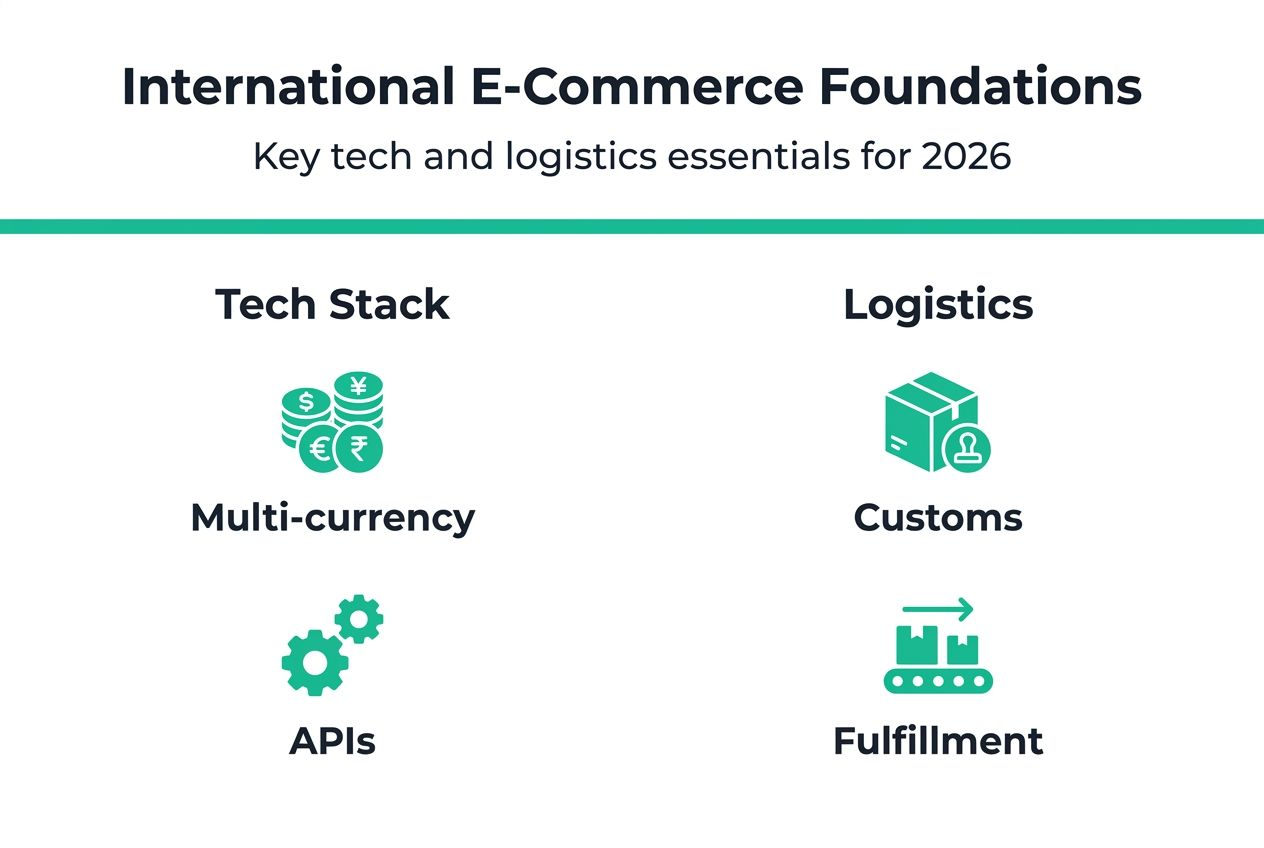
Many brands underestimate the integration complexity. Your e-commerce solutions for Africa must connect marketplace APIs, payment gateways, tax engines, shipping carriers, and analytics platforms into a coherent system. Each integration point represents potential failure modes that scale with transaction volume. Purpose-built cross-border enablement services eliminate this integration burden by providing pre-integrated infrastructure designed specifically for African and global expansion.
Navigating regulatory, cultural, and logistical complexities in international expansion
Technical readiness is necessary but insufficient for international e-commerce success. Regulatory frameworks, cultural nuances, and logistical realities shape what is operationally possible in each target market.
Regulatory environments in African markets vary dramatically. Research on digital partnerships between Chinese firms and West African stakeholders highlights the political, regulatory, and cultural risks shaping cross-border digital commerce. Key regulatory considerations include:
- Import licensing and customs clearance: Many African countries require specific import permits for certain product categories and impose variable duty rates
- Data localization requirements: Some jurisdictions mandate local storage of customer data and transaction records
- Consumer protection regulations: Return policies, warranty requirements, and dispute resolution mechanisms differ by country
- Payment regulation: Cross-border payment flows face foreign exchange controls and reporting requirements in several markets
Cultural factors influence buying behavior and trust more than many brands anticipate. Language localization beyond English and French is critical in markets with strong indigenous language preferences. Payment method preferences vary: cash-on-delivery remains dominant in markets where digital payment trust is still developing. Customer service expectations differ, with some markets expecting phone support over digital channels.
Logistical challenges compound as you expand across African markets. Connectivity is mobile-led in Africa, with data costs and patchy 3G/4G networks affecting session length and conversion rates. Infrastructure limitations create operational friction:
- Addressing systems: Many areas lack formal street addresses, requiring alternative location identification methods
- Last-mile delivery: Poor road infrastructure and security concerns in some regions increase delivery complexity
- Returns management: High logistics costs make returns economically challenging, requiring careful quality control upstream
- Inventory positioning: Balancing centralized inventory efficiency against distributed inventory responsiveness
Sub-Saharan Africa accounts for only 2.5% of global merchandise trade despite having 14% of the world’s population, illustrating the massive untapped potential constrained by infrastructure and regulatory barriers.
Successful market entry requires partnering with providers who have local operational expertise. Generic international logistics providers consistently underperform in African markets because they lack the localized knowledge and relationships required for effective execution. Working with specialists in brand onboarding and market navigation dramatically increases success probability and reduces time to profitability.
Policy harmonization across African markets is gradually improving. The African Continental Free Trade Area (AfCFTA) aims to reduce tariff and non-tariff barriers, potentially transforming intra-African e-commerce economics. However, implementation timelines vary by country, and brands must navigate current realities while anticipating future regulatory evolution.
How MoreShores supports your international e-commerce growth
Expanding into African and global markets demands operational capabilities that take years to build independently. MoreShores eliminates this barrier by providing comprehensive cross-border enablement infrastructure purpose-built for brands targeting African markets and beyond.

We handle the complexity you should not build yourself. Our e-commerce logistics platform acts as your Importer of Record, managing customs clearance, duties, VAT, and regulatory compliance across multiple African jurisdictions. We provide warehousing, inventory management, and fulfillment and logistics through our integrated multi-courier network, ensuring reliable delivery even in challenging last-mile environments. Our marketplace integration connects your products to Takealot, Amazon SA, Jumia, Kilimall, and major platforms while offering seamless Shopify and WooCommerce integration. By partnering with MoreShores, you gain immediate operational readiness in markets where building from scratch would require prohibitive time and capital investment.
Frequently asked questions
What distinguishes international e-commerce from domestic e-commerce?
International e-commerce requires multi-jurisdictional operational capability including tax calculation across borders, multi-currency pricing, localized payment methods, and cross-border logistics. Domestic e-commerce operates within a single regulatory and operational framework, while international operations multiply complexity across every business dimension.
How can African e-commerce companies overcome trade cost barriers?
Partner with specialized cross-border enablement platforms that aggregate volume and provide integrated customs clearance, warehousing, and fulfillment infrastructure. Localizing inventory within target markets and optimizing product mix for margin preservation also reduces effective trade costs compared to single-shipment cross-border models.
What technology is essential for scaling cross-border sales?
Automated tax and duty calculation engines, multi-currency pricing systems, unified customer identity management, integrated payment rails supporting local methods, and fulfillment management connecting multiple carriers and warehouses form the minimum viable technology stack. Manual processes collapse under volume before profitability materializes.
Why is operational readiness more critical than just expansion?
Poor operational execution in new markets damages brand reputation and creates financial losses that compound as volume scales. Building operational muscle before aggressive market expansion ensures positive unit economics and sustainable growth rather than expensive failure that requires market re-entry later.
How do cultural factors impact e-commerce success in new markets?
Payment method preferences, customer service channel expectations, language localization needs, and trust-building requirements vary dramatically across cultures. Brands that adapt checkout flows, communication strategies, and product presentation to local preferences consistently outperform those using one-size-fits-all approaches.