What is global retail? How e-commerce brands expand worldwide

TL;DR:
- Modern global retail in Africa relies on digital platforms, local payment methods, and adaptive logistics.
- Africa’s e-commerce market is projected to grow over threefold by 2033, driven by mobile use and young demographics.
- Building trust through reliable delivery, local support, and tailored policies is key to success in African markets.
Africa’s e-commerce market hit $317B in 2024 and is projected to reach $1,017B by 2033, growing at a 13.8% CAGR. Yet most brands still assume global retail is reserved for large multinationals with deep pockets and established distribution networks. That assumption is wrong, and it’s costing ambitious brands real revenue. Whether you’re a foreign brand looking to enter African markets or an African brand ready to scale internationally, global retail is now within reach. This guide breaks down what global retail actually means in 2026, why Africa sits at the center of that conversation, and how you can act on it.
Table of Contents
- Defining global retail in 2026: More than just selling abroad
- Why Africa is central to the future of global retail
- Core strategies for e-commerce brands entering African markets
- Key challenges: Logistics, payments, and scaling trust across borders
- The real key: Why trust and local adaptation outpace flashy tech
- Connect with trusted partners for seamless African market expansion
- Frequently asked questions
Key Takeaways
| Point | Details |
|---|---|
| Global retail redefined | Modern global retail means seamless digital selling and adapting to local markets, not just shipping abroad. |
| Africa’s explosive growth | Africa’s e-commerce market will triple by 2033, driven by mobile technology and youthful shoppers. |
| Trust and adaptation win | Building local trust and tailoring logistics, payments, and service outpaces technology alone. |
| Start with one market | Phased entry into a single metro or country ensures sustainable scaling across Africa. |
Defining global retail in 2026: More than just selling abroad
Global retail used to mean opening physical stores in foreign countries, a process that required enormous capital and years of planning. That model still exists, but it no longer defines the category. Today, global retail means selling across borders through digital channels, local platforms, and adaptive fulfillment systems, regardless of your company’s size.
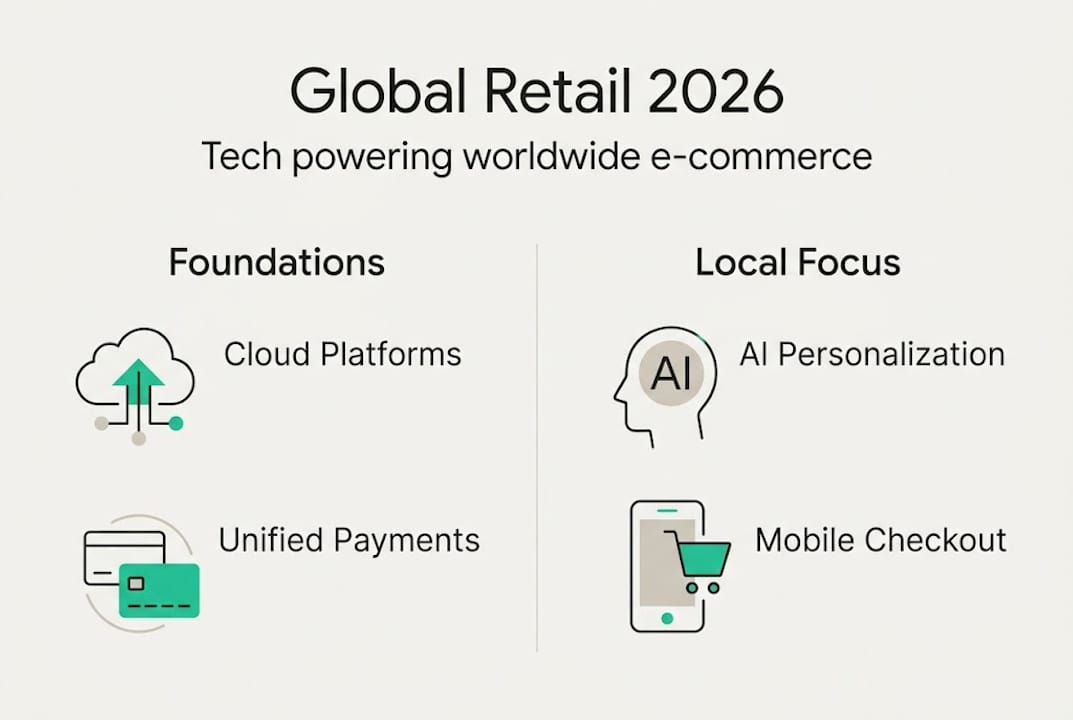
Modern cross-border retail infrastructure now includes cloud platforms, AI personalization, mobile payments, and unified commerce systems that connect inventory, sales, and customer data across multiple markets. A brand based in Shanghai or São Paulo can list products on Takealot in South Africa, Jumia in Nigeria, and Kilimall in Kenya, all from a single dashboard. That’s a structural shift, not a trend.
For Africa specifically, global retail looks different than it does in Europe or North America. The continent is mobile-first, with a young population that shops primarily through smartphones. Payment preferences vary by region. Trust in online brands is earned differently. Africa is also not a single market. South Africa has a relatively mature e-commerce infrastructure. Nigeria and Kenya are mobile-led with high smartphone penetration. Many other countries are still emerging, with significant untapped demand.
Here’s what modern global retail actually involves for brands entering Africa:
- Marketplace integration: Listing on local platforms like Takealot, Jumia, and Kilimall alongside global platforms
- Local payment support: Accepting M-Pesa, mobile wallets, and regional payment rails, not just cards
- Regulatory compliance: Managing duties, VAT, and import requirements per country
- Fulfillment and returns: Operating last-mile delivery and reverse logistics within local networks
- Customer trust signals: Providing visible support, local language options, and simple return processes
“The brands that win in new markets aren’t always the ones with the best products. They’re the ones that make buying feel safe and easy for local customers.”
Pro Tip: Before you invest in technology, invest in local trust. Reliable delivery windows and a clear returns policy will drive repeat purchases faster than any AI personalization tool.
If you’re evaluating where to start, exploring e-commerce solutions for Africa gives you a practical view of what infrastructure is already in place. The barrier to entry is lower than you think, but only if you use the right cross-border enablement tools from the start.
Why Africa is central to the future of global retail
The numbers are hard to ignore. Africa’s e-commerce market was valued at $317B in 2024 and is on track to reach $1,017B by 2033. South Africa alone is seeing online retail grow at 38% year over year, with e-commerce now accounting for roughly 10% of total retail sales. These are not speculative projections. They reflect real shifts in consumer behavior driven by mobile adoption, expanding internet access, and a growing middle class.

The demographic story is equally compelling. Africa has the world’s youngest population, with a median age under 20 in many countries. These consumers are digital natives. They discover products on social media, compare prices on mobile apps, and expect fast, trackable delivery. That behavior pattern is exactly what global e-commerce brands are built to serve.
Here’s a snapshot of key African markets for e-commerce entry:
| Market | Maturity level | Primary payment method | Key platform |
|---|---|---|---|
| South Africa | Advanced | Card, EFT | Takealot, Amazon SA |
| Nigeria | Emerging/mobile-led | Mobile wallets, USSD | Jumia |
| Kenya | Mobile-led | M-Pesa | Jumia, Kilimall |
| Ghana | Emerging | Mobile money | Jumia |
| Egypt | Growing | Card, cash on delivery | Jumia, noon |
The AfCFTA agreement is reducing tariffs and simplifying cross-border trade across member states, but significant gaps in logistics infrastructure and regulatory alignment remain. That means opportunity exists precisely because the market is not yet saturated or fully optimized.
Key growth drivers to know:
- Mobile money adoption across East and West Africa is accelerating financial inclusion
- 30%+ of African online shoppers already purchase from cross-border sellers
- Urban youth populations in Lagos, Nairobi, and Johannesburg are driving premium product demand
- Logistics networks are improving rapidly through local and regional investment
For brands ready to act, understanding Africa marketplace integration is the practical starting point. Getting brand onboarding in Africa right from day one saves significant time and cost later.
Core strategies for e-commerce brands entering African markets
Knowing the opportunity exists is one thing. Knowing how to enter without overextending your resources is another. The brands that succeed in Africa share a common approach: they start focused, adapt fast, and scale methodically.
Here are the core steps for a structured market entry:
- Validate in one market first. Choose a single country or metro area, South Africa’s Johannesburg or Cape Town, for example, and test product-market fit before expanding regionally.
- Match your payment stack to the market. Use card and EFT in South Africa, M-Pesa in Kenya, and mobile wallets in West Africa. Forcing customers to use unfamiliar payment methods kills conversion.
- Localize your customer experience. Translate key product pages, offer local currency pricing, and provide support in the local language where possible.
- Partner for fulfillment. Last-mile delivery in Africa requires local knowledge. Work with established logistics networks rather than building your own from scratch.
- Integrate your systems early. Connect your inventory, payments, and reporting through a unified platform so you can manage multiple markets without operational chaos.
Phased market entry combined with metro-focused launches and localized payment options consistently outperforms broad, simultaneous expansion across multiple countries. The data supports a measured approach.
| Strategy | Phased entry | All-in expansion |
|---|---|---|
| Risk level | Low to medium | High |
| Time to first revenue | Faster | Slower |
| Operational complexity | Manageable | Very high |
| Recommended for | Most brands | Established players only |
On the payments side, PAPSS and ISO 20022 are streamlining cross-border transactions across African markets, reducing settlement times and currency conversion friction. AI tools are also enabling personalization at scale, helping brands deliver relevant product recommendations without building expensive local teams.
Pro Tip: Invest in a unified ERP or order management system before you expand to your second market. Trying to retrofit systems after the fact is far more expensive and disruptive.
For brands evaluating logistics options, reviewing African fulfillment and logistics infrastructure early helps you avoid costly gaps. If you’re considering a deeper operational relationship, partnering for logistics is worth exploring.
Key challenges: Logistics, payments, and scaling trust across borders
Africa’s growth story is real, but so are the operational challenges. Brands that underestimate them tend to stall after their initial launch. Understanding what you’re walking into lets you plan for it rather than react to it.
Logistics fragmentation is the most common pain point. Last-mile delivery infrastructure varies enormously between countries and even between urban and rural areas within the same country. Reverse logistics, managing returns, is even more complex and often underdeveloped. You need local courier partnerships and a clear returns policy before you launch, not after.
Currency volatility is a real financial risk. Average inflation across Africa ran at 12.6% in 2026, and currency fluctuations can erode margins quickly if you’re pricing in local currencies without a hedging strategy. Multi-currency payment systems and dynamic pricing tools help manage this exposure.
Regulatory complexity adds another layer. Each country has its own import duties, VAT rules, product certification requirements, and customs procedures. What clears customs easily in South Africa may face significant delays in Nigeria. Working with an Importer of Record removes much of this burden.
Here’s a summary of the key operational challenges:
- Inconsistent last-mile delivery quality across markets
- Multi-currency management and currency risk exposure
- Country-specific regulatory and customs requirements
- Consumer skepticism toward unfamiliar foreign brands
- Fraud risk in markets with lower digital payment maturity
“Trust is built through local delivery, transparent returns, and responsive support, not just competitive pricing.”
Cloud-based systems and AI-powered fraud detection are becoming standard tools for brands scaling across multiple African markets. They allow you to harmonize the customer experience while managing risk at a system level. For brands managing multiple storefronts, integrating marketplaces through a single platform significantly reduces operational overhead.
The real key: Why trust and local adaptation outpace flashy tech
Here’s a perspective that most global retail guides won’t tell you: technology is not your primary differentiator in African markets. It’s a prerequisite, not an advantage.
We’ve seen brands arrive with sophisticated AI tools, dynamic pricing engines, and slick mobile apps, and still fail to gain traction. Why? Because they didn’t invest in the things African consumers actually care about: knowing their order will arrive, being able to return a product without a fight, and feeling like the brand understands their context.
Local adaptation consistently outperforms technological sophistication when it comes to conversion and retention. A brand with a basic Shopify storefront, a reliable local courier, and a responsive WhatsApp support line will outperform a brand with a custom app and no local fulfillment presence.
The brands that build lasting market share in Africa do it by treating local operations as a core investment, not an afterthought. That means hiring local support staff, partnering with regional logistics providers, and designing return policies that work within local infrastructure constraints.
Technology matters. But it works best when it’s layered on top of genuine local understanding. Understanding how onboarding actually works in practice gives you a clearer picture of what that looks like operationally.
Connect with trusted partners for seamless African market expansion
The insights in this guide point to one practical conclusion: expanding into African markets requires more than a good product and a payment gateway. It requires a partner that understands compliance, fulfillment, and marketplace integration from the inside out.
MoreShores is built specifically for this. We act as your Importer of Record, manage customs clearance, duties, and VAT, and connect your inventory to platforms like Takealot, Amazon SA, Jumia, and Kilimall. Our cross-border e-commerce solutions remove the operational barriers that slow most brands down. If you’re a logistics provider looking to expand your network reach, you can also become a logistics partner and grow alongside us. Explore our full Africa e-commerce solution to see how we can support your expansion from day one.
Frequently asked questions
What does ‘global retail’ mean for e-commerce brands?
Global retail means selling across borders using digital platforms, local payment methods, and adaptive logistics. It’s not limited to traditional exports or physical store networks, and modern infrastructure makes it accessible to brands of all sizes.
Is Africa really a prime opportunity for global retail growth?
Yes. Africa’s e-commerce market is projected to grow from $317B in 2024 to $1,017B by 2033, driven by mobile adoption, young demographics, and rising consumer spending power.
What are the biggest risks when entering African markets?
Currency volatility, logistics fragmentation, and country-specific regulatory requirements are the primary risks, alongside the challenge of building consumer trust as an unfamiliar foreign brand.
How can brands build trust with African customers?
Trust is built through reliable local delivery, transparent return policies, local payment options, and responsive customer support, not through pricing alone.