
Many e-commerce businesses think fulfillment just means shipping products. That’s a costly mistake. The reality involves a sophisticated end-to-end process managing inventory, orders, and returns across borders. For African cross-border merchants, mastering fulfillment determines whether you scale profitably or drown in operational chaos. This guide delivers practical strategies to optimize your fulfillment operations for international trade success.
Table of Contents
- Understanding E-Commerce Fulfillment: The Full Cycle
- The Omnichannel Fulfillment Model: Balancing Speed, Cost, And Customer Experience
- Cross-Border E-Commerce Fulfillment In Africa: Opportunities And Challenges
- Optimizing Your E-Commerce Fulfillment Strategy For Cross-Border Success
- How MoreShores Supports Your African Cross-Border E-Commerce Fulfillment
Key takeaways
| Point | Details |
|---|---|
| Fulfillment encompasses receiving inventory, order processing, picking, packing, shipping, and returns management | Manual processes cause up to 80% of fulfillment errors and consume 55% of warehouse costs |
| Omnichannel models unify inventory across sales channels to prevent stockouts and improve delivery consistency | Critical for African merchants selling through marketplaces, online stores, and local pickup simultaneously |
| Africa’s cross-border e-commerce reached $30-40 billion in 2022-2023 with double-digit growth continuing | AfCFTA protocols and PAPSS payment system reduce friction that previously added 7%+ transaction costs |
| Optimization requires automation, local partnerships, accurate inventory control, and localized payment options | Continuous KPI tracking of delivery times, error rates, and cost per order drives competitive advantage |
Understanding e-commerce fulfillment: the full cycle
E-commerce fulfillment is the end-to-end process of delivering online orders, covering inventory receipt through product shipping and returns handling. Each step directly impacts your operational costs and customer satisfaction scores.
The core fulfillment workflow includes six critical stages. First, receiving and storing inventory in warehouses with proper tracking systems. Second, processing orders as they arrive from multiple sales channels. Third, picking products from storage locations based on order specifications. Fourth, packing items securely with appropriate materials and documentation. Fifth, coordinating shipping through carriers and managing customs for international orders. Sixth, handling returns and exchanges efficiently to maintain customer trust.
Manual picking accounts for 55% of warehouse operating costs while causing 80% of fulfillment errors. These mistakes damage customer relationships and force expensive corrective shipments. For cross-border African operations, errors multiply when dealing with customs documentation, multiple currencies, and varied regulatory requirements across markets.
Cross-border fulfillment adds complexity through customs clearance, duty calculations, international shipping coordination, and compliance with destination country regulations. African merchants face additional challenges including infrastructure gaps, fragmented logistics networks, and inconsistent border procedures between countries.
Key strategies to streamline your fulfillment cycle:
- Implement barcode scanning systems to eliminate manual picking errors and track inventory movement in real time
- Organize warehouse layouts by product velocity, placing fast-moving items near packing stations to reduce travel time
- Standardize packing procedures with documented workflows and quality checkpoints before shipping
- Integrate order management systems across all sales channels to prevent overselling and synchronize inventory levels
- Partner with experienced fulfillment providers who understand African cross-border logistics and compliance requirements
Pro Tip: Map your current fulfillment process to identify bottlenecks where orders wait unnecessarily. Most warehouses discover 30-40% of fulfillment time involves products sitting idle between stages rather than active processing.
The omnichannel fulfillment model: balancing speed, cost, and customer experience
The omnichannel fulfillment model provides a structured approach to plan, orchestrate, and execute customer orders across all selling channels. This framework solves the recurring problem where inventory strands in one channel while another stocks out, creating inconsistent promises between web stores and physical locations.
Traditional single-channel fulfillment treats each sales platform as an independent operation with dedicated inventory. This creates artificial scarcity and prevents you from leveraging your total available stock to meet customer demand wherever it originates.

| Aspect | Traditional Fulfillment | Omnichannel Fulfillment |
|---|---|---|
| Inventory visibility | Channel-specific silos | Unified across all channels |
| Order routing | Fixed to origin channel | Dynamic based on proximity and availability |
| Delivery promises | Inconsistent by platform | Standardized customer experience |
| Stock utilization | Lower due to fragmentation | Higher through intelligent allocation |
| System complexity | Simpler but less efficient | More integrated but optimized |
For African cross-border sellers juggling international marketplaces like Jumia, Amazon SA, Takealot, and direct Shopify stores, omnichannel fulfillment becomes essential. You can’t afford to hold separate inventory pools for each platform when storage costs are high and demand patterns fluctuate.
The model enables you to fulfill a Takealot order from inventory originally designated for your Shopify store if that location offers faster delivery to the customer. This flexibility improves delivery speed while reducing total inventory carrying costs by 15-25% compared to siloed approaches.
Implementing omnichannel fulfillment requires integrated technology connecting your inventory management, order processing, and shipping systems. Your platform must update stock levels in real time across all channels to prevent overselling when one location depletes.
Pro Tip: Start your omnichannel journey by connecting your two highest-volume sales channels first. Prove the model’s value with measurable improvements in stock turnover and delivery speed before expanding to additional platforms. This phased approach reduces implementation risk while building internal expertise.
Explore comprehensive fulfillment services designed for multi-channel African operations. Consider partnering with platforms that provide pre-integrated omnichannel infrastructure rather than building custom connections.
Cross-border e-commerce fulfillment in Africa: opportunities and challenges
Africa’s cross-border e-commerce reached $30-40 billion in 2022-2023 with double-digit annual growth continuing through 2026. Rising internet penetration, mobile payment adoption, and growing middle-class demand for international products drive this expansion. African consumers increasingly purchase from foreign sellers while African brands discover lucrative export markets.
Yet fulfillment remains the primary barrier preventing more businesses from capturing cross-border opportunities. Infrastructure fragmentation creates unpredictable delivery times when shipments cross multiple national borders. Regulatory inconsistencies force merchants to navigate different import rules, tax structures, and documentation requirements for each destination country. High transaction costs historically added over 7% to order values, eroding margins and forcing higher customer prices.
Recent developments are transforming this landscape. The Protocol on Digital Trade adopted in 2024 marked coordinated efforts to dismantle digital borders hindering cross-border commerce within the African Continental Free Trade Area framework. This protocol harmonizes data protection standards, digital signatures, and online dispute resolution across member states.
The Pan-African Payment and Settlement System (PAPSS) reduced reliance on scarce foreign exchange while lowering transaction costs from their previous 7%+ average. PAPSS enables instant cross-border payments in local currencies, eliminating the need to convert through US dollars or euros for intra-African transactions. Settlement times dropped from days to seconds, dramatically improving cash flow for merchants.
These infrastructure improvements create tangible fulfillment advantages. Merchants operating in markets like Côte d’Ivoire successfully leverage regional logistics hubs, mobile money integration for cash-on-delivery alternatives, and improved customs coordination between West African Economic and Monetary Union countries.
Strategies to capitalize on Africa’s cross-border fulfillment opportunities:
- Establish strategic warehouse locations in regional trade hubs with strong logistics infrastructure and favorable trade agreements
- Leverage specialized e-commerce platforms that handle customs clearance, duties, and regulatory compliance across multiple African markets
- Offer localized payment methods including mobile money, bank transfers, and installment options tailored to each target market’s preferences
- Partner with last-mile delivery providers who understand local address systems and can navigate informal settlement areas urban mapping tools miss
- Utilize cross-border enablement services that act as Importer of Record to simplify customs and tax obligations
- Monitor AfCFTA implementation progress to identify newly harmonized corridors where cross-border fulfillment becomes more efficient
- Invest in customer communication systems that provide proactive shipment updates in local languages to build trust despite longer delivery windows
Follow comprehensive onboarding processes that clarify documentation requirements and compliance steps before launching in new markets. This prevents costly shipment delays from missing paperwork or incorrect tariff classifications.
Optimizing your e-commerce fulfillment strategy for cross-border success
Consistent, cost-effective delivery has become a strategic imperative in e-commerce rather than just an operational function. Your fulfillment performance directly determines customer lifetime value, repeat purchase rates, and word-of-mouth referrals in competitive African markets.
Five-step optimization framework for cross-border fulfillment:
-
Audit your current fulfillment accuracy by tracking order error rates, mis-picks, incorrect addresses, and damaged shipments for 30 days to establish your baseline performance and identify the highest-impact improvement opportunities.
-
Implement warehouse management software with barcode scanning, automated reorder triggers based on velocity analysis, and real-time inventory synchronization across all sales channels to eliminate manual tracking errors.
-
Negotiate partnerships with multiple shipping carriers including both international couriers and local last-mile providers to create routing flexibility based on destination, speed requirements, and cost parameters for each order.
-
Establish clear service level agreements with measurable delivery windows for each market you serve, then communicate these timelines transparently on product pages and during checkout to set accurate customer expectations.
-
Create a returns management process that balances customer convenience with cost control by offering strategic return locations, clear return windows, and quality inspection procedures to identify patterns indicating product or packing improvements.
Localization drives conversion and retention in African cross-border commerce. Understanding consumer behavior and localization patterns proves crucial for improving funnel performance across diverse markets. Beyond payment methods, consider packaging preferences, unboxing experiences valued in gift-giving cultures, and communication styles that build trust.
Continuous measurement separates optimization from guesswork. Track these critical KPIs weekly:
- Average order delivery time from purchase to customer receipt, segmented by destination country and shipping method
- Fulfillment error rate measuring incorrect items, quantities, or addresses per 1,000 orders shipped
- Cost per order including picking, packing, shipping, duties, and handling as a percentage of order value
- On-time delivery percentage against your promised delivery windows by carrier and route
- Return rate by product category and destination to identify quality issues or mismatched customer expectations
Pro Tip: Build relationships with local market experts who understand cultural nuances affecting delivery preferences. A logistics approach working perfectly in Lagos may fail in Nairobi due to different address systems, preferred delivery times, or security considerations. Local insights provide competitive advantages algorithms cannot replicate.
Leverage professional fulfillment and logistics services that provide established infrastructure rather than building everything internally. Utilize cross-border enablement specialists who already navigate complex customs and regulatory environments across multiple African markets.
How MoreShores supports your African cross-border e-commerce fulfillment
Navigating Africa’s cross-border fulfillment complexity requires specialized expertise and established infrastructure. MoreShores provides end-to-end enablement for e-commerce businesses expanding across African markets and international channels.
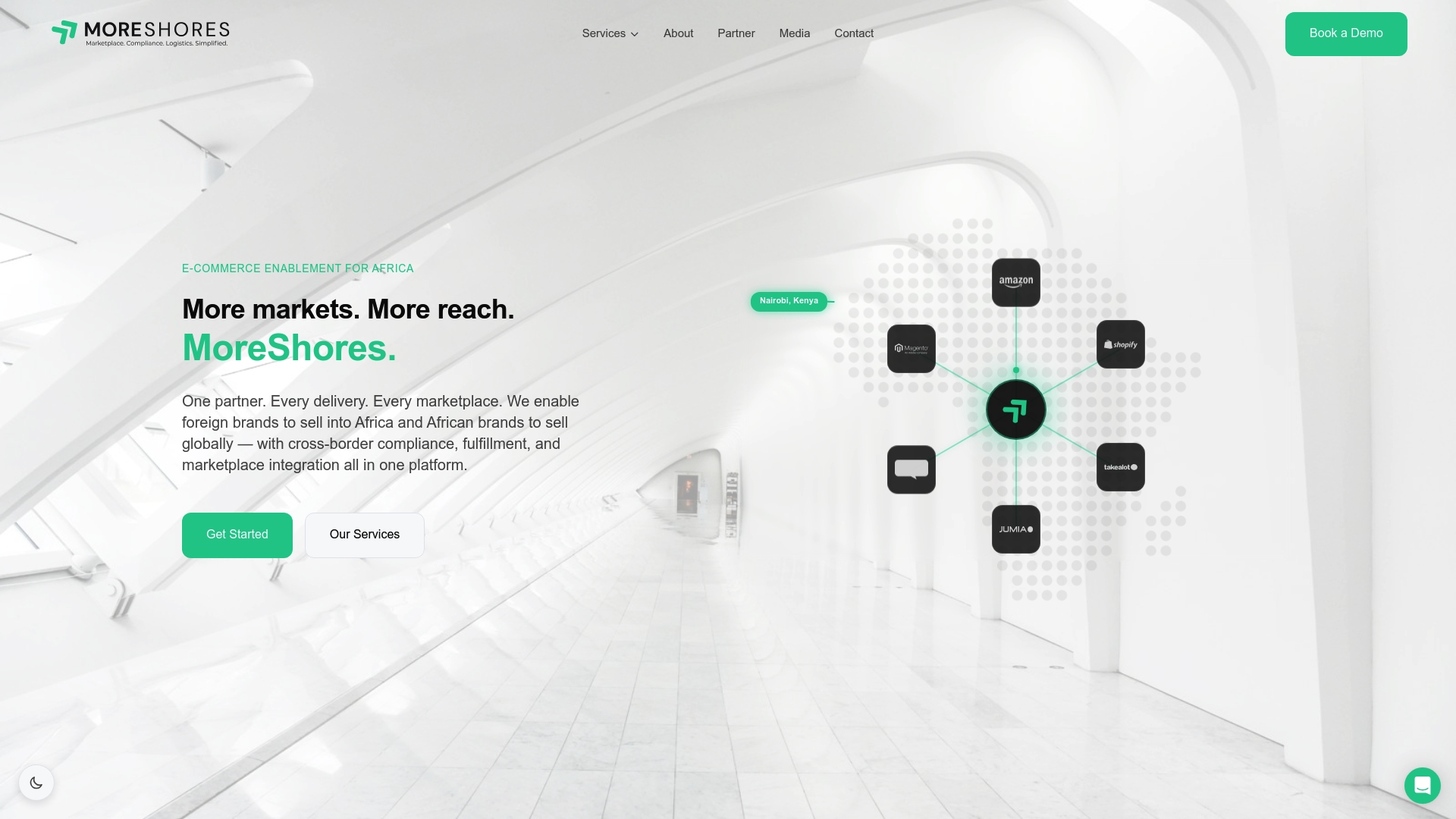
The platform handles critical fulfillment components including Importer of Record services for customs clearance, warehousing with inventory management systems, and multi-courier fulfillment networks. Integration with major marketplaces like Takealot, Amazon SA, Jumia, and Kilimall plus seamless Shopify and WooCommerce connections enables true omnichannel operations.
MoreShores manages duties, VAT, and regulatory compliance across markets so you focus on growth rather than bureaucratic obstacles. Their fulfillment infrastructure provides the operational backbone for consistent delivery performance. Cross-border services simplify international expansion with established compliance and logistics frameworks. Partnership opportunities offer collaborative approaches to market entry and scaling.
Explore how MoreShores transforms complex cross-border fulfillment into a competitive advantage for your e-commerce business.
FAQ
What is e-commerce fulfillment and why does it matter?
E-commerce fulfillment encompasses the complete process of receiving inventory, processing customer orders, picking and packing products, coordinating shipping, and managing returns. It matters because fulfillment performance directly determines customer satisfaction, repeat purchase rates, and your operational profitability. Poor fulfillment creates negative reviews, high return rates, and customer churn that destroys otherwise strong businesses.
What are the main challenges of cross-border fulfillment in Africa?
The primary challenges include fragmented logistics infrastructure causing unpredictable delivery times, inconsistent customs and regulatory requirements across countries, and historically high transaction costs exceeding 7% of order values. However, recent improvements through AfCFTA digital trade protocols and the PAPSS payment system significantly reduce these friction points. These developments harmonize rules and enable local currency settlements, making cross-border fulfillment increasingly viable.
How does the omnichannel fulfillment model improve customer experience?
Omnichannel fulfillment unifies inventory visibility across all sales channels, enabling intelligent order routing based on proximity and stock availability rather than artificial channel boundaries. This creates faster delivery by fulfilling orders from the optimal location regardless of purchase origin. Customers receive consistent delivery promises and service quality whether they buy through your website, marketplace listings, or other channels, building trust and satisfaction.
What are actionable steps to optimize fulfillment for African cross-border e-commerce?
Start by implementing warehouse management systems with barcode scanning to eliminate manual errors, then establish partnerships with multiple carriers for routing flexibility. Adopt localized payment options and communication approaches that match each target market’s preferences to improve conversion and trust. Focus on continuous measurement of delivery times, error rates, and costs per order to identify improvement opportunities, and consider partnering with specialized fulfillment providers who already navigate African cross-border complexity.