The Role of Compliance in Export: What You Must Know

TL;DR:
- Many businesses view export compliance as a mere paperwork task, but it influences market access and penalties.
- An effective compliance program involves operational practices such as product classification, ongoing screening, training, and documentation to reduce legal risks.
Most business owners treat export compliance as a filing exercise. Submit the paperwork, ship the goods, move on. That framing is expensive. The role of compliance in export operations is far broader than documentation. It determines which markets you can access, whether your licenses hold up under scrutiny, and whether a single shipment error becomes a six-figure penalty. For compliance officers and business owners operating across borders, especially in complex corridors like Africa and the global market, understanding how export regulations work and how to operationalize them is not optional. It is the foundation your entire international strategy rests on.
Table of Contents
- Key takeaways
- The role of compliance in export: what the rules actually cover
- Risks and consequences of non-compliance
- Building an effective export compliance program
- Integrating compliance into your export operations
- My take on why compliance is your strongest business asset
- How Moreshores helps you export with confidence
- FAQ
Key takeaways
| Point | Details |
|---|---|
| Compliance is not just paperwork | Export compliance covers licensing, classification, end-user screening, and documentation across multiple regulatory bodies. |
| Penalties for violations are severe | Civil penalties per violation can exceed $300,000, and willful misconduct triggers criminal liability. |
| A written program is not enough | Regulators assess whether compliance is operationalized through training, audits, and escalation procedures, not just whether policies exist. |
| Distributors do not absorb your risk | Companies retain full compliance responsibility for transactions handled by third-party logistics providers or distributors. |
| Voluntary self-disclosure reduces exposure | Proactively disclosing violations with documented remediation efforts is treated favorably by regulators and can significantly reduce penalties. |
The role of compliance in export: what the rules actually cover
Export compliance is not a single regulation. It is a system of overlapping legal frameworks, each with its own scope, enforcement agency, and penalty structure. Knowing which frameworks apply to your business is the starting point.
In the United States, three primary regulatory bodies govern export activity:
- Bureau of Industry and Security (BIS) administers the Export Administration Regulations (EAR), which control the export of commercial goods, software, and technology with potential dual-use applications. Every exportable item is assigned an Export Control Classification Number (ECCN), and the wrong classification can invalidate a license exception retroactively.
- Directorate of Defense Trade Controls (DDTC) administers the International Traffic in Arms Regulations (ITAR), which govern defense articles and services listed on the U.S. Munitions List. ITAR violations are prosecuted criminally, not just civilly.
- Office of Foreign Assets Control (OFAC) enforces sanctions programs targeting specific countries, entities, and individuals. OFAC operates on a strict liability standard, meaning intent is not a defense in many cases.
Beyond the U.S. framework, regulations continue to expand globally. The UK introduced new Sanctions End-Use Controls in May 2026, requiring licenses for exports at risk of high-risk diversion even when standard controls would not otherwise apply. Compliance officers working in international trade must now monitor regulatory changes across multiple jurisdictions simultaneously.
The distinction between export controls, sanctions, and antiboycott regulations also matters. Export controls govern what you sell and to whom based on product sensitivity. Sanctions restrict transactions with specific parties or countries based on foreign policy objectives. Antiboycott rules prohibit participation in certain foreign-led boycotts. Treating them as interchangeable is a compliance gap that regulators notice.
Risks and consequences of non-compliance
The penalties for export violations are not theoretical. Civil penalties for OFAC sanctions violations reached $377,700 per violation as of January 2025. Multiply that across multiple transactions in a shipment sequence and you understand why enforcement actions can threaten business continuity outright.
“Export control violations can trigger severe consequences including civil and criminal penalties, export bans, and individual executive liability, with severity increased for willful misconduct or concealment.” — BIS Investigations and Enforcement
The impact of compliance failures extends well beyond fines. A company placed on the Denied Parties List loses its export privileges, which effectively ends international operations. Individual executives can face personal criminal liability. The reputational damage from a public enforcement action signals to customers, partners, and investors that the business lacks operational discipline.
Enforcement priorities have also shifted. Dual-use technology exports, end-user screening failures, and third-party intermediary risks now sit at the top of BIS and OFAC enforcement agendas. Absent functional compliance programs including training and transaction reviews, BIS enforcement penalties often follow weak escalation procedures and customer screening failures.
The strict liability nature of many export regulations is what catches businesses off guard. Under OFAC, you can be held responsible for a sanctions violation even if you did not know the end customer was on a restricted list. That standard eliminates the “we did not know” defense and makes proactive due diligence the only viable protection.
Building an effective export compliance program
A written compliance policy filed in a drawer does not constitute a compliance program. A well-documented Export Compliance Program (ECP) can mean the difference between a warning letter and full enforcement action, but only if it is operational. Here is what an effective ECP actually requires:
- Assign a dedicated compliance officer. Someone must own export compliance with authority to pause transactions, escalate concerns, and access legal counsel. This role cannot be a part-time addition to someone’s other responsibilities.
- Classify your products accurately. Misclassification of goods under the ECCN is one of the most frequent and costly compliance mistakes, invalidating license exceptions and triggering retroactive violations. Every product you export needs a defensible ECCN determination on file.
- Implement end-user and sanctions screening. Screening is not a one-time check. Sanctions lists update frequently without notice, and effective programs require continuous monitoring with immediate action on confirmed hits, including blocking transactions and filing required reports within 10 business days.
- Train everyone who touches export transactions. Sales teams, logistics staff, and finance personnel all make decisions that carry compliance implications. Limiting training to the compliance department is a documented cause of enforcement exposure.
- Establish escalation and documentation procedures. When a red flag surfaces, the team needs a clear path to escalate and document the decision. Regulators assess escalation protocols directly when investigating companies.
- Retain records systematically. Export documentation must be retained for at least five years. Records that cannot be produced during an audit are treated as if they do not exist.
- Prepare a voluntary self-disclosure process. Timely disclosures to BIS can reduce the base penalty to 50% of transaction value, capped at $125,000 per violation, with fast-track resolutions for minor issues completed within 60 days. Companies that discover violations and say nothing face the full enforcement range.
Pro Tip: Document your compliance decision-making at every step. If you determined a product did not require a license, write down why. If you screened a customer and cleared them, record the date and method. Documented reasoning protects you during audits and demonstrates good faith to regulators.
Avoid two common pitfalls that undermine otherwise reasonable programs. The first is delegating compliance responsibility to distributors or logistics providers. Companies remain responsible for screening and due diligence regardless of who physically handles the shipment. Regulators treat indirect exports like direct ones when knowledge of the transaction exists. The second pitfall is “paper compliance”: policies that look right on paper but are never tested, trained on, or enforced.

Integrating compliance into your export operations
Knowing the rules is one thing. Building them into daily workflows is where compliance actually protects your business. Here is how to make compliance operational rather than theoretical.
Technology-enabled screening and classification reduces human error and speeds up transaction processing. Dedicated export management software can automate ECCN lookups, screen counterparties against multiple restricted party lists simultaneously, and flag transactions for human review based on configurable risk rules. This does not replace human judgment. It focuses human judgment on the right decisions.
Know Your Customer (KYC) due diligence is a formal requirement, not a best practice suggestion. BIS maintains over 27 KYC red flags that require due diligence before export, including unusual delivery addresses, cash payments for high-value orders, and customers whose stated business line does not match the products they are purchasing. Any one of these red flags should trigger enhanced screening before the transaction proceeds.
Below is a practical comparison of reactive versus proactive compliance approaches and their impact on business outcomes:
| Approach | Reactive compliance | Proactive compliance |
|---|---|---|
| Screening timing | At point of violation discovery | Before every transaction |
| Training frequency | After enforcement action | Ongoing, cross-functional |
| Classification review | When queried by authorities | At product onboarding |
| Third-party oversight | Minimal, delegated | Direct and documented |
| Regulatory relationship | Adversarial | Collaborative |
| Business impact | Penalties, bans, reputational damage | Market access, partner trust, continuity |
Continuous monitoring rounds out a practical compliance approach. Assign periodic review cycles to audit transaction records, test screening software against known restricted parties, and reassess classifications when products or regulations change. Aligning this review process with your broader enterprise risk management calendar keeps compliance from being treated as a separate, isolated function.
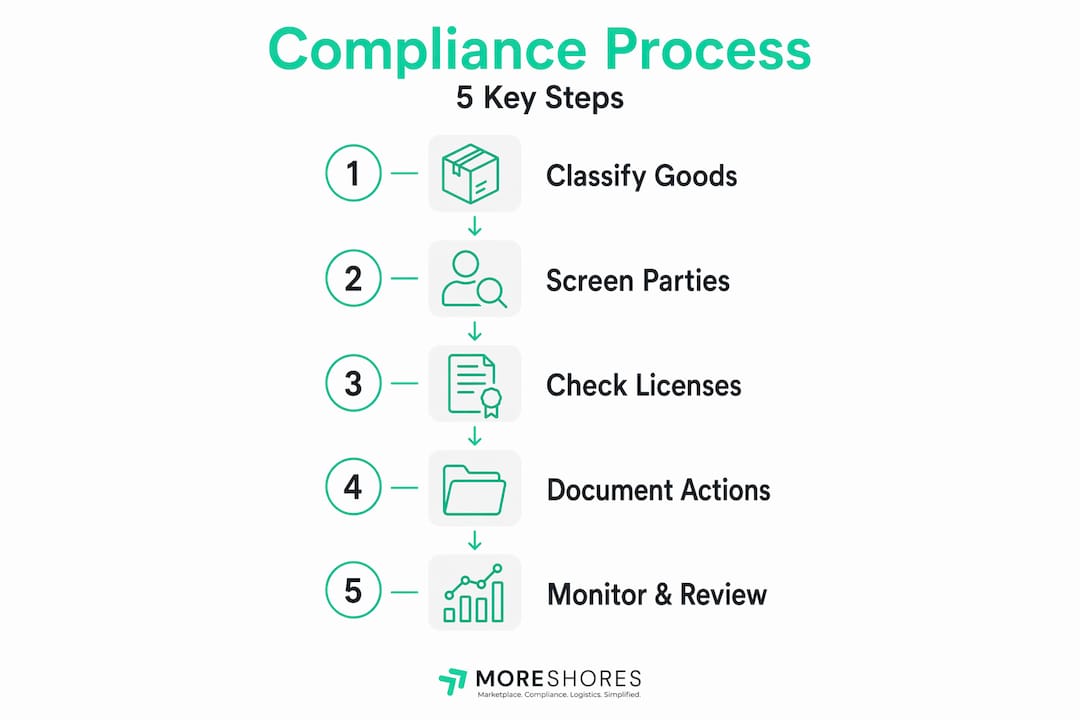
When you expand into new markets, particularly through cross-border trade platforms, compliance obligations shift. Each new destination country adds regulatory layers, and export compliance must be mapped to those layers before the first shipment departs.
My take on why compliance is your strongest business asset
I have worked with enough companies crossing borders to say this directly: the ones that treat export compliance as a foundational business function rather than a legal obligation consistently outperform those that treat it as a checkbox.
Here is what I have observed. Businesses that invest in operational compliance build better relationships with customs authorities, move goods faster, and win contracts with customers who require compliance certifications from their suppliers. Compliance becomes a competitive differentiator, not a cost center.
What I have also seen is the other outcome. A company with a strong product and real market demand loses its export privileges because someone on the sales team processed an order without running a restricted party check. The damage is not just the fine. The damage is the market access that takes years to rebuild, if it comes back at all.
The advice I give consistently is this: operationalize compliance before you scale. It is far harder to retrofit a compliance program onto a high-volume operation than to build the right processes from the start. If you discover a violation, disclose it promptly and with full documentation. Regulators respond to transparency differently than they respond to concealment.
Compliance is not the friction that slows your business down. It is the structure that keeps your business moving forward.
— Matt
How Moreshores helps you export with confidence

Managing export compliance while also running fulfillment, marketplace listings, and logistics is a significant operational load. Moreshores is built to carry that load with you. As a cross-border enablement platform, Moreshores acts as Importer of Record for customs clearance, handles duties and VAT, and manages regulatory compliance across African and global trade corridors. The fulfillment and logistics infrastructure supports compliant export operations from warehousing through last-mile delivery via a multi-courier network. If you are ready to build a compliant, scalable export operation without building every function from scratch, partner with Moreshores and get the infrastructure that makes it possible.
FAQ
What is regulatory compliance for exporters?
Regulatory compliance for exporters means following the legal requirements governing what goods can be exported, to whom, under what conditions, and with what documentation. In the U.S. context, this includes adherence to EAR, ITAR, and OFAC sanctions frameworks.
What are the main consequences of export non-compliance?
Non-compliance can result in civil penalties exceeding $300,000 per violation, denial of export privileges, criminal liability for executives, and long-term reputational damage. Strict liability standards under OFAC mean intent is not always a defense.
How does voluntary self-disclosure help exporters?
Timely voluntary self-disclosure to BIS, backed by documented internal investigation and remediation, can reduce penalties to 50% of transaction value capped at $125,000 per violation, with fast-track resolution for minor violations within 60 days.
Can a company rely on its distributor to handle compliance?
No. Companies retain full compliance responsibility for export transactions regardless of which intermediary handles the shipment. Regulators treat indirect exports like direct shipments when the exporter had knowledge of the transaction.
What should an export compliance program include?
An effective program includes assigned compliance ownership, accurate product classification, continuous sanctions screening, cross-functional training, escalation procedures, document retention, and a process for voluntary self-disclosure when violations are discovered.