Demystifying sourcing in cross-border trade for e-commerce

TL;DR:
- Sourcing in cross-border trade is a strategic approach that optimizes cost, quality, resilience, and compliance.
- Africa offers growing trade potential through market integration, infrastructure improvements, and local manufacturing.
- Successful brands utilize hybrid sourcing, technology, and local partnerships to manage risks and enhance resilience.
Most e-commerce brands treat sourcing as a cost-cutting exercise. Find the cheapest supplier, lock in the lowest FOB price, and ship. That mindset works until it doesn’t, and in cross-border trade between Africa and global markets, it breaks down fast. Sourcing is actually a strategic function that shapes your market access, compliance posture, supply chain resilience, and long-term profitability. This guide walks you through what sourcing really means in cross-border trade, how the mechanics work in practice, where the risks hide, and why Africa is gaining serious ground as a sourcing and distribution hub for forward-thinking e-commerce brands.
Table of Contents
- Defining sourcing in cross-border trade
- The mechanics: How cross-border sourcing works
- Major challenges and risks in sourcing between Africa and global markets
- Trends, benefits, and strategies: Why sourcing from Africa is rising
- A real-world perspective: Why cross-border sourcing success means hybrid, not just cost
- How MoreShores enables cross-border sourcing success
- Frequently asked questions
Key Takeaways
| Point | Details |
|---|---|
| Sourcing is strategic | Effective cross-border sourcing focuses on value, reliability, and growth, not just cost savings. |
| Africa is rising | Africa’s trade potential and digitalization offer new opportunities for global e-commerce brands. |
| Challenges require solutions | Brands must address logistics, compliance, and local market barriers for sourcing success. |
| Hybrid strategies win | Combining regional suppliers and global partners builds resilience and competitive advantage. |
Defining sourcing in cross-border trade
Sourceing is one of the most misunderstood terms in international trade. Many brands reduce it to vendor selection or price negotiation. In cross-border trade, it means something much broader.
Sourcing in cross-border trade is a procurement strategy that optimizes cost, quality, innovation, and supply chain resilience across international supplier networks.
That definition matters because it reframes the goal. You are not just buying products. You are building a supply chain that can absorb disruptions, meet market-specific compliance requirements, and scale with your growth.
For brands operating in or expanding into African markets, this is especially relevant. Cross-border enablement requires navigating different regulatory environments, currency risks, and logistics realities simultaneously. Sourcing decisions made at the procurement stage directly affect what happens downstream at customs, in the warehouse, and on the marketplace listing.
Here are the core strategic elements that define effective cross-border sourcing:
- Cost optimization: Not just unit price, but total landed cost including duties, freight, and compliance fees
- Quality assurance: Supplier audits, product certifications, and testing against destination-market standards
- Innovation access: Partnering with suppliers who bring new materials, designs, or production capabilities
- Risk management: Diversifying supplier bases to avoid single-source dependency
- Logistics integration: Aligning supplier lead times with fulfillment and marketplace delivery expectations
- Regulatory compliance: Ensuring products meet import requirements in the destination country before they ship
One common misconception is that local sourcing is always safer and international sourcing is always riskier. The reality is more nuanced. Local sourcing can limit your product range and innovation capacity. International sourcing, when managed well, opens up competitive advantages that local-only strategies cannot match.
For Africa-focused e-commerce, the global sourcing overview shows that the most successful brands combine regional supplier relationships with global procurement discipline. That means applying the same rigor you would use for a European supplier to an African one, and vice versa.
The mechanics: How cross-border sourcing works
Once you know what sourcing entails, understanding the mechanics is critical for putting strategy into practice. Cross-border sourcing is a multi-stage process with clear decision points at each step.
Here is how the process typically unfolds for e-commerce brands:
- Market research and supplier identification: Define product specifications, target cost, and required certifications. Use trade directories, industry events, and digital platforms to identify potential suppliers across regions.
- Supplier evaluation and qualification: Assess financial stability, production capacity, quality systems, and compliance history. Request samples and conduct factory audits where possible.
- Negotiation and contracting: Agree on pricing terms (FOB, CIF, DDP), payment schedules, lead times, and quality benchmarks. Document everything in a formal supply agreement.
- Trade compliance and documentation: Confirm HS codes, import duties, VAT obligations, and any product-specific certifications required in the destination market.
- Logistics coordination: Book freight, arrange insurance, and align delivery timelines with warehouse receiving schedules and marketplace restock windows.
- Performance monitoring: Track on-time delivery rates, defect rates, and lead time consistency. Use data to renegotiate or replace underperforming suppliers.
According to trade logistics research, sourcing mechanics involve supplier selection, evaluation, risk management, trade compliance, and ongoing performance monitoring as interconnected stages, not isolated tasks.
For Africa-specific sourcing, several adaptations are necessary. Payment infrastructure varies widely, so you need to plan for mobile money, local bank transfers, and currency conversion costs. Logistics lead times are longer in many corridors, which means safety stock levels need adjustment. Marketplace integration on platforms like Jumia or Takealot requires product data that meets local listing standards from day one.
Pro Tip: Map your sourcing timeline backward from your marketplace launch date. Include buffer time for customs clearance, quality inspection, and warehouse receiving. Most delays happen because brands underestimate the time between supplier shipment and product going live on a marketplace.
| Sourcing stage | Key decision | Common mistake |
|---|---|---|
| Supplier identification | Region and category fit | Choosing on price alone |
| Evaluation | Compliance and capacity | Skipping factory audits |
| Contracting | Incoterms and payment | Vague quality clauses |
| Compliance | HS codes and duties | Misclassifying products |
| Logistics | Lead time and insurance | No buffer stock planning |
| Monitoring | KPIs and renegotiation | Set-and-forget approach |
Understanding your brand onboarding process before committing to a supplier helps you align sourcing decisions with your actual operational capacity.
Major challenges and risks in sourcing between Africa and global markets
Mechanics aside, real-world sourcing is full of hurdles, and the stakes are highest between Africa and global markets. Understanding where risk concentrates helps you build a more resilient sourcing strategy.

Key sourcing challenges include logistics delays, regulatory changes, quality inconsistencies, geopolitical risks, non-tariff barriers (NTBs), infrastructure gaps, and informal trade dynamics.
Africa-specific challenges deserve particular attention:
- Non-tariff barriers (NTBs): Many African countries impose import permits, local content requirements, and product standards that are not always published or consistently enforced
- Infrastructure gaps: Port congestion, unreliable road networks, and limited cold-chain capacity add cost and unpredictability to inbound logistics
- Informal trade: A significant share of goods move through informal channels, which creates price distortion and compliance blind spots for formal e-commerce operators
- Regulatory fragmentation: Each African country has its own import regime, which means a product cleared in South Africa may face entirely different requirements in Kenya or Nigeria
- Currency volatility: Exchange rate fluctuations affect landed cost calculations and can erode margins between order placement and payment
Here is how Africa compares to other major sourcing regions on key risk dimensions:
| Risk factor | Africa | Asia (China/Vietnam) | EU/North America |
|---|---|---|---|
| Regulatory complexity | High | Medium | Low |
| Logistics reliability | Variable | High | High |
| NTB exposure | High | Medium | Low |
| Cost competitiveness | High potential | High | Low |
| Informal trade impact | High | Low | Minimal |
| Currency risk | High | Medium | Low |
The Africa trade statistics show that these barriers are real but not insurmountable. Brands that invest in local compliance expertise and fulfillment and logistics partnerships consistently outperform those that try to manage Africa entry from a distance.
The most overlooked risk is overconfidence after an initial successful shipment. Regulatory environments in Africa shift frequently. A compliant product today may require new documentation next quarter. Building ongoing compliance monitoring into your sourcing process is not optional.
For brands navigating e-commerce logistics hurdles, the answer is almost always a combination of local partners, technology, and a willingness to adapt sourcing strategy as market conditions change.
Trends, benefits, and strategies: Why sourcing from Africa is rising
Facing these challenges, why are brands increasingly looking to Africa as a sourcing hub, and how can you get ahead of the curve?
The numbers tell a compelling story. Africa’s trade potential is significant: the continent currently accounts for roughly 3% of global trade, and intra-African trade sits at only 18%. The African Continental Free Trade Area (AfCFTA) is projected to boost African income by $450 billion by 2035 and lift 30 million people out of poverty. That trajectory signals a structural shift, not a short-term trend.
Several growth drivers are accelerating this shift:
- AfCFTA implementation: Reducing tariffs across 54 countries creates new intra-African sourcing corridors that did not exist five years ago
- Digitalization: Mobile commerce, digital payments, and cloud-based logistics platforms are reducing the friction that historically made African sourcing difficult
- Logistics investment: New port infrastructure, logistics parks, and last-mile delivery networks are improving reliability in key markets
- Young manufacturing base: Countries like Ethiopia, Rwanda, and Morocco are developing competitive manufacturing capacity in textiles, electronics assembly, and agro-processing
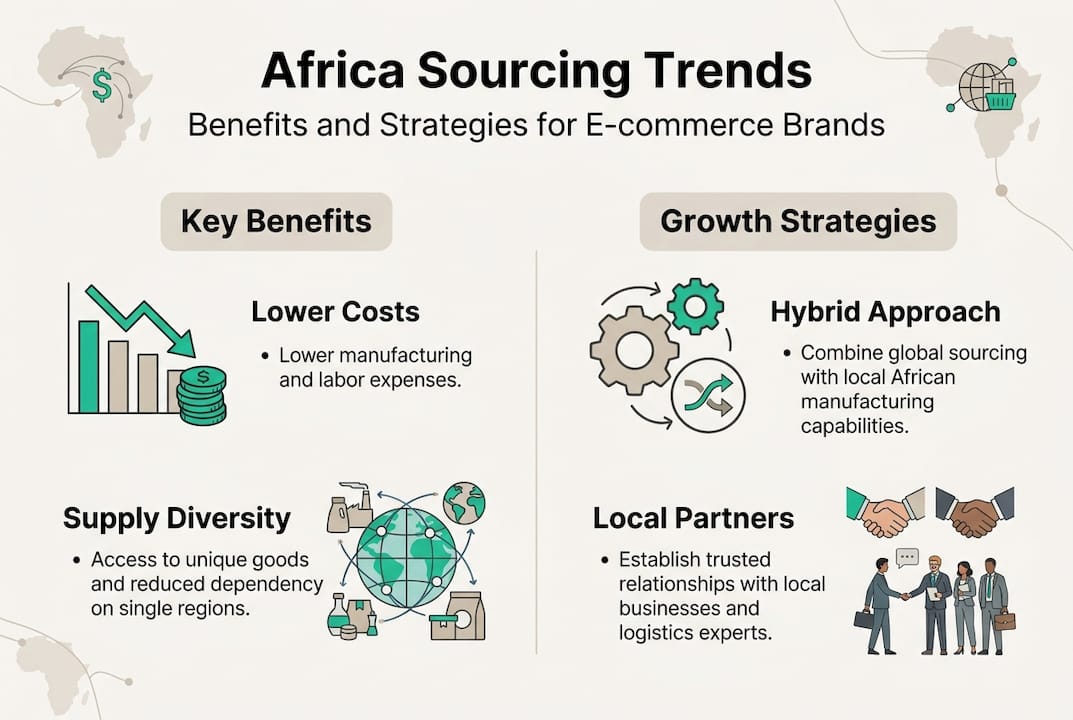
For e-commerce brands, the strategic benefits of incorporating African sourcing include supply chain diversification, reduced dependence on single-region suppliers, and access to products with authentic African origin stories that resonate with global consumers.
Pro Tip: When entering African markets, use Delivered Duty Paid (DDP) pricing models with your end customers. This removes customs uncertainty from the buyer experience and dramatically reduces cart abandonment on cross-border orders.
Hybrid sourcing strategies, combining African suppliers for certain product categories with Asian or European suppliers for others, offer the best balance of cost, resilience, and innovation. The hybrid sourcing strategies that work best are built around product-category logic, not geography alone.
For marketplace integration across platforms like Jumia, Kilimall, or Amazon SA, sourcing decisions need to account for listing requirements, category restrictions, and local consumer preferences from the start.
A real-world perspective: Why cross-border sourcing success means hybrid, not just cost
Here is what most sourcing guides do not tell you: the brands that win in cross-border trade between Africa and global markets are not the ones with the lowest unit costs. They are the ones with the most adaptable sourcing models.
We have seen brands enter African markets with a single-supplier, lowest-cost strategy and struggle badly when one regulatory change or port delay disrupts their entire supply chain. The cost savings evaporate instantly when you are out of stock on a marketplace for three weeks.
The smarter approach is to treat sourcing as a portfolio. Maintain primary suppliers for volume and cost efficiency, but invest in secondary suppliers in different regions for resilience. Use African suppliers where they offer genuine competitive advantage, whether that is proximity to market, regulatory ease, or product authenticity.
Technology is the enabler here. Brands that use integrated platforms to monitor supplier performance, track shipments in real time, and automate compliance documentation respond to disruptions faster. Those relying on spreadsheets and email chains do not.
Building strategic logistics partnerships with local experts is not a nice-to-have. It is the operational foundation that makes hybrid sourcing work at scale.
How MoreShores enables cross-border sourcing success
For brands ready to put this guide into action, MoreShores streamlines your cross-border sourcing journey from supplier integration through to marketplace sales.
MoreShores acts as your Importer of Record, handling customs clearance, duties, VAT, and regulatory compliance so your products enter African markets without delays or compliance surprises. Our streamlined fulfillment network covers warehousing, inventory management, and multi-courier delivery across key African markets. For brands managing marketplace presence, our Africa e-commerce solutions connect your inventory to Takealot, Amazon SA, Jumia, Kilimall, Shopify, and WooCommerce from a single platform. Whether you are sourcing into Africa or sourcing from Africa for global distribution, cross-border trade enablement is what we do every day.
Frequently asked questions
What does sourcing in cross-border trade involve?
It involves finding and integrating suppliers abroad to optimize cost, quality, and logistics, while ensuring compliance and risk management across the full supply chain. The goal of sourcing is to build supply chain resilience, not just reduce unit costs.
Why is Africa important for global sourcing in 2026?
Africa offers growing trade potential, supply chain diversification, and structural opportunities created by AfCFTA, which could boost African income by $450 billion by 2035, despite unique logistics and compliance hurdles.
What are the biggest risks in cross-border sourcing?
Key risks include logistics delays, regulatory changes, quality inconsistencies, overreliance on single suppliers, and region-specific barriers like NTBs and infrastructure gaps. The sourcing risk landscape is most complex in markets with high regulatory fragmentation.
How can e-commerce brands manage cross-border sourcing challenges?
Hybrid sourcing strategies, technology integration, and local partnerships are the most effective tools for building resilience and efficiency. Hybrid approaches reduce single-source dependency while maintaining cost competitiveness across regions.