
Managing cross-border e-commerce across African and global markets means juggling fragmented marketplaces, complex customs procedures, and localized payment systems. For merchants selling on platforms like Jumia, Takealot, and Amazon SA simultaneously, this fragmentation creates operational chaos. Marketplace aggregation unifies these disparate channels into a single dashboard, transforming how brands handle inventory, orders, and fulfillment. This article explains how aggregation works, its role in overcoming cross-border logistics challenges, and practical strategies for leveraging it to scale efficiently in African and international markets.
Table of Contents
- Key takeaways
- Understanding marketplace aggregation and its core mechanics
- Role of marketplace aggregation in overcoming cross-border logistics challenges
- Navigating the African marketplace landscape with aggregation platforms
- Business impact and strategic considerations of marketplace aggregation
- How MoreShores supports efficient cross-border e-commerce via marketplace aggregation
- FAQ
Key Takeaways
| Point | Details |
|---|---|
| Unified dashboard across marketplaces | Aggregation centralizes inventory, orders, and fulfillment into a single interface for managing multiple marketplaces. |
| Real time inventory sync | APIs continuously sync stock levels across channels when sales occur. |
| Cross border compliance | Automation handles tax, shipping, and payment localization for multiple markets. |
| Cost savings and faster delivery | Eliminates manual data entry and reduces logistic delays, lowering costs and improving delivery times. |
| Prebuilt connectors reduce setup time | Ready to connect integrations shorten implementation time and enable faster scaling. |
Understanding marketplace aggregation and its core mechanics
Marketplace aggregation refers to platforms or tools that unify listings, inventory, orders, and fulfillment across multiple e-commerce marketplaces. Instead of logging into Jumia, Takealot, Amazon SA, and Shopify separately, merchants manage everything from one interface. This consolidation matters because brands selling on three or more platforms face exponential complexity in maintaining accurate inventory counts, processing orders promptly, and analyzing performance data.
The technical foundation relies on API integrations that sync inventory in real-time, ensuring stock levels update across all channels when a sale occurs. Order routing automatically directs purchases to the appropriate fulfillment center based on location and inventory availability. Dynamic pricing engines adjust prices by marketplace and currency, accounting for local taxes and shipping costs. Centralized ERP and OMS systems consolidate data streams, while multi-currency handling converts transactions seamlessly. Unified analytics dashboards aggregate sales metrics, customer behavior, and marketplace performance into actionable reports.
These mechanics deliver tangible operational benefits. Merchants eliminate manual data entry errors that cause overselling or stockouts. You gain the ability to test pricing strategies across markets simultaneously and identify which platforms drive the highest margins. Marketplace integration services handle the technical complexity of connecting diverse APIs, letting you focus on growth rather than troubleshooting integration failures.
For brands expanding internationally, aggregation becomes essential infrastructure. Managing localized product descriptions, regional compliance requirements, and marketplace-specific promotional calendars manually creates bottlenecks. Aggregation platforms automate these workflows, enabling you to launch in new markets faster. When your South African inventory can fulfill orders from Takealot, Amazon SA, and your Shopify store without manual intervention, you unlock scalability that manual processes cannot match.
Pro Tip: Before selecting an aggregation platform, audit your current marketplace mix and identify which integrations you need immediately versus those planned for future expansion. Prioritize platforms offering pre-built connectors for your primary channels to reduce implementation time.
Role of marketplace aggregation in overcoming cross-border logistics challenges
Cross-border e-commerce between Africa and global markets involves navigating customs clearance, fragmented carrier networks, VAT compliance, and localized payment systems. Aggregation platforms handle logistics through FBA equivalents, customs automation, multi-carrier shipping coordination, VAT/GST compliance modules, and payment localization. These capabilities prove crucial for merchants operating Africa-global trade routes where regulatory complexity multiplies with each new market.
The data reveals significant friction points. Research shows 45% of SMEs face delays exceeding 30 days when managing cross-border logistics manually. Aggregation platforms like Mall for Africa, which consolidates over 200 US and UK stores for African buyers, demonstrate how centralized coordination cuts these delays. The African Continental Free Trade Area agreement reduces logistics costs by 12-18%, but capturing these savings requires systems that optimize routing and consolidate shipments across borders.
Payment localization presents another barrier. African markets rely heavily on mobile money platforms like M-Pesa, Airtel Money, and MTN Mobile Money, alongside cash on delivery. Aggregation platforms integrate these payment methods, converting transactions and reconciling funds across currencies. When you sell from Nigeria to Kenya, your system must accept naira via bank transfer, convert to Kenyan shillings, process M-Pesa payments, and handle currency fluctuations without manual intervention.
Customs and tax compliance automation reduces clearance bottlenecks. Aggregators pre-calculate duties, generate required documentation, and submit filings electronically. This automation matters because manual customs processing adds 7-14 days to delivery times in many African corridors. Cross-border enablement services that include Importer of Record functionality handle regulatory obligations, letting you sell into markets without establishing local entities.

Multi-carrier coordination optimizes shipping costs and delivery speed. Instead of contracting with each courier separately, aggregation platforms negotiate bulk rates and route shipments based on real-time performance data. If DHL experiences delays on the Lagos-Nairobi route, the system automatically switches to an alternative carrier. Fulfillment and logistics solutions integrated with aggregation platforms provide warehousing in strategic locations, reducing last-mile delivery costs by 20-35%.
Pro Tip: When evaluating aggregators for cross-border operations, request case studies showing customs clearance times and carrier performance metrics in your target corridors. Generic claims about logistics optimization matter less than documented performance in specific Africa-global routes.
Navigating the African marketplace landscape with aggregation platforms
African e-commerce operates across fragmented marketplaces with distinct logistics networks, payment preferences, and regulatory environments. Jumia dominates West Africa with localized operations in Nigeria, Kenya, and Egypt. Takealot leads South African e-commerce with sophisticated fulfillment infrastructure. Kilimall focuses on East Africa with mobile-first experiences. Each platform requires separate integrations, compliance protocols, and operational workflows.
Mobile money dominance shapes payment strategies. In Kenya, 75% of e-commerce transactions use M-Pesa. Nigeria sees 60% cash on delivery adoption due to limited banking penetration. Aggregation platforms integrate these payment rails, reconciling transactions across methods and currencies. When your Jumia Kenya sale processes via M-Pesa while your Takealot order uses credit card payment, unified reconciliation prevents accounting chaos.
Logistics costs consume disproportionate resources in African markets. Data shows logistics expenses equal 30% of total costs for Nigerian e-commerce operations, compared to 8-12% in developed markets. Aggregation reduces these costs through coordinated fulfillment, bulk shipping negotiations, and optimized warehouse placement. Platforms like AfriMarket consolidate inventory across regional hubs, cutting redundant storage and improving delivery economics.
| Market | Size (2026) | Leading Marketplace | Market Share | Logistics Cost % |
|---|---|---|---|---|
| Nigeria | $9.5B | Jumia Nigeria | 40% | 30% |
| South Africa | $7.2B | Takealot | 52% | 18% |
| Kenya | $3.8B | Jumia Kenya | 35% | 25% |
| Egypt | $6.1B | Jumia Egypt | 38% | 28% |
Marketplace-specific requirements add complexity. Takealot mandates GS1 barcodes for product identification and implements strict quality standards. Jumia requires localized product descriptions in French for West African markets. Kilimall prioritizes mobile-optimized listings with compressed images. Managing these variations manually creates errors and delays. Aggregation platforms store marketplace-specific templates and automatically format listings to meet each platform’s requirements.
Marketplace integration options handle technical connectivity while you focus on merchandising and customer service. When launching in a new African market, pre-built integrations reduce time to market from months to weeks. You avoid building custom API connections for each platform and leverage tested workflows that handle edge cases like split shipments or partial refunds.
Pro Tip: SMEs entering African markets should prioritize aggregators offering bundled payment processing and logistics coordination rather than point solutions. Fragmented tools create integration gaps that cause order fulfillment failures and payment reconciliation errors.
Business impact and strategic considerations of marketplace aggregation
Empirical data quantifies aggregation’s impact on operational efficiency and revenue growth. Multi-marketplace operations cut costs by 30-40% through consolidated inventory management and reduced platform fees. Revenue increases average 19% as brands access broader customer bases without proportional cost increases. Cross-border platforms reduce customs clearance times by 41% and shipping costs from 29% to 13% of order value through optimized routing and bulk negotiations.
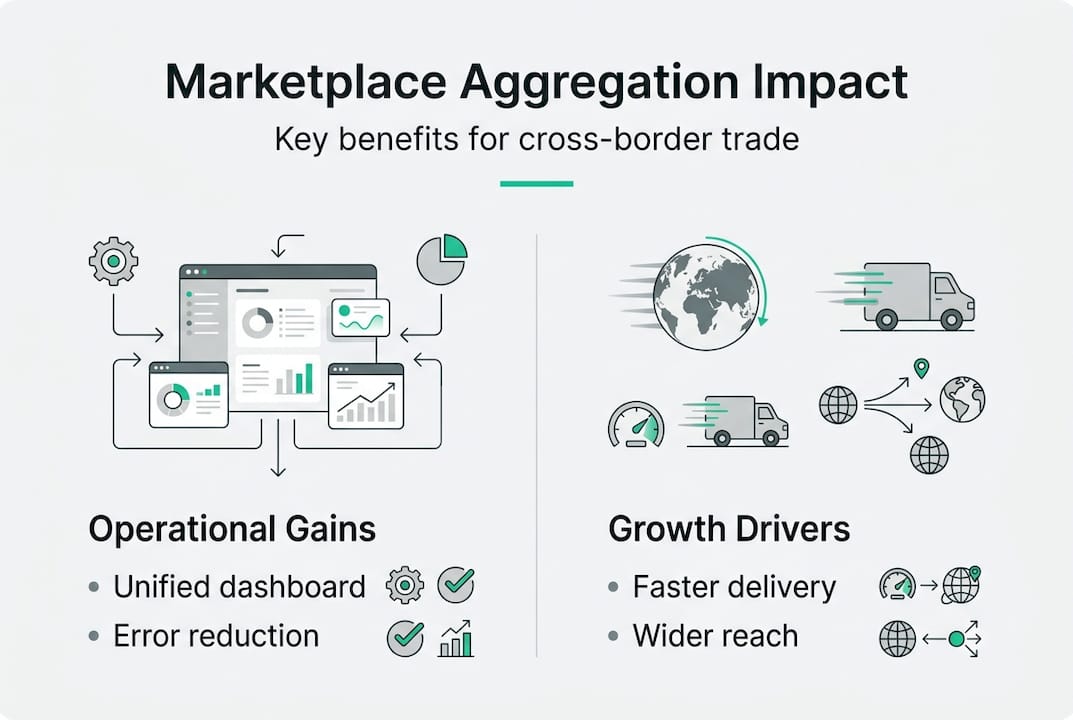
| Metric | Before Aggregation | After Aggregation | Improvement |
|---|---|---|---|
| Operational Costs | 35% of revenue | 21% of revenue | 40% reduction |
| Average Delivery Time | 8.5 days | 3.5 days | 59% faster |
| Order Processing Time | 4.2 hours | 0.8 hours | 81% reduction |
| Inventory Accuracy | 87% | 98% | 13% improvement |
| Multi-channel Revenue | Baseline | +19% | Revenue growth |
Strategic cautions temper these benefits. High-return categories like fashion and electronics retain marketplace fees even after refunds, eroding margins. Merchants should avoid concentrating over 50% of revenue on a single marketplace to reduce dependency risk. Platform policy changes or fee increases can devastate businesses lacking channel diversification.
IT infrastructure readiness determines aggregation success for SMEs. Research indicates 73% of African SMEs lack technical capabilities for API integration and real-time data syncing. Choosing aggregators with low-code interfaces and managed services bridges this gap. You need systems that work without dedicated IT staff while still providing the automation benefits that drive efficiency gains.
Five practical strategies mitigate aggregation risks and maximize returns:
- Diversify revenue across at least three marketplaces to prevent overdependence on any single platform’s policies or traffic.
- Implement automated inventory buffers that prevent overselling during sync delays, especially critical during high-traffic promotional periods.
- Monitor marketplace fee structures quarterly and adjust product mix to prioritize high-margin items on platforms with favorable economics.
- Establish direct customer acquisition channels like email lists to reduce long-term reliance on marketplace traffic and build owned audiences.
- Negotiate service level agreements with aggregation providers that specify uptime guarantees, sync frequency, and support response times.
Refund handling deserves special attention in categories with return rates exceeding 20%. Ensure your aggregator automates refund processing across channels and accounts for marketplace-specific policies. When Takealot processes a return differently than Jumia, manual reconciliation creates accounting errors. Automated workflows that update inventory, process refunds, and adjust financial records prevent these discrepancies.
Brand onboarding guides from experienced aggregation platforms detail these operational considerations and provide frameworks for evaluating readiness. Before committing to multi-marketplace expansion, audit your current processes to identify bottlenecks that aggregation will solve versus those requiring separate operational improvements.
How MoreShores supports efficient cross-border e-commerce via marketplace aggregation
MoreShores unifies multi-marketplace management for brands navigating African and global e-commerce expansion. Our platform integrates Takealot, Jumia, Amazon SA, Kilimall, Shopify, and WooCommerce into a single operational dashboard, eliminating the friction of managing disparate systems. Real-time API and ERP integration keeps inventory synchronized across all channels, preventing overselling while optimizing stock allocation based on marketplace demand patterns.
Cross-border compliance support handles the regulatory complexity that stops many brands from scaling internationally. We act as Importer of Record, managing customs clearance, duties, VAT calculations, and regulatory filings across African markets. Our fulfillment network coordinates multi-carrier shipping, leveraging bulk rates and optimized routing to reduce delivery times and costs. Mobile money integration for M-Pesa, Airtel Money, and other African payment methods ensures you capture sales regardless of customer payment preferences.
Core services supporting aggregation users include:
- Cross-border enablement handling customs, compliance, and regulatory requirements
- Marketplace integration connecting your inventory to major African and global platforms
- Fulfillment and logistics providing warehousing, inventory management, and multi-carrier shipping
- Real-time analytics dashboards consolidating performance data across all sales channels
Explore how MoreShores transforms cross-border complexity into scalable growth opportunities for your brand.
FAQ
What is marketplace aggregation and how does it benefit cross-border sellers?
Marketplace aggregation unifies multiple e-commerce platforms like Jumia, Takealot, and Amazon SA into one management interface. It simplifies inventory tracking, order processing, and fulfillment coordination, reducing operational costs by 30-40% while enabling brands to scale across borders without proportional increases in complexity or staffing.
How does marketplace aggregation handle African payment and logistics challenges?
Aggregation platforms integrate mobile money systems like M-Pesa and cash on delivery, which account for 70% of African e-commerce transactions. They coordinate multi-carrier shipping networks and automate customs clearance, reducing delivery times by 59% and cutting logistics costs from 30% to under 20% of revenue in markets like Nigeria.
What should merchants consider when choosing a marketplace aggregator?
Avoid concentrating over 50% of revenue on a single marketplace to reduce dependency risk. Verify the aggregator handles refund processing and fee reconciliation for high-return categories automatically. Ensure the platform offers API and ERP integration that works with your existing systems, or provides managed services if you lack dedicated IT resources.
Can marketplace aggregation improve delivery times and reduce costs?
Yes, aggregation reduces customs clearance times by 41% and shipping costs from 29% to 13% of order value through optimized routing and bulk carrier negotiations. Delivery times improve to an average of 3.5 days with 99% deliverability when aggregators coordinate fulfillment across strategically located warehouses and multiple carrier networks.