Retail logistics in Africa: 30-40% cost reality
TL;DR:
- Logistics costs in Africa are significantly higher, often 30-40% of product value, due to infrastructure and border delays. Modernizing logistics involves establishing strategic warehouses, digital customs, AI demand forecasting, and local last-mile networks. Building physical infrastructure first, then layering in technology and local partnerships, is key to long-term success.
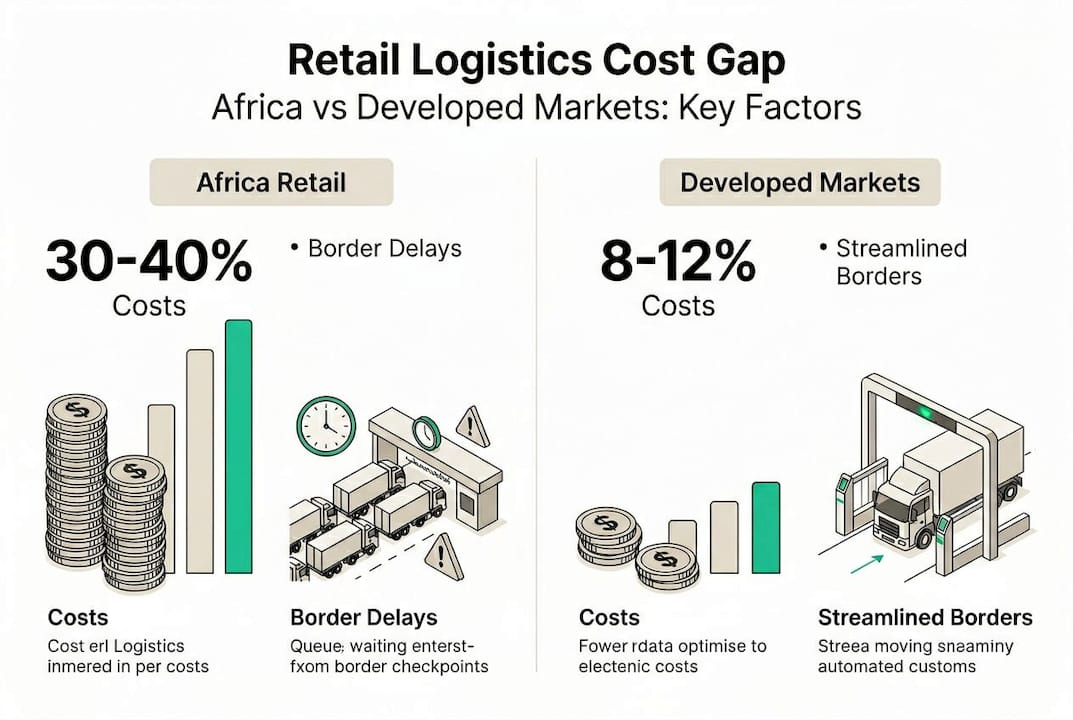
Logistics costs represent 30-40% of product value in African markets, compared to less than 10% in advanced economies. For retail decision-makers and logistics managers at international brands, that gap is not just a line item. It is the difference between a profitable market entry and a costly misstep. African markets offer genuine growth potential, but logistics complexity, from port congestion to fragmented infrastructure, creates barriers that catch many brands off guard. This guide gives you a clear, actionable playbook for understanding how logistics works in African retail, where the risks and opportunities sit, and how to structure operations for compliance and long-term performance.
Table of Contents
- Understanding the logistics landscape in African retail
- How logistics shapes retail outcomes: Risks and opportunities
- Modern approaches to streamline retail logistics in Africa
- Solving logistics edge cases: Informal trade, perishables, and SMEs
- Why harmonizing infrastructure and innovation is the untold secret
- Enable seamless retail logistics with MoreShores
- Frequently asked questions
Key Takeaways
| Point | Details |
|---|---|
| Logistics is make-or-break | Supply chain and logistics account for up to 40% of retail product value in Africa, shaping profitability and compliance. |
| Local adaptation is critical | Success hinges on blending global best-practices like AI with infrastructure investments and local partnerships. |
| Modernize with purpose | Leverage phased technology deployment—such as digital customs and smart forecasting—after foundations are set. |
| Solve for edge cases | Informal trade, perishables, and SMEs require tailored frameworks—public-private partnerships often deliver outsized results. |
Understanding the logistics landscape in African retail
Now that you are aware of the sheer impact of logistics costs, let’s unpack what logistics really means for African retail. Logistics in retail encompasses inventory management, transportation, warehousing, order fulfillment, and last-mile delivery. Each of these functions carries its own cost weight, and in Africa, each one faces structural challenges that do not exist at the same scale elsewhere.
The difference between supply chain and logistics is worth clarifying here. Supply chain covers the broader network of sourcing, production, and distribution. Logistics is the operational execution of moving goods through that network. In Africa, both layers are stressed.
Here is what drives the cost and complexity:
- Infrastructure gaps: Many roads, ports, and warehouses are underdeveloped, adding transit time and damage risk
- Port congestion: 20-30 day dwell times at major African ports are common, compared to 3-5 days in Europe or Asia
- Border delays: Non-tariff barriers (NTBs), manual customs processing, and inconsistent regulatory enforcement slow cross-border flows
- Last-mile difficulty: Low address formalization and rural dispersion increase delivery costs significantly
“Port congestion and infrastructure deficits compound each other. A container that clears customs quickly can still sit at port for three weeks waiting for road transport.”
Benchmarking Africa vs. developed markets
| Logistics factor | African markets | Developed markets |
|---|---|---|
| Logistics cost as % of product value | 30-40% | Under 10% |
| Average port dwell time | 20-30 days | 3-5 days |
| Road network quality | Fragmented, variable | Standardized, dense |
| Customs processing | Largely manual | Mostly digital |
| Last-mile delivery coverage | Partial, high cost | Near-universal |
Understanding this baseline is essential before you build your Africa logistics model. The numbers are not designed to discourage you. They are there to help you plan realistically, price accurately, and choose partners who know the terrain.
How logistics shapes retail outcomes: Risks and opportunities
With these logistics fundamentals and context in mind, it is crucial to recognize how logistics choices translate directly to bottom-line risks and performance, for better or worse. Every logistics decision you make in Africa ripples through your cost structure, customer experience, and compliance standing.
When logistics is optimized, you gain:
- Faster customs clearance and reduced holding costs
- Reliable stock availability across multiple markets
- Stronger customer satisfaction through predictable delivery
- Lower spoilage rates on time-sensitive goods
- Scalable market reach without proportional cost increases
When logistics breaks down, the consequences are concrete. Nigeria’s ranking on the World Bank Logistics Performance Index reflects how NTBs, delays, and infrastructure challenges multiply costs and erode margins in real time.
Impact of optimized vs. suboptimal logistics on key performance indicators
| KPI | Optimized logistics | Suboptimal logistics |
|---|---|---|
| Order fulfillment rate | 95%+ | 60-75% |
| Average delivery time | 3-7 days | 14-30 days |
| Customer return rate | Low | High |
| Compliance penalties | Minimal | Frequent |
| Total logistics cost | Controlled | 30-40% of value |
The risk side is not only operational. Regulatory non-compliance in African markets can result in shipment holds, fines, and reputational damage. Each country has its own import documentation requirements, product standards, and labeling rules. Missing any of these adds delays and cost.
For African e-commerce logistics solutions, the opportunity is clearest where compliance is treated as a logistics function, not an afterthought. Brands that build regulatory checkpoints into their logistics workflow from day one move faster and spend less.
Pro Tip: Map the specific NTBs and documentation requirements for each country in your target market before your first shipment. A country-by-country compliance checklist reviewed by a local partner can prevent 80% of avoidable customs delays.
Modern approaches to streamline retail logistics in Africa
Understanding the stakes, what practical, modern approaches can help international retailers win in Africa’s distinctive logistics landscape? The good news is that the toolset is expanding fast, and early adopters are already seeing measurable returns.
AI adoption is currently used by 30% of logistics firms in Africa, with projections reaching 41% within two years. Digital customs platforms are cutting clearance times by 30-50% where they have been implemented. These are meaningful gains, but they work best when layered onto solid operational foundations.
Here is a step-by-step framework for modernizing your Africa retail logistics:
- Establish warehousing anchors first. Identify strategic warehouse locations near major ports or consumer hubs before optimizing transport routes. Solar-powered warehousing is gaining traction in markets with unreliable grid power.
- Integrate digital customs tools. Work with platforms that connect to single-window customs systems, reducing manual documentation and speeding up border processing.
- Apply AI to demand forecasting. Use historical sales data and seasonal patterns to run leaner inventory without stockouts. A “just-in-case” inventory buffer remains important in Africa given supply unpredictability.
- Optimize last-mile through local networks. Partner with regional courier networks that understand local address systems, informal settlements, and payment preferences including mobile money.
- Adopt route optimization software. Tools that account for road quality, traffic, and fuel costs can reduce last-mile delivery costs by 15-20% in urban corridors.
- Phase in green logistics. Electric vehicles (EVs) for urban last-mile delivery are becoming viable in cities like Lagos, Nairobi, and Cape Town where fuel costs are high.
For brands managing product listings across multiple African marketplaces, integrating African marketplaces through a unified platform reduces manual work and keeps inventory data synchronized.
Pro Tip: Do not rush advanced technology before your physical logistics are stable. A well-mapped warehouse with reliable transport links will deliver more ROI than an AI dashboard sitting on top of fragmented infrastructure. Use the brand onboarding guide to sequence your setup correctly.
Solving logistics edge cases: Informal trade, perishables, and SMEs
While overarching strategies matter, retailers cannot ignore Africa’s on-the-ground realities and edge cases that influence logistics daily. Three areas deserve focused attention: informal trade, perishable goods, and the cost premium facing smaller brands.
Informal trade represents 75% of African trade, which means a significant share of retail movement happens outside formal customs and documentation systems. This creates traceability gaps, tax leakage, and compliance risk for international brands trying to maintain consistent standards.
Key bottlenecks and practical responses:
- Informal trade: Use e-payment platforms and digital invoicing to formalize transactions along informal corridors. Partner with local distributors who operate within recognized networks.
- Perishables: Cold chain gaps lead to spoilage rates that can reach 30-40% for fresh goods. Investing in refrigerated transport and temperature-monitored warehousing is non-negotiable for food and pharma.
- SME cost premium: Smaller brands often pay 20-30% more per unit for logistics than large multinationals. Joining trucking cooperatives or shared warehousing arrangements reduces this gap meaningfully.
- NTBs across borders: Use AfCFTA (African Continental Free Trade Area) air and road corridors where available to reduce non-tariff friction between participating countries.
Stakeholders and interventions by issue type
| Issue | Key stakeholders | Practical intervention |
|---|---|---|
| Informal trade | Local distributors, regulators | E-payments, digital invoicing, PPPs |
| Perishables | Cold chain providers, logistics firms | Refrigerated transport, temp monitoring |
| SME cost premium | Cooperatives, 3PLs | Shared warehousing, consolidated freight |
| NTBs | Customs authorities, AfCFTA bodies | Single-window customs, corridor agreements |
PPP (public-private partnership) reforms and AfCFTA implementation could cut logistics costs 15-25% for brands operating across multiple African markets. That potential saving is significant enough to factor into your market entry financial model.
For brands needing structured support with last-mile fulfillment solutions and cross-border compliance tools, the right partner handles these edge cases as part of a managed service rather than leaving your team to navigate them from scratch.
Why harmonizing infrastructure and innovation is the untold secret
Looking at all these solutions, is there a single change that truly unlocks logistics performance in Africa? From our experience working across African markets, the honest answer is no. There is no silver bullet.
The industry conversation often centers on technology: AI, digital customs, blockchain for traceability. These tools are genuinely valuable. But global retail pushes tech for 40% time-savings, and African markets still need infrastructure investments before advanced digital solutions reach their full impact.
A warehouse management system cannot compensate for a warehouse that floods in the rainy season. Route optimization software cannot fix a road that becomes impassable. AI-powered customs tools require digital customs systems to connect to in the first place.
Our view is that the brands succeeding in African logistics follow a deliberate sequence: build or secure the physical foundation first, then layer in technology, then deepen local partnerships. Trying to shortcut to digital-first without the operational base typically results in expensive failures.
The most durable strategic logistics partnerships we see are ones where global expertise and local knowledge are genuinely integrated, not just coordinated from a distance.
Enable seamless retail logistics with MoreShores
Ready to translate lessons into seamless operations and growth?
MoreShores is built specifically for international brands navigating the complexity of African retail logistics. We act as your Importer of Record, managing customs clearance, duties, VAT, and regulatory compliance so you stay focused on growth. Our fulfillment services in Africa cover warehousing, inventory management, and multi-courier delivery across key markets. For brands moving goods across borders, our cross-border retail logistics infrastructure handles documentation, compliance, and carrier coordination end to end. If you are ready to establish or scale your African retail presence with a partner that understands both the opportunity and the operational reality, partner with MoreShores and let’s build something that lasts.
Frequently asked questions
Why are logistics costs so high for retailers in Africa?
Logistics costs are higher due to infrastructure gaps, port congestion, border delays, and non-tariff barriers. These factors combine to push logistics costs to 30-40% of product value, far above the under-10% norm in advanced economies.
How does technology improve retail logistics in Africa?
AI and digital customs tools boost supply chain visibility, cut clearance times by 30-50%, and improve demand forecasting, but they deliver full value only when physical infrastructure is already functional.
What practical steps can help retailers overcome logistics edge cases in Africa?
Joining trucking cooperatives, using PPP frameworks, leveraging AfCFTA corridors, and adopting single-window customs platforms can collectively reduce costs and improve cross-border reliability for retailers.
How is informal trade handled in logistics strategies?
Informal trade represents 75% of African retail activity, and the most effective responses include e-payment integration, digital invoicing, and structured partnerships with local distributors operating in recognized networks.