
Operational costs are quietly eroding margins for e-commerce brands expanding into new markets. Returns alone totaled $890B in 2024, and that figure doesn’t account for the compounding costs of logistics, compliance, and tech overhead that come with entering regions like Africa. The good news is that reducing costs doesn’t mean slashing budgets indiscriminately. It means building smarter systems, choosing the right partners, and applying proven frameworks that deliver sustained savings without sacrificing customer experience or growth momentum.
Table of Contents
- Essential criteria for reducing e-commerce costs
- Unify your tech stack for operational savings
- Cut return rates with better product information and smarter logistics
- Automate inventory and fulfillment for lean operations
- Outsource non-core tasks and leverage third-party logistics
- Leverage local partnerships and pickup innovations for Africa
- Localize payments, taxes, and shipping for global advantage
- Create a cost-aware culture and measure success
- How MoreShores helps you reduce costs and enter African markets
- Frequently asked questions
Key Takeaways
| Point | Details |
|---|---|
| Unify tech and operations | Integrating platforms reduces duplication and operational costs by over 20 percent. |
| Smart returns management | Improved product info and reverse logistics directly lower losses from returns. |
| Automate and outsource | AI and 3PLs make fulfillment and warehousing faster, leaner, and less expensive. |
| Localize for efficiency | Adapting payments, logistics, and partnerships to each market reduces friction and boosts profits. |
| Build a cost-focused culture | Ongoing measurement and company-wide cost discipline are key to lasting savings. |
Essential criteria for reducing e-commerce costs
Before you start cutting, you need a clear framework for deciding where to focus. Not all cost reductions are equal. Some deliver a one-time saving that quickly rebounds; others restructure your operations permanently.
Here are the core criteria to evaluate any cost-reduction initiative:
- Target margin impact: Will this change move your gross or net margin by a meaningful percentage?
- Customer experience risk: Does the change risk increasing cart abandonment, returns, or negative reviews?
- Sustainability: Is the saving structural, or will costs creep back within 12 months?
- Regional fit: Does the strategy account for Africa-specific variables like higher logistics costs, regulatory complexity, and infrastructure gaps?
Blunt cost cuts often rebound, while zero-based redesign, which means rebuilding cost structures from the ground up rather than trimming line items, can sustain reductions of 25%. That’s a fundamentally different approach. It requires cross-functional alignment and a willingness to question every expense category.
For brands entering African markets, the stakes are higher. Logistics costs, import duties, and compliance requirements add layers that don’t exist in mature markets. Understanding Africa e-commerce entry requirements before you commit to a cost model is essential.
Pro Tip: Prioritize cost-reduction initiatives that deliver persistent, structural savings over quick fixes. A 5% reduction that holds for three years is worth far more than a 15% cut that rebounds in six months.
Unify your tech stack for operational savings
With sound criteria in place, the next strategy is tackling tech stack complexity. Most growing e-commerce brands accumulate tools over time: separate platforms for inventory, order management, customer support, and analytics. Each one adds vendor fees, integration risk, and data silos.
Common pitfalls of a fragmented tech stack include:
- Duplicate vendor fees across overlapping tools
- Manual data reconciliation that increases labor costs and error rates
- Delayed inventory visibility that leads to overstocking or stockouts
- Poor analytics because data lives in disconnected systems
Unified POS solutions reduce total cost of ownership by 22%, and the benefits extend beyond software fees. Tighter inventory data means fewer write-offs. Better analytics means smarter purchasing decisions. When you enter a new region, a unified system also makes localization faster because you’re configuring one platform, not five.

When you’re ready to scale into Africa, understanding the technology onboarding process for cross-border operations will help you avoid costly integration mistakes from the start.
Cut return rates with better product information and smarter logistics
Beyond tech, one of the most overlooked cost drivers is high return rates. Returns are expensive at every stage: processing, restocking, shipping, and customer service. The data is stark.
| Return cost factor | Impact |
|---|---|
| Cost as % of item value | 20% to 65% |
| Total U.S. e-commerce returns (2024) | $890 billion |
| Primary cause | Inaccurate product information |
| Best mitigation | Enhanced content and AR tools |
Returns cost 20 to 65% of item value, making them one of the highest-leverage areas for cost reduction. The most effective interventions are:
- High-resolution photography from multiple angles
- Accurate sizing charts with regional measurement standards
- AR try-on or visualization tools for apparel and home goods
- Clear product descriptions that set accurate expectations
- Efficient reverse logistics that minimize handling costs when returns do occur
For brands operating in Africa, Africa reverse logistics infrastructure is still developing, which makes prevention even more valuable than cure. Getting the product information right the first time is cheaper than managing a return across a fragmented logistics network.
Pro Tip: Use your order management data to identify your top 10 highest-return SKUs. Audit their product pages first. In most cases, better content alone will reduce return rates by a measurable percentage within 60 days.
Automate inventory and fulfillment for lean operations
Once return costs are addressed, focus shifts to the core logistics of inventory and fulfillment. Overstocking ties up working capital. Understocking loses sales. Both are expensive, and both are largely preventable with the right systems.
Key automation strategies include:
- AI-driven demand planning that forecasts based on real-time sales velocity, seasonality, and market trends
- Just-in-time inventory that reduces holding costs without sacrificing fill rates
- Automated warehouse management systems that cut labor costs and picking errors
- Third-party logistics (3PL) outsourcing to convert fixed warehouse costs into variable costs
AI and automation cut warehousing and distribution costs by 10 to 20%. That’s a significant margin improvement, especially for brands operating across multiple markets with different demand patterns.
The key is incremental implementation. Replacing your entire warehouse operation overnight creates disruption. Start with demand planning automation, then layer in warehouse management tools as your volume justifies the investment. Explore outsourced fulfillment solutions to understand how a 3PL partner can absorb complexity while keeping your costs variable.
Pro Tip: Integrate AI demand planning before you expand into a new market. Entering Africa without accurate demand forecasting leads to either costly overstock or missed sales opportunities during your critical launch window.
Outsource non-core tasks and leverage third-party logistics
After optimizing your own operations, the next logical step is smart outsourcing of complex, non-core tasks. Every hour your team spends on fulfillment, returns processing, or customer support is an hour not spent on product development, marketing, or market expansion.
Here are the top non-core tasks worth outsourcing:
- Order fulfillment and warehousing to a 3PL with regional expertise
- Returns management to a specialized reverse logistics provider
- Customer support to a partner with local language capability
- Compliance and import documentation to an Importer of Record (IOR) service
- Marketplace listing management to a platform that handles multiple channels simultaneously
The results can be dramatic. SilkSilky reduced return rates from 7 to 8% down to under 1% by automating return management through a specialized partner.
“Automating return routing helped us drop return rates to well under 1%.”
Outsourcing also converts fixed costs into variable costs, which is critical when you’re testing new markets. You pay for capacity when you need it, not when you don’t. Connect with logistics platform partners who understand the African market to build a flexible, scalable cost structure from day one.
Leverage local partnerships and pickup innovations for Africa
While the strategies above apply globally, Africa demands region-specific approaches. Logistics costs across the continent run 50 to 75% higher than in developed markets, driven by infrastructure gaps, fragmented carrier networks, and last-mile delivery challenges.
| Delivery model | Cost efficiency | Scalability | Customer reach |
|---|---|---|---|
| Traditional door-to-door | Low | Limited | High in urban areas |
| Pickup stations | High | High | Growing rapidly |
| Local partner fulfillment | Medium to high | Medium | Strong in key regions |
Jumia’s fulfillment model cut per-order costs by 12%, and pickup stations now handle over 24% of orders on the platform. Pep’s investment in centralized distribution centers delivered similar results at scale.
Practical Africa-specific strategies include:
- Pickup station networks that reduce last-mile delivery costs significantly
- JForce-style agent models that use local community networks for distribution
- Centralized distribution centers positioned near major urban corridors
- Local carrier partnerships that provide better rates and reliability than international couriers
Integrating with established African marketplace platforms like Jumia, Takealot, and Kilimall gives you immediate access to existing logistics infrastructure without building it yourself.
Localize payments, taxes, and shipping for global advantage
Optimizing logistics and fulfillment leads naturally to the often-overlooked cost levers of payments, taxes, and shipping. Many brands enter new markets with their existing payment stack and discover that conversion rates are far lower than expected.
| Localization factor | Impact on cost and conversion |
|---|---|
| Local currency pricing | Up to 24% conversion increase |
| Three or more local payment methods | 23% more completed transactions |
| DDP (Delivered Duty Paid) shipping | Reduces customer friction and disputes |
| Multi-currency checkout | Lowers cart abandonment |
Offering local payment options boosts conversion by up to 24%, and providing three or more local payment methods drives 23% more completed transactions. Higher conversion means lower customer acquisition cost per sale, which is a direct cost reduction.
Common payment and tax pitfalls to avoid:
- Displaying prices in USD only in markets where local currency is preferred
- Ignoring VAT and import duty obligations that create unexpected landed cost surprises
- Using a single global shipping rate that either overcharges or undercovers actual costs
A phased market entry approach, starting with marketplace listings before building a standalone storefront, lets you test demand with minimal fixed cost. Explore cross-border enablement options that handle duty, VAT, and multi-currency complexity on your behalf.
Create a cost-aware culture and measure success
No cost strategy works unless it’s adopted across the organization and tracked with clear metrics. Cost discipline can’t live only in the finance team.
Key steps to build a cost-aware culture include:
- Set visible cost KPIs for every team, not just finance. Fulfillment teams should track cost per order. Marketing teams should track customer acquisition cost.
- Align decisions with cost criteria at every level. Cascading cost-aware decisions downward increases transformation success rates to 80%.
- Build feedback loops so teams can flag cost inefficiencies as they arise, not at the end of the quarter.
- Tie metrics to real savings from the strategies above: return rate reduction, fulfillment cost per order, tech stack TCO, and conversion rate improvements.
Tracking cost measurement for global e-commerce outcomes over time is what separates brands that sustain margin improvements from those that see costs creep back after an initial reduction push.
How MoreShores helps you reduce costs and enter African markets
If you’re an international brand looking to reduce operational costs while entering African markets, the strategies above are most effective when supported by the right infrastructure partner.
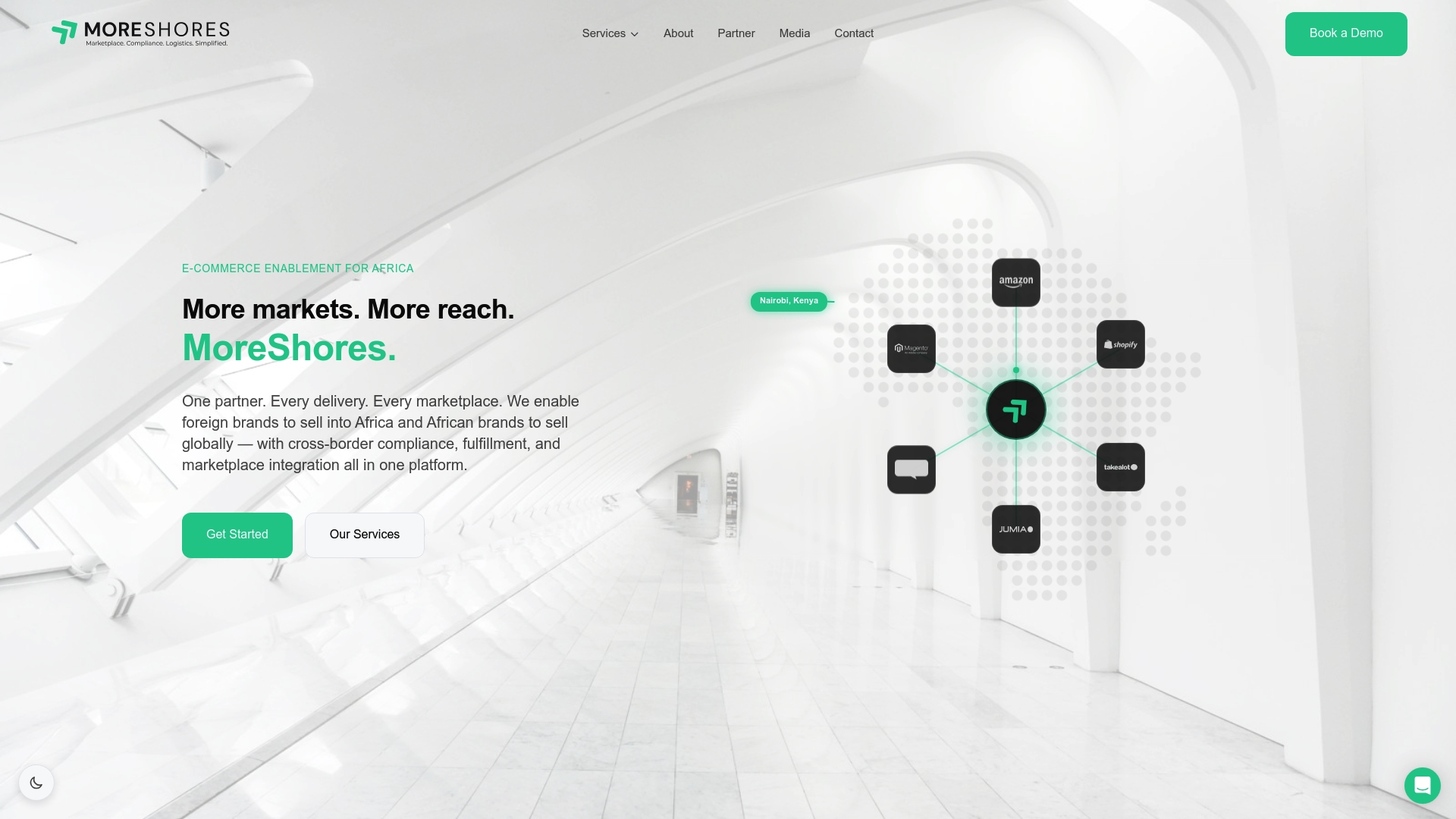
MoreShores acts as your end-to-end cross-border enablement platform. We handle Importer of Record services, customs clearance, VAT and duty compliance, warehousing, fulfillment through a multi-courier network, and marketplace integration across Takealot, Amazon SA, Jumia, and Kilimall. We also integrate directly with your Shopify or WooCommerce storefront. Instead of building costly infrastructure from scratch, you plug into a system that’s already optimized for African market entry. That means lower fixed costs, faster time to market, and a variable cost model that scales with your revenue. Visit moreshores.com to learn how we can support your expansion.
Frequently asked questions
What is the most effective way to reduce e-commerce logistics costs in Africa?
Partnering with local fulfillment providers and using pickup station networks can cut per-order costs by 12% or more, while pickup stations already handle over 24% of orders on major African platforms.
How does unifying the tech stack save costs for online retailers?
A unified POS and operations platform eliminates duplicate vendor fees and data reconciliation labor, and reduces total cost of ownership by 22% compared to fragmented systems.
What role does automation play in e-commerce cost reduction?
AI and automation lower warehousing and distribution costs by 10 to 20%, primarily through smarter demand forecasting, reduced labor in picking and packing, and fewer inventory write-offs.
Why is zero-based cost redesign better than simple budget cuts?
Simple cuts tend to rebound as teams work around restrictions, while zero-based redesign sustains 25% reductions by rebuilding cost structures from the ground up with cross-functional alignment.
How do local payment options impact global e-commerce costs and sales?
Local currency payments boost conversion by up to 24%, which directly lowers your customer acquisition cost per completed sale and reduces revenue leakage from cart abandonment.