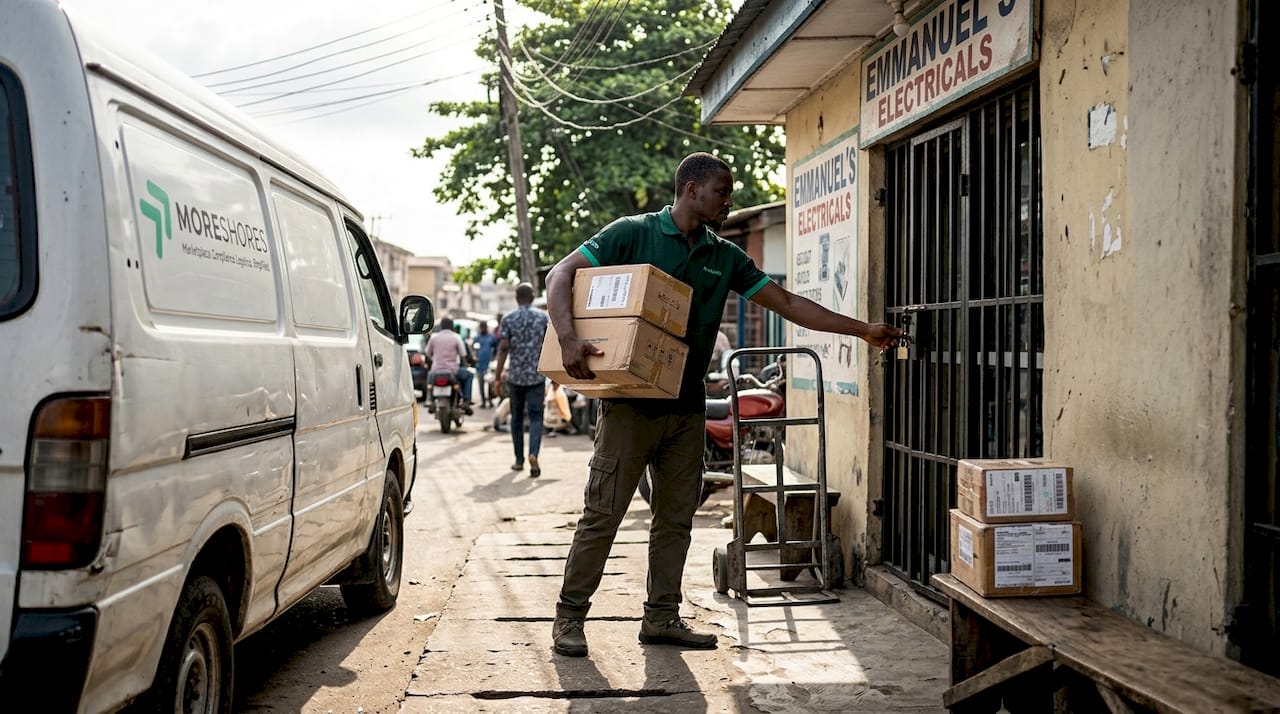
Africa’s cross-border road freight market sits at USD 10.23 billion in 2025 and is projected to nearly double to USD 19.94 billion by 2034. That growth signal is hard to ignore. Yet a surprising number of international brands enter African marketplaces with strong products and weak logistics plans, and they pay for it in abandoned carts, poor seller ratings, and stalled revenue. This guide breaks down the real logistics challenges, the frameworks top performers use, and the specific tactics that turn African marketplace potential into measurable sales growth.
Table of Contents
- Why logistics determines marketplace success
- Understanding Africa’s logistics landscape
- Key logistics challenges and how leaders solve them
- Proven logistics optimization frameworks
- Best practices for cross-border logistics in Africa
- Accelerate your marketplace growth with MoreShores
- Frequently asked questions
Key Takeaways
| Point | Details |
|---|---|
| Logistics drives marketplace wins | On-time delivery and fulfillment solutions can double marketplace sales in Africa. |
| Address unique African hurdles | Tackle infrastructure, customs, and rural delivery gaps with regional hubs and local partnerships. |
| Frameworks create big gains | Applying micro-fulfillment and cross-docking systems leads to lower costs and faster turnaround. |
| Prioritize transparency | Clear tracking and transparent duties are more valuable than sheer speed for African consumers. |
| Leverage experienced partners | Working with skilled cross-border logistics firms helps brands scale efficiently across Africa. |
Why logistics determines marketplace success
On African marketplaces like Takealot, Jumia, and Kilimall, logistics is not a back-office function. It is a front-line sales driver. Buyers who experience late deliveries or unclear tracking do not wait around. They leave negative reviews, request refunds, and rarely return. That behavior directly tanks your seller performance score, which most platforms use to rank listings and award the buy box.
The metrics that matter most on these platforms are all logistics-dependent:
- On-time delivery rate (OTD): Most top-tier sellers maintain above 95%
- Inventory accuracy: Overselling or stockouts trigger automatic listing suppression
- Returns processing speed: Slow returns handling increases dispute rates
- Order defect rate: Tied directly to fulfillment errors and carrier performance
The numbers behind optimized fulfillment strategies are striking. Lavazza’s experience on Walmart Marketplace is a clean benchmark: by leveraging Walmart Fulfillment Services, the brand achieved a 99% on-time delivery rate and drove 200% sales growth. That is not a marginal improvement. It is a complete business transformation driven by logistics execution. The lesson for African marketplace sellers is direct: fix fulfillment first, and revenue follows.
Understanding Africa’s logistics landscape
To apply winning logistics models, you must first grasp Africa’s unique operating environment. The continent is not a single market. It is 54 countries with varying infrastructure quality, customs regimes, currency controls, and carrier networks. What works in South Africa will not automatically work in Kenya or Nigeria.
Here is a snapshot of the key data points shaping the landscape:
| Metric | Value | Source/Context |
|---|---|---|
| Cross-border road freight market (2025) | USD 10.23B | Growing at 7.7% CAGR to 2034 |
| Projected market size (2034) | USD 19.94B | Nearly double current value |
| E-commerce logistics automation market | USD 1.3B | Driven by rapid e-commerce adoption |
| Paved road coverage | Less than 43% | Major last-mile barrier |
“Less than half of African roads are paved, creating persistent last-mile delivery challenges that require localized, adaptive logistics strategies rather than one-size-fits-all solutions.”
The African Continental Free Trade Area (AfCFTA) is changing the equation. By reducing intra-African tariffs and streamlining border protocols across member states, AfCFTA is lowering the cost and complexity of moving goods between countries. For cross-border sellers, this means regional distribution becomes more viable and cost-effective than it was three years ago.
Automation is also accelerating. The e-commerce logistics automation market is valued at USD 1.3 billion, with Jumia Logistics leading the charge in deploying route optimization, automated sorting, and digital tracking across multiple African markets. These platforms are building the infrastructure that international brands can plug into through cross-border enablement partnerships.
Key logistics challenges and how leaders solve them
Knowing the context, leaders can anticipate pain points and build smart logistics strategies. Here are the six core challenges and the solutions that actually work:
-
Infrastructure gaps. Unpaved roads and unreliable transport networks slow delivery, especially outside major cities. Solution: Use regional fulfillment hubs positioned near urban centers to reduce last-mile distance. Partner with local 3PLs (third-party logistics providers) who know the terrain.
-
Customs and border friction. Customs delays average 11 to 23 days in some corridors, driven by document errors and manual processing. Solution: Digitize customs documentation, use accurate HS codes (Harmonized System codes that classify goods for tariff purposes), and work with a licensed Importer of Record to handle compliance.
-
Rural last-mile delivery. Urban coverage is improving, but rural areas remain underserved. Solution: Hub-and-spoke models, where goods move from a central hub to smaller local pickup points, dramatically extend reach without requiring full carrier coverage.
-
Power and network reliability. Warehouse management systems and tracking tools depend on consistent power and connectivity. Solution: Choose logistics partners with backup power infrastructure and offline-capable tracking systems.
-
Cash on delivery (COD) reliance. A large share of African consumers still prefer COD, which increases return rates and cash flow complexity. Solution: Build COD reconciliation into your fulfillment workflow and use carriers with proven COD collection track records.
-
Returns complexity. Poor roads and border delays make reverse logistics expensive and slow. Solution: Pre-position return hubs in key markets and set clear return windows that match local carrier capabilities.
Pro Tip: Diversify your carrier mix across at least two or three regional providers. Single-carrier dependency is the fastest way to lose OTD performance when one network experiences disruption. Also, use DDP (Delivered Duty Paid) shipping terms so buyers see the full landed cost upfront. Hidden duties at delivery are a top reason for refusals and returns in African markets.
Brands like Jumia and Takealot have built competitive advantages by embedding African e-commerce logistics strategies directly into their seller onboarding. Their local warehouse networks and carrier partnerships are models worth studying before you build your own stack. You can also explore market-specific logistics solutions designed for the African context.

Proven logistics optimization frameworks
With solutions mapped, here is how top performers engineer rapid logistics gains in African markets. The frameworks below are not theoretical. Each has a documented track record.
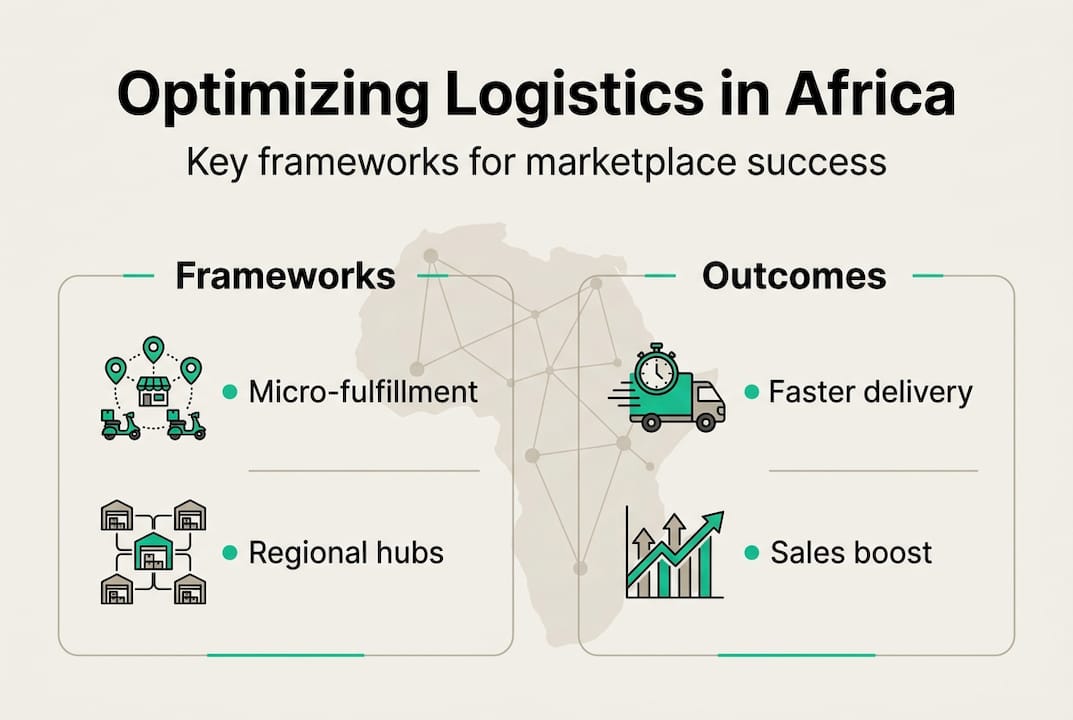
| Framework | Primary benefit | Best for | Complexity |
|---|---|---|---|
| Micro-fulfillment centers | Cuts last-mile distance and delivery time | High-volume urban markets | Medium |
| Cross-docking | Reduces warehousing cost, speeds throughput | Fast-moving consumer goods | High |
| Real-time inventory visibility | Prevents stockouts and overselling | Multi-marketplace sellers | Medium |
| Local warehousing | Improves OTD, reduces customs friction | Brands with steady demand | Low to medium |
| Last-mile tech platforms | Optimizes routing, reduces failed deliveries | Rural and peri-urban delivery | Medium |
Flipkart’s logistics overhaul is a useful benchmark even outside India. Their optimization program reduced order cycle time from 4.8 to 3.2 days, cut returns from 5 to 2 days, and brought logistics cost per order down by 12%. Those gains came from combining local warehousing with real-time inventory visibility and route optimization. The same combination applies directly to African marketplace operations.
On the fulfillment side, on-time delivery above 98% consistently correlates with 20% to 200% sales increases across marketplace categories. That range is wide, but the direction is always the same: better logistics equals better sales.
Pro Tip: Do not optimize purely for speed. African buyers often prioritize knowing when their order will arrive over receiving it fast. Full logistics transparency, including proactive delay notifications, reduces customer service contacts and negative reviews more effectively than shaving one day off delivery time.
For sellers managing listings across Takealot, Amazon SA, Jumia, and Kilimall simultaneously, marketplace logistics integration is the connective tissue that keeps inventory synchronized and order routing efficient. Pair that with automation and order tracking tools to close the loop on fulfillment visibility.
Best practices for cross-border logistics in Africa
Leaders who adopt these frameworks consistently follow a set of golden practices. Here is what separates brands that scale from those that stall.
Do these:
- Build direct relationships with local carriers and 3PLs in each target market
- Deploy real-time tracking technology that buyers can access independently
- Use accurate HS codes on every shipment to avoid customs holds
- Invest in localized warehouses or fulfillment hubs before scaling volume
- Apply DDP shipping terms to eliminate surprise duties at delivery
- Run pilot programs with African-focused logistics partners before committing to full rollout
- Study how Jumia and Takealot succeed via local warehouse networks and adapt their model to your category
Avoid these:
- Relying on a single carrier for all markets and all delivery zones
- Ignoring rural last-mile coverage when your product has national demand
- Assuming that automation alone solves every fulfillment problem
- Using generic global logistics contracts that do not account for African-specific edge cases
- Treating returns as an afterthought rather than a designed part of your logistics workflow
The brands winning on African e-commerce solutions platforms right now are not necessarily the ones with the best products. They are the ones with the most reliable, transparent, and locally adapted logistics operations. That is the competitive edge worth building.
Accelerate your marketplace growth with MoreShores
Every challenge covered in this article, from customs friction and last-mile gaps to multi-marketplace inventory sync, is exactly what MoreShores is built to solve. We act as your Importer of Record, manage duties and VAT compliance, and run fulfillment through a multi-courier network across African markets. You get the infrastructure without having to build it from scratch.
Whether you are entering South Africa via Takealot, scaling across Jumia markets in West and East Africa, or managing a Shopify storefront alongside marketplace listings, our cross-border enablement services connect every piece of the logistics chain. Explore our fulfillment and logistics capabilities or take the first step and partner with MoreShores to build a logistics operation that actually scales.
Frequently asked questions
What makes logistics so crucial for online marketplace success in Africa?
Without reliable logistics, sellers face delivery delays, poor ratings, and high customer churn, all of which directly suppress sales velocity. Proven cases show that optimized fulfillment can drive up to 200% sales growth on major marketplaces.
How can brands overcome customs and border challenges in Africa?
Brands should use regional fulfillment hubs, partner with licensed local carriers, digitize customs documentation, and apply accurate HS codes on every shipment. Regional hubs and local partners are the most effective tools for reducing border delays and customs friction.
What’s the role of technology in African e-commerce logistics?
Technology enables real-time tracking, route optimization, and automated fulfillment that reduce order cycle times and logistics costs. The Africa e-commerce logistics automation market is already valued at USD 1.3 billion, reflecting rapid adoption across the continent.
How big is the e-commerce logistics market in Africa?
The African cross-border road freight market is projected to grow from USD 10.23B in 2025 to nearly USD 20 billion by 2034, representing one of the fastest-growing logistics corridors globally.