
Africa’s warehousing occupancy hit 83% in 2026, reflecting explosive e-commerce growth that demands sophisticated logistics infrastructure. As online retail could surpass $75 billion this year, strategic warehousing has become the competitive differentiator for brands navigating cross-border trade. Yet many logistics managers still view African warehousing through outdated lenses, missing opportunities to leverage automation, integration, and location strategy. This guide reveals how efficient warehousing is a strategic necessity for Africa’s transforming logistics industry, covering technologies, challenges, and actionable optimization strategies that drive fulfillment speed and customer satisfaction across diverse African markets.
Table of Contents
- Understanding The Strategic Role Of Warehousing In Africa’s E-Commerce Growth
- How Warehouse Management Systems And Technology Transform Efficiency
- Addressing Unique Challenges And Driving Operational Excellence In African Warehouses
- Optimizing Warehousing For Cross-Border E-Commerce Success In Africa
- Discover Moreshores Solutions To Optimize Your E-Commerce Warehousing In Africa
- Frequently Asked Questions
Key takeaways
| Point | Details |
|---|---|
| WMS integration is essential | Warehouse Management Systems connect with transport, ERP, and marketplace platforms to enable real-time visibility and coordinated operations. |
| Automation drives accuracy gains | Technologies like barcode scanning and RFID reduce manual errors and improve inventory precision by significant margins. |
| African markets offer high growth | Despite infrastructure challenges, incremental technology investment and workforce training unlock substantial competitive advantages. |
| Strategic location matters | Positioning warehouses near urban centers and transport hubs reduces delivery times and cross-border trade costs. |
| Continuous optimization pays off | Regular process evaluation and technology upgrades sustain operational excellence and customer satisfaction. |
Understanding the strategic role of warehousing in Africa’s e-commerce growth
Africa’s e-commerce explosion has transformed warehousing from a cost center into a strategic asset. The continent’s online retail market could surpass $75 billion this year, driven by mobile penetration, digital payment adoption, and rising consumer expectations for fast delivery. Warehousing serves as the central nervous system for this growth, acting as the hub where goods are received, stored, organized, and distributed to customers across vast geographic distances.
Urbanization intensifies warehousing demand as African cities expand rapidly. Lagos, Nairobi, Johannesburg, and Cairo are becoming logistics hotspots where proximity to consumers directly impacts fulfillment speed and cost efficiency. Regional trade agreements like the African Continental Free Trade Area further amplify the need for warehouses that can handle cross-border inventory flows, customs documentation, and multi-country distribution. You need warehousing infrastructure that adapts to these dynamics, not just static storage space.
Efficient warehousing is a strategic necessity for Africa’s transforming logistics industry because it directly affects your ability to compete on delivery speed, inventory availability, and operational costs. Countries like Nigeria, South Africa, and Kenya are leading automation adoption, recognizing that modern warehousing technology separates market leaders from laggards. When you integrate warehousing with your broader cross-border e-commerce enablement for Africa strategy, you create a foundation for scalable growth.
Consider these factors driving strategic warehousing importance:
- Customer expectations: African consumers increasingly demand same-day or next-day delivery, matching global standards
- Inventory complexity: Managing SKUs across multiple marketplaces and storefronts requires sophisticated organization
- Cost pressure: Efficient space utilization and throughput directly reduce per-unit fulfillment costs
- Compliance requirements: Cross-border trade involves customs, VAT, and regulatory documentation that warehouses must support
The warehousing landscape is shifting from basic storage to integrated logistics hubs that combine inventory management, order processing, quality control, and distribution coordination. You cannot treat warehousing as an afterthought when entering or expanding in African markets. Your warehousing strategy shapes customer experience, operational efficiency, and ultimately your brand reputation across the continent.
“Strategic warehousing enables brands to position inventory closer to customers, reduce delivery times, and respond quickly to demand fluctuations in Africa’s dynamic markets.”
How warehouse management systems and technology transform efficiency
Warehouse Management Systems represent the technological backbone that elevates basic storage into intelligent logistics operations. A WMS orchestrates receiving, putaway, picking, packing, and shipping processes through digital workflows that eliminate manual coordination bottlenecks. WMS are crucial for rising inventory volumes and reducing operational inefficiencies in Africa, where e-commerce growth outpaces traditional logistics infrastructure development.
Integration amplifies WMS value exponentially. When your WMS connects with Transportation Management Systems, Enterprise Resource Planning platforms, and e-commerce marketplaces, you create a unified data ecosystem. Real-time inventory visibility flows from warehouse shelves to marketplace listings, preventing overselling and stockouts. Order data automatically triggers picking workflows, eliminating the lag between customer purchase and warehouse action. This integration supports faster decision-making because you see inventory status, order volume, and fulfillment capacity in one dashboard.
Technology like barcode scanning and RFID improves inventory accuracy up to 12%, a substantial gain that compounds across thousands of transactions. Manual inventory counts introduce human error at every step, from receiving verification to cycle counts. Automated data capture through scanning devices ensures each item movement gets recorded accurately, creating an audit trail that supports compliance and quality control. You reduce shrinkage, misplaced inventory, and the costly expedited shipping required to fix fulfillment errors.

Pro Tip: Start WMS implementation with your highest-volume SKUs to demonstrate ROI quickly, then expand to your full catalog as your team gains proficiency with the system.
Key WMS functions that transform warehouse efficiency:
- Slotting optimization: Algorithms position fast-moving items in easily accessible locations, reducing picker travel time
- Wave planning: Batches orders intelligently to maximize picking efficiency and minimize warehouse congestion
- Labor management: Tracks worker productivity and identifies training opportunities or process improvements
- Inventory forecasting: Analyzes historical data to predict demand and optimize stock levels
The technology stack extends beyond WMS to include automated guided vehicles, conveyor systems, and pick-to-light solutions in more advanced facilities. While full automation requires significant capital investment, even basic WMS implementation with barcode scanning delivers measurable gains. You can partner with an e-commerce logistics platform partnership to access shared warehouse technology without bearing full infrastructure costs.
| Technology | Primary Benefit | Implementation Complexity |
|---|---|---|
| Basic WMS | Inventory accuracy and process standardization | Medium |
| Barcode scanning | Data capture accuracy and speed | Low |
| RFID tags | Real-time tracking and reduced manual scanning | Medium |
| Automated picking | Labor cost reduction and throughput increase | High |
| Conveyor systems | Movement efficiency and reduced handling | High |
Integration between WMS and marketplace platforms like Takealot, Jumia, and Amazon SA ensures inventory synchronization across sales channels. When a customer purchases on any platform, your WMS immediately reserves that inventory and initiates fulfillment, preventing the overselling that damages customer trust. This real-time coordination becomes critical when managing cross-border inventory that serves multiple African markets simultaneously.
Addressing unique challenges and driving operational excellence in African warehouses
African warehousing faces distinct challenges that require tailored solutions rather than copying Western models wholesale. Limited technology access and infrastructural constraints hinder full automation potential in Africa, from unreliable power supply to limited internet connectivity in some regions. Workforce training gaps compound these issues, as many warehouse staff lack experience with digital systems and automated equipment. You must acknowledge these realities when designing your warehousing strategy.
Infrastructure variability across African countries means your Nairobi warehouse might operate very differently from your Lagos facility. Power backup systems become essential investments, not optional upgrades. Internet connectivity redundancy through multiple providers ensures your WMS stays online during outages. Physical infrastructure like loading docks, climate control, and security systems often require upgrades in older buildings repurposed for e-commerce warehousing.
Performance metrics reveal the impact of addressing these challenges systematically. Space utilization, throughput, and order fulfillment rate correlate strongly with warehouse performance, providing clear targets for improvement initiatives. Manual warehouses typically achieve 60 to 70% space utilization, while automated facilities reach 85% or higher through vertical storage and optimized slotting. Throughput measured in orders per hour can double when you implement even basic picking optimization and barcode scanning.
Steps to drive operational excellence in African warehouses:
- Conduct baseline assessment: Measure current space utilization, picking accuracy, and throughput to establish improvement targets
- Prioritize quick wins: Implement barcode scanning and basic WMS functionality before pursuing expensive automation
- Invest in workforce training: Develop internal expertise through structured programs that build digital literacy and system proficiency
- Optimize layout: Redesign warehouse zones based on product velocity, placing fast movers near packing stations
- Establish quality controls: Create verification checkpoints at receiving, picking, and packing to catch errors early
- Monitor KPIs continuously: Track order accuracy, fulfillment speed, and inventory accuracy weekly to identify degradation quickly
Pro Tip: Implement a continuous improvement culture where warehouse staff suggest process enhancements, creating ownership and surfacing practical insights management might miss.
Incremental automation investment delivers better ROI than attempting full transformation overnight. Start with conveyor belts for high-volume pathways, add pick-to-light systems for your fastest SKUs, then expand automation as volume and capital allow. This phased approach lets your team adapt to new technology while demonstrating value to stakeholders. You build internal change management capability that supports future upgrades.
| Metric | Manual Warehouse | Semi-Automated Warehouse | Fully Automated Warehouse | | — | — | — | | Space utilization | 60 to 70% | 75 to 80% | 85 to 95% | | Order accuracy | 92 to 95% | 97 to 98% | 99%+ | | Orders per hour | 15 to 25 | 40 to 60 | 100+ | | Labor cost per order | High | Medium | Low |
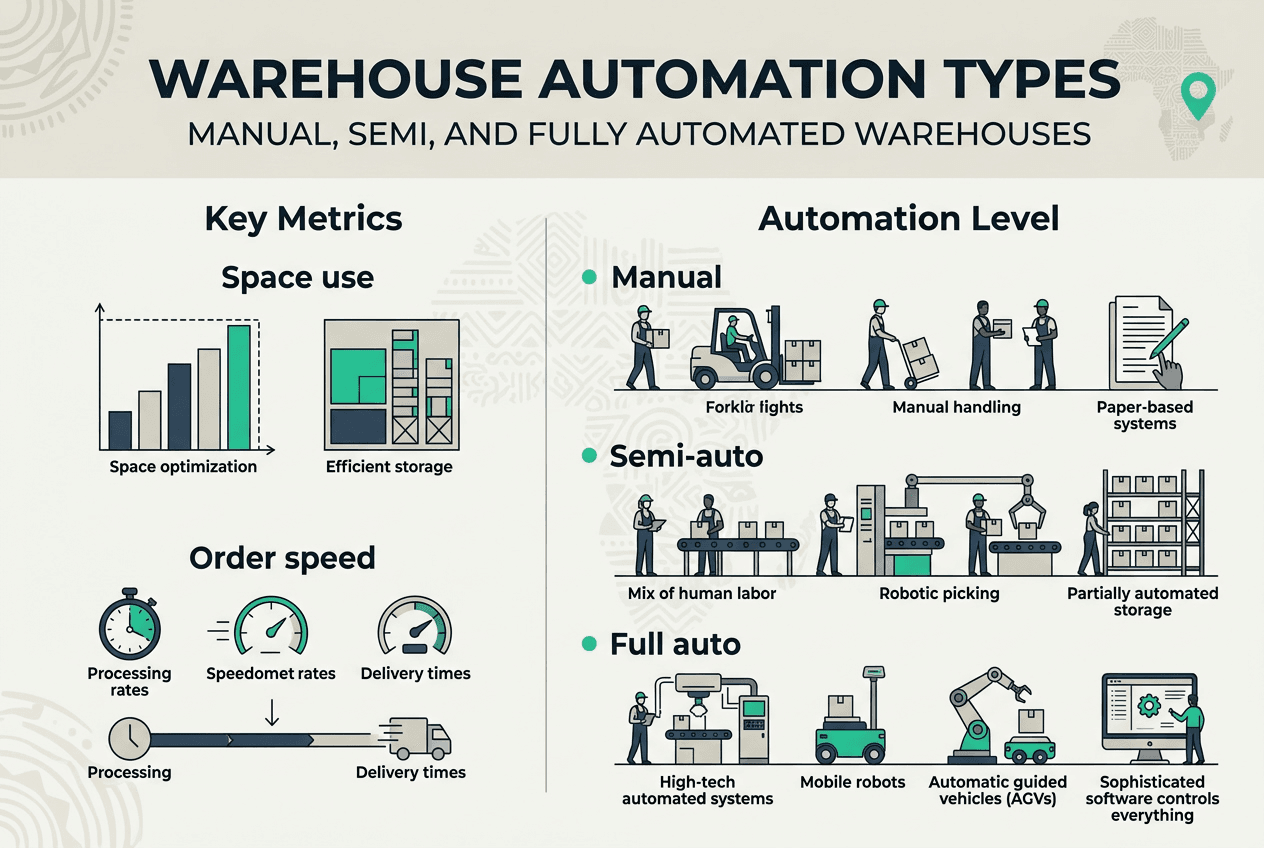
Cost efficiency improves dramatically when you address foundational challenges before layering on advanced technology. Reliable power, trained staff, and optimized processes create the foundation that makes automation investments productive. Partner with e-commerce solutions in Africa providers who understand these regional nuances and can guide your technology roadmap based on local conditions rather than generic best practices.
Optimizing warehousing for cross-border e-commerce success in Africa
Cross-border e-commerce in Africa demands warehousing strategies that balance speed, accuracy, and regulatory compliance across diverse markets. Strategic warehousing is the backbone of efficient e-commerce operations in East Africa and beyond, enabling brands to serve customers across borders without maintaining separate facilities in every country. Your warehousing location decisions directly impact customs clearance speed, last-mile delivery costs, and your ability to meet customer expectations.
Fulfillment speed separates winners from losers in competitive African e-commerce markets. Customers in Nairobi expect the same delivery timelines as shoppers in Johannesburg, regardless of where your warehouse sits. Strategic warehouse placement near major urban centers and transport hubs reduces the distance products travel, cutting both delivery time and shipping costs. You gain flexibility to offer same-day or next-day delivery in key markets, a capability that drives conversion rates and repeat purchases.
The Africa E-Commerce Logistics Automation Market is valued at $1.3 billion, reflecting growing investment in technologies that support cross-border operations. Automation enables you to scale fulfillment without proportional increases in labor costs, critical when serving markets with different wage structures and labor availability. You can process higher order volumes during peak seasons without hiring and training temporary staff who lack system familiarity.
Actionable strategies for cross-border warehousing optimization:
- Centralize inventory strategically: Position warehouses in countries with favorable trade agreements and efficient customs processes to serve regional markets
- Implement zone-based storage: Organize inventory by destination country to streamline picking and customs documentation
- Leverage technology for compliance: Use WMS features that auto-generate required customs paperwork and ensure regulatory adherence
- Partner with multi-courier networks: Maintain relationships with carriers serving different African regions to optimize delivery routes
- Monitor cross-border metrics: Track customs clearance times, international shipping costs, and delivery success rates by destination
Adaptability becomes crucial when managing inventory for multiple African markets simultaneously. Demand patterns vary significantly between countries based on local holidays, economic conditions, and competitive dynamics. Your WMS should support dynamic inventory allocation that shifts stock between markets based on real-time demand signals. This flexibility prevents stockouts in high-demand markets while reducing excess inventory in slower regions.
Pro Tip: Establish relationships with customs brokers in your key markets before you need them, ensuring smooth clearance processes when cross-border orders spike unexpectedly.
Collaboration with logistics partners amplifies your warehousing capabilities beyond your physical facilities. Integrated platforms connect your warehouse with marketplace APIs, transportation providers, and payment processors to create seamless order-to-delivery workflows. When a customer purchases on Jumia, your system should automatically reserve inventory, generate shipping labels, and notify the courier without manual intervention. This integration reduces fulfillment cycle time and eliminates coordination errors.
Throughput optimization requires continuous process evaluation and refinement. Analyze your order data to identify bottlenecks in receiving, picking, packing, or shipping. Maybe your receiving process creates delays because suppliers deliver without advance notice, preventing efficient putaway planning. Perhaps your packing station lacks adequate supplies during peak hours, slowing order completion. Small process improvements compound into substantial throughput gains when you address them systematically.
Space management directly affects your cost structure and scalability. Vertical storage solutions maximize cubic footage utilization in expensive urban warehouse locations. Seasonal inventory planning prevents overcrowding during peak periods while avoiding empty space during slow months. You might negotiate flexible warehouse agreements that let you expand or contract space based on inventory levels, aligning costs with revenue.
Technology upgrades should follow a clear ROI framework rather than chasing the latest innovations. Evaluate each potential investment based on measurable impact on order accuracy, fulfillment speed, or labor productivity. A $50,000 conveyor system that increases throughput by 30% might deliver better returns than a $200,000 automated picking system that only improves speed by 15%. You build sustainable competitive advantage through smart technology choices aligned with your specific operational constraints and growth trajectory.
Your fulfillment and logistics services strategy should integrate warehousing with broader supply chain capabilities including customs clearance, last-mile delivery, and returns processing. This end-to-end approach ensures consistency across the customer experience while simplifying your vendor management and reducing coordination overhead.
Discover MoreShores solutions to optimize your e-commerce warehousing in Africa
Optimizing warehousing for African e-commerce success requires partners who understand both the opportunities and challenges across diverse markets. MoreShores delivers comprehensive cross-border enablement services designed specifically for brands navigating Africa’s complex logistics landscape, from customs clearance to multi-country distribution.

Our fulfillment and logistics services integrate warehousing, inventory management, and multi-courier networks to accelerate your order-to-delivery cycle while maintaining accuracy and compliance. We handle the operational complexity so you can focus on growing your brand across African markets. Whether you are entering Africa for the first time or expanding from one market to many, our infrastructure supports your ambitions.
Partner with MoreShores e-commerce platform to access integrated technology, regional expertise, and scalable fulfillment capabilities that transform warehousing from a cost center into a competitive advantage. Let us show you how strategic warehousing drives customer satisfaction and operational excellence across Africa.
Frequently asked questions
What is the primary role of warehousing in e-commerce?
Warehousing serves as the central hub where e-commerce goods are received, stored, organized, and prepared for distribution to customers. It ensures product availability, maintains inventory accuracy, and enables timely fulfillment that meets customer delivery expectations. Strategic warehousing reduces shipping costs and delivery times by positioning inventory closer to target markets.
How does warehouse automation improve e-commerce operations?
Automation reduces manual errors and improves inventory accuracy by up to 12% through technologies like barcode scanning and RFID tracking. It accelerates order fulfillment by optimizing picking routes and reducing handling time, enabling warehouses to process higher order volumes without proportional labor increases. Automated systems also provide real-time visibility into inventory levels and order status, supporting faster decision-making.
What are the biggest challenges for warehousing in African e-commerce?
Infrastructure limitations including unreliable power supply and limited internet connectivity hinder automation adoption in many African markets. Workforce skill gaps create challenges in operating digital warehouse systems and maintaining technology. Strategies to mitigate these include incremental technology investment starting with basic WMS and scanning, backup power systems, and structured training programs that build digital literacy among warehouse staff.
Why is integration between WMS and other systems important?
Integration enables real-time inventory visibility across warehouse operations, transportation networks, and marketplace platforms, preventing overselling and stockouts. It automates data flow between systems, eliminating manual coordination that introduces delays and errors. Connected systems support coordinated logistics management where order data automatically triggers fulfillment workflows, reducing cycle time and improving customer satisfaction through faster, more accurate delivery.