
Shipping products across borders between Africa and global markets creates frustrating delays, unexpected costs, and compliance headaches that hurt both merchants and customers. Hidden duties, slow customs clearance, and fragmented infrastructure turn promising sales into operational nightmares. This guide walks you through proven strategies to master logistics, streamline compliance, and integrate marketplace tools that unlock profitable cross-border trade. You’ll learn how to cut delivery times, avoid costly penalties, and build customer trust through transparent shipping and payment processes.
Table of Contents
- Key takeaways
- Preparing your cross-border logistics strategy
- Executing efficient cross-border shipments
- Leveraging technology and marketplace integration
- Troubleshooting and verifying your cross-border logistics success
- Explore MoreShores cross-border logistics solutions
- Frequently asked questions
Key Takeaways
| Point | Details |
|---|---|
| Regional fulfillment hubs | Using regional hubs in Lagos, Nairobi, and Johannesburg speeds deliveries and reduces transit times. |
| HS codes and VAT IOSS | Accurate HS classification along with VAT or IOSS registrations helps prevent duties and customs delays. |
| Marketplace integrations | Platforms that integrate payments and compliance tools automate workflows and expand cross border selling opportunities. |
| AfCFTA opportunities | Leveraging AfCFTA certificates of origin can unlock tariff savings and access broader African markets. |
Preparing your cross-border logistics strategy
Before shipping a single package internationally, you need a solid foundation covering logistics partners, compliance documentation, and marketplace infrastructure. Skipping these preparation steps leads to shipment rejections, surprise fees, and angry customers.
Start by identifying logistics partners with regional fulfillment hubs. Regional fulfillment hubs in Lagos, Nairobi, Johannesburg enable faster deliveries compared to shipping everything from a single origin point. Partners with established networks across multiple African countries give you flexibility to route orders efficiently and respond to local demand patterns.
Next, classify every product you sell with the correct Harmonized System code. Accurate HS code classification, IOSS/VAT registration, and AfCFTA certificates are essential for compliance to avoid duties and delays at customs. Wrong codes trigger inspections, fines, and shipment holds that destroy customer experience. Invest time upfront to get classification right, and register for VAT or IOSS in markets where you’ll sell frequently.
Leverage AfCFTA certificates of origin when shipping within African markets to reduce or eliminate tariffs. This continental trade agreement creates significant cost advantages for merchants operating across African borders. Work with your logistics partner to understand which corridors and product categories benefit most from AfCFTA treatment.
Research marketplace platforms that integrate payment processing and compliance tools directly into their seller interfaces. Platforms like Takealot, Jumia, and Amazon SA offer built-in solutions that simplify cross-border operations. Evaluate each platform’s fee structure, customer base, and technical requirements before committing resources.
Prepare comprehensive documentation packages for each shipment route you plan to use regularly:
- Commercial invoices with accurate product descriptions and values
- Certificates of origin for preferential trade agreements
- Product compliance certificates for regulated categories
- Import licenses where required by destination markets
- Packing lists with detailed item breakdowns
Forecast duties and taxes using Delivered Duty Paid models so you can display accurate total costs to customers at checkout. Surprise fees at delivery kill conversion rates and generate negative reviews. DDP shipping transfers the duty burden to you as the merchant, but creates transparency that builds customer trust and reduces cart abandonment.
Explore the brand onboarding process to understand how enablement platforms streamline these preparation steps. Consider whether to partner with MoreShores for integrated logistics and compliance support. Review marketplace integration solutions that automate documentation and payment flows. Learn more about cross-border selling logistics best practices.
Executing efficient cross-border shipments
Once your logistics foundation is ready, execution becomes the daily reality of moving products across borders quickly and cost-effectively. Every decision about fulfillment location, shipping mode, and payment method directly impacts delivery speed and customer satisfaction.
-
Select strategic fulfillment hub locations based on your target markets and order volumes. Lagos serves West Africa efficiently, Nairobi covers East Africa, and Johannesburg reaches Southern African markets. Placing inventory closer to customers cuts transit time dramatically and reduces shipping costs per unit.
-
Implement Delivered Duty Paid shipping to prepay all duties and taxes before the package reaches the customer. Distributed fulfillment reduces delivery times from 15-30 days to 2-5 days, and DDP reduces cart abandonment by 30%. Customers see the final price upfront and trust your brand more when no surprise fees appear at delivery.
-
Integrate mobile-first payment methods like M-Pesa, MTN MoMo, and Airtel Money that dominate African markets. Credit card penetration remains low across much of the continent, so offering mobile money options is essential for conversion. Partner with payment processors that handle currency conversion and settlement automatically.
-
Design returnless refund policies for products where return shipping costs exceed the item value. Returns from distant markets can cost more than the original sale, destroying your margins. Offer partial refunds or replacements on future orders instead of paying for international return logistics.
-
Monitor shipment progress actively through tracking systems and maintain direct communication with courier partners. Infrastructure gaps, customs delays, and currency volatility create unpredictable situations that require quick responses. Set up alerts for shipments that miss expected milestones so you can intervene before customers complain.
Pro Tip: Build a 3-5 day buffer into your delivery estimates for cross-border African shipments. Infrastructure challenges and customs processing times vary significantly, and under-promising gives you room to delight customers with early arrivals instead of disappointing them with late ones.
Choose courier partners with proven track records in your target corridors. DHL, Aramex, and regional specialists understand local customs procedures and have relationships that smooth clearance processes. Avoid the cheapest option if it lacks experience in African cross-border logistics.

Test different fulfillment models with small order volumes before committing to large inventory transfers. Some products and markets work better with centralized fulfillment, while others demand distributed inventory. Collect data on delivery times, costs, and customer satisfaction across different approaches.
Explore fulfillment and logistics services that handle the operational complexity of multi-country distribution. Review cross-border enablement services designed specifically for African markets. Learn about cross-border e-commerce efficiencies through marketplace integration.
Leveraging technology and marketplace integration
Manual cross-border operations don’t scale. Technology platforms automate the repetitive tasks of order routing, compliance documentation, and payment processing that consume merchant time and create error opportunities.
Marketplace integration platforms enable automated logistics, multi-currency payments, and compliance tools for merchants. Platforms like Comilmart, Amazon FBA Global, and Mall for Africa connect your inventory to customers across multiple countries while handling the technical complexity behind the scenes.
Integrate multiple payment methods through a single API instead of managing separate relationships with each payment provider. Modern payment orchestration platforms support credit cards, mobile money, bank transfers, and digital wallets simultaneously. They handle currency conversion, fraud screening, and settlement automatically.
Leverage built-in compliance tools that generate correct customs documentation based on product data and destination requirements. These systems maintain updated HS code databases, calculate duties and taxes accurately, and produce certificates of origin when applicable. Automation eliminates the manual errors that cause customs delays.
Monitor shipment data through centralized dashboards that aggregate information from multiple courier partners. Track key metrics like average delivery time by corridor, customs clearance duration, and delivery success rates. Use this data to identify underperforming routes and optimize your fulfillment network over time.
Key capabilities to evaluate in integration platforms:
- Real-time inventory synchronization across multiple marketplaces
- Automated order routing to optimal fulfillment locations
- Multi-currency pricing and payment processing
- Customs documentation generation and compliance checks
- Shipment tracking aggregation from multiple couriers
- Returns management and customer communication tools
Pro Tip: Start with one or two marketplace integrations and master them before expanding to additional platforms. Each marketplace has unique requirements and seller expectations. Building expertise on a few platforms delivers better results than spreading resources thin across many.
| Distribution model | Advantages | Disadvantages | Best for |
|---|---|---|---|
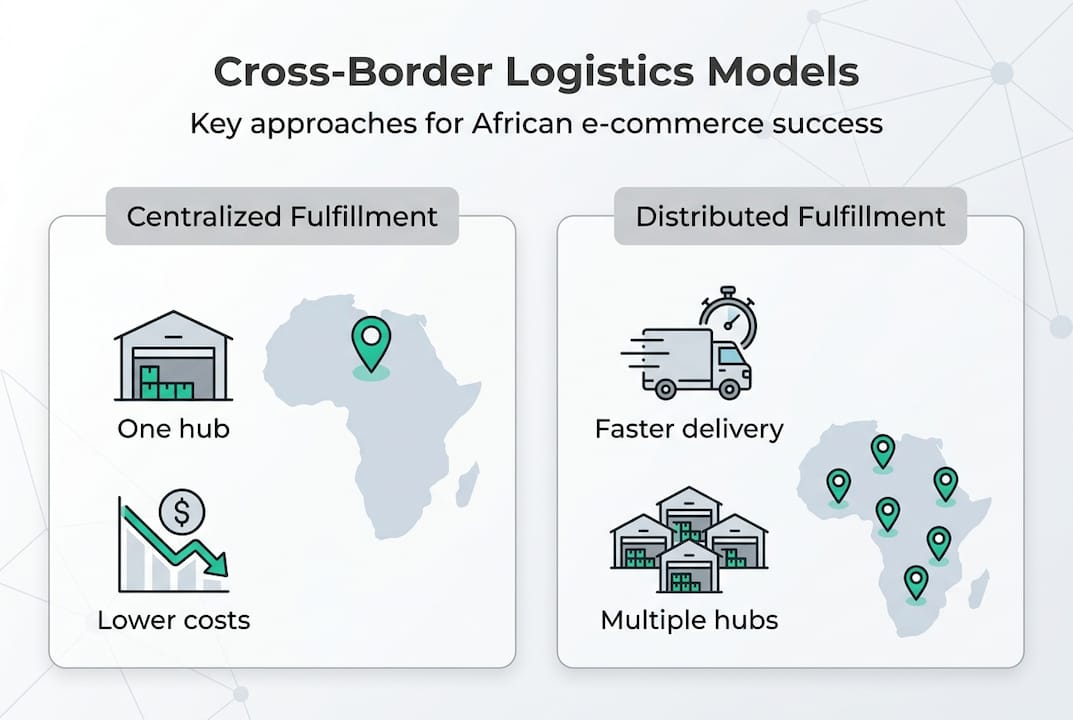
| Centralized fulfillment | Lower inventory costs, simpler management | Longer delivery times, higher shipping costs | Low-volume merchants, testing new markets |
| Regional fulfillment | Faster delivery, lower shipping costs per unit | Higher inventory costs, complex coordination | High-volume merchants, established markets |
| Hybrid approach | Flexibility to optimize by product category | Most complex to manage | Merchants with diverse product portfolios |
Understand the trade-offs between centralized and distributed fulfillment based on your order volumes, product mix, and target markets. Most merchants start centralized and migrate to regional fulfillment as volumes justify the additional complexity.
Explore marketplace integration solutions that connect your products to African and global platforms. Review the partner program for technology providers and logistics specialists. Discover e-commerce solutions designed for cross-border trade. Learn more about cross-border e-commerce in Africa marketplace dynamics.
Troubleshooting and verifying your cross-border logistics success
Even well-planned cross-border operations encounter challenges. Returns, infrastructure gaps, and currency volatility create situations that demand flexible responses and continuous improvement.
Manage returns cost-effectively by implementing returnless refunds for low-value items or distant markets where return shipping exceeds product value. Returns cost is high; use returnless refunds; landlocked countries face corridor infrastructure issues; FX volatility causes delays. Offer store credit or partial refunds instead of paying for international return logistics that destroy margins.
Understand infrastructure differences between coastal and landlocked African countries. Coastal nations with major ports like Nigeria, Kenya, and South Africa offer faster customs clearance and more courier options. Landlocked countries depend on corridor infrastructure through neighboring nations, adding transit time and complexity. Plan delivery estimates and pricing accordingly.
Monitor foreign exchange volatility and build buffers into your pricing strategy. Currency fluctuations between order placement and fulfillment can erode margins quickly. Consider dynamic pricing that adjusts for exchange rate movements or build a 5-10% buffer into cross-border prices.
Set clear key performance indicators to measure logistics success:
- Average delivery time by corridor and fulfillment method
- Customs clearance duration and rejection rates
- Delivery success rate and customer satisfaction scores
- Cost per delivery by market and shipping method
- Return rate and return processing costs
Pro Tip: Survey customers after delivery to gather feedback on packaging quality, delivery speed, and overall experience. Customer perception often differs from internal metrics, and direct feedback reveals improvement opportunities you might miss in operational data.
| Challenge | Ignoring it | Addressing it |
|---|---|---|
| High return costs | Margins eroded by expensive international returns | Returnless refunds protect profitability |
| Infrastructure gaps | Unpredictable delays damage customer trust | Buffer delivery estimates, choose experienced couriers |
| Currency volatility | Exchange rate losses eat into profits | Dynamic pricing or built-in buffers maintain margins |
| Compliance errors | Customs rejections and fines disrupt operations | Automated compliance tools prevent mistakes |
Benchmark your performance against industry standards and competitor offerings. If your delivery times significantly exceed market norms, customers will choose faster alternatives. Continuously test new fulfillment locations, courier partners, and technology solutions to stay competitive.
Document lessons learned from logistics failures and near-misses. Create playbooks for common scenarios like customs holds, lost shipments, and damaged goods. Train your team to respond consistently and quickly when problems arise.
Review the brand onboarding guide for structured approaches to cross-border logistics. Explore fulfillment services overview for end-to-end solutions. Learn about cross-border logistics challenges and mitigation strategies.
Explore MoreShores cross-border logistics solutions
Navigating African cross-border logistics requires specialized expertise in compliance, fulfillment, and marketplace integration. MoreShores offers end-to-end enablement services designed specifically for merchants trading between Africa and global markets.

Our platform handles the complexity of customs clearance, warehousing, multi-courier fulfillment, and marketplace listings across Takealot, Amazon SA, Jumia, and Kilimall. We act as your Importer of Record, manage duties and VAT, and integrate seamlessly with Shopify and WooCommerce storefronts.
Explore our cross-border enablement services that simplify international trade. Partner with MoreShores to leverage our fulfillment network and compliance expertise. Discover marketplace integration solutions that connect your products to customers across Africa and beyond.
Frequently asked questions
What are the most important compliance requirements for cross-border shipments from Africa?
Accurate HS code classification is essential for customs clearance and duty calculation. EU markets require VAT or IOSS registration for shipments to consumers. AfCFTA certificates of origin unlock tariff preferences for intra-African trade. Use Delivered Duty Paid shipping to prepay all duties and taxes, reducing cart abandonment and building customer trust.
How can I reduce delivery times for cross-border e-commerce shipments in Africa?
Place inventory in regional fulfillment hubs located in Lagos, Nairobi, and Johannesburg to serve nearby markets within 2-5 days instead of 15-30 days from distant origins. Partner with experienced couriers like DHL or Aramex that understand local customs procedures. Distributed fulfillment dramatically improves delivery speed and customer satisfaction.
What strategies help manage costly returns in cross-border trade?
Implement returnless refunds for low-value items where return shipping costs exceed the product price. Offer store credit or partial refunds instead of paying for international return logistics. Clearly communicate your returns policy at checkout so customers understand options before purchasing. This approach protects margins while maintaining customer goodwill.
Why is marketplace integration critical for African e-commerce merchants?
Integrated platforms automate order fulfillment, simplify multi-currency payments, and ensure compliance with local regulations across multiple markets simultaneously. They provide access to established customer bases and built-in trust that independent websites struggle to build. Technology tools within marketplaces enhance competitiveness and accelerate growth without requiring merchants to build complex infrastructure themselves.