
Managing global fulfillment between Africa and international markets presents unique challenges that can derail even the most promising e-commerce ventures. Port delays averaging 14 to 25 days, informal addressing systems, and infrastructure gaps create costly bottlenecks that frustrate logistics managers daily. Yet businesses that master the end-to-end fulfillment process unlock faster delivery times, reduced costs, and competitive advantages in this rapidly growing market. This guide walks you through proven strategies and actionable steps to optimize every stage of your cross-border fulfillment operations, from inventory onboarding to final delivery and returns management.
Table of Contents
- Key takeaways
- Understanding the global fulfillment process for Africa cross-border e-commerce
- Preparing your global fulfillment network: methodologies and regional strategies
- Executing efficient fulfillment operations in Africa cross-border trade
- Verifying performance and troubleshooting common pitfalls in global fulfillment
- Streamline your global fulfillment with MoreShores solutions
- Frequently asked questions
Key Takeaways
| Point | Details |
|---|---|
| End to end fulfillment | The process covers receiving, storage, picking and packing, shipping, and returns across global operations, with Africa adding regional complexities. |
| Regional hubs shorten delivery | Establish Lagos, Nairobi, and Johannesburg hubs to move from weeks to days by placing stock near customers and addressing infrastructure gaps. |
| Third party logistics dominance | Third party logistics providers dominate the market with about 70 percent share and bring established networks to reduce carrier burden and delays. |
| Africa cross border challenges | Common issues include port congestion, informal addresses, power outages, high returns due to cash on delivery, and limited rural carrier coverage requiring tailored solutions. |
Understanding the global fulfillment process for Africa cross-border e-commerce
The global fulfillment process in e-commerce involves end-to-end management from inventory receipt to delivery and returns, including receiving, storage, picking and packing, shipping, and reverse logistics. For Africa cross-border operations, this workflow requires additional layers of complexity and strategic planning that distinguish it from fulfillment in more developed markets.
Your fulfillment journey begins when inventory arrives at a receiving facility, where staff inspect, count, and onboard products into warehouse management systems. Storage follows, with products organized by SKU, demand velocity, and shipping requirements in strategically located warehouses. When orders come in, warehouse teams pick items from shelves, pack them according to destination requirements, and hand them off to carriers for the shipping phase.
Africa cross-border e-commerce adds critical requirements to this standard process. Regional hubs in Lagos, Nairobi, and Johannesburg become essential distribution points that reduce transit times from weeks to days. You need to account for poor road infrastructure that slows last-mile delivery, informal addressing systems that complicate routing, and regulatory delays at customs checkpoints that can hold shipments for extended periods.
Common Africa fulfillment challenges include:
- Port congestion causing delays of 14 to 25 days in major shipping centers
- Informal addressing with no standardized street names or postal codes
- Power outages disrupting warehouse operations and cold chain logistics
- Higher return rates due to cash-on-delivery preferences and product uncertainty
- Limited carrier coverage in rural and peri-urban areas
Fulfillment models vary in their suitability for African markets. Centralized fulfillment from a single warehouse location struggles with the continent’s vast distances and infrastructure limitations. Distributed networks placing inventory across multiple regional hubs perform better by positioning stock closer to customers. Third-party logistics providers dominate with 70% market share, offering specialized expertise and established networks that reduce the burden on individual merchants.
Understanding these foundational steps and Africa-specific challenges sets the stage for designing an efficient fulfillment network. Your success depends on selecting the right model, placing inventory strategically, and partnering with providers who know how to navigate local conditions. The fulfillment and logistics infrastructure you build today determines your ability to compete and scale tomorrow.
Preparing your global fulfillment network: methodologies and regional strategies
Your fulfillment network design directly impacts delivery speed, costs, and customer satisfaction across African markets. The choice between centralized and distributed models carries significant implications for cross-border operations.
| Network Type | Advantages | Disadvantages | Best For |
|---|---|---|---|
| Centralized | Lower inventory holding costs, simplified management, easier quality control | Longer delivery times, higher shipping costs, single point of failure | Low-volume operations, testing new markets |
| Distributed Regional | 71% faster shipping times, lower per-order costs, improved customer experience | Higher inventory requirements, complex coordination, multiple facility costs | High-volume sellers, established brands, competitive markets |
| Hybrid 3PL | Scalability, local expertise, reduced capital investment, multi-market coverage | Less direct control, variable service quality, dependency on partner performance | Most Africa cross-border operations |
Distributed regional hubs deliver measurable performance improvements by placing inventory closer to demand centers. When you stock products in Lagos for West African customers, Nairobi for East Africa, and Johannesburg for Southern Africa, you cut average delivery times from 20-plus days to under seven in many cases. This proximity reduces shipping costs per order while improving the customer experience through faster fulfillment.
Strategic inventory placement requires analyzing order data to identify high-demand SKUs and regional preferences. You allocate fast-moving products across multiple hubs while keeping slower items in a central location. This approach balances inventory holding costs against the speed and cost benefits of distributed fulfillment.

Customs automation becomes critical when managing multiple entry points and regulatory jurisdictions. Tools like the Pan-African Payment and Settlement System speed clearance by standardizing documentation and payment processes. You reduce delays by pre-clearing shipments, maintaining compliant paperwork, and working with customs brokers who understand local requirements.
Local last-mile partners solve the informal addressing challenge that defeats international carriers. These providers employ drivers familiar with neighborhood landmarks, verbal directions, and community networks that enable successful deliveries where GPS coordinates fail. Their knowledge of road conditions and alternative routes keeps shipments moving despite infrastructure limitations.
Pro Tip: Groupage or pooling shipments from multiple small sellers into consolidated containers cuts costs by 30% or more, making distributed regional networks economically viable for SMEs who cannot fill entire containers alone.
Third-party logistics providers dominate African fulfillment because they absorb the complexity of managing distributed networks, customs compliance, and local partnerships. However, hybrid models combining 3PL services with your own technology platforms offer greater visibility and control. You maintain oversight through integrated systems while leveraging partner expertise for on-ground operations.
The cross-border enablement services you select should provide technology integration, regulatory compliance support, and established relationships with regional carriers. These capabilities transform fulfillment from a operational headache into a competitive advantage that enables you to serve customers faster and more cost-effectively than competitors relying on centralized models.
Executing efficient fulfillment operations in Africa cross-border trade
Efficient execution separates successful cross-border operations from those that struggle with delays, costs, and customer complaints. Follow these steps to run smooth fulfillment operations:
-
Onboard inventory through regional hubs that improve stock availability and visibility. Route shipments to Lagos, Nairobi, or Johannesburg based on target markets, then distribute to secondary locations as demand patterns emerge. Use warehouse management systems that provide real-time inventory tracking across all locations.
-
Deploy unified order management, warehouse management, and transportation management platforms for seamless coordination. These integrated systems automatically route orders to the optimal fulfillment location, trigger picking and packing workflows, and select carriers based on destination, cost, and speed requirements. Integration eliminates manual handoffs that create errors and delays.
-
Optimize picking and packing with attention to local packaging and labeling requirements. African markets often require specific languages on labels, country-of-origin documentation, and protective packaging that withstands rough handling during transit. Train warehouse staff on these requirements to prevent customs rejections and returns.
-
Employ multi-modal freight combining air, ocean, and truck transport for optimal cost and time balance. Air freight delivers speed for high-value or time-sensitive products, ocean freight provides economy for bulk shipments, and truck transport connects ports to inland destinations. Smart routing switches between modes based on urgency and budget constraints.
-
Partner with local last-mile providers and use technology like AI routing to address informal addressing and poor roads. These partners employ drivers with local knowledge who navigate using landmarks and community connections. AI routing optimizes delivery sequences and predicts delays based on historical data and real-time conditions.
Pro Tip: Use bonded warehouses and AfCFTA integration for customs and clearance efficiency in Africa. Bonded warehouses allow you to store imported goods without paying duties until they sell, improving cash flow. The African Continental Free Trade Area reduces tariffs and simplifies cross-border movement between member countries.
Risk mitigation requires proactive strategies throughout the fulfillment process. Maintain open communication channels with customs authorities to resolve issues quickly. Provide transparent return policies that build customer confidence while implementing quality checks that reduce return rates. Monitor carrier performance metrics and maintain backup providers to ensure continuity when primary partners face disruptions.
Technology enables exception management that keeps operations running smoothly. Set up automated alerts for delayed shipments, inventory shortages, and carrier performance issues. Use dashboards that provide visibility into every order’s status from warehouse to doorstep. This transparency allows you to intervene before small problems become customer complaints.
The e-commerce solutions you implement should connect inventory, orders, and shipping into a single operational view. When you partner with MoreShores, you gain access to integrated platforms that handle these complexities while you focus on growing your business.
Verifying performance and troubleshooting common pitfalls in global fulfillment
Measuring fulfillment performance reveals opportunities for improvement and validates that your operations meet customer expectations. Track these key performance indicators:
- Delivery time from order placement to customer receipt
- Return rate as a percentage of total orders shipped
- Cost per order including warehousing, picking, packing, and shipping
- Customer satisfaction scores and Net Promoter Score
- Order accuracy rate measuring correct items and quantities
- Inventory turnover showing how quickly stock moves
Africa cross-border operations face specific pitfalls that require targeted solutions. Port delays averaging 14 to 25 days demand buffer inventory and proactive communication with customers about realistic delivery windows. Informal addressing requires local partners and technology that captures precise delivery locations using GPS coordinates and landmark descriptions. Inefficient routing wastes time and fuel, but AI-powered optimization reduces costs while improving delivery success rates.
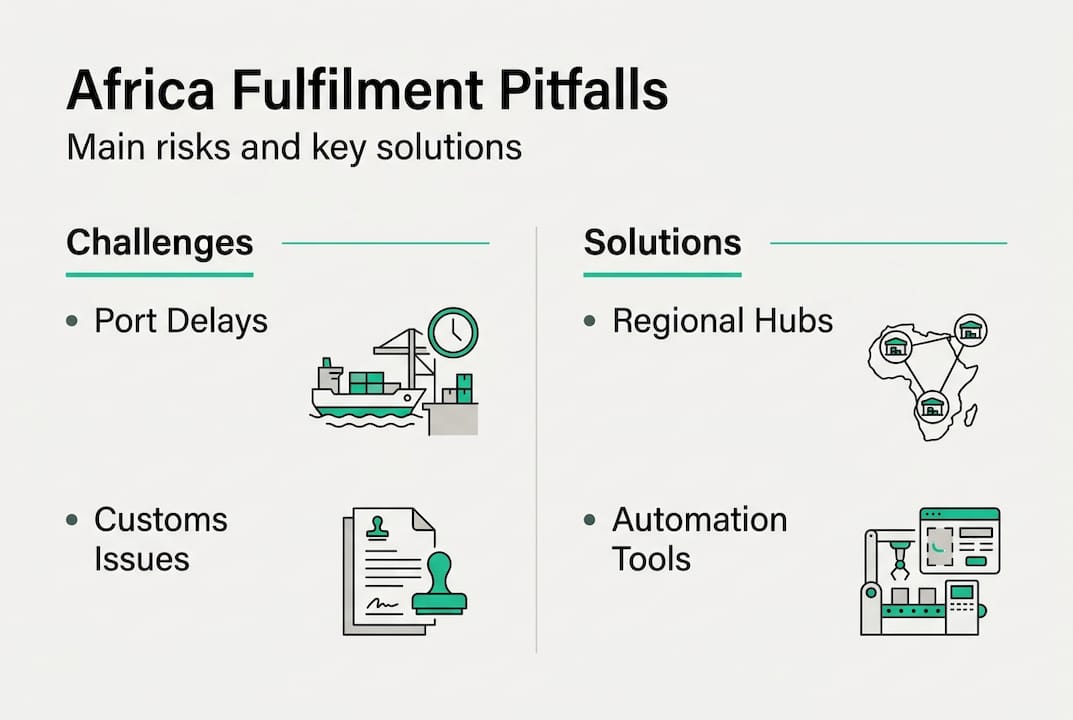
| Challenge | Impact | Mitigation Strategy |
|---|---|---|
| Port congestion and delays | 14-25 day delays, inventory tied up, missed delivery windows | Use air freight for time-sensitive items, maintain buffer stock, provide tracking updates |
| Informal addressing | Failed deliveries, returns, customer frustration | Partner with local carriers, use landmark-based routing, collect phone numbers for driver contact |
| Poor road infrastructure | Damaged goods, delayed deliveries, higher costs | Use protective packaging, select carriers with appropriate vehicles, build delivery time buffers |
| High return rates | $15 per return cost, 20-30% rate draining profits | Provide detailed product information, offer quality guarantees, streamline return processes |
| Customs bottlenecks | Unpredictable delays, additional fees, compliance risks | Use customs brokers, pre-clear shipments, maintain compliant documentation |
Data analytics transforms raw operational data into actionable insights. Track exception patterns to identify recurring issues with specific carriers, routes, or product categories. Monitor seasonal demand fluctuations to adjust inventory placement before peak periods. Analyze customer feedback to spot quality issues or delivery problems before they escalate.
Compliance verification prevents costly bottlenecks at customs checkpoints. Ensure all shipments include proper documentation, accurate product descriptions, and correct valuation. Stay current with AfCFTA policies that reduce tariffs and simplify cross-border movement between member countries. Work with customs brokers who understand local requirements and maintain relationships with clearing authorities.
Continuous improvement requires regular review of performance metrics against benchmarks. Best-in-class operations achieve 2 to 3 day domestic delivery within major African markets, though cross-border shipments take longer. Return rates below 20% indicate strong product quality and accurate listings. Cost per order should decline as you optimize routes, consolidate shipments, and negotiate better carrier rates.
The how it works process at MoreShores includes built-in performance monitoring and optimization recommendations based on your specific operation. This ongoing support helps you identify issues early and implement solutions that keep your fulfillment running smoothly.
Streamline your global fulfillment with MoreShores solutions
Navigating Africa’s complex cross-border fulfillment landscape requires specialized expertise and integrated technology that few businesses can build in-house. MoreShores provides end-to-end solutions designed specifically for the challenges you face in African and international markets.
Our platform combines regional fulfillment hubs, customs compliance automation, and local last-mile partnerships into a unified system that simplifies your operations. You gain access to warehouses strategically located in major African markets, technology that tracks inventory and orders in real-time, and carrier networks that deliver successfully despite informal addressing and infrastructure challenges. We handle the complexity of duties, VAT, and regulatory compliance as your Importer of Record, removing barriers that slow down cross-border trade.
The cross-border enablement services we provide include marketplace integration with Takealot, Amazon SA, Jumia, and Kilimall, plus seamless connections to your Shopify and WooCommerce storefronts. Our fulfillment and logistics infrastructure scales with your business, supporting growth from initial market entry to high-volume operations across multiple countries. When you partner with MoreShores, you transform fulfillment from a cost center into a competitive advantage that enables faster delivery, lower costs, and superior customer experiences.
Frequently asked questions
How long does global fulfillment usually take between Africa and international markets?
Delivery times vary widely due to port delays and infrastructure challenges, with traditional routes taking 20 to 30 days or more. Regional fulfillment hubs can reduce transit to under 7 days for major African cities by positioning inventory closer to customers. Using multi-modal freight and distributed networks improves both speed and reliability compared to centralized fulfillment models.
What fulfillment models work best for Africa cross-border e-commerce?
Distributed regional fulfillment networks paired with 3PL outsourcing deliver the fastest shipping times and dominate with 70% market share. Centralized models struggle with Africa’s vast distances and infrastructure limitations. Hybrid approaches combining 3PL services with integrated technology platforms offer flexibility that balances control and costs while leveraging local expertise.
How can e-commerce businesses reduce costs and delays in African cross-border fulfillment?
Leverage regional hubs and strategic inventory placement that positions stock close to demand centers. Use bonded warehouses and customs automation tools like PAPSS to speed clearance and improve cash flow. Partner with local last-mile providers familiar with informal addressing and road conditions. Consolidate shipments through groupage or pooling methods that reduce costs by 30% or more for smaller sellers.
What are the biggest challenges in Africa cross-border fulfillment?
Port congestion causes delays of 14 to 25 days in major shipping centers, while informal addressing with no standardized street names complicates last-mile delivery. Poor road infrastructure slows transit and increases damage risk. High return rates of 20 to 30% driven by cash-on-delivery preferences and product uncertainty strain profitability. Power outages disrupt warehouse operations, particularly for temperature-sensitive goods requiring cold chain management.
How do you handle returns in Africa cross-border e-commerce?
Establish transparent return policies that build customer confidence while implementing quality checks that reduce return frequency. Returns cost around $15 per order, so prevention through detailed product information and accurate listings delivers better economics than processing returns. Partner with local providers who can handle reverse logistics efficiently, and use bonded warehouses that simplify the customs process for returned international shipments.