Why integrated trade platforms transform African e-commerce

TL;DR:
- Africa’s cross-border trade involves complex regulations, fragmented infrastructure, and multiple market rules.
- Integrated trade platforms centralize compliance, logistics, and data, enabling faster and more accurate operations.
- Using integrated systems leads to quicker customs clearance, lower costs, and better data-driven adaptability.
Many international e-commerce brands assume that entering African markets is primarily a logistics puzzle. Ship the product, clear customs, find a local courier, and you’re done. That assumption is costly. Africa’s cross-border trade environment involves layered regulatory frameworks, fragmented infrastructure, and dozens of distinct market rules that shift without warning. Brands that rely on manual processes or piecemeal tools consistently face delays, fines, and lost revenue. The real differentiator for sustainable African market entry is seamless platform integration, and this guide explains exactly why that matters and how to act on it.
Table of Contents
- The complexity of cross-border e-commerce in Africa
- What are integrated trade platforms?
- Integrated vs. manual trade processes: What’s the real gain?
- How international brands can leverage integration for African market entry
- The overlooked advantage: Data-driven adaptability
- Next steps: Scale your African e-commerce with integrated platforms
- Frequently asked questions
Key Takeaways
| Point | Details |
|---|---|
| Streamlined market entry | Integrated platforms simplify documentation, compliance, and logistics for multiple African markets. |
| Lower costs and risks | Automation reduces errors, delays, and unexpected fees in cross-border commerce. |
| Data-driven agility | Real-time insights enable brands to adapt quickly to regulatory, demand, and logistics changes. |
| Scalable for growth | Integrated systems support SMEs and large brands as they expand across Africa. |
The complexity of cross-border e-commerce in Africa
Africa is not a single market. It is 54 distinct economies, each with its own customs authority, tax code, import documentation requirements, and enforcement practices. What clears smoothly in South Africa may be held indefinitely in Nigeria or Kenya due to a missing certificate or an incorrect HS code. Africa’s 54 countries each bring unique regulatory, infrastructure, and customs hurdles that no single manual process can reliably manage at scale.
Beyond regulation, the operational environment adds further pressure. Infrastructure gaps mean that last-mile delivery in many cities depends on informal networks that are difficult to track or standardize. Payment systems are fragmented, with mobile money platforms, bank transfers, and cash-on-delivery coexisting in the same market. Currency controls in countries like Nigeria and Ethiopia can delay fund repatriation for weeks. These are not edge cases. They are the standard operating conditions for cross-border sellers.
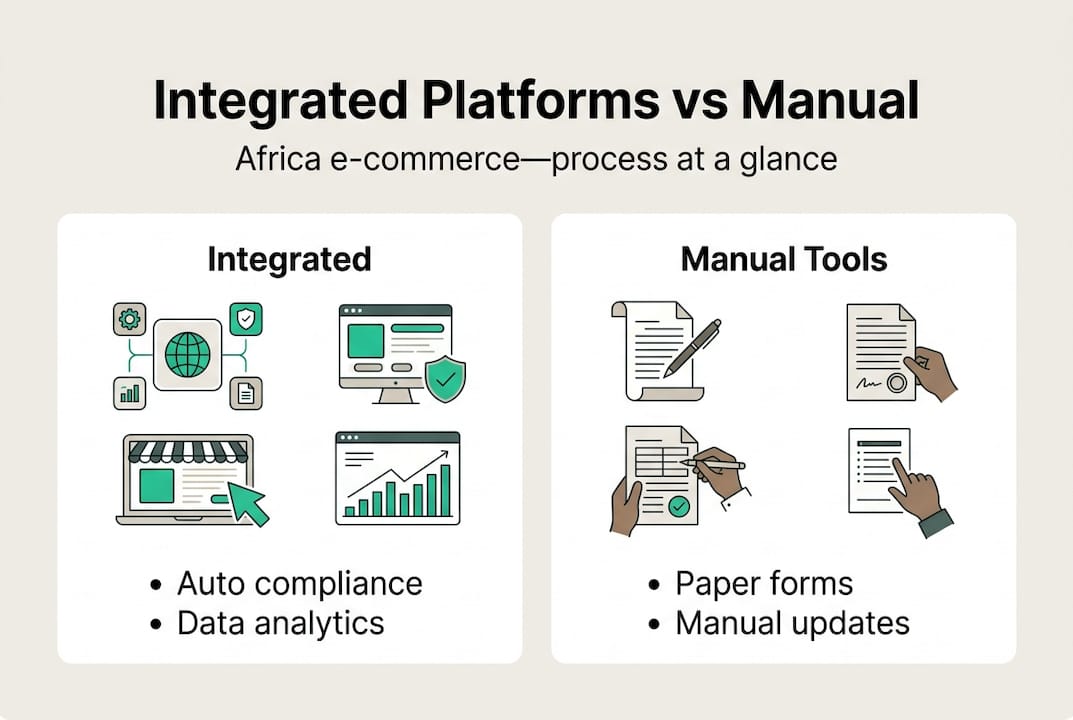
The logistics challenges in Africa are compounded by the fact that most exporters manage compliance through spreadsheets, email chains, and local agents who may not have real-time visibility into regulatory changes. A single missed update can trigger a customs hold that erodes a month’s profit margin.
Here is a summary of the core challenges brands face:
- Regulatory fragmentation: Customs rules, VAT rates, and import duties differ by country and product category
- Infrastructure gaps: Road, port, and warehousing quality varies significantly across regions
- Payment complexity: Multiple payment systems with limited interoperability
- Currency risk: Exchange rate volatility and capital controls affect cash flow
- Documentation errors: Manual paperwork increases the risk of costly compliance failures
- Limited visibility: No centralized tracking across shipments, agents, and markets
Statistic: Cross-border trade costs in Africa remain among the highest in the world, with non-tariff barriers and administrative delays accounting for a significant share of total trade friction according to regulatory challenges in African markets.
For e-commerce managers overseeing multi-market strategies, this complexity is not abstract. It shows up in delayed launches, unexpected duties, and customer experience failures that damage brand reputation before you have had a chance to build it. Understanding this landscape is the first step. The second is knowing what tools actually solve it.
What are integrated trade platforms?
An integrated trade platform is a centralized system that connects all the moving parts of cross-border commerce into a single operational layer. Rather than managing customs documentation in one tool, shipping in another, and marketplace listings in a third, an integrated platform brings all of these functions together through a unified dashboard or API layer.
Integrated platforms bundle customs, compliance, logistics, and market data into one dashboard, giving your operations team real-time visibility and control across every stage of the trade cycle. That means fewer handoffs, fewer errors, and faster response times when something changes.
The core features of a well-built integrated trade platform typically include:
- Customs and compliance management: Automated HS code classification, duty calculation, and document generation for each destination market
- Marketplace connectivity: Direct integration with platforms like Takealot, Jumia, Amazon SA, and Kilimall, as well as Shopify and WooCommerce storefronts
- Fulfillment coordination: Real-time inventory tracking across warehouses with multi-courier dispatch
- Payment reconciliation: Support for local payment gateways and currency conversion
- Regulatory updates: Automatic alerts and rule updates when tax or import requirements change in a target market
Here is how integrated platforms compare to fragmented tool stacks:
| Feature | Integrated platform | Fragmented tools |
|---|---|---|
| Compliance updates | Automatic | Manual monitoring |
| Document submission | One-click | Multi-step, error-prone |
| Shipment visibility | Real-time, centralized | Siloed by provider |
| Marketplace sync | Unified | Separate logins and uploads |
| Cost per transaction | Lower at scale | Higher due to redundancy |
The marketplace integration capability is particularly valuable for brands entering Africa, where consumer purchasing behavior is split across multiple platforms depending on the country. A single integration layer removes the need to manage each marketplace independently.
Pro Tip: When evaluating integrated platforms, ask specifically how they handle regulatory updates for each African market you plan to enter. Platforms that push automatic compliance changes save you from costly reactive fixes later.
Integrated vs. manual trade processes: What’s the real gain?
The operational gap between integrated and manual trade processes is wider than most decision makers expect. Manual processes account for most delays and compliance issues in African cross-border shipments, making them a direct liability for brands that need predictable delivery timelines and clean customs records.

With manual trade management, your team typically juggles separate systems for freight booking, customs documentation, marketplace listing, and payment tracking. Data gets re-entered multiple times, increasing error rates. Local agents operate with limited visibility into your inventory or shipment status. When a regulation changes, you find out after the fact, often through a customs hold or a fine.
Integrated platforms change this dynamic in measurable ways:
- Real-time tracking: Every shipment, document, and payment is visible in one place
- One-click document submission: Customs paperwork is generated and submitted automatically based on product and destination data
- Proactive compliance alerts: The platform flags regulatory changes before they affect your shipments
- Centralized agent coordination: Local logistics partners receive instructions and updates through the platform, not through email chains
- Audit trail: Every action is logged, making it easier to resolve disputes and demonstrate compliance
“The question is not whether you can manage African trade manually. The question is whether you can do it at the speed and accuracy that competitive market entry requires.”
The cross-border enablement advantage becomes especially clear when you are managing entry into multiple African markets simultaneously. Each country adds a new layer of documentation, tax rules, and logistics coordination. Without integration, that complexity scales linearly with your team’s workload. With integration, it scales with your platform’s capacity.
Pro Tip: Before committing to a platform, request a demo that walks through a real customs clearance scenario for your target African market. The quality of that workflow tells you more than any feature list.
The platform onboarding process also matters. Platforms that offer structured onboarding with compliance support reduce the time from contract to first shipment significantly.
How international brands can leverage integration for African market entry
Knowing that integrated platforms outperform manual systems is useful. Knowing exactly how to implement one for your African strategy is what drives results. Companies that adopted integrated platforms achieved up to 30% faster customs clearance and 20% lower overall shipping costs, which translates directly to faster time-to-market and stronger margins.
Here is a practical framework for getting started:
- Assess market fit: Identify which African markets align with your product category, price point, and logistics capacity. South Africa, Nigeria, Kenya, and Egypt are the most developed e-commerce markets, but each has distinct requirements.
- Select the right platform: Prioritize platforms with direct relationships with African customs authorities, local logistics networks, and marketplace integrations relevant to your target countries.
- Integrate your existing systems: Connect your ERP, Shopify or WooCommerce storefront, and inventory management tools to the platform via API. This eliminates duplicate data entry from day one.
- Customize for compliance: Work with your platform provider to configure country-specific tax rules, restricted product categories, and documentation templates before your first shipment.
- Scale with analytics: Use the platform’s reporting tools to monitor clearance times, return rates, and marketplace performance. Let the data guide your expansion sequence.
Common pitfalls to avoid:
- Ignoring local compliance requirements until a shipment is held
- Underestimating staff training needs for new platform workflows
- Choosing a platform based on price alone without verifying African market coverage
- Skipping the integration of local payment gateways, which limits conversion rates
- Failing to establish a returns process before launch
The marketplace onboarding step is often underestimated. Each African marketplace has its own listing standards, category rules, and seller verification requirements. A platform with built-in marketplace support handles this systematically rather than leaving your team to navigate it manually.
Pro Tip: Build your integration roadmap in phases. Start with one market and one marketplace, validate the workflow end-to-end, then expand. Trying to launch in five markets simultaneously without a proven process is a common and expensive mistake.
Partnering with integration specialists who have established relationships with African regulators and logistics providers shortens your setup time and reduces the risk of early-stage compliance failures.
The overlooked advantage: Data-driven adaptability
Most discussions about integrated trade platforms focus on compliance automation and process efficiency. Those benefits are real. But the advantage that separates long-term winners from short-term entrants is something less visible: data-driven adaptability.
When your trade operations run through a dynamic integration layer, every transaction generates structured data. Clearance times by country. Return rates by product category. Marketplace conversion rates by region. Duty costs by shipment type. Over time, this data reveals patterns that no manual process can surface at the same speed or accuracy.
Decision makers who use these analytics features can pivot quickly when a new African market opens, when a currency devaluation shifts consumer purchasing power, or when a regulatory change creates a compliance window that competitors miss. That kind of agility is not possible when your operations are fragmented across disconnected tools.
We believe the brands that will dominate African e-commerce over the next decade are not necessarily the ones with the biggest budgets. They are the ones who treat their integration platform as a strategic intelligence asset, not just an operational convenience. Evaluate every platform you consider as much for its data capabilities as for its automation features.
Next steps: Scale your African e-commerce with integrated platforms
You now have a clear picture of what integrated trade platforms do, why they outperform manual systems, and how to implement one for your African market strategy. The next step is finding a partner with the infrastructure, relationships, and African market expertise to make it real.
MoreShores provides end-to-end cross-border enablement for international brands entering African markets, covering customs clearance, Importer of Record services, warehousing, fulfillment, and marketplace integration across Takealot, Jumia, Amazon SA, and more. Our platform connects directly with Shopify and WooCommerce, so your existing storefront becomes Africa-ready without a rebuild. Explore our full suite of e-commerce solutions or reach out to discuss your African entry strategy with our team.
Frequently asked questions
What is the main benefit of using an integrated trade platform for Africa?
The main benefit is streamlined compliance and logistics across multiple African countries, reducing costs and delays. Integrated platforms improve efficiency and reduce manual errors that typically slow cross-border shipments.
How do integrated platforms handle local regulations and taxes?
They automatically update compliance requirements and tax calculations for each country to minimize the risk of penalties. This means your team does not need to manually monitor regulatory changes across every African market you serve.
Are integrated platforms suitable for small and medium-sized e-commerce brands?
Yes, they provide scalability and cost efficiency that make them accessible for SMEs as well as large enterprises. Scalable platform solutions allow smaller brands to access the same compliance and logistics infrastructure as major players without proportional overhead.
Can integrated trade platforms work with local payment and shipping providers?
Modern integrated platforms support connections to local payment gateways and logistics partners for a seamless experience. This local system connectivity is essential for meeting consumer expectations in markets where mobile money and informal delivery networks are standard.