
African e-commerce is growing fast, and merchants across the continent are sitting on real export potential. Yet turning that potential into consistent international revenue is harder than most expect. Regulatory complexity, documentation gaps, and logistics fragmentation stop many brands before they even ship their first order. This guide walks you through every critical stage of the export process, from market research and compliance to finding buyers, managing payments, and scaling up, so you can move forward with clarity and confidence.
Table of Contents
- Understanding market demand and compliance basics
- Preparing products for international standards
- Finding and negotiating with global buyers
- Shipping, logistics, and documentation requirements
- Getting paid securely: Payment methods and currency risk
- Troubleshooting common export challenges and scaling up
- Accelerate your global exports with MoreShores
- Frequently asked questions
Key Takeaways
| Point | Details |
|---|---|
| Know legal requirements | Securing export licenses and certifications is essential to avoid costly legal and customs issues. |
| Prepare products meticulously | International buyers expect certified, well-packaged products that meet their market standards. |
| Choose the right partners | Logistics and payment providers specialized in African exports can reduce risk and streamline your process. |
| Document everything accurately | Complete, compliant documentation speeds up customs and minimizes delays or fines. |
| Scale strategically | Analyze feedback, address pain points, and use proven partners to expand reliably into more markets. |
Understanding market demand and compliance basics
Before you ship a single unit, you need to know exactly where your product fits in the global market. Start with structured market research: analyze buyer demand in your target regions, study competitor pricing, and identify gaps your product can fill. This is not optional groundwork. It directly determines whether your export effort will generate returns or drain resources.
Registering as an export business is your next mandatory step. In Nigeria, for example, the market research and registration process with authorities such as NEPC (Nigerian Export Promotion Council) is a foundational requirement before you can legally export. Similar bodies exist across the continent, and engaging them early saves you from costly compliance errors later.
You also need to get familiar with the core compliance documents every international shipment requires:
- HS codes (Harmonized System codes that classify your product for customs)
- Commercial invoices with accurate product descriptions and declared values
- Certificates of origin confirming where goods were produced
- Product-specific certifications required by your destination market
Pro Tip: Government export councils are underused resources. They often provide free guidance on certification pathways, market entry requirements, and even buyer introductions. Reach out before you finalize your product lineup.
Explore Africa e-commerce solutions to understand how platforms like MoreShores can support your compliance setup from day one.
Important: Non-tariff barriers, such as technical standards, labeling rules, and sanitary requirements, are often more disruptive than tariffs themselves. Regulations vary significantly between destination markets, and what clears customs in one country may be rejected in another. Always verify requirements for each specific market before committing to a shipment.
Preparing products for international standards
Once you understand the market and compliance basics, you must prepare your products to pass international scrutiny. Global buyers and customs authorities expect products to meet defined quality benchmarks. Falling short means rejected shipments, damaged relationships, and wasted capital.

The importance of global standards such as ISO, HACCP, and product-specific certifications cannot be overstated. Here is a quick comparison of the most relevant ones:
| Certification | Applicable to | Key requirement |
|---|---|---|
| ISO 9001 | Most product categories | Quality management systems |
| HACCP | Food and beverage | Hazard analysis and critical control points |
| NAFDAC | Nigerian food, drugs, cosmetics | National regulatory approval |
| CE Marking | Products sold in the EU | Safety and compliance standards |
| SABS Mark | Products entering South Africa | South African Bureau of Standards approval |
Follow this step-by-step process to get your products export-ready:
- Audit your current product quality against the standards required in your target market.
- Identify certification gaps and engage accredited testing laboratories to close them.
- Adjust packaging and labeling to meet destination-market language, measurement, and safety requirements.
- Document everything, including test results, material sourcing, and manufacturing processes.
- Run a test shipment to a single buyer before committing to large-volume exports.
Review the full compliance checklist to make sure nothing is missed before your first shipment leaves.
Pro Tip: A small-scale test export is one of the smartest moves you can make. It validates your documentation, tests your logistics chain, and surfaces problems before they become expensive at scale. Treat it as a paid rehearsal.
When you are ready to move forward, the brand onboarding steps at MoreShores walk you through exactly how to get set up for cross-border selling.
Finding and negotiating with global buyers
With your products ready, the next stage is getting them in front of the right global buyers and negotiating the terms. This is where many African merchants lose momentum. Finding buyers is not just about listing on a platform. It requires active outreach, careful vetting, and structured contract negotiation.
Sourcing buyers via B2B platforms and trade fairs, combined with contract negotiation using Incoterms, is the proven approach for African exporters entering global markets. Here are the top channels to use:
- Alibaba and Global Sources for reaching Asian and global wholesale buyers
- Kompass and Europages for European B2B connections
- Trade fairs such as the Canton Fair, Africa’s Big Seven, and SIAL for face-to-face buyer meetings
- LinkedIn outreach targeting procurement managers and import buyers directly
- Government trade portals like South Africa’s DTIC for verified buyer leads
Always validate buyers before signing anything. Request business registration documents, check references, and use escrow or letters of credit for first transactions. Incoterms (International Commercial Terms) define who bears responsibility for shipping costs, insurance, and risk at each stage. FOB (Free on Board) and CIF (Cost, Insurance, and Freight) are the most commonly used in African export contracts.
Using marketplace integration tools can also help you list products across multiple international platforms simultaneously, expanding your buyer reach without multiplying your workload.
Leverage trade agreements: The AfCFTA (African Continental Free Trade Area) opens preferential access to 54 African markets. AGOA (African Growth and Opportunity Act) gives eligible African exporters duty-free access to the US market for thousands of product categories. These agreements can significantly reduce your cost of entry into key markets.
Shipping, logistics, and documentation requirements
With buyers secured and contracts in place, the focus shifts to safely moving your products across borders and through customs. This stage is where documentation errors cause the most damage. A single missing certificate can hold an entire shipment for weeks.
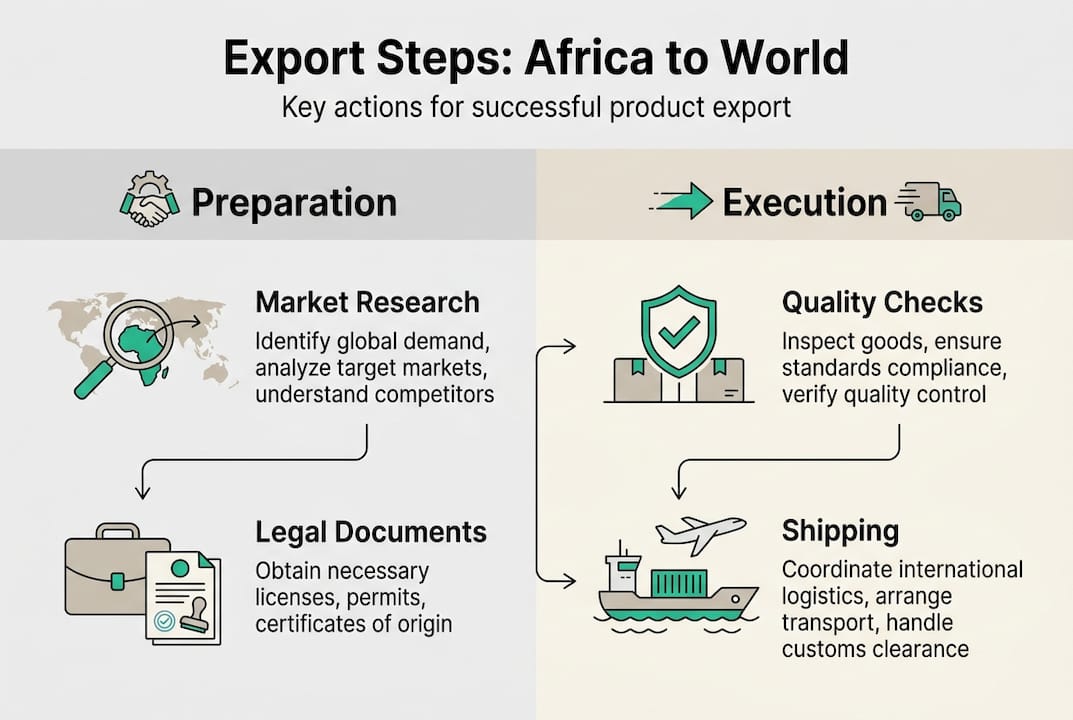
The core Africa-specific shipping documents you need include:
| Document | Purpose | When required |
|---|---|---|
| Commercial invoice | Declares value and product details | Every shipment |
| Packing list | Details contents, weight, dimensions | Every shipment |
| Bill of lading / Air waybill | Proof of shipment contract | Sea / air freight |
| Certificate of origin | Confirms product source country | Most markets |
| Insurance certificate | Covers loss or damage in transit | Recommended always |
Follow these steps when working with logistics providers:
- Select a freight forwarder with documented experience in African export corridors.
- Confirm Incoterms with your buyer so liability is clearly assigned at every stage.
- Arrange cargo insurance before goods leave your warehouse.
- Submit all documents to your freight forwarder at least 48 hours before the cargo cutoff.
- Track your shipment using the carrier’s system and maintain communication with your buyer throughout transit.
For EU-bound shipments, you need to account for IOSS (Import One-Stop Shop) VAT registration if selling directly to consumers. For US-bound goods under AGOA, confirm your product’s eligibility and prepare the required GSP Form A. Review the full documentation checklist before every shipment.
Pro Tip: Partner with freight forwarders who specialize in African exports, not generalist global shippers. They know the specific port procedures, documentation quirks, and customs officer expectations that generic providers miss.
For end-to-end support, explore fulfillment and logistics solutions and connect with vetted shipping partners through MoreShores.
Getting paid securely: Payment methods and currency risk
Once logistics are in motion, ensuring you get paid safely and efficiently is critical for ongoing business growth. International payments carry real risks: fraud, non-payment, and foreign exchange losses can each erode your margins significantly.
Here are the most reliable payment methods for African exporters:
- Letters of credit (LC): Bank-guaranteed payment upon document submission. Best for large orders with new buyers.
- Escrow services: Funds held by a neutral third party until delivery is confirmed. Ideal for mid-size transactions.
- PAPSS (Pan-African Payment and Settlement System): Enables intra-Africa payments in local currencies, reducing FX conversion costs.
- PayPal and Payoneer: Widely accepted for smaller international transactions, especially with European and North American buyers.
- Mobile money platforms: M-Pesa and similar services work well for intra-Africa trade.
Foreign exchange risk is real. When your buyer pays in USD or EUR and your costs are in local currency, rate fluctuations can turn a profitable deal into a loss. The best practices for FX risk include forward contracts (locking in an exchange rate in advance) and pricing in USD where possible to reduce exposure.
Pro Tip: Before finalizing any deal, confirm the buyer’s preferred payment method and local currency. Offering the wrong payment option can stall a deal or introduce unnecessary conversion fees on both sides.
For merchants managing multiple markets, cross-border enablement through MoreShores helps streamline payment flows and reduce friction across regions.
Troubleshooting common export challenges and scaling up
With a successful export completed, it is important to reflect, resolve any issues, and plan for sustainable growth. Most African exporters hit the same set of obstacles, and knowing how to respond quickly is what separates brands that scale from those that stall.
The challenges like non-tariff barriers, regulatory inconsistencies, and logistics gaps remain significant for African SMEs despite the optimism surrounding AfCFTA. Here are the most common mistakes and how to fix them fast:
- Incomplete documentation: Build a pre-shipment checklist and assign one person to verify it before every dispatch.
- Customs holds: Contact your freight forwarder immediately and provide any missing documents within 24 hours to minimize storage fees.
- Buyer disputes: Reference your signed contract and Incoterms. Use your escrow or LC structure to enforce payment terms.
- Logistics delays: Build buffer time into your delivery commitments and communicate proactively with buyers.
- Regulatory changes: Subscribe to updates from your national export council and destination-market trade bodies.
To scale efficiently, use your sales data to identify which products, markets, and buyers generate the best margins. Double down on those combinations before expanding into new regions. Government export programs often provide subsidized market research, trade mission access, and export financing that most merchants never use.
Digital tools matter: Platforms that centralize order management, inventory tracking, and compliance documentation give African SMEs a real competitive edge. Automating these processes reduces errors and frees your team to focus on growth rather than administration. Explore scaling export operations to see how structured systems can support your next phase.
Accelerate your global exports with MoreShores
Scaling up global exports requires robust partners. Every stage of the export journey, from compliance and fulfillment to marketplace listing and payment management, demands expertise that takes years to build in-house. MoreShores exists to give African e-commerce brands that expertise from day one.
Through African cross-border enablement, MoreShores handles the complexity of customs clearance, duties, VAT, and regulatory compliance so you can focus on growing your brand. Our fulfillment and logistics help connects you to a multi-courier network with proven African export experience. From warehousing to last-mile delivery, we manage the operational layer so your products reach global buyers reliably and on time. Ready to move faster? Partner with MoreShores and get dedicated support for every step of your international expansion.
Frequently asked questions
What licenses do I need to export goods from Africa?
You typically need to register your business, obtain an export license from relevant authorities such as NEPC in Nigeria, and meet any product-specific certification requirements for your target market.
Which documents are mandatory for international shipments?
Core documents include a commercial invoice, packing list, bill of lading or air waybill, and certificates of origin and product compliance relevant to your destination country.
How do I reduce payment risks in global trade?
Use secure methods like letters of credit, localized payment platforms, and clearly defined contract terms. Hedging FX risks through forward contracts adds another layer of financial protection.
What are the most common barriers to exporting from Africa?
Inconsistent regulations, non-tariff barriers, logistics shortfalls, and documentation gaps are the main hurdles, but working with experienced partners can minimize their impact significantly.
How do I find reliable international buyers for my products?
Use trusted B2B platforms and trade fairs to source leads, then thoroughly vet buyer credentials and use secure payment structures before finalizing any deal.