Efficient International Trade: Methods for E-Commerce Success

TL;DR:
- Proper preparation with accurate documentation and digital systems is essential for smooth cross-border trade.
- Leveraging FTAs and correct HS classification can reduce duty costs by up to 40 percent.
- Digital customs tools and regional strategies significantly cut border delays and operational costs in Africa.
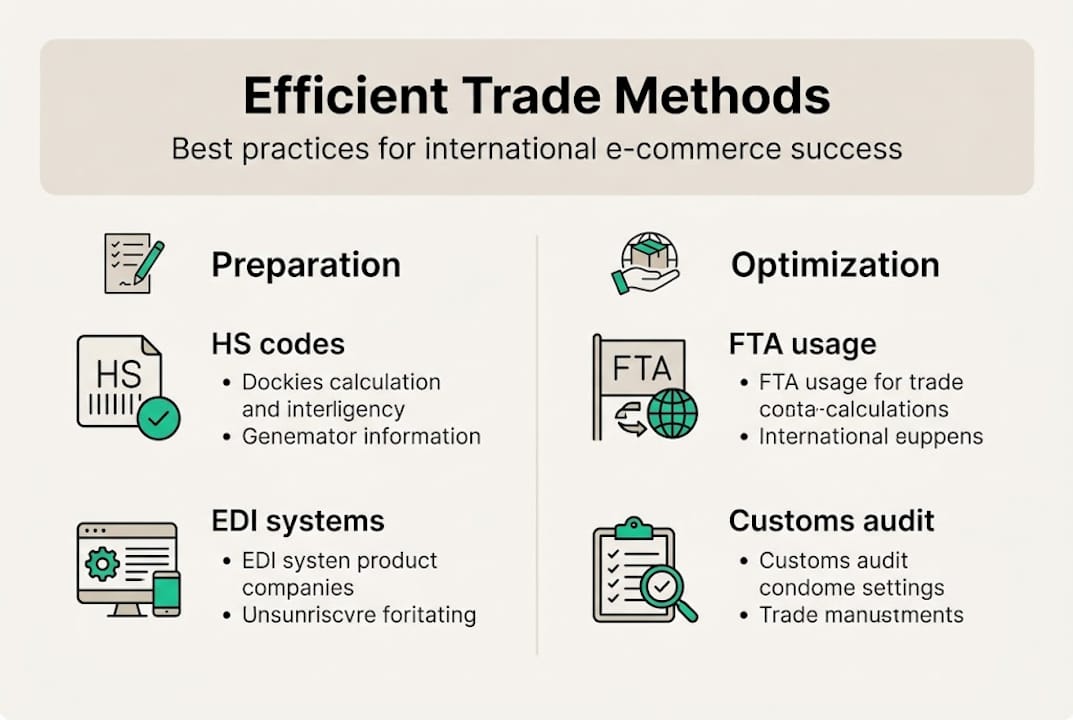
Cross-border e-commerce looks profitable until a misclassified HS code triggers a customs hold, your shipment sits at the port for two weeks, and your customer cancels the order. For e-commerce managers at international and African brands, inefficiency in trade operations is not just an inconvenience. It erodes margin, damages customer trust, and stalls market entry. The good news is that most trade inefficiencies are preventable. This article walks you through the specific methods that reduce delays, cut duty costs, and keep cross-border operations moving, from compliance preparation through regional African strategies.
Table of Contents
- Understand and prepare: Key requirements for efficient trade
- Optimize customs and duties: Leverage smart classification and FTAs
- Streamline customs clearance: Digital solutions and Incoterms
- Cut costs and transit times: Regional strategies for Africa
- What most trade guides miss about efficiency: Lessons from real operations
- Take the next step: Power your efficient trade
- Frequently asked questions
Key Takeaways
| Point | Details |
|---|---|
| Classify products accurately | Proper HS code use prevents costly duty mistakes and compliance fines. |
| Leverage trade agreements | Free Trade Agreements and Rules of Origin can drastically reduce tariffs on cross-border e-commerce. |
| Go digital for faster customs | Using Single Window and Advance Data clears shipments hours faster than manual processing. |
| Target Africa with regional strategies | OSBPs, RECTS, and AfCFTA reforms cut transit times and paperwork for African cross-border trade. |
| Integrate compliance and logistics | Blending compliance steps into logistics is more effective than focusing only on technology. |
Understand and prepare: Key requirements for efficient trade
To act efficiently, you must begin with complete preparation and compliance. Most cross-border failures trace back to documentation gaps, not logistics breakdowns. Before your first shipment moves, you need to have the right paperwork and digital infrastructure in place.
Core documents every international e-commerce shipment requires:
- Commercial invoice: Must include buyer and seller details, item description, declared value, and currency
- Packing list: Confirms quantities, weights, and dimensions for each item in the shipment
- HS codes: Eight to ten digit codes that classify your product for duty and tax calculation
- Import and export licenses: Required for regulated product categories such as electronics, food, and cosmetics
- Certificate of origin: Needed to qualify for preferential tariff treatment under trade agreements
Precise HS code classification is foundational for accurate duty calculation and compliance, reducing errors that lead to fines or delays. Many brands underestimate how a single wrong digit in an HS code can reroute a shipment or trigger a penalty.
Beyond paperwork, digital readiness matters. Electronic Data Interchange, or EDI, systems allow you to submit trade documents to customs authorities automatically. Single Window portals, now standard in over 100 countries, let you file all customs declarations through one government platform instead of multiple agencies. Getting your team familiar with these portals before your first shipment saves considerable time.
Here is a quick reference for what preparation delivers:
| Requirement | Action needed | Outcome |
|---|---|---|
| Accurate HS codes | Classify all SKUs before listing | Correct duty rates, fewer holds |
| Digital declarations | Integrate EDI or Single Window | Faster clearance, fewer errors |
| Import licenses | Apply 6 to 8 weeks before shipment | No regulatory blocks |
| Certificate of origin | Obtain from chamber of commerce | Tariff preference eligibility |
For brands new to cross-border trade, reviewing the brand onboarding steps and e-commerce readiness essentials can clarify exactly where to start. A case study on customs cost savings also shows how preparation translates directly into lower landed costs.
Pro Tip: Invest in a digital audit tool that flags HS code mismatches and missing documents before submission. Real-time compliance verification catches errors that manual checks miss, especially when you are managing hundreds of SKUs across multiple markets.
Optimize customs and duties: Leverage smart classification and FTAs
Once basic requirements are met, it is critical to look for duty savings and compliance advantages. The two most powerful levers are accurate product classification and Free Trade Agreements, or FTAs.
Here is a step-by-step process for HS code classification:
- Identify the product’s primary material and function
- Search the World Customs Organization’s HS nomenclature database
- Check the importing country’s national tariff schedule for the correct local subheading
- Verify the classification against recent rulings from that country’s customs authority
- Document your classification rationale for audit purposes
How FTAs and non-FTA shipments compare in practice:
| Factor | FTA shipment | Non-FTA shipment |
|---|---|---|
| Duty rate | Reduced or zero | Standard MFN rate |
| Documentation required | Certificate of origin | Standard invoice |
| Processing time | Often expedited | Standard queue |
| Cost impact | Up to 40% savings possible | Full duty applied |
Leveraging FTAs and Rules of Origin can reduce or eliminate tariffs, with potential savings up to 40%. That is not a marginal improvement. For high-volume brands, it can represent the difference between a profitable trade lane and a losing one.
Rules of Origin determine whether your product qualifies for FTA treatment. A product assembled in one country using components from a non-FTA country may not qualify. You need to trace your supply chain carefully.
“GlobalGadgets, a mid-sized electronics brand, cut total duty costs by 30% after reclassifying 12 product lines under the correct HS codes and qualifying for FTA treatment on its primary trade lane. The reclassification process took three weeks and returned results within the first shipment cycle.”
You can explore cross-border enablement details to understand how platforms like MoreShores manage this classification process on your behalf. The reclassification case study offers further evidence of what optimized classification delivers.
Pro Tip: Audit your top 20 recurring SKUs for HS code accuracy at least once per quarter. Regulations and tariff schedules change, and a code that was correct a year ago may now carry a higher duty rate or disqualify you from FTA treatment.
Streamline customs clearance: Digital solutions and Incoterms
Smart tariff reduction is amplified when paired with digital-first customs processes. Even with correct classifications and FTA eligibility, slow or manual clearance processes burn time and money.
The most impactful digital tools for customs clearance today include:
- Electronic Advance Data, or EAD: Pre-submitting shipment data to customs before arrival, which allows authorities to pre-clear or flag shipments before they reach the border
- Single Window systems: One government portal for all declarations, reducing duplicated submissions across agencies
- Automated tariff calculation software: Calculates landed costs in real time, which is critical for DDP pricing
- Blockchain-based document verification: Emerging but increasingly used for high-value or regulated goods
Digital customs procedures, EAD, and Single Window systems streamline clearance, reducing processing from days to hours. For e-commerce brands managing thousands of shipments monthly, hours saved per shipment scale into significant operational gains.

Delivery Duty Paid, or DDP, Incoterms deserve particular attention. Under DDP, the seller takes responsibility for all import duties, taxes, and customs clearance before delivery. The buyer receives the package without any surprise charges.
DDP Incoterms shift costs to seller upfront, improving transparency and reducing refusal rates. When customers are hit with unexpected duties at delivery, refusal rates climb sharply. DDP eliminates that friction entirely.
Steps to implement DDP and EAD in your workflow:
- Work with your freight forwarder or 3PL to confirm they support DDP billing structures
- Integrate a landed cost calculator into your storefront checkout so buyers see the full price upfront
- Register for EAD submission with your importing country’s customs authority
- Pre-submit shipment manifests at least 24 hours before cargo arrives at port or airport
- Monitor clearance status in real time through your customs broker’s portal
For guidance specific to shipments entering the US market, U.S. digital customs guidance provides current CBP requirements. Brands looking to modernize their fulfillment and logistics infrastructure can find integrated solutions that handle these processes end to end.
Cut costs and transit times: Regional strategies for Africa
Regional strategies are especially necessary for those expanding into or operating across Africa. The continent’s 54 countries, multiple regulatory environments, and varied infrastructure create complexity that generic global logistics approaches cannot resolve.
The African Continental Free Trade Area, or AfCFTA, is the most important development in African trade in decades. With a goal of eliminating tariffs on 90% of goods, it is progressively reducing the cost of intra-African trade. One-Stop Border Posts, or OSBPs, are equally important. These facilities consolidate border processing from both sides of a crossing into a single facility, cutting wait times from days to hours.
AfCFTA reduces tariffs with a 90% elimination goal, while OSBPs and electronic cargo tracking like RECTS cut transit times and non-tariff barriers significantly.
“In East Africa, RECTS implementation at key border crossings reduced cargo dwell times by up to 30%, directly lowering the cost of intra-regional trade for e-commerce operators.”
For African e-commerce operations, your regional checklist should include:
- Select regional hub locations based on port efficiency ratings and AfCFTA membership status
- Choose courier partners with established last-mile networks in your target countries
- Integrate mobile money payment options such as M-Pesa in Kenya or MTN Mobile Money across West Africa
- Formalize any informal trade relationships to access volume discounts and regulatory protections
- Use RECTS or equivalent electronic cargo tracking on cross-border routes to monitor shipments in real time
Steps to build an efficient African trade lane:
- Confirm AfCFTA status and applicable tariff schedules for your product categories
- Identify OSBP locations on your primary routes using the cross-border logistics guide
- Partner with a regional 3PL that holds bonded warehouse licenses in multiple countries
- Register your products on African marketplace platforms to reach consumers efficiently
- Explore e-commerce partnerships in Africa that provide local compliance and fulfillment support
What most trade guides miss about efficiency: Lessons from real operations
Most articles on trade efficiency focus on checklists and tools. That is useful, but it misses something important. The brands that consistently move goods faster and cheaper are not the ones with the longest checklists. They are the ones that integrated compliance and logistics into a single operational workflow, rather than treating them as separate functions.
We see this repeatedly. A brand adopts an automated HS code tool but does not connect it to their warehouse management system. The tool flags an issue, nobody sees the alert in time, and the shipment is held. Automation without alignment fails. Digital tools without trained people behind them create a false sense of security.
The uncomfortable truth is that local knowledge still outperforms algorithmic efficiency in many African markets. Currency fluctuations, informal trade norms, and relationship-based regulatory environments require human judgment that no platform fully replaces. The brands that win are those who combine strong real e-commerce solutions with teams that understand the market on the ground. Process integration, not just digital adoption, is the actual competitive edge.
Take the next step: Power your efficient trade
If you have read this far, you understand that efficient cross-border trade is not a one-time fix. It is a system built on correct classification, digital processes, smart use of trade agreements, and regional expertise. MoreShores is built to operationalize exactly these methods for brands trading between Africa and global markets.
From managing cross-border enablement and acting as your Importer of Record, to running your logistics solutions and integrating your products across African marketplaces, MoreShores handles the complexity so you can focus on growing your brand. If you are ready to move from understanding these principles to applying them at scale, explore our full range of e-commerce solutions or contact our team to discuss your specific trade requirements.
Frequently asked questions
What is the most cost-effective way to handle customs in international e-commerce?
Correct HS code classification combined with FTA utilization can save up to 40% in duties, making it the highest-return compliance investment for most e-commerce brands.
How do Delivery Duty Paid (DDP) Incoterms benefit cross-border e-commerce?
DDP shifts duty costs to the seller upfront, eliminating surprise charges at delivery and reducing parcel refusal rates, which directly protects your conversion rate and customer satisfaction.
What recent regulation affects duty-free low-value e-commerce shipments to the US?
Executive Order 14324 suspended the de minimis threshold in August 2025, meaning low-value shipments under $800 now require formal customs entries or are subject to IEEPA duties, ending duty-free treatment for that category.
How can African companies reduce border delays in cross-border trade?
Using OSBPs, registering for RECTS cargo tracking, and qualifying shipments under AfCFTA tariff schedules can meaningfully reduce both physical wait times and paperwork burdens at African border crossings.
What is the main mistake international e-commerce companies make with duties?
38% of e-commerce businesses overpay duties by 15 to 25% due to incorrect HS codes or failure to leverage FTAs, meaning most brands are leaving significant savings on the table with every shipment.