Ecommerce VAT compliance: Navigate global rules and succeed

TL;DR:
- Cross-border ecommerce faces significant VAT compliance costs, including fines and loss of revenue.
- African markets have rapidly changing, complex VAT rules requiring local expertise and ongoing monitoring.
- Building operational flexibility and working with local partners are key to staying compliant and competitive.
VAT non-compliance costs cross-border ecommerce merchants an average of 4.3% in lost revenue per year, and that figure climbs sharply when you factor in fines, forced marketplace de-listings, and audit costs. Many brands assume VAT is a European problem, something to sort out when you start selling into Germany or France. The reality is very different. African markets are rapidly rolling out VAT obligations for non-resident digital and physical goods sellers, and the rules are changing faster than most compliance teams can track. If you are selling cross-border today, VAT compliance is your problem regardless of where your customers live.
Table of Contents
- What is ecommerce VAT compliance?
- How platform liability is changing VAT compliance
- African VAT compliance: Patchwork rules and rapid changes
- B2B vs. B2C: Different VAT paths and compliance workflows
- Non-compliance risks and how to avoid them
- Perspective: The uncomfortable truth about ecommerce VAT in Africa
- Next steps: Simplifying VAT compliance with MoreShores
- Frequently asked questions
Key Takeaways
| Point | Details |
|---|---|
| Compliance is critical | Failing to comply with VAT rules can cost your business revenue, exposure, and growth opportunities. |
| African VAT rules shift fast | Expect regular changes in rates and registration, so ongoing monitoring is essential. |
| B2B and B2C differ | Different rules and workflows apply depending on whether you are selling to businesses or consumers. |
| Platforms change the game | Marketplaces may collect VAT for you, but brands must still track compliance and registration status. |
| Expert partners help | Local expertise and up-to-date solutions make cross-border VAT compliance far more manageable. |
What is ecommerce VAT compliance?
Value Added Tax (VAT) is a consumption tax applied at each stage of a product’s journey from manufacturer to end customer. In ecommerce, VAT compliance means registering in the right countries, charging the correct tax rates at checkout, filing regular returns, and remitting collected tax to the relevant tax authority on time.
For cross-border sellers, the obligations are more complex than for domestic retailers. You may need to register in multiple countries simultaneously, apply different rates to different product categories, and file returns on varying schedules. Physical goods, digital products, and services often attract different VAT treatments even within the same country.
The core obligations for any cross-border ecommerce merchant include:
- VAT registration in every country where you meet the local threshold or where you have a taxable presence
- Charging the correct rate at the point of sale based on the customer’s location and product type
- Issuing compliant invoices that include your VAT number, the applicable rate, and the tax amount
- Filing periodic returns (monthly, quarterly, or annually depending on the country)
- Remitting collected VAT to the tax authority by the stated deadline
“The global cross-border VAT compliance market was valued at $12.7 billion in 2024 and is projected to grow at a CAGR of 13.4% to reach $39.7 billion by 2033, reflecting how seriously governments worldwide are treating digital trade taxation.”
This growth signals one thing clearly: tax authorities are investing in enforcement infrastructure. Sellers who treat VAT as an afterthought are increasingly likely to be caught. Whether you are using fulfillment and logistics solutions to ship physical goods or running a digital storefront, your VAT obligations follow your customers, not your warehouse location.
Brands partnering with an ecommerce logistics platform that understands local tax environments gain a significant operational edge, because compliance is built into the process rather than bolted on afterward.
How platform liability is changing VAT compliance
The traditional model placed full VAT responsibility on the seller. You sold a product, you collected the tax, you filed the return. That model is rapidly being replaced by marketplace liability rules, where the platform itself becomes the deemed supplier for VAT purposes.
Under these rules, marketplaces are often deemed suppliers, meaning they collect and remit VAT on behalf of their sellers. This shifts a significant compliance burden away from individual merchants, but it also introduces new risks if you do not understand exactly what the platform is handling and what remains your responsibility.
Here is how the obligations typically split across different scenarios:
| Scenario | Who collects VAT | Who files the return | Seller action required |
|---|---|---|---|
| Marketplace sale (platform liable) | Marketplace | Marketplace | Monitor status, provide correct product data |
| Direct storefront sale (B2C) | Seller | Seller | Register, charge, remit |
| B2B sale with valid VAT ID | Neither (reverse charge) | Buyer | Validate buyer’s VAT ID |
| Marketplace sale (seller liable) | Seller | Seller | Full compliance |
The distinction matters enormously. If you assume Amazon SA or Jumia is handling your VAT when it is not, you accumulate a tax debt that can trigger audits and back-payment demands covering multiple years.
Pro Tip: Always request written confirmation from each marketplace about their VAT liability status in every country where you sell. Rules vary by platform and by country, and they change. A platform that handles VAT in South Africa may not do so in Kenya or Nigeria.
Your marketplace integration setup should include a review of VAT liability status for each channel, updated at least annually. This is not a one-time check. Platform rules evolve as governments negotiate new agreements with major technology companies.
African VAT compliance: Patchwork rules and rapid changes
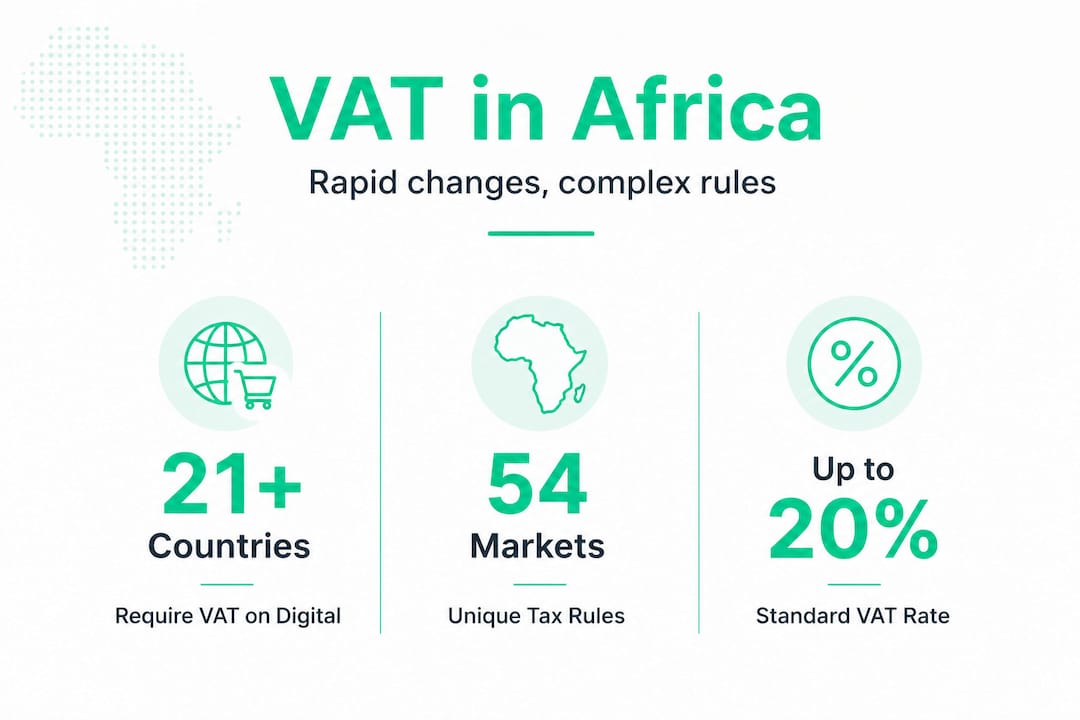
Africa is not a single market. It is 54 countries, each with its own tax authority, VAT rate, registration threshold, and enforcement approach. For cross-border sellers, this fragmentation creates a compliance environment that is genuinely difficult to navigate without local expertise.

Here is a snapshot of VAT rates and thresholds across key African markets:
| Country | Standard VAT rate | Digital services threshold | Recent change |
|---|---|---|---|
| South Africa | 15% | ZAR 1 million (~$55,000) | Ongoing enforcement tightening |
| Egypt | 14% | No minimum threshold | Expanded digital scope 2023 |
| Kenya | 16% | KES 5 million (~$38,000) | Digital services VAT since 2020 |
| Nigeria | 7.5% | No formal threshold | Finance Act updates 2023 |
| Ethiopia | 15% | New rules introduced 2024 | Non-resident registration required |
| Senegal | 18% | New digital VAT framework 2024 | Rapid implementation |
More than 21 African countries now require non-resident digital suppliers to register and charge VAT, and that number is growing. Ethiopia, the Democratic Republic of Congo, and Senegal all introduced or significantly updated their digital VAT frameworks in 2024, often with little advance notice for affected businesses.
The contrast with the European Union is stark. The EU’s One-Stop-Shop (OSS) system lets sellers register once and file a single return covering all 27 member states. Africa has no equivalent. Each country requires separate registration, separate filings, and compliance with separate local rules.
Key challenges for sellers in African markets include:
- No harmonized threshold system: Some countries have no minimum threshold, meaning your first sale triggers a registration obligation
- Inconsistent product classifications: A product taxed at the standard rate in one country may be exempt or zero-rated in a neighboring country
- Rapid rule changes: New regulations are sometimes announced and implemented within weeks
- Technology-driven enforcement: Several countries are deploying AI-powered invoice matching and e-invoicing mandates, making under-reporting far easier to detect
- Currency and remittance complexity: Paying VAT in local currency while managing foreign exchange risk adds operational cost
For brands using cross-border enablement infrastructure, having a partner with on-the-ground knowledge of each market’s current requirements is not a luxury. It is a practical necessity.
B2B vs. B2C: Different VAT paths and compliance workflows
One of the most common sources of VAT errors in cross-border ecommerce is misclassifying a transaction as B2B when it is actually B2C, or vice versa. The compliance workflows for each are fundamentally different, and the consequences of getting it wrong can be significant.
For B2B transactions, the reverse charge mechanism typically applies. This means:
- Your business customer provides their VAT registration number before the transaction is completed.
- You validate that VAT ID against the relevant government database (in the EU, this is VIES; in Africa, validation systems vary by country).
- If the VAT ID is valid, you charge no VAT on the invoice. The buyer accounts for VAT in their own country.
- You record the transaction as a zero-rated B2B supply and report it in your VAT return.
- You retain evidence of the VAT ID validation in case of audit.
For B2C transactions, the process is different:
- You identify the customer’s location at checkout (IP address, billing address, payment country).
- You apply the VAT rate for that country to the sale price.
- You collect the VAT from the customer at the point of sale.
- You remit the collected VAT to the relevant tax authority by the filing deadline.
- You issue a compliant VAT invoice or receipt to the customer.
Pro Tip: Never rely solely on a customer’s self-declaration for B2B classification. If a buyer provides a VAT number but you do not validate it, and it turns out to be invalid, you remain liable for the uncollected VAT. Validation is your protection.
Common pitfalls in transaction categorization include:
- Assuming all business buyers will provide a VAT ID proactively
- Failing to re-validate VAT IDs periodically (they can be deregistered)
- Applying B2B treatment to transactions where the buyer is a sole trader without a formal VAT registration
- Misidentifying the customer’s location when they use a VPN or pay with a card registered in a different country
Your Africa ecommerce solutions setup should include clear workflows for both transaction types, with automated VAT ID validation integrated into your checkout process. Reviewing your onboarding guide with a compliance-aware partner helps you build these workflows correctly from the start.
Non-compliance risks and how to avoid them
The risks of VAT non-compliance are not theoretical. Tax authorities across Africa and globally are investing heavily in enforcement technology, and the consequences for sellers who fall behind are real and growing.
“Non-compliance risks include fines, blocked listings, audits, and significant margin erosion, with platforms increasingly enforcing VAT compliance as a condition of continued selling access.”
The specific consequences you may face include:
- Financial penalties: Most countries apply interest on unpaid VAT plus fixed or percentage-based fines. In South Africa, penalties can reach 10% of the outstanding amount per month.
- Marketplace de-listing: Amazon, Jumia, Takealot, and other platforms are increasingly suspending seller accounts when VAT compliance cannot be verified. Reinstatement can take weeks.
- Forced back-payment: Tax authorities can assess unpaid VAT retroactively, sometimes going back three to five years. A small annual shortfall compounds into a significant liability.
- Reputational damage: A public audit or enforcement action can damage relationships with marketplace partners and logistics providers.
- Operational disruption: Responding to an audit diverts management time and resources away from growth activities.
The most effective way to stay ahead of these risks is to build compliance into your operations from day one, rather than trying to retrofit it after a problem emerges. Practical steps include:
- Register proactively in every market where you meet or approach the threshold, rather than waiting until you clearly exceed it
- Track sales by country in real time so you can identify when you are approaching registration thresholds
- Use automated VAT calculation tools that update rates and rules as regulations change
- Work with local compliance partners in key markets who can alert you to regulatory changes before they take effect
- Conduct an annual VAT health check across all markets where you sell
Pro Tip: Set internal threshold alerts at 80% of each country’s VAT registration threshold. This gives you time to register and configure your systems before your first taxable sale in that market.
Connecting with experienced ecommerce partners who operate in your target markets can dramatically reduce the time and cost of staying compliant, because they have already built the local relationships and knowledge you need.
Perspective: The uncomfortable truth about ecommerce VAT in Africa
Most compliance guides tell you to “monitor regulatory changes” and “consult local experts.” That advice is correct but incomplete. Here is what those guides typically leave out.
Africa’s VAT landscape is not moving toward stability. It is accelerating. The assumption that rules will eventually harmonize into something resembling the EU’s OSS system is a reasonable long-term hope, but it is not a planning assumption you can rely on in 2026 or the years immediately following. African VAT rules change frequently with little advance notice, and platform collection obligations are emerging in line with OECD guidance, but implementation varies wildly by country.
The brands that are winning in African markets are not the ones waiting for clarity. They are the ones that have built operational flexibility into their compliance infrastructure. They treat each regulatory change as a data point rather than a disruption, because their systems can absorb updates without requiring a complete overhaul.
There is also a competitive angle that most guides ignore. When a new VAT rule lands in Ethiopia or Senegal with 30 days’ notice, many of your competitors will pause selling into that market while they figure out what to do. If you have already built the registration and filing capability, you can keep selling. Compliance speed becomes market access speed.
The brands we see struggling most are those that centralized their VAT function in a single geography, typically their home country, and expected it to manage African markets remotely without local support. The tax authorities in Nairobi and Lagos do not operate the same way as those in Amsterdam or Singapore. Local knowledge is not a nice-to-have. It is the difference between a smooth audit and a costly one.
Investing in cross-border enablement infrastructure that includes compliance as a core function, not an add-on, is the structural decision that separates brands that scale in Africa from those that stall.
Next steps: Simplifying VAT compliance with MoreShores
Navigating VAT across African markets while managing fulfillment, marketplace listings, and customer experience is a significant operational challenge. Most brands do not have the internal capacity to handle all of it effectively on their own.

MoreShores is built specifically for this problem. Our cross-border enablement services include acting as Importer of Record, managing customs clearance, handling duties and VAT at the border, and keeping your compliance posture current as regulations evolve. Our marketplace integration solutions connect your products to Takealot, Amazon SA, Jumia, Kilimall, and other major African platforms, with VAT status monitoring built in. For brands that need end-to-end support, our Africa e-commerce support covers everything from sourcing and import through to fulfillment and marketplace management. Reach out to our team to discuss how we can simplify your compliance and accelerate your growth across African markets.
Frequently asked questions
Do I need to register for VAT if I’m selling digital products to African countries?
Yes, 21+ African countries now require non-resident digital sellers to register for VAT, regardless of whether you have a physical presence or sell through a local platform.
What happens if I miss VAT registration or filing deadlines?
Missing deadlines can result in fines, blocked listings, audits, and back-payment demands that cover multiple years of unpaid tax.
How do platforms like Amazon handle VAT for sellers?
Marketplaces are increasingly treated as deemed suppliers, meaning they collect and remit VAT on behalf of sellers in many markets, though this varies by platform and country.
Are VAT rules the same for all types of products and customers?
No. B2B sales often use the reverse charge mechanism when a valid VAT ID is confirmed, while B2C sellers must collect and remit destination-country VAT, with rates varying by product type and location.
Does VAT compliance software work for Africa’s fragmented rules?
Many platforms cover major African markets, but local expertise and frequent rule updates are essential because African VAT regulations change rapidly and often without significant advance notice.